Emergency Water Damage Restoration in Anaheim, CA
MoldRx connects Anaheim property owners with vetted, IICRC-certified water damage restoration specialists — 24 hours a day, 7 days a week.
Water damage does not wait for business hours. It does not wait for you to finish comparing contractors. It does not wait while you file an insurance claim. Right now, if water is standing in your Anaheim home or business, structural materials are absorbing moisture, mold spore germination timelines are accelerating, and every passing hour drives your restoration costs higher.
Call (888) 609-8907 now or request your free estimate to get a vetted specialist dispatched to your Anaheim property today.
MoldRx does not perform restoration work directly. We vet and coordinate IICRC-certified restoration professionals who follow IICRC S500 (Standard for Professional Water Damage Restoration) and IICRC S520 (Standard for Professional Mold Remediation) protocols. Every specialist we send has been screened for proper licensing through the California Contractors State License Board (CSLB), carries appropriate insurance, and adheres to Cal/OSHA safety requirements. You get the right team — not just the closest one.
Why Anaheim Properties Face Serious Water Damage Risks
Anaheim is Orange County's largest city by population — approximately 350,000 residents spread across more than 50 square miles of housing stock that spans over a century of construction methods, materials, and building codes. That diversity creates a wide spectrum of water damage vulnerabilities that generic restoration companies often miss.
The Colony District and Pre-War Housing (1900s-1940s)
Anaheim was incorporated in 1876, making it one of Orange County's oldest communities. The Colony Historic District — the city's original residential core — contains craftsman bungalows, California vernacular homes, and early 20th-century structures with construction details that demand specialized restoration knowledge.
These homes commonly feature clay and cast-iron sewer lines that collapse or corrode from decades of acidic soil contact. Supply plumbing may include galvanized steel pipes that rust from the inside out, gradually restricting flow before failing catastrophically. Foundations in this era were often unreinforced concrete or pier-and-beam, both of which allow water intrusion pathways that modern slab foundations do not. When a pipe fails in a Colony District home, water can reach structural framing, original plaster walls, and hardwood subfloors within minutes — and the damage classification escalates rapidly from Category 1 (clean water from a supply line) to Category 2 or Category 3 if sewage backup is involved.
Post-War Expansion and Tract Housing (1950s-1970s)
The majority of Anaheim's residential housing stock was built during the massive post-war suburban expansion. Neighborhoods across West Anaheim, Downtown Anaheim, East Anaheim, and the flatlands between Harbor Boulevard and the 57 Freeway are dominated by single-story ranch homes on concrete slab foundations built between 1950 and 1975.
These properties are now 50 to 75 years old. Original galvanized steel supply pipes and cast iron drain lines have reached or exceeded their service life. Slab leaks — pinhole failures in copper supply lines running beneath the foundation — are one of the most common water damage triggers in these neighborhoods. A slab leak can run undetected for weeks, saturating the concrete, warping flooring, and creating concealed moisture reservoirs that breed mold behind walls. By the time you notice warped baseboards or a musty smell, you may already be dealing with a Class 3 or Class 4 water damage event requiring extensive structural drying.
Anaheim Hills and Modern Construction (1980s-2000s)
The hillside communities of Anaheim Hills, Canyon Rim, and Deer Canyon represent Anaheim's newer housing stock — but "newer" does not mean immune. Builder-grade polybutylene piping (installed between 1978 and 1995) is notorious for brittle fractures. Hillside grading and drainage designs that were adequate when built can fail as soil settles over decades, directing storm runoff toward foundations rather than away from them.
Properties in Anaheim Hills face additional challenges during heavy rain events. Steep terrain amplifies surface runoff velocity, and when water enters a hillside home through failed weatherproofing or overwhelmed drainage, gravity drives it downward through multiple floors — creating complex multi-level water damage scenarios that require advanced drying strategies.
The Santa Ana River Flood Corridor
Anaheim's western and southern edges border the Santa Ana River — the largest river system in Southern California and a documented flood hazard. The catastrophic 1938 flood inundated parts of Anaheim with water up to 6 feet deep for several weeks. While modern flood control infrastructure has reduced the risk, FEMA flood zone mapping identifies over 3,000 Anaheim properties with a high probability of flooding within the next 30 years — more than 20% of all properties in the city. Properties near the river corridor, the Carbon Creek Channel, and the East Garden Grove-Wintersburg Channel face elevated storm flooding risk during atmospheric river events.
Climate Factors
Anaheim's semi-arid Mediterranean climate concentrates approximately 13 inches of annual rainfall into a narrow November-through-March window. Months of dry heat harden the soil surface, and when winter storms arrive — sometimes dropping several inches in 24 hours — the ground cannot absorb water quickly. Surface flooding, foundation seepage, and overwhelmed storm drainage systems are the result. Average humidity runs around 65%, climbing to 70%+ during late spring marine layer season, which accelerates secondary mold growth in any structure with unresolved moisture.
How IICRC S500 Water Damage Restoration Works in Anaheim
The IICRC S500 Standard for Professional Water Damage Restoration is not optional guidance — it is the industry benchmark that separates qualified restoration from guesswork. Every specialist MoldRx coordinates in Anaheim follows this protocol precisely.
Phase 1: Emergency Response and Loss Assessment
When you call (888) 609-8907, the goal is to get a certified technician on-site as fast as possible. The initial assessment establishes three critical parameters:
Water Damage Category (Contamination Level):
- Category 1 — Clean water from a sanitary source (broken supply line, sink overflow, melting ice). Lowest health risk, but still demands immediate extraction.
- Category 2 — Gray water with significant contamination (dishwasher discharge, washing machine overflow, toilet overflow with urine). Potential to cause illness through contact or ingestion. Requires enhanced PPE and antimicrobial treatment.
- Category 3 — Black water containing pathogenic, toxic, or other harmful agents (sewage backup, storm flooding, standing water that has contacted soil or decay). EPA guidelines and Cal/OSHA safety protocols govern the handling, containment, and disposal of Category 3 water and contaminated materials.
Water Damage Class (Evaporation Load):
- Class 1 — Slow evaporation rate. Water has affected only part of a room with minimal absorption into materials.
- Class 2 — Fast evaporation rate. Water has wicked up walls at least 12 inches, saturated carpet and cushion, and affected an entire room.
- Class 3 — Fastest evaporation rate. Water may have come from overhead, saturating ceilings, walls, insulation, carpet, cushion, and subfloor.
- Class 4 — Specialty drying. Water has penetrated deep into low-permeability materials like hardwood, plaster, concrete, or stone — common in Anaheim's older homes.
This classification determines every subsequent decision: equipment selection, drying strategy, safety protocols, and timeline.
Phase 2: Water Extraction
Standing water is removed immediately using truck-mounted and portable extraction units capable of removing hundreds of gallons per hour. In Anaheim slab-on-grade homes, sub-surface extraction may be required to pull water from beneath flooring materials. The faster water is extracted, the lower the final damage class — and the lower your restoration cost.
Phase 3: Structural Drying and Dehumidification
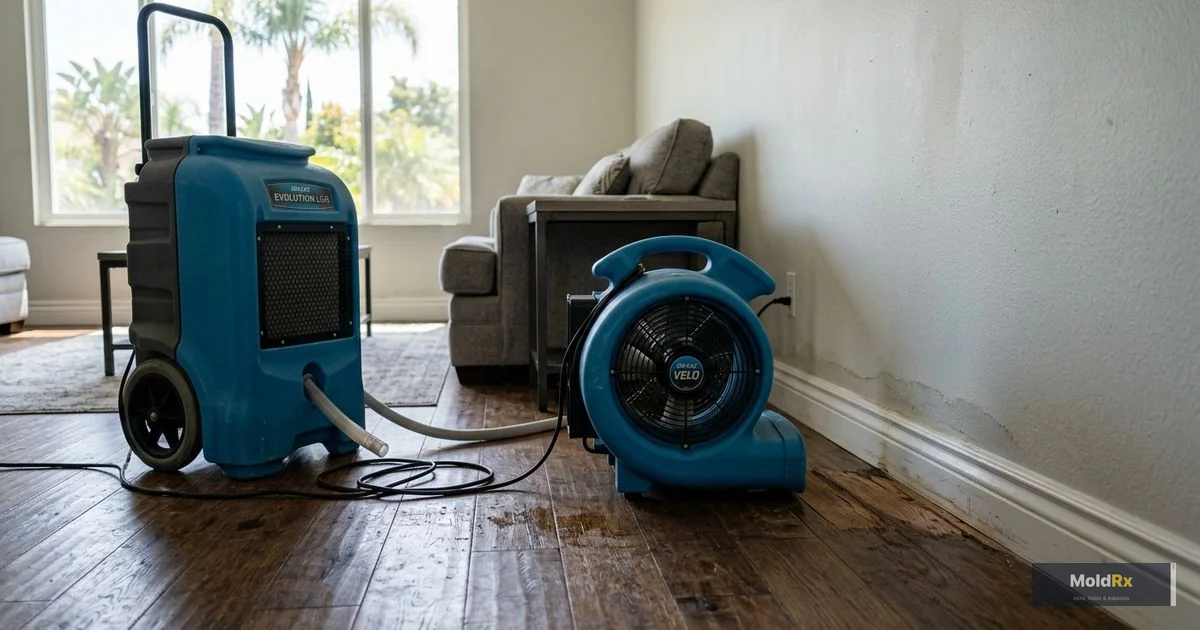
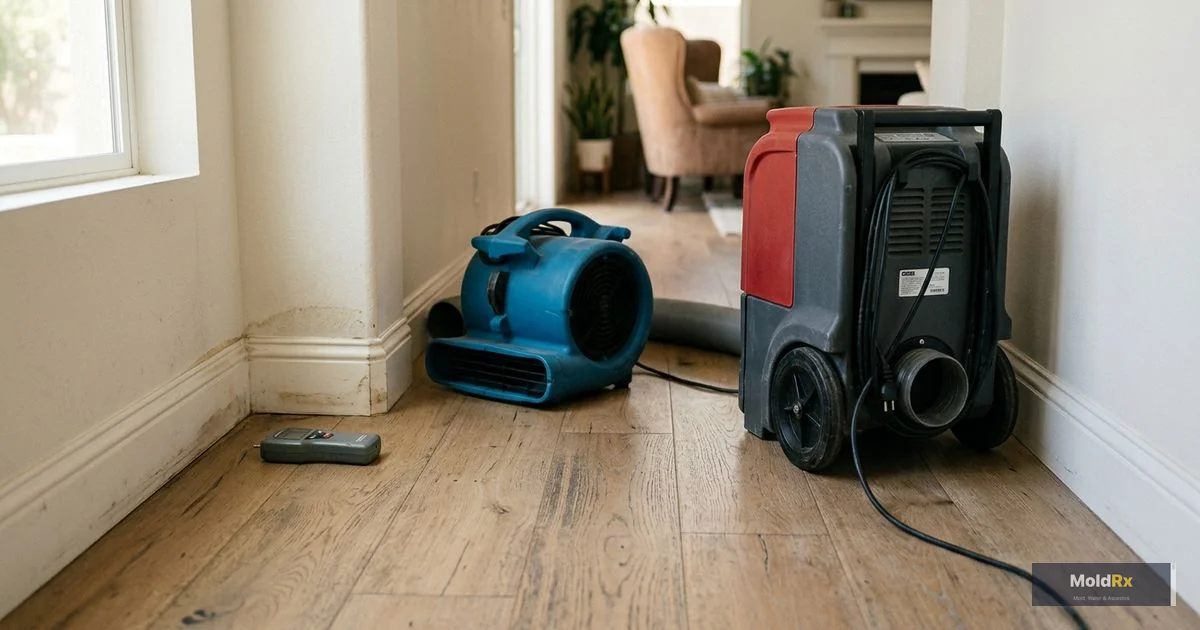
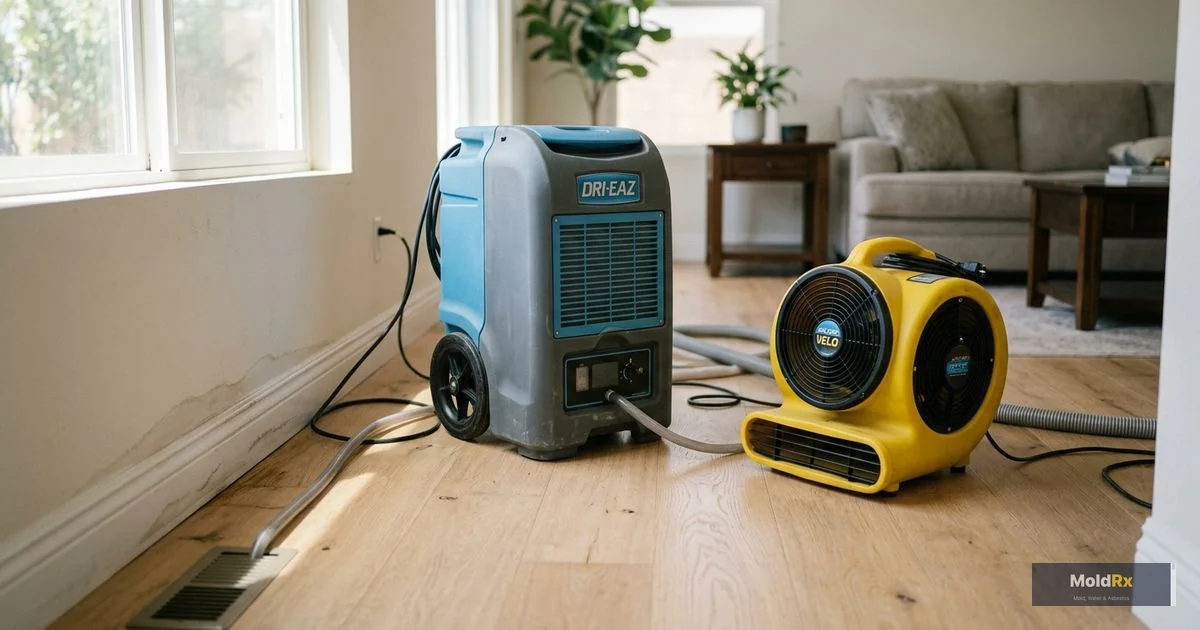
This is where expertise separates competent restoration from callbacks and mold claims. Commercial-grade air movers create targeted airflow across wet surfaces while industrial dehumidifiers pull moisture from the air. Technicians use thermal imaging cameras and calibrated moisture meters to track drying progress in walls, subfloors, and structural cavities daily.
In Anaheim's older homes — especially those with plaster walls, hardwood subfloors, or pier-and-beam foundations — Class 4 specialty drying techniques including desiccant dehumidification, heat drying, and wall cavity drying systems may be necessary. Standard air movers alone will not dry a plaster wall or a concrete slab. Cutting corners here is how mold grows behind walls three weeks later.
Structural drying typically requires 3 to 5 days for a Class 2 event and 5 to 7+ days for Class 3 or Class 4 events.
Phase 4: Cleaning, Antimicrobial Treatment, and Restoration
Once moisture readings confirm the structure has reached its dry standard, all affected surfaces are cleaned and treated with antimicrobial solutions per IICRC S520 protocols to prevent mold colonization. Materials that cannot be restored — saturated drywall, contaminated insulation, delaminated flooring — are removed, documented, and replaced. The goal is returning your Anaheim property to its pre-loss condition, verified by instrument readings, not assumptions.
What You Get When MoldRx Coordinates Your Anaheim Restoration
-
Only Vetted Specialists — Every professional we send carries current IICRC certification, active CSLB licensing, and proper insurance coverage. We do not send whoever is closest. We send whoever is qualified.
-
Honest Assessment — If your water damage is less severe than you feared, you will hear that. If it is worse, you will know exactly why, what the damage category and class are, and what needs to happen next. No inflated scopes of work.
-
Complete Insurance Documentation — Water damage claims require moisture readings, thermal images, photo documentation, material inventories, and detailed drying logs. Our vetted specialists generate all of this from day one because rebuilding documentation after the fact is nearly impossible and insurance adjusters know the difference.
-
Mold Prevention as Standard Protocol — Every phase of the S500 process is designed to prevent secondary mold damage. If environmental conditions or moisture readings indicate mold growth may have already initiated, you will know immediately so IICRC S520-compliant testing and remediation can be arranged before the problem compounds.
-
Cal/OSHA Compliance — For Category 2 and Category 3 water events, worker safety and occupant safety are governed by Cal/OSHA regulations. Our specialists follow confined space entry, PPE, and contaminated material handling protocols — protecting both crews and your family.
Anaheim Neighborhoods and ZIP Codes We Serve
MoldRx coordinates emergency water damage restoration across every Anaheim neighborhood, including:
- Colony Historic District (92805) — Pre-war homes with aging clay/cast-iron lines and original plumbing
- West Anaheim (92804, 92801) — 1950s-1970s tract homes with slab leak vulnerability
- Downtown Anaheim / Platinum Triangle (92805, 92802) — Mixed residential and commercial with older infrastructure
- East Anaheim (92806) — Mid-century housing with aging supply lines
- Anaheim Hills (92807, 92808) — Hillside properties with runoff and drainage challenges
- Canyon Rim / Deer Canyon (92808) — Modern construction with polybutylene pipe risk
- Sycamore Canyon / Nohl Ranch (92807) — Hillside homes with multi-level water damage potential
We also respond to emergencies in neighboring communities including Fullerton, Orange, Garden Grove, Placentia, Yorba Linda, Buena Park, and Cypress.
Related Services in Anaheim
Water damage and mold go hand in hand. In addition to water damage restoration, we coordinate Mold Removal in Anaheim, Asbestos Removal in Anaheim.
→ Learn more about remediation services in Anaheim
Frequently Asked Questions
How fast do I need to act on water damage in my Anaheim home?
Immediately. The IICRC S500 standard emphasizes that microbial amplification — mold growth — can begin within 24 to 48 hours of water intrusion in conditions typical of Anaheim's climate. Every hour water remains in contact with structural materials, the damage class escalates, drying times extend, and restoration costs increase. Category 1 water left standing can degrade to Category 2 or Category 3 within 48 to 72 hours as bacterial contamination develops. This is not an exaggeration — it is the science of water damage. Call (888) 609-8907 or request your free estimate now.
What determines the cost of water damage restoration in Anaheim?
Restoration costs are driven by the water damage category (1, 2, or 3), the damage class (1 through 4), the square footage affected, the materials involved, and how long water has been present before restoration begins. A Category 1, Class 2 event in a single room is a fundamentally different project than a Category 3, Class 3 event affecting multiple rooms. Every situation requires on-site assessment with instrumented readings before an honest scope of work can be developed. Contact us to discuss your specific situation — we do not quote blind estimates.
Will my homeowner's insurance cover water damage restoration?
Most homeowner's policies cover sudden and accidental water damage — a burst pipe, a failed water heater, an appliance malfunction. Gradual damage from deferred maintenance, long-term seepage, and ground-source flooding typically require separate coverage or may be excluded. Our vetted specialists document everything from the first hour — moisture maps, thermal images, material readings, and drying logs — specifically to support your insurance claim with the evidence adjusters require.
How long does water damage restoration take in Anaheim?
Timeline depends on damage class. Class 1 events may reach dry standard in 2 to 3 days. Class 2 events typically require 3 to 5 days of active drying. Class 3 and Class 4 events — common in Anaheim's older homes with plaster walls and concrete slabs — can require 5 to 10+ days including specialty drying techniques. These are not arbitrary timelines. They are determined by daily moisture readings against the IICRC S500 dry standard for each material type.
Can water-damaged materials in older Anaheim homes be saved?
It depends on the material, the water category, and the exposure duration. Hardwood floors, structural framing, and quality cabinetry can often be restored if addressed within the first 24 to 48 hours of a Category 1 event. Porous materials exposed to Category 2 or Category 3 water — drywall, insulation, carpet padding — typically require removal per IICRC S500 and EPA guidelines. Original plaster in Colony District homes requires specialized Class 4 drying that many generic restoration companies are not equipped to perform. Our vetted specialists assess salvageability material-by-material based on instrument readings, not guesswork.
What makes Category 3 water damage so dangerous?
Category 3 (black water) contains or may contain pathogenic organisms, toxic substances, or other harmful agents. Sewage backups, storm flooding that has contacted soil or contaminants, and any standing water that has remained long enough to support microbial growth fall into this category. EPA guidelines and Cal/OSHA regulations govern the handling, containment, and disposal of Category 3 water and all materials it has contacted. This is not a DIY situation. Improper handling creates immediate health risks from bacterial, viral, and parasitic exposure. Certified technicians wearing appropriate PPE, following containment protocols, and using EPA-registered antimicrobials are not optional — they are required.
Your Anaheim Property Is Taking Damage Right Now
Every minute that water sits in contact with your walls, flooring, and structural materials, the damage deepens. Drywall absorbs moisture vertically at a measurable rate. Subfloor materials swell and delaminate. Microbial colonies establish in concealed cavities where you cannot see them. The difference between a straightforward Class 2 restoration and a complex Class 3 or Class 4 event with secondary mold contamination is often measured in hours, not days.
MoldRx exists because finding a trustworthy, qualified restoration company during an emergency should not be another source of stress. We only send vetted, IICRC-certified professionals who follow S500 and S520 protocols, carry proper CSLB licensing, and will give you an honest assessment of what your property actually needs — nothing more, nothing less.
Do not wait. Request your free estimate now or call (888) 609-8907 for immediate emergency response to your Anaheim water damage.