Professional Asbestos Removal and Abatement
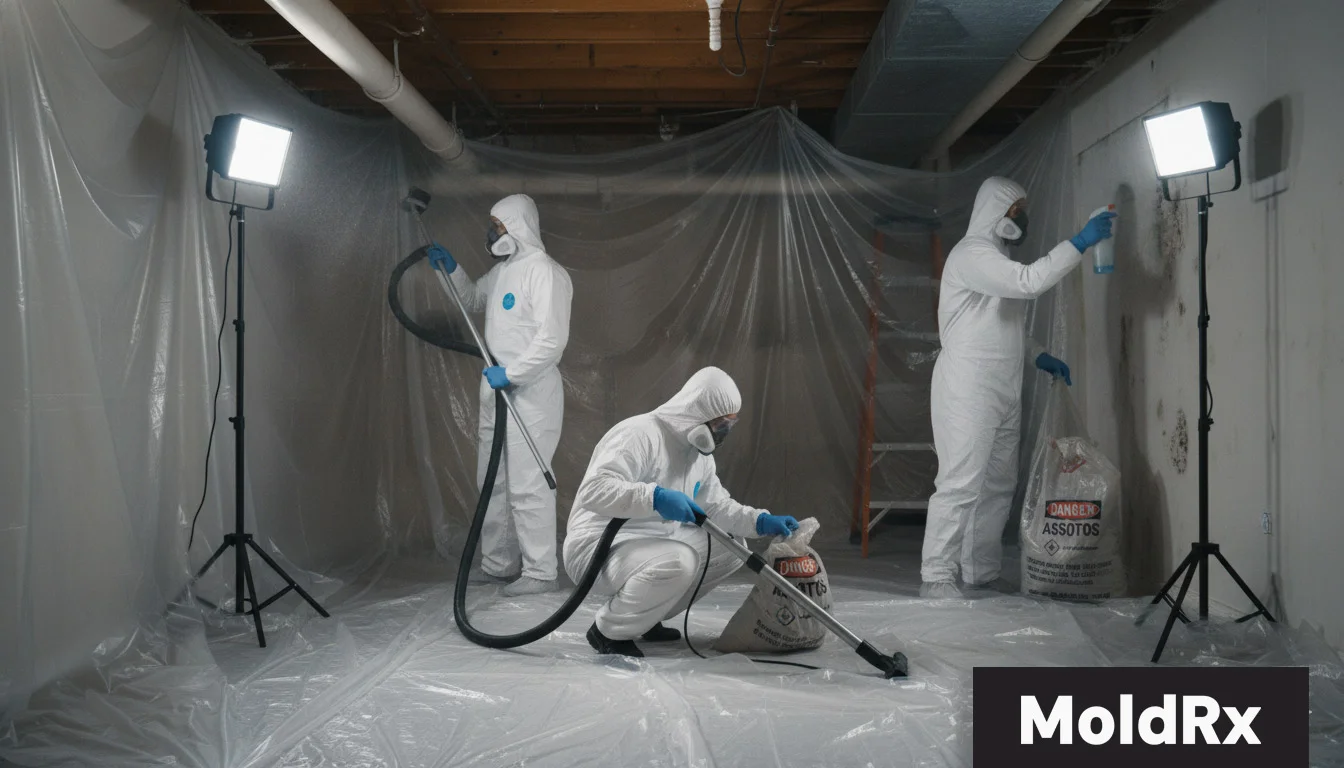
Asbestos removal is the process of safely containing, removing, and disposing of asbestos-containing materials (ACMs) from your property — performed exclusively by licensed, certified abatement professionals as required by California law, EPA regulations, and OSHA standards. MoldRx provides full-service asbestos abatement across Orange County, Riverside County, and San Bernardino County through vetted, licensed professionals who follow strict containment, wet removal, and verified disposal protocols on every project.
If you've discovered asbestos during a renovation, received test results confirming ACMs in your property, or you're looking at deteriorating materials in a building constructed before 1980 — the most important thing to understand is this: there is no safe DIY approach to asbestos removal. The health risks are serious, cumulative, and irreversible. Mesothelioma, asbestosis, and lung cancer — diseases with latency periods of 10 to 50 years — are directly caused by asbestos fiber exposure. California law requires that asbestos removal be performed by licensed abatement contractors for a reason.
Call (888) 609-8907 to talk to a real person about your situation. No scripts, no pressure — just honest guidance from a family-owned company that has built its reputation on doing things the right way. Learn more about what asbestos is and whether it's dangerous.
What Asbestos Removal Actually Involves
Professional asbestos removal — formally called asbestos abatement — is a regulated, multi-step process governed by federal EPA NESHAP regulations, OSHA standard 1926.1101, and California's Cal/OSHA requirements. This is not a cleanup job. It is a controlled operation designed to remove hazardous materials from your property without releasing microscopic fibers into the air you breathe.
Asbestos was used in thousands of building products from the 1920s through the late 1970s — insulation, floor tiles, ceiling texture, pipe wrap, roofing, siding, adhesives, joint compound, and dozens of other materials. When these materials are intact and undisturbed, they generally don't release fibers. But when they're damaged, deteriorating, or disturbed during renovation, demolition, or even routine maintenance, microscopic asbestos fibers become airborne. Those fibers are invisible, remain suspended in the air for hours, and can travel throughout an entire building. Once inhaled, they lodge permanently in lung tissue and cannot be removed by the body. Learn about what are some indicators you may have asbestos.
Proper abatement addresses three things simultaneously:
- The asbestos-containing materials — physical removal under full containment using wet methods that prevent fiber release
- The airborne environment — negative pressure containment and HEPA filtration to ensure fibers cannot migrate to clean areas during the work
- The disposal chain — proper packaging, labeling, manifested transport, and disposal at certified facilities as required by EPA and state regulations
If any one of these is mishandled, you've created a contamination problem that is far more dangerous and far more expensive than the original condition. That's why every jurisdiction in California requires licensed, certified professionals for this work.
What It Includes
- Pre-removal testing — Asbestos testing with NVLAP-accredited laboratory analysis confirms exactly which materials contain asbestos, what type, and at what concentration before any removal work begins
- Full containment — The work area is sealed with 6-mil polyethylene sheeting barriers, creating an airtight enclosure. Negative air pressure is established using HEPA-filtered air scrubbers so that all airflow moves into the containment zone, never out of it
- Wet removal methods — ACMs are thoroughly wetted before and during removal to suppress fiber release. This is not optional — it is required by EPA NESHAP regulations and is the single most effective method for controlling airborne fibers during physical removal
- HEPA air filtration — Air scrubbers with HEPA filters run continuously throughout the abatement process, capturing airborne fibers down to 0.3 microns. Air is monitored to verify containment integrity
- Material removal and packaging — Contaminated materials are carefully removed and immediately double-bagged in labeled 6-mil poly disposal bags. Workers wear full personal protective equipment including respirators with HEPA cartridges and disposable coveralls
- Manifested transport and legal disposal — All asbestos waste is transported under manifest documentation to certified disposal facilities. The manifest creates a legally defensible chain of custody from your property to the landfill
- Clearance testing — Post-removal air monitoring by an independent party verifies that airborne fiber levels are below EPA clearance standards before containment barriers are removed and the space is reoccupied
- Complete documentation — You receive the full project record: pre-removal test results, scope of work, air monitoring data, waste manifests, clearance test results, and before/during/after photographs
What It Does Not Include
- Removal without containment (this contaminates your entire property and violates federal law)
- Dry removal without wetting (maximizes fiber release — explicitly prohibited by EPA NESHAP)
- Disposal in standard waste containers or landfills (asbestos waste requires certified facilities and manifest tracking)
- "Encapsulation-only" approaches for materials that are damaged, deteriorating, or about to be disturbed (encapsulation is only appropriate for intact, undisturbed materials that will remain in place)
- Work by unlicensed individuals, general contractors, or homeowners (California law requires licensed abatement contractors for all asbestos removal work)
When You Need Professional Asbestos Removal
Not every asbestos-containing material requires immediate removal. Intact, undisturbed ACMs in good condition that will not be affected by planned work can sometimes be managed in place with periodic monitoring. The decision depends on the material's condition, location, and what you plan to do with the property.
Professional removal becomes necessary when:
Materials Are Damaged or Deteriorating
- Crumbling or friable insulation — pipe insulation, attic insulation, or boiler insulation that is cracking, flaking, or falling apart. Friable (easily crumbled) ACMs are the most dangerous because they release fibers with minimal disturbance
- Damaged floor or ceiling materials — cracked 9"x9" vinyl floor tiles, water-damaged popcorn ceilings, or broken ceiling tiles. Physical damage exposes the asbestos-containing substrate
- Water damage has compromised ACMs — water intrusion causes ceiling textures, insulation, and wall materials to deteriorate, releasing fibers that would otherwise remain trapped in the material matrix
Renovation or Demolition Is Planned
- Any work that will cut, drill, sand, or demolish materials in a pre-1980 building requires asbestos testing first — and if ACMs are confirmed, professional removal before work proceeds
- Kitchen or bathroom remodels, flooring replacement, wall removal, ceiling work — the most common residential triggers for asbestos abatement
- Commercial tenant improvements, buildouts, or retrofits — OSHA 1926.1101 requires employers to identify and address asbestos hazards before workers are exposed
- Full or partial demolition — California and SCAQMD Rule 1403 require a pre-demolition asbestos survey and abatement of all ACMs before demolition permits are issued
Health or Safety Concerns Exist
- Occupants are reporting respiratory symptoms in areas near suspect or confirmed ACMs
- Materials are in accessible locations where they can be disturbed by normal activity — especially in homes with children
- Previous work may have disturbed ACMs without proper containment, potentially contaminating occupied spaces
Documentation or Compliance Is Required
- You're selling a property and need to resolve known asbestos issues with documentation for the buyer
- You're a landlord or property manager with disclosure obligations and liability exposure
- Regulatory compliance requires asbestos management or removal — OSHA, Cal/OSHA, SCAQMD, or local jurisdiction requirements
- Insurance or lender requirements mandate abatement before coverage or financing proceeds
You've Confirmed ACMs Through Testing
If asbestos testing has confirmed the presence of asbestos-containing materials and your plans involve disturbing those materials — or they're already in deteriorated condition — removal by a licensed abatement contractor is the required next step. There is no legitimate workaround.
Why There Is No Safe DIY Approach
This section exists because people search for it — and the answer needs to be unambiguous.
You cannot safely remove asbestos yourself. This is not a judgment call. It is not a matter of being careful. It is a matter of physics, biology, and law.
The fibers are invisible. A single asbestos fiber is 1,200 times thinner than a human hair. You cannot see them being released. You cannot see them floating in the air. You cannot see them settling on surfaces. By the time you realize you've created a contamination problem, you've already been breathing the fibers — and so has everyone else in the building.
Standard protective equipment doesn't work. Dust masks, N95 respirators, and standard work gloves do not provide adequate protection against asbestos fibers. Professional abatement workers use powered air-purifying respirators (PAPRs) or supplied-air respirators, full-body disposable suits, and undergo medical surveillance specifically for asbestos exposure. The equipment exists because the hazard requires it.
Containment requires engineering controls. Negative pressure containment isn't a plastic sheet taped over a doorway. It is an engineered barrier system with monitored air pressure differentials, HEPA-filtered exhaust, and decontamination chambers. Without these controls, every fiber you release during removal migrates to the rest of your property.
The health consequences are irreversible. Asbestos causes mesothelioma (a cancer of the lung and abdominal lining with a median survival of 12 to 21 months), asbestosis (progressive scarring of lung tissue), and lung cancer. These diseases have latency periods of 10 to 50 years — meaning you won't know what you've done to yourself until decades later. There is no safe level of asbestos exposure, and the damage is cumulative: every exposure adds risk.
It's illegal. California law requires that asbestos removal be performed by licensed, DOSH-registered abatement contractors. Homeowners who perform their own asbestos removal face potential fines, are liable for contamination of neighboring properties, and have no legal protection if someone is exposed. Improper disposal of asbestos waste carries additional penalties under EPA and SCAQMD regulations.
Never disturb asbestos-containing materials without professional assessment. If you suspect asbestos, stop all work and call (888) 609-8907.
How MoldRx Handles Asbestos Removal
1. You Call — and Talk to a Real Person
When you call (888) 609-8907, you talk to someone who listens to your situation, asks the right questions, and gives you honest guidance — not a call center, not a script, not a sales pitch. We'll help you understand what you're likely dealing with, whether testing is needed first, and what the process looks like for your specific situation.
2. Testing and Confirmation
If you haven't already had asbestos testing performed, we coordinate a licensed inspector to collect samples and send them to an NVLAP-accredited laboratory for analysis. You cannot identify asbestos by sight — laboratory confirmation is required before any abatement work begins. If you already have positive test results, we review them and move directly to planning.
3. Clear Scope of Work
Before any work begins, you receive a detailed abatement plan: which materials are being removed, how the containment will be configured, what the timeline looks like, and what to expect at every stage. Every question gets answered. No surprises. The scope of work documents exactly what will happen and serves as your record of the project plan.
4. Containment Setup
The work area is sealed with 6-mil polyethylene sheeting to create an airtight enclosure. Negative air pressure is established using HEPA-filtered air scrubbers — this means air flows into the containment zone, never out. Entry and exit pass through a decontamination chamber. Air monitoring begins before removal starts to establish baseline readings. This containment system is the engineering control that makes the difference between a safe operation and a contamination event.
5. Wet Removal and Disposal
Licensed abatement workers in full protective equipment — respirators, disposable suits, gloves, boot covers — systematically remove ACMs using wet methods that suppress fiber release. Materials are thoroughly saturated before and during removal. Removed materials are immediately double-bagged in labeled 6-mil poly disposal bags, sealed, and staged for transport. All waste is transported under manifest to a certified asbestos disposal facility. The manifest documents every bag from your property to the landfill.
6. Air Monitoring and Clearance Testing
Air quality is monitored throughout the project to verify containment integrity. After removal is complete, independent clearance testing — phase contrast microscopy (PCM) or transmission electron microscopy (TEM) analysis — confirms that airborne fiber concentrations are below EPA clearance standards. Containment barriers are not removed until clearance is achieved. If clearance is not achieved on the first test, additional cleaning and re-testing occurs until the space is verified safe.
7. Final Walkthrough and Documentation
We walk through the completed project with you, explain everything that was done, and answer any remaining questions. You receive the complete project record: pre-removal test results, scope of work, air monitoring data from throughout the project, waste manifests with disposal facility confirmation, clearance test results, and before/during/after photographs. This documentation package protects you for regulatory compliance, real estate transactions, insurance purposes, and future liability.
Who We Serve
Homeowners
Whether it's asbestos confirmed during a pre-renovation test, deteriorating pipe insulation in a crawl space, popcorn ceiling texture you've been living under for years, or ACMs discovered during a home inspection — we handle residential asbestos abatement of all sizes. From a single bathroom's worth of floor tile to a whole-house abatement before a major remodel, every project gets the same licensed professionals, full containment, and complete documentation.
Commercial and Industrial Properties
Office buildings, retail spaces, warehouses, manufacturing facilities, schools, and medical buildings all face asbestos obligations — and the regulatory stakes are higher. OSHA 1926.1101 requirements, SCAQMD Rule 1403 compliance, tenant notification protocols, and liability documentation add complexity that residential projects don't have. We adjust our process for commercial timelines, after-hours and weekend scheduling, phased abatement to maintain business continuity, and the compliance documentation packages commercial property owners and facility managers require.
Property Managers and Landlords
Damaged ACMs in rental units create immediate liability exposure and potential health hazards for tenants. Tenant asbestos concerns require fast, professional response — both for tenant safety and your legal protection. We provide the documentation you need: inspection reports, laboratory results, scope of work, air monitoring data, waste manifests, clearance testing, and complete project records. We understand the urgency and accountability your position demands, including disclosure obligations under California law.
Real Estate Professionals
Asbestos discovered during a home inspection can stall or collapse a transaction. Whether you represent the buyer or the seller, we provide objective assessment, professional abatement, and clearance documentation that gives both parties confidence to close. Fast turnaround when transaction timelines are tight. Pre-listing abatement eliminates a major negotiation obstacle. Post-inspection abatement preserves the deal.
Contractors and Construction Professionals
You can't start demolition or renovation work on ACMs without licensed abatement — and you know it. We provide the abatement services you need to keep your project moving: fast scheduling, professional containment and removal, clearance testing, and the documentation your permit file requires. We work around your project timeline, not the other way around.
Where We Work
MoldRx provides asbestos removal and abatement services throughout Southern California:
- Orange County — Irvine, Anaheim, Santa Ana, Huntington Beach, Costa Mesa, Newport Beach, Fullerton, Orange, Mission Viejo, Lake Forest, and 30+ more cities
- Riverside County — Riverside, Corona, Temecula, Murrieta, Palm Springs, Palm Desert, Hemet, Moreno Valley, and 20+ more cities
- San Bernardino County — San Bernardino, Ontario, Rancho Cucamonga, Fontana, Redlands, Victorville, Upland, and 15+ more cities
Asbestos Removal FAQs
How do I know if I need asbestos removal or if materials can stay in place?
It depends on the material's condition and your plans. Intact, undisturbed asbestos-containing materials in good condition that won't be affected by renovation, demolition, or maintenance can sometimes be managed in place with periodic monitoring or encapsulation. Materials that are damaged, deteriorating, friable, or in the path of planned construction work require professional removal before anything else happens. A licensed inspector evaluates the condition and your situation and recommends the appropriate approach — removal is not always the answer, but when it is, there is no alternative. Start with asbestos testing if you haven't confirmed ACMs yet.
Is asbestos testing required before removal?
Yes. You cannot identify asbestos by sight — no one can. NVLAP-accredited laboratory analysis is the only way to confirm which materials contain asbestos, what type, and at what concentration. Test results determine the scope of work, the containment requirements, and the disposal protocols. Removal without confirmed test results means you don't know what you're dealing with, and the abatement plan has no foundation. Learn more about asbestos testing.
How long does asbestos removal take?
Most contained residential projects — a single room's flooring, a bathroom renovation area, or pipe insulation in a crawl space — take 2 to 5 days including containment setup, removal, clearance testing, and demobilization. Larger projects involving multiple rooms, whole-house abatement, or commercial properties can take one to several weeks depending on the scope. Clearance testing adds 1 to 2 days because results must be confirmed before containment is removed. We provide a realistic timeline during your scope review.
Can I stay in my home during asbestos removal?
In many cases, yes — provided the containment zone is effectively isolated from occupied living spaces and the HVAC system is properly managed to prevent cross-contamination. For whole-house abatement projects, projects involving the HVAC system itself, or households with members who have respiratory conditions, temporary relocation during the most intensive phases is recommended. We'll advise you based on the specific scope, containment configuration, and your household's circumstances.
What happens to the asbestos waste after removal?
All asbestos waste is double-bagged in labeled 6-mil polyethylene disposal bags, sealed, and transported under manifest documentation to a certified asbestos disposal facility. The manifest creates a chain of custody that tracks every bag from your property to the landfill. You receive copies of the waste manifests as part of your project documentation. This process is required by EPA NESHAP regulations and California law — asbestos waste cannot legally be placed in standard waste containers or taken to regular landfills.
What certifications and licenses should an asbestos removal company have?
In California, asbestos abatement contractors must hold a valid C-22 Asbestos Abatement contractor's license, be registered with the Division of Occupational Safety and Health (DOSH), and have workers who have completed EPA-accredited asbestos worker training with current certifications. The company should carry general liability insurance and workers' compensation coverage specific to asbestos work. Ask to see current documentation before work begins. MoldRx professionals are licensed, DOSH-registered, and fully insured for asbestos abatement work.
Does homeowner's insurance cover asbestos removal?
Generally, no. Most standard homeowner's insurance policies exclude asbestos abatement because asbestos is classified as a pre-existing condition of the building rather than the result of a sudden event. Some policies may cover asbestos-related costs if the ACMs were damaged by a covered peril — a fire, storm, or pipe burst that compromised previously intact materials. Review your specific policy language and contact your carrier with your test results and the scope of work. We provide thorough documentation to support any claim that may apply.
What's the difference between asbestos removal and asbestos encapsulation?
Removal is the physical extraction of asbestos-containing materials from the building, followed by proper disposal. Encapsulation involves coating intact ACMs with a specialized sealant that binds the fibers in place and prevents their release. Encapsulation is only appropriate for materials that are in good condition, will not be disturbed by future work, and are accessible for periodic inspection. If materials are damaged, friable, or in the path of planned renovation or demolition, removal is required — encapsulation is not a substitute.
How dangerous is asbestos really?
The health risks from asbestos exposure are serious, cumulative, and irreversible. Inhaled asbestos fibers cause mesothelioma (an aggressive cancer of the lung or abdominal lining), asbestosis (progressive, irreversible scarring of lung tissue), and lung cancer. These diseases have latency periods of 10 to 50 years — symptoms appear decades after exposure. There is no known safe level of asbestos exposure, and the risk increases with each additional exposure. This is not a theoretical hazard. Asbestos-related diseases kill thousands of Americans every year. Learn more about whether asbestos is dangerous.
Can I do partial asbestos removal and leave some materials in place?
Yes, in some situations. If only certain ACMs need to be disturbed for your planned work, a licensed abatement contractor can remove those specific materials while leaving intact, undisturbed ACMs in place. The materials left in place should be documented, their condition assessed, and a management plan established for periodic monitoring. This approach is common in phased renovation projects and commercial buildings where complete abatement isn't practical or necessary. Your abatement plan will specify exactly which materials are being removed and which are being managed in place.
Get Your Free Asbestos Assessment
If you suspect asbestos in your property — or you're planning renovation or demolition work on a building constructed before 1980 — don't guess and never disturb suspect materials without professional answers first. Call (888) 609-8907 or request a free estimate online. You'll talk to a real person who will listen to your situation, answer your questions honestly, and help you understand your options. No pressure. No obligation. Just straightforward guidance when it matters most.
Asbestos Testing → · Mold Removal → · Mold Testing → · All Services → · Service Areas → · Contact Us →