Water Damage Restoration in Beaumont, CA -- Emergency 24/7 Response
Vetted Water Damage Restoration Specialists Serving Beaumont and the San Gorgonio Pass Region -- Call Now
Water is spreading through your Beaumont home and every minute you wait makes the damage worse, the restoration harder, and the cost higher. It does not matter if it started from a burst pipe in a 2005-era Sundance home, a slab leak in an older downtown property, or flash flooding from a summer monsoon that overwhelmed your lot's drainage -- the water is destroying your home right now, and it will not stop until professionals intervene.
Beaumont is one of the fastest-growing cities in California, and that explosive growth has created a housing landscape unlike anywhere else in the Inland Empire. You have brand-new construction sitting a few miles from century-old downtown buildings. Massive master-planned communities built during the 2000s housing boom alongside modest ranch homes from the 1950s. Each type of home fails differently when water enters it, and each requires a different restoration approach. Generic water damage companies that treat every job the same will miss critical factors that are specific to Beaumont properties.
Do not wait for it to dry on its own. Do not try to handle this with fans and towels. Contact MoldRx immediately for emergency water damage restoration in Beaumont.
Why Water Damage in Beaumont Requires Urgent Professional Response
Beaumont sits at approximately 2,600 feet elevation in the San Gorgonio Pass, with a population that has exploded from roughly 11,000 in 2000 to over 60,000 today. That growth -- making it the fastest-growing city in California during that period -- defines the water damage challenges homeowners face here. Understanding why Beaumont properties are particularly vulnerable explains why speed and expertise matter so much.
Two Eras of Construction, Two Sets of Problems
Beaumont's housing stock splits into two distinct categories, and each faces different water damage vulnerabilities:
The Boom-Era Communities (2000-2015)
Approximately 44% of Beaumont's homes were built between 2000 and 2009 during the massive housing boom that transformed this city from a quiet pass town into a sprawling suburban center. Master-planned communities including Sundance, Tournament Hills, Fairway Canyon, Oak Valley, and Four Seasons at Beaumont account for the majority of the city's residential square footage.
These homes were built fast. Thousands of units went up in just a few years, many during a period when construction labor was stretched thin and oversight was inconsistent. Construction defect litigation has affected Beaumont developments -- including documented cases involving the Four Seasons at Beaumont community. While not every boom-era home has defects, the rapid pace of construction during this period means that plumbing connections, flashing installation, window sealing, and drainage grading were done under time pressures that sometimes compromised quality.
Common water damage sources in boom-era Beaumont homes include:
- Improperly seated plumbing connections that develop slow leaks behind walls or under slabs, sometimes not appearing for 10 to 15 years
- Inadequate exterior grading that directs storm runoff toward foundations rather than away from them
- Window and door flashing failures that allow wind-driven rain to enter wall cavities
- Polybutylene or early PEX plumbing in some developments that degrades over time
- Water heater installations in interior closets where failures flood living spaces directly
These homes are now 15 to 25 years old. They are entering the age when latent construction issues begin manifesting as water damage events. Expect this to accelerate.
The Older Core (Pre-1990)
Beaumont's original downtown and surrounding neighborhoods feature homes dating from the early 1900s through the 1980s. These properties face the classic aging-infrastructure water damage risks:
- Galvanized steel plumbing corroding from the inside
- Original copper pipes developing pinhole leaks
- Slab foundations without modern moisture barriers
- Aging roofing materials that have endured decades of San Gorgonio Pass wind
- Water heaters well past their expected service life
Older Beaumont homes also tend to have less advanced drainage systems, making them more vulnerable to foundation-level water intrusion during heavy rains.
The Soil Problem
This is a factor that most homeowners never think about, but it is one of the most significant water damage contributors in Beaumont. The San Gorgonio Pass region features clay-heavy soils that behave dramatically differently in wet and dry conditions.
During Beaumont's long dry seasons -- typically April through October -- these clay soils shrink and contract, pulling away from foundations and creating gaps and channels around the perimeter of your home. When the rainy season arrives, typically November through March, water pours into these gaps and channels directly along your foundation walls. The clay soil absorbs water slowly, so rather than percolating down and away from your home, rainwater pools against foundations, saturates the soil immediately adjacent to your home, and builds hydrostatic pressure that forces water through any crack or weakness in your slab or foundation walls.
The result: foundation-level water intrusion that can flood entire lower levels, saturate subfloor assemblies, and create moisture problems that persist for months after the rain stops. This is not a hypothetical risk -- it is a recurring reality for Beaumont homeowners.
Heat-Accelerated Mold Colonization
Beaumont's summer temperatures regularly reach the high 90s and low 100s. In these conditions, mold colonization on damp materials accelerates dramatically. The standard 48-hour window before mold growth begins shrinks to 24 hours or less when temperatures are elevated and moisture is present. Hidden moisture inside wall cavities -- where temperatures can be even higher than ambient room temperature due to solar heating of exterior walls -- creates ideal incubation conditions.
This means that during Beaumont's warmer months, the margin for error with water damage is essentially zero. If water enters your home in July and professional extraction does not begin within hours, you are very likely looking at a combined water damage and mold remediation project rather than water damage alone.
Emergency Water Damage Restoration Process in Beaumont
MoldRx coordinates vetted water damage restoration specialists who understand Beaumont's specific challenges -- the dual-era housing stock, the clay soil dynamics, the heat-accelerated mold risk, and the unique drying requirements of San Gorgonio Pass properties.
Phase 1: Emergency Deployment and Assessment (Hours 0-4)
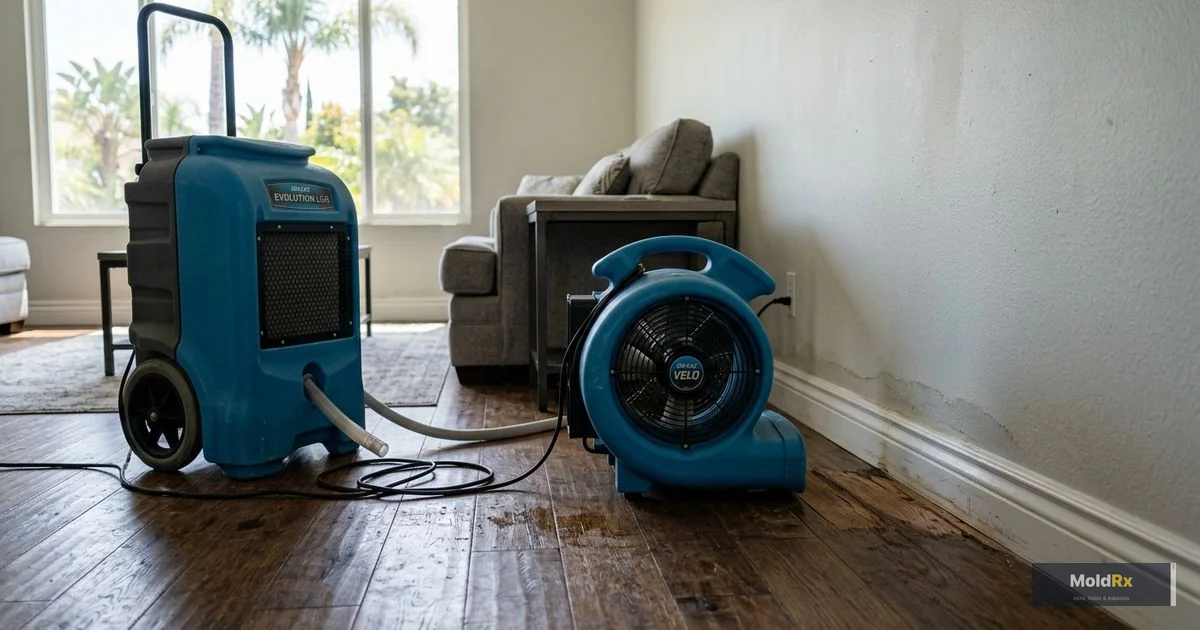
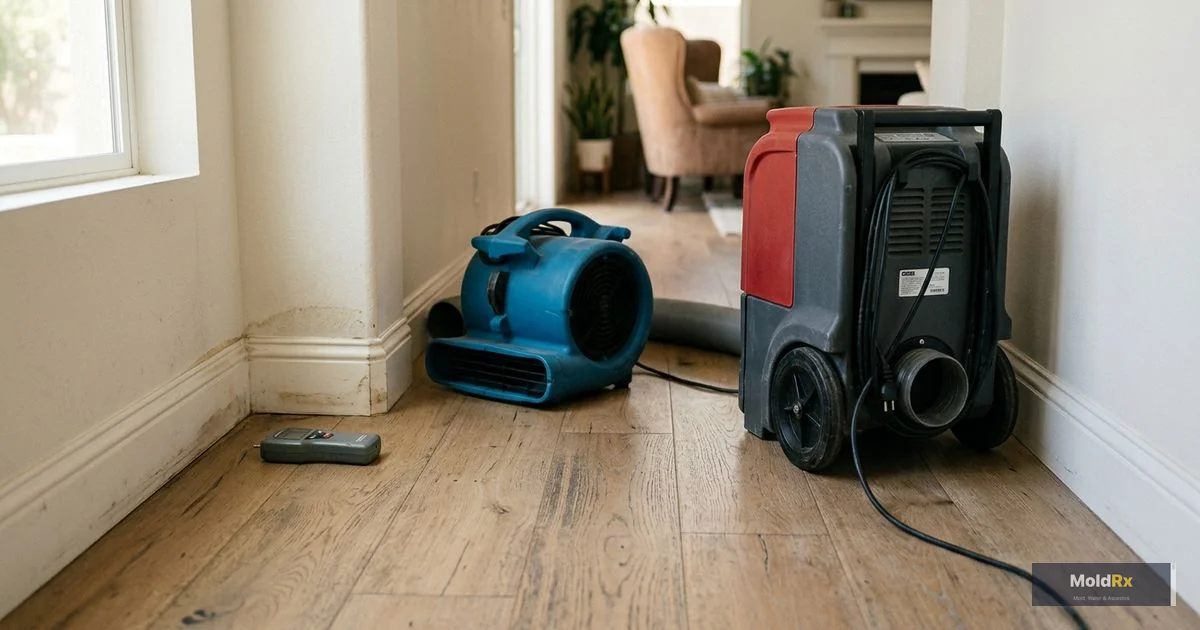
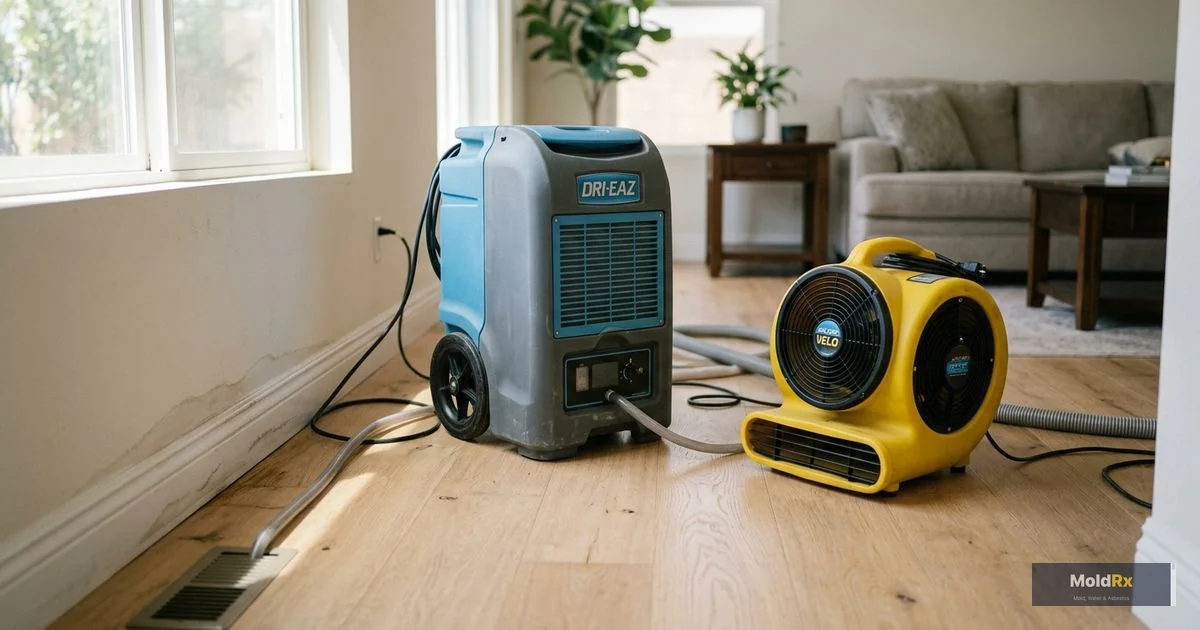
When you call, our specialists deploy to your Beaumont property immediately with truck-mounted extraction equipment, commercial dehumidifiers, industrial air movers, moisture detection instruments, and documentation tools.
Source Control -- The water source is identified and stopped. Plumbing failures get shut off at the nearest valve or at the main. Storm intrusion points get emergency sealing. Appliance failures get disconnected. Until the source is controlled, extraction is fighting a losing battle.
Water Classification -- Water is categorized on-site:
- Category 1 (Clean Water): Supply line breaks, faucet failures, water heater overflow from clean source. Standard extraction and drying protocols.
- Category 2 (Gray Water): Washing machine overflow, dishwasher discharge, toilet overflow without feces. Requires antimicrobial treatment of contacted materials.
- Category 3 (Black Water): Sewage backup, toilet overflow with feces, flood water from external sources. Biohazard protocols. Contacted porous materials must be removed and disposed of. Mandatory antimicrobial and sanitization treatment.
Comprehensive Documentation -- Every affected area is photographed. Moisture readings are taken in all materials. The scope and extent of damage are recorded. This documentation serves dual purposes: it drives the restoration plan and it supports your insurance claim.
Emergency Extraction -- Professional-grade truck-mounted extractors remove standing water at volume. Portable extraction units access tight spaces, closets, and cabinet interiors. In Beaumont homes with slab foundations, extraction includes addressing water that has pooled beneath flooring materials and in expansion joints.
Phase 2: Structural Drying and Monitoring (Days 1-5)
Removing visible water is only the beginning. The water you cannot see -- trapped inside drywall, absorbed into wood framing, saturating carpet padding, pooled beneath flooring -- is what destroys homes if not systematically extracted.
Our specialists deploy equipment calibrated for Beaumont's specific conditions:
- Commercial dehumidifiers rated for the volume of affected spaces, with output adjusted for Beaumont's elevation (2,600 feet) and ambient humidity levels
- Industrial air movers positioned to create targeted airflow patterns that draw moisture from structural materials without spreading contamination
- Thermal imaging cameras that reveal hidden moisture in walls, ceilings, floors, and crawl spaces -- areas where water migrates but remains invisible to the naked eye
- Daily moisture monitoring with pin-type and pinless meters tracking drying progress in every affected material against established target thresholds
In Beaumont's boom-era homes, structural drying must account for the materials common in these constructions: engineered wood products, OSB (oriented strand board) sheathing, spray foam insulation, and vinyl plank flooring. Each of these materials has different moisture absorption and release characteristics that affect drying times and equipment placement.
In older Beaumont homes, drying must account for plaster walls, hardwood subfloors, fiberglass batt insulation, and other materials that absorb and retain water differently than modern alternatives.
Drying is not complete until every affected material reaches verified target moisture content. Not surface-dry. Not mostly dry. Actually, measurably dry to standards that prevent mold growth and structural degradation.
Phase 3: Sanitization and Contamination Removal (Days 3-7)
For Category 2 and Category 3 events, thorough cleaning and antimicrobial treatment follow structural drying. Contaminated materials that cannot be restored are removed and disposed of properly. Air scrubbers with HEPA filtration capture airborne particles and mold spores during and after demolition work.
In Beaumont homes where water damage has contacted soil around foundations -- common with the clay-soil intrusion pattern -- sanitization extends to crawl spaces, foundation surfaces, and subfloor assemblies.
Phase 4: Restoration and Rebuild (Days 5-14+)
Once the structure is verified dry and clean, restoration returns your Beaumont home to pre-damage condition:
- Drywall replacement and finishing
- Flooring replacement or repair (matching existing materials where possible)
- Baseboard, trim, and millwork installation
- Cabinet repair or replacement
- Interior painting and finish work
- Insulation replacement in affected wall and attic spaces
All work meets current building codes. In Beaumont's newer communities, restoration is matched to the existing construction specifications. In older homes, repairs are brought to code while blending with existing finishes.
What You Should Expect From MoldRx
-
The Truth About Your Situation. If the water affected one room and the damage is limited, you will hear that. If the water migrated through wall cavities into multiple rooms and the actual scope is three times what you initially thought -- which happens regularly in Beaumont homes where clay-soil intrusion patterns send water along foundation walls -- you will hear that too. We do not downplay problems and we do not exaggerate them.
-
Communication You Can Actually Understand. What is happening, why it is happening, what comes next, what it will take, and what your options are. In plain language. Answered when you ask. Not when it is convenient for someone else.
-
Documentation That Gets Claims Paid. Detailed photographic evidence, moisture data logs with before-and-after readings, material inventories, scope-of-work documents. Insurance adjusters need specific information in specific formats. Our vetted specialists know what those formats are.
-
No Pressure to Buy What You Do Not Need. The urgency is real -- water damage does get worse with every hour. But we will never manufacture additional urgency or recommend services that are not necessary. You get an honest assessment of what must happen, what should happen, and what is optional.
Beaumont Neighborhoods and Areas We Serve
Our vetted water damage restoration specialists respond to emergencies across all of Beaumont:
- Sundance -- Master-planned community with 2000s-era construction entering the age of latent defect emergence
- Tournament Hills -- Mid-2000s homes now 15-20 years old with aging plumbing connections and water heaters
- Fairway Canyon and Oak Valley -- Boom-era developments with specific grading and drainage considerations
- Four Seasons at Beaumont -- Active adult community with documented construction history
- Downtown Beaumont and surrounding older neighborhoods -- Pre-1990 homes with aging infrastructure
- Properties along Highland Springs Avenue and the I-10 corridor
We serve ZIP code 92223 and surrounding areas, with rapid response extending to Cherry Valley to the north, Calimesa to the west, and Banning to the east. Residential and commercial properties throughout the region are within our service area.
Related Services in Beaumont
Water damage and mold are inseparable -- particularly in Beaumont, where elevated temperatures accelerate mold colonization on damp materials. If water has been present in your home for more than 24 hours during warm months, mold testing should be considered mandatory. In addition to water damage restoration, we also offer Mold Removal in Beaumont, Asbestos Removal in Beaumont services to Beaumont property owners.
-> Learn more about remediation services in Beaumont
Frequently Asked Questions
How quickly should I address water damage in my Beaumont home?
Immediately. Hours matter, not days. In Beaumont's warm climate, mold can begin colonizing damp materials within 24 hours -- faster during summer months when temperatures exceed 90 degrees. The clay soils around your foundation will continue wicking moisture into your home even after rain stops. Surface drying in Beaumont's dry climate creates a false sense of security while trapped moisture destroys structural materials from within. Professional extraction and drying should begin within hours of discovery, not days.
My Beaumont home was built in the early 2000s. Is it really at risk?
Yes, and increasingly so. Homes built during Beaumont's 2000-2009 construction boom are now 17 to 26 years old -- the age when latent construction issues begin manifesting. Plumbing connections that were installed under time pressure may develop slow leaks. Water heaters from original installation are past their expected lifespan. Grading that settled differently than designed may now direct water toward rather than away from your foundation. Construction defect litigation in Beaumont-area developments confirms that not all boom-era construction was executed to the highest standards. Be vigilant, and respond immediately to any sign of water intrusion.
Does insurance cover water damage restoration in Beaumont?
Most homeowner's policies cover sudden and accidental water damage -- burst pipes, water heater failures, appliance malfunctions, supply line breaks. Gradual damage from slow leaks, deferred maintenance, or construction defects may be excluded or require different claim paths. Flash flood damage from external sources typically requires separate flood insurance. Our vetted specialists document everything comprehensively to support your claim, but contact your insurance company immediately to open a claim alongside calling for restoration.
How long does water damage restoration take in Beaumont?
Timeline depends on severity, water category, and scope. Minor clean-water events in a single room: 3 to 5 days. Moderate damage affecting multiple rooms with structural drying: 7 to 10 days. Major events involving contaminated water, clay-soil foundation intrusion, or mold remediation: 2 to 4 weeks. Beaumont's elevation and climate affect drying equipment performance and timelines. You will receive an honest, realistic timeline after the initial assessment.
What is the clay soil problem and how does it affect my home?
Beaumont sits on clay-heavy soils that shrink during dry seasons, creating gaps around your foundation. When rains arrive, water channels through these gaps directly against your foundation walls. The clay absorbs water slowly, so instead of draining away, water pools and builds pressure against your foundation. This hydrostatic pressure forces water through any crack or weakness in your slab or foundation walls. The result is water intrusion at the foundation level that can saturate subfloor assemblies and persist long after the rain stops. Professional drainage assessment and foundation sealing can mitigate this risk, but once water has entered, professional extraction and drying are essential.
What should I do right now while waiting for the restoration team?
Turn off the water supply at the main shutoff valve if the damage is from a plumbing source. Move furniture, electronics, and valuables out of standing water and off wet flooring. Do not use household vacuums -- they are not rated for water extraction and present electrical hazard. Do not turn on your HVAC system if ductwork or ceiling spaces may be affected -- this can spread contaminated moisture throughout your entire home. Take photos and video of all visible damage for insurance documentation. Then stay out of affected areas and wait for professional help.
Your Beaumont Home Is Being Damaged Right Now
If water has entered your Beaumont property, the destruction is ongoing whether you can see it or not. Water is wicking up through drywall. Moisture is saturating subfloor assemblies. Clay soil around your foundation is channeling additional water toward your home. And in Beaumont's warm climate, mold spores are already finding the damp, dark conditions they need to colonize and spread.
This is not a situation that resolves itself. The dry San Gorgonio Pass air will dry your surfaces and deceive you into thinking the problem is improving. It is not. Hidden moisture will continue destroying your home from the inside for weeks and months until it is professionally extracted.
Contact MoldRx now for emergency water damage restoration in Beaumont. Vetted specialists. Honest assessment. Fast deployment. No excuses.