Water Damage Restoration in Blythe, CA — MoldRx
24/7 Emergency Water Damage Restoration Professionals Serving Blythe, the Palo Verde Valley, and the Colorado River Corridor
Water does not wait. Not in Blythe. Not when summer air temperatures hit 124 degrees Fahrenheit and interior wall cavities bake past 100. Not when your 1960s-era copper supply line finally gives out after six decades of thermal stress. Not when a monsoon cell drops an inch of rain in thirty minutes onto sun-hardened desert soil that absorbs nothing, sending sheet flow against your foundation and through every crack it finds. Not when your evaporative cooler's float valve sticks open at 2 AM and water pours into your ceiling cavity for hours before you hear the drip. In Blythe, every hour of unaddressed water intrusion accelerates damage exponentially — subfloor warping beyond salvage, drywall disintegrating from the inside, insulation collapsing under saturated weight, and mold colonies germinating within 24 to 48 hours. In this heat, it can happen in half that time.
This is not a situation that improves on its own. It gets catastrophically worse with every passing hour.
MoldRx only sends vetted water damage restoration professionals who follow IICRC S500 standards — the national benchmark for water damage inspection, extraction, drying, and restoration. Our teams arrive with commercial-grade equipment, document everything for your insurance claim from the first minute on-site, and do not leave until moisture readings confirm your property is dry and safe.
Call now for emergency service — (888) 609-8907. Fast response. Professional extraction and drying.
Why Water Damage Is an Emergency in Blythe
Blythe sits at the far eastern edge of Riverside County in the Palo Verde Valley, where the Colorado River forms the California-Arizona border. The city's roughly 17,800 residents live in one of the hottest inhabited places in the United States — summer highs routinely exceeding 115 degrees Fahrenheit, with the all-time record reaching 124 degrees in June 2016. Annual rainfall averages just 3.5 to 4 inches. The Palo Verde Irrigation District's canal system threads through the valley, delivering Colorado River water to over 100,000 acres of agricultural land surrounding the city. Those numbers create a dangerous illusion — that water damage is rare here. The reality is the opposite. When water enters a Blythe structure, from any source, the extreme heat turns a manageable problem into a structural emergency faster than almost anywhere else in the state.
1950s-1970s Housing Stock and Its Plumbing Legacy
Blythe's residential development tracks directly with the postwar agricultural expansion of the Palo Verde Valley. The Palo Verde Diversion Dam was completed in 1957, opening the valley to large-scale irrigated farming and triggering a construction boom. The majority of Blythe's housing stock was built between the 1950s and 1970s — California ranch homes and modest tract houses designed for a desert agricultural community. That means the plumbing systems in thousands of Blythe homes are now 50 to 70 years old.
Galvanized steel supply lines corroded from the inside by decades of mineral-heavy Colorado River water. Original copper pipes stressed past their design life by thermal cycling that no coastal plumber would believe — 120-degree afternoon surface temperatures plunging to 60 degrees overnight, expanding and contracting thousands of times per year. Cast iron drain lines with half a century of scale buildup. Slab-on-grade foundations where supply lines run beneath the concrete, developing pinhole leaks that saturate your foundation for weeks before a warm spot on the floor or an unexplained water bill spike alerts you to the problem.
These plumbing systems do not announce their failure in advance. They fail suddenly and completely — at 3 AM, during a weekend, while you are visiting family in Riverside or Phoenix. By the time you find the damage, hundreds or thousands of gallons have already saturated structural materials. Blythe's extreme heat means those saturated materials begin growing mold faster than almost any other location in California.
Evaporative Coolers: Blythe's Most Common Hidden Water Damage Source
In a city where summer temperatures regularly exceed 115 degrees, evaporative coolers are not optional — they are the primary cooling system in the majority of Blythe's older homes. These rooftop-mounted systems depend on continuous water supply through copper or plastic feed lines running from interior plumbing, up through the ceiling, and onto the roof. Float valves regulate water flow into the cooler pan. Overflow pans catch excess water.
Every one of these components degrades under Blythe's extreme UV exposure and punishing thermal cycling. Supply lines corrode. Float valves stick open. Overflow pans crack and warp. When failure occurs, water flows directly into your attic space, saturates ceiling insulation, wicks through ceiling drywall, and runs down wall cavities into the living space below. Because the leak originates at the highest point of the structure, gravity carries water through every layer — ceiling joists, top plates, wall insulation, electrical wiring channels — before you see the first ceiling stain.
By the time you notice a discolored spot on your ceiling or a musty smell in a bedroom, weeks of hidden moisture damage may have already occurred in enclosed spaces with zero airflow and triple-digit temperatures. Mold colonization in these conditions is not a risk — it is a near certainty without professional intervention.
Monsoon Season and Flash Flooding
From July through September, the North American Monsoon pushes moisture from the Gulf of California and the Gulf of Mexico across the desert Southwest. Blythe sits directly in this moisture pathway. Monsoon thunderstorms develop rapidly and can drop an inch or more of rain in under an hour onto hardpan desert soil with near-zero absorption capacity.
The result is immediate sheet flooding. Water sheets across roadways, concentrates in washes and drainage channels, and pools against foundations. Homes in low-lying areas near Palo Verde Irrigation District canals and agricultural drainage ditches face compounded risk — storm runoff mixes with agricultural irrigation overflow, carrying sediment, fertilizer residue, and organic matter directly against residential structures. Flash flood water entering homes through garage door seals, foundation cracks, window wells, and saturated soil forcing moisture upward through slab foundations is almost always classified as Category 2 or Category 3 under the IICRC S500 standard — contaminated water requiring specialized extraction, antimicrobial treatment, and removal of all contacted porous materials.
The Colorado River itself, while managed by the Bureau of Reclamation and the Palo Verde Diversion Dam, adds another dimension of risk during high-water events. Properties along the river corridor and near canal infrastructure remain vulnerable to seepage and localized flooding when the system handles above-normal flows.
The 24-to-48-Hour Mold Window
Mold colonization begins within 24 to 48 hours of sustained moisture exposure. The EPA and IICRC S520 both confirm this timeline. In Blythe, where interior wall cavities can exceed 100 degrees during summer months, germination can begin in as little as 12 to 18 hours. Stachybotrys chartarum — black mold — can colonize within 48 to 72 hours on saturated drywall and cellulose insulation. Evaporative cooler failures are the highest-risk scenario because they introduce moisture into enclosed attic and ceiling spaces with minimal airflow and extreme heat — exactly the conditions mold thrives in.
Once mold takes hold, your restoration project doubles in scope. A water damage restoration becomes a water damage plus IICRC S520 mold remediation project — dramatically increasing timeline, cost, and disruption. Professional extraction and drying within the first 24 hours is the single most effective mold prevention measure. Box fans and open windows do not produce the airflow volume or dehumidification capacity needed to dry wall cavities, subfloor assemblies, and structural framing to safe moisture levels. In Blythe's summer heat, opening windows raises interior temperatures and accelerates mold germination inside saturated materials.
Every hour you wait narrows the window between restoration and remediation.
Insurance Documentation Starts Immediately
Insurance policies require prompt notification and mitigation. Delayed response can result in denied claims — insurers may argue that secondary damage resulted from failure to mitigate rather than the original event. Professional documentation beginning the moment technicians arrive establishes the timeline insurers need to process your claim.
Most homeowner's policies cover sudden and accidental water damage — burst pipes, failed water heaters, appliance line ruptures, swamp cooler supply line failures. Flood damage from external sources like monsoon flash flooding typically requires separate flood insurance. Our documentation includes initial loss assessment with timestamped photographs, water category and damage class classification, daily moisture readings, equipment placement records, drying progress reports, and final verification readings. This package gives your adjuster the objective evidence needed to validate the claim.
Water Damage Categories and Classes
The IICRC S500 standard classifies water damage by contamination level and physical scope. Understanding the classification of your situation determines safety protocols, equipment requirements, and which materials can be salvaged versus which must be removed.
Category 1 (Clean Water) — from a sanitary source like a broken supply line, water heater inlet, or ice maker line. Not an immediate health threat, but degrades to Category 2 or 3 within 48 to 72 hours if not extracted. In Blythe's extreme heat, this degradation accelerates significantly.
Category 2 (Gray Water) — significant contamination from washing machine overflow, dishwasher discharge, evaporative cooler overflow, or toilet overflow with urine. Requires antimicrobial treatment. Contacted porous materials — carpet pad, particleboard, unsealed drywall — typically require removal.
Category 3 (Black Water) — the most hazardous classification. Sewage backups, flash flood water carrying agricultural runoff and desert sediment, and any standing water present long enough to support bacterial and pathogenic growth. Monsoon flooding in Blythe almost always qualifies as Category 3. Requires full PPE, removal of all contacted porous materials, and thorough sanitization per IICRC S500 protocols. There is no drying Category 3 carpet or pad — it gets removed.
The IICRC S500 also classifies physical scope into four classes: Class 1 (minimal absorption, small area), Class 2 (significant absorption affecting an entire room with wall wicking up to 24 inches — common in Blythe supply line failures and slab leaks), Class 3 (water from overhead saturating walls, ceilings, insulation, and subfloors — the most common class in evaporative cooler failures), and Class 4 (specialty drying situations involving low-permeability materials like concrete slabs, hardwood flooring, and plaster walls — frequent in Blythe's older slab-on-grade homes with slow leaks beneath the foundation).
Our Water Damage Restoration Process
Every water damage event is different, but the IICRC S500 protocol provides the systematic framework our vetted professionals follow on every Blythe job.
1. Emergency Response and Assessment — Technicians identify the water source, classify the water category (Category 1 through Category 3) and damage class (Class 1 through Class 4), and map the full extent of moisture intrusion using thermal imaging and penetrating moisture meters — including water you cannot see behind walls, beneath flooring, and inside ceiling cavities above evaporative cooler supply lines.
2. Water Extraction — Standing water is removed immediately using truck-mounted and portable extraction units. Submersible pumps handle deep standing water from flood events. For evaporative cooler failures, extraction targets attic insulation, ceiling cavities, and interior wall assemblies. Every gallon removed directly reduces drying time and limits secondary damage. In Blythe, where heat accelerates every stage of deterioration, extraction speed is the single most critical variable.
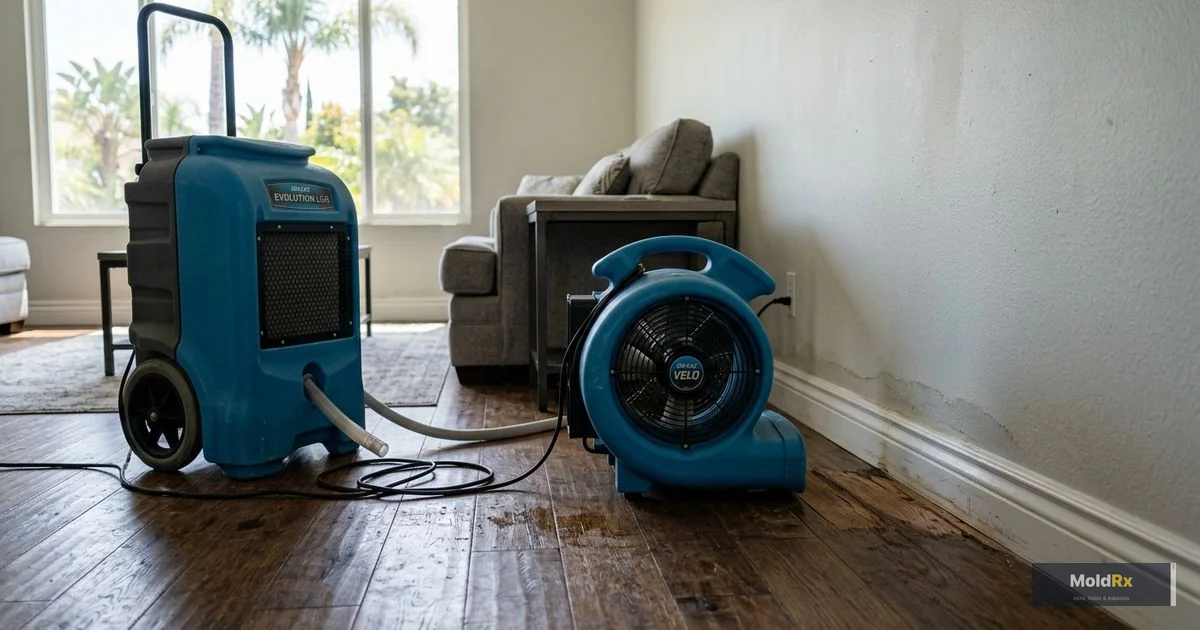
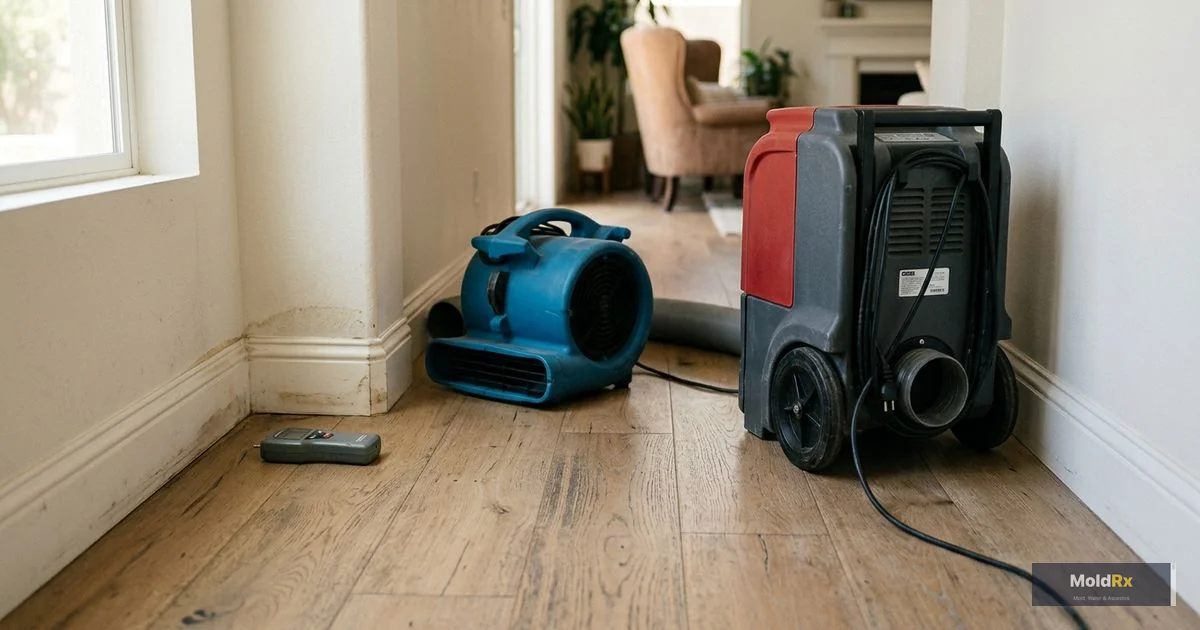
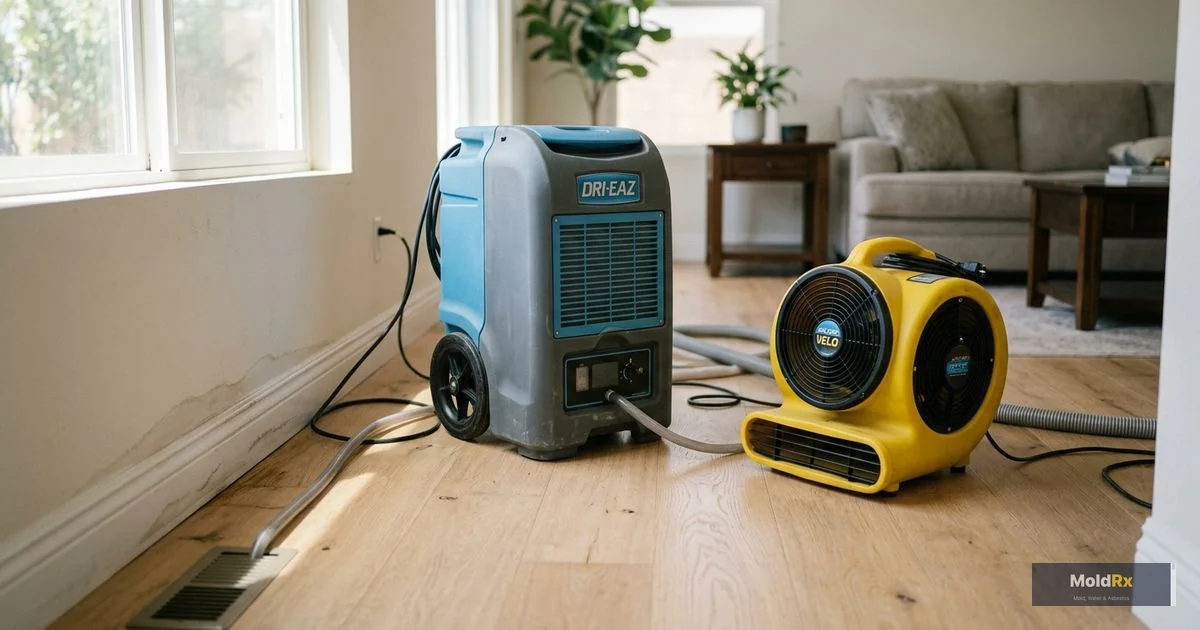
3. Structural Drying and Dehumidification — Commercial-grade dehumidifiers and high-velocity air movers are positioned according to psychrometric calculations calibrated for Blythe's desert conditions. Wall cavities receive directed airflow through injection drying systems. Concrete slab foundations common in Blythe homes require specialty drying equipment placed directly on the slab surface to draw moisture from the concrete. The goal is to reach dry standard throughout all affected materials.
4. Moisture Monitoring and Documentation — Daily moisture readings using pin-type and pinless meters, thermo-hygrometers, and thermal imaging. Every reading is logged and provides your insurance adjuster with timestamped evidence that professional drying was performed per IICRC S500 standards.
5. Cleaning, Sanitizing, and Antimicrobial Treatment — Category 2 and Category 3 losses require antimicrobial application to all contacted structural materials. HEPA air scrubbers filter airborne contaminants. All protocols comply with Cal/OSHA safety requirements and IICRC S500/IICRC S520 standards.
6. Restoration and Rebuild — From reinstalling baseboards to replacing drywall, insulation, flooring, and cabinetry damaged beyond salvage. All rebuild work is performed by CSLB-licensed professionals who understand desert construction methods — stucco exteriors, slab-on-grade foundations, flat and low-slope roofing systems, and the evaporative cooler penetrations common in Blythe homes.
Get emergency help now — (888) 609-8907.
What to Do Before We Arrive
- Shut off the water source if you can reach the shutoff safely. For slab leaks, turn off the main supply at the meter. For evaporative cooler failures, shut off the supply valve to the rooftop unit. For water heater ruptures, close the cold water inlet valve at the top of the unit.
- Turn off electricity to affected areas at the breaker panel. Never step into standing water near active outlets or appliances.
- Move valuables to dry ground. Remove documents, photographs, electronics, and irreplaceable items from affected rooms.
- Document everything with photos and video before moving anything. Photograph the water source, the extent of visible water, and all damaged materials. This evidence is critical for your insurance claim.
- Do not use a household vacuum on standing water — electrical shock hazard.
- Do not run fans or your HVAC system. You risk spreading contaminated moisture through ductwork and into unaffected areas of the home.
- Do not open windows during summer months — Blythe's extreme outdoor heat accelerates mold germination inside saturated wall cavities and ceiling spaces.
What Sets MoldRx Apart
- Fast emergency response. Water damage is the most time-sensitive restoration service. In Blythe's extreme heat, the gap between recoverable damage and total material loss narrows faster than anywhere else. The faster extraction begins, the more of your property we save.
- IICRC S500-certified professionals only. Every technician holds current IICRC certification and CSLB licensing. These are trained water damage restoration specialists who understand the specific challenges of restoring properties in the Colorado River Valley — extreme heat, aging plumbing infrastructure, slab-on-grade foundations, and evaporative cooler complications.
- Complete documentation for insurance. From the first timestamped photo to the final moisture verification reading, every step is documented to the standard your insurance adjuster needs.
- Psychrometric drying science calibrated for Blythe's desert climate — not guesswork. Proper drying calculations account for outdoor temperatures exceeding 115 degrees, low ambient humidity, and the thermal mass of concrete slab foundations. Faster drying times, fewer complications.
- We only send vetted professionals. When we put a team in your Blythe home, our reputation goes with them. If something is not right, you call us directly.
Blythe Neighborhoods and Areas We Serve
MoldRx provides emergency water damage restoration throughout Blythe and the Palo Verde Valley:
- Downtown Blythe / Hobsonway Corridor — Commercial buildings and residential properties along Blythe's main commercial strip. Older construction from the 1950s-1970s with aging plumbing infrastructure and flat-roof commercial buildings vulnerable to ponding water.
- Chanslor Way / Central Residential — Mid-century ranch homes built during the agricultural expansion era. Galvanized and copper plumbing systems at or past end-of-life. High evaporative cooler usage throughout.
- Mesa Drive / Northern Blythe — Single-family homes with slab-on-grade foundations. Slab leak risks from shifting desert soils and decades of thermal cycling on subslab supply lines.
- Palo Verde College Area — Mixed residential housing serving the college community. Older rental properties with deferred plumbing maintenance and high water damage risk.
- Agricultural Periphery / Canal-Adjacent Properties — Homes near Palo Verde Irrigation District canals and drainage infrastructure. Elevated flood risk during monsoon events and irrigation system surges. Flash flood water reaching these properties typically qualifies as Category 2 or Category 3.
- Riviera Drive / Colorado River Corridor — Properties near the Colorado River with exposure to high-water events and elevated groundwater during river flow surges.
- Interstate 10 Commercial Corridor — Hotels, restaurants, gas stations, and commercial buildings serving I-10 travelers. Commercial water damage from aging roofing systems, supply line failures, and HVAC condensation issues.
Coverage extends throughout ZIP code 92225 and the broader Palo Verde Valley, including Ripley and surrounding unincorporated Riverside County communities.
Related Services
- Mold Removal in Blythe — If the 24-to-48-hour mold window has passed, IICRC S520 remediation is the next step.
- Asbestos Removal in Blythe — Licensed abatement required under Cal/OSHA and EPA regulations when asbestos-containing materials are disturbed during restoration.
-> Learn more about remediation services in Blythe
Frequently Asked Questions
How quickly do you respond to water damage emergencies in Blythe?
We treat every call as an emergency because it is one. In Blythe's extreme heat, mold colonization begins faster than almost anywhere else in California. Extraction that starts within the first few hours saves exponentially more material — and costs exponentially less — than extraction that starts the next day. Call (888) 609-8907 immediately.
What should I do first when I discover water damage in my Blythe home?
Stop the water source if you safely can. Turn off electricity to affected areas at the breaker panel. Do not walk through standing water near active electrical connections. Document visible damage with photos. Then call (888) 609-8907 immediately — do not wait until morning, do not wait until Monday, do not try to handle it yourself with fans and towels.
My evaporative cooler leaked into my ceiling. How serious is this?
Very serious. Evaporative cooler failures introduce water at the highest point of your structure, where gravity carries it through ceiling joists, insulation, wall cavities, and wiring channels into the living space below. The enclosed attic and ceiling spaces where this water collects have minimal airflow and extreme temperatures during Blythe's summer — ideal conditions for rapid mold growth. Professional extraction and drying of the ceiling cavity and affected walls is critical. Do not assume a ceiling stain is the extent of the damage.
Does homeowner's insurance cover water damage restoration in Blythe?
Most policies cover sudden and accidental water damage — burst pipes, failed water heaters, appliance line ruptures, evaporative cooler supply line failures. Gradual damage from neglected maintenance may not be covered. Flood damage from monsoon flash flooding or Colorado River overflow typically requires separate flood insurance. Our vetted professionals document every aspect of the restoration per IICRC S500 standards to support your claim.
How long does water damage restoration take in Blythe?
A contained Category 1 event in one room may reach dry standard in three to five days. A major event involving multiple rooms, Category 3 contaminated water, or attic saturation from an evaporative cooler failure can require one to three weeks. Slab leaks requiring concrete access may extend the timeline further. We do not rush drying — incomplete drying leads to mold, and in Blythe's heat, mold establishes faster than anywhere else.
What is the difference between water damage categories?
Category 1 is clean water from a sanitary source like a supply line or water heater. Category 2 is gray water with contaminants — washing machine discharge, cooler overflow, toilet overflow. Category 3 is black water — sewage, floodwater, or any water contaminated enough to cause illness. All categories are defined by the IICRC S500 standard, and each requires different safety protocols, equipment, and material handling.
My home was built in the 1960s. Does that affect water damage restoration?
Yes. Homes built in the 1950s through 1970s — the majority of Blythe's housing stock — may contain asbestos in flooring, pipe insulation, joint compound, or textured ceilings. When water damage requires removal of these materials, Cal/OSHA and EPA regulations mandate asbestos testing before disturbance. Our vetted professionals identify potential asbestos-containing materials during the initial assessment and coordinate testing when needed.
Why can't I dry water damage myself with fans?
Household fans cannot generate the airflow volume or dehumidification capacity needed to dry wall cavities, subfloor assemblies, ceiling spaces, and structural framing to safe moisture levels. In Blythe's summer, opening windows introduces 115-degree air that raises interior temperatures and accelerates mold germination inside saturated materials. Professional drying equipment uses psychrometric calculations to achieve evaporation rates that household equipment cannot approach — the difference between a dried structure and a mold-infested one.
Will you work with my insurance adjuster?
Yes. We provide complete technical documentation — timestamped photographs, moisture readings, drying logs, equipment placement records, water category and class classifications, and final verification data — directly to your adjuster. Our documentation follows IICRC S500 standards, the framework most insurers use to evaluate water damage claims.
Get Water Damage Restoration in Blythe Now
Water damage is an active emergency that compounds with every passing hour. The materials inside your walls, beneath your floors, and above your ceilings are absorbing water right now. Mold spores are finding the warm, saturated conditions they need. Structural elements are weakening. Whether it is a burst supply line in your 1960s ranch home off Chanslor Way, an evaporative cooler overflow soaking through your attic insulation in July, a slab leak silently saturating your foundation near Mesa Drive, or monsoon floodwater forcing through your garage door seal carrying agricultural sediment and contamination — waiting makes everything worse.
MoldRx only sends vetted water damage restoration professionals who follow IICRC S500 standards, carry current CSLB licensing, and understand Blythe's extreme desert conditions. Every technician complies with Cal/OSHA safety standards and EPA guidelines for contaminated water handling. We do not send whoever is available. We send professionals who are qualified, vetted, and equipped for the job.
Every hour matters. In Blythe, it matters more than almost anywhere else.
Call MoldRx now — (888) 609-8907. Every hour matters.