Emergency Water Damage Restoration in Brea, CA
MoldRx connects Brea property owners with vetted, IICRC-certified water damage restoration specialists — 24 hours a day, 7 days a week.
If water is in your Brea home right now, the clock is already running. Water migrates through drywall, saturates subfloors, and pools in wall cavities at a rate you cannot see. Within 24 to 48 hours, what started as a plumbing failure or storm leak becomes a mold colonization event. Within 72 hours, Category 1 clean water degrades to Category 2 or Category 3 as bacterial contamination develops. Every hour you wait changes the scope, the timeline, and the cost of your restoration.
Call (888) 609-8907 now or request your free estimate to get a vetted specialist dispatched to your Brea property today.
MoldRx does not perform restoration work directly. We vet and coordinate IICRC-certified restoration professionals who follow IICRC S500 (Standard for Professional Water Damage Restoration) and IICRC S520 (Standard for Professional Mold Remediation) protocols. Every specialist we send has been screened for proper licensing through the California Contractors State License Board (CSLB), carries appropriate insurance, and adheres to Cal/OSHA safety requirements. You get the right team for Brea's unique challenges — not just the cheapest bid.
Why Brea Properties Face Elevated Water Damage Risk
Brea is not a typical North Orange County suburb. Its identity was forged by oil, its geography is defined by hills, and its housing stock tells the story of a city that transformed from an industrial oil town into a residential community in a single generation. Each of these factors creates specific water damage vulnerabilities that restoration companies without local knowledge routinely miss.
The Oil Town Foundation (Pre-1950s)
Brea was established in 1911 at the mouth of Brea Canyon, built on the Brea-Olinda Oil Field — one of California's most productive, with over 430 million barrels extracted since its 1880 discovery. By 1912, 105 wells had been drilled in the Brea Canyon area alone.
This history matters for water damage because the oil field infrastructure left lasting marks on the land. Subsurface conditions in parts of Brea reflect decades of drilling, extraction, and associated ground disturbance. Soil composition varies dramatically from block to block — some areas sit on stable alluvial deposits, while others overlie fill material, abandoned well sites, or clay-heavy soils with poor drainage characteristics. These subsurface irregularities contribute to differential foundation settling, which stresses plumbing lines and creates the conditions for slab leaks that are among Brea's most common water damage triggers.
The small number of pre-war structures that remain — mostly in the Original Townsite near Birch Street and Brea Boulevard — feature construction methods that predate modern building codes. Clay sewer lines, unreinforced masonry foundations, and minimal waterproofing make these properties particularly vulnerable when pipe failures or storm events drive water into structural cavities.
The Housing Boom (1950s-1970s)
When oil production peaked in 1953 and then declined, Union Oil — the region's largest landowner — pivoted aggressively to residential development. In a single decade, Brea quadrupled in size. Highways, air conditioning, and improved water systems made suburban living attractive, and thousands of single-family homes went up across Central Brea, Brea Olinda, and the flatland neighborhoods south of Lambert Road.
These homes are now 50 to 70+ years old. That means:
- Galvanized steel supply pipes corroding from the inside, restricting flow before rupturing
- Cast iron drain lines deteriorating from decades of chemical and biological contact
- Polybutylene piping (1978-1995 installations) prone to sudden, catastrophic brittle fractures
- Copper supply lines under slab foundations developing pinhole leaks from decades of pressure and soil chemistry contact
- Original water heaters long past their 10-15 year service life, with tanks corroded and pressure relief valves potentially compromised
Slab leaks are epidemic in this era of Brea construction. A pinhole leak beneath a concrete foundation can run for weeks before you notice warped flooring, an unexplained spike in your water bill, or a musty odor signaling that mold has already established. By the time these symptoms appear, you may be dealing with a Class 3 or Class 4 water damage event with secondary microbial contamination — a fundamentally different restoration project than catching a leak on day one.
Hillside Properties (1980s-2000s)
Brea's expansion into the hills — Olinda Ranch, Country Hills, Brea Trails, Blackstone — brought modern construction to terrain that adds complexity to water damage scenarios.
Hillside homes face runoff and drainage challenges that flatland properties do not. Storm water flows downhill with significant velocity, and when grading or drainage systems fail — from settled soil, clogged sub-drains, or inadequate slope management — water is directed toward foundations rather than away. In multi-level hillside homes, a roof leak or failed flashing sends water cascading downward through multiple stories, affecting ceilings, walls, and floors at each level. These are complex, multi-zone drying scenarios that require technicians who understand vertical water migration patterns.
The Carbon Canyon corridor on Brea's northeast edge adds wildfire risk to the water damage equation. The 2008 Freeway Complex Fire originated near the Brea-Olinda oil field, and the Carbon Canyon area sits within the designated wildland-urban interface. Post-fire landscapes — stripped of vegetation and coated in hydrophobic ash — dramatically amplify storm runoff. A moderate rainstorm following a fire event can produce debris flows and flash flooding that overwhelm drainage systems and drive Category 3 contaminated water into homes.
Climate and Seasonal Risk
Brea receives approximately 14 inches of annual rainfall, almost entirely between November and March. The city's position at the base of the Puente Hills means that storm systems drop moisture as they encounter terrain — and that water flows downhill through Brea's neighborhoods. Tributaries including Brea Creek Channel drain southward through the city toward Carbon Creek and ultimately the San Gabriel River.
Summer temperatures regularly reach the mid-80s to low 90s, and average humidity climbs to 65-70% during late spring marine layer periods. In a structure with concealed moisture from an undetected slab leak or slow pipe failure, these conditions accelerate mold growth in wall cavities, under flooring, and in attic spaces — exactly the hidden locations where damage compounds before becoming visible.
IICRC S500 Water Damage Restoration Process for Brea Properties
The IICRC S500 Standard defines the science-based protocol that every MoldRx-vetted specialist follows in Brea. This is not a checklist — it is a systematic framework that ensures your property is restored to pre-loss condition with verified results, not assumptions.
Phase 1: Emergency Response and Damage Classification
When you call (888) 609-8907, the priority is getting a certified technician on-site to stop active water intrusion and classify the event.
Water Damage Categories (Contamination Level per IICRC S500):
- Category 1 — Clean water from a sanitary source. Broken supply line, tub overflow, appliance feed line failure. Lowest immediate health risk, but Category 1 water degrades to Category 2 or 3 if left standing.
- Category 2 — Gray water with significant contamination. Dishwasher discharge, washing machine overflow, toilet overflow with urine. Can cause illness through contact or ingestion. Enhanced PPE and antimicrobial treatment required.
- Category 3 — Black water containing pathogenic, toxic, or harmful agents. Sewage backup, storm flooding that has contacted soil, any standing water supporting microbial growth. EPA guidelines and Cal/OSHA regulations govern handling, containment, and disposal.
Water Damage Classes (Evaporation Load per IICRC S500):
- Class 1 — Minimal absorption. Water has affected only part of a room with low-porosity materials.
- Class 2 — Significant absorption. Water has wicked into carpet, cushion, and structural materials. Walls affected up to 24 inches.
- Class 3 — Maximum absorption. Water from overhead sources has saturated ceilings, walls, insulation, carpet, and subfloor throughout the affected area.
- Class 4 — Specialty drying required. Water has penetrated deep into low-permeability materials — hardwood, plaster, concrete, stone. This class is common in Brea's older homes with original plaster walls and concrete slab foundations.
Phase 2: Rapid Water Extraction
Standing water is removed using truck-mounted and portable extraction equipment. In Brea's slab-on-grade homes, sub-surface extraction techniques may be necessary to pull water from beneath flooring where it has migrated through expansion joints or penetrated the slab-to-wall junction. Speed is everything in this phase — every hour that water remains in contact with structural materials increases the damage class, extends the drying timeline, and elevates the risk of secondary mold contamination.
Phase 3: Monitored Structural Drying
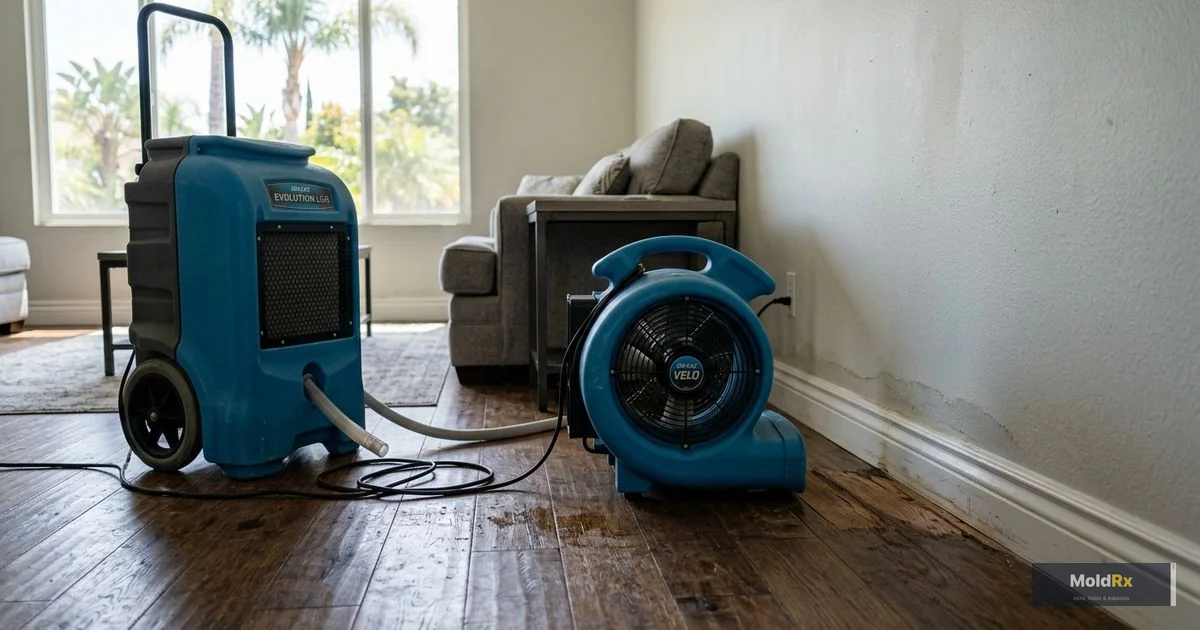
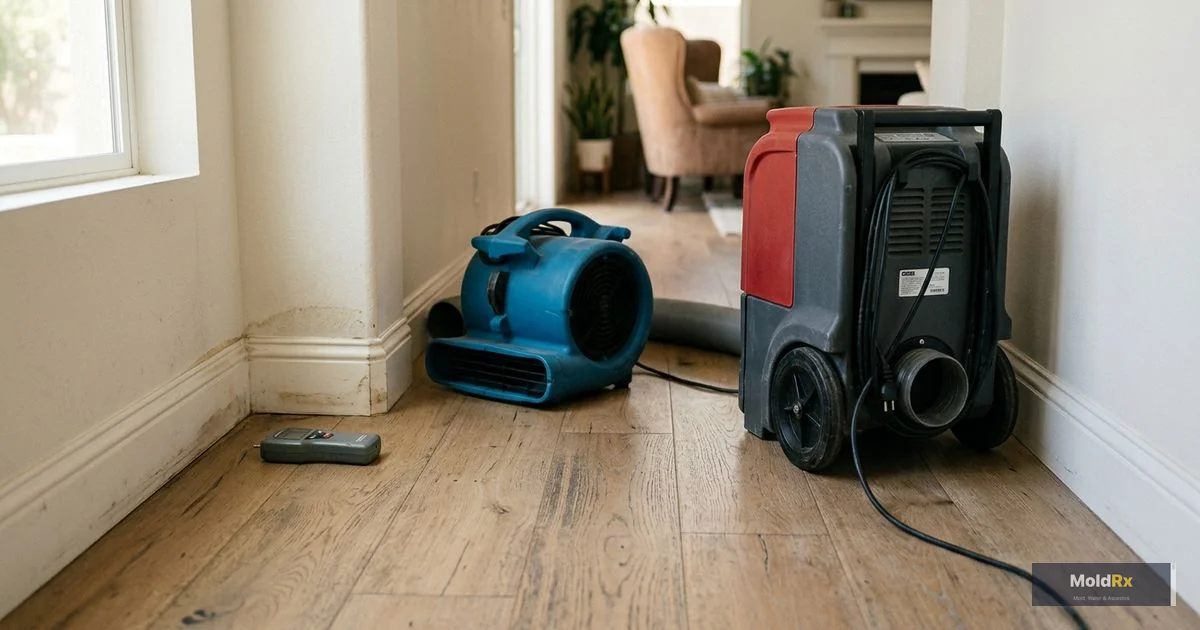
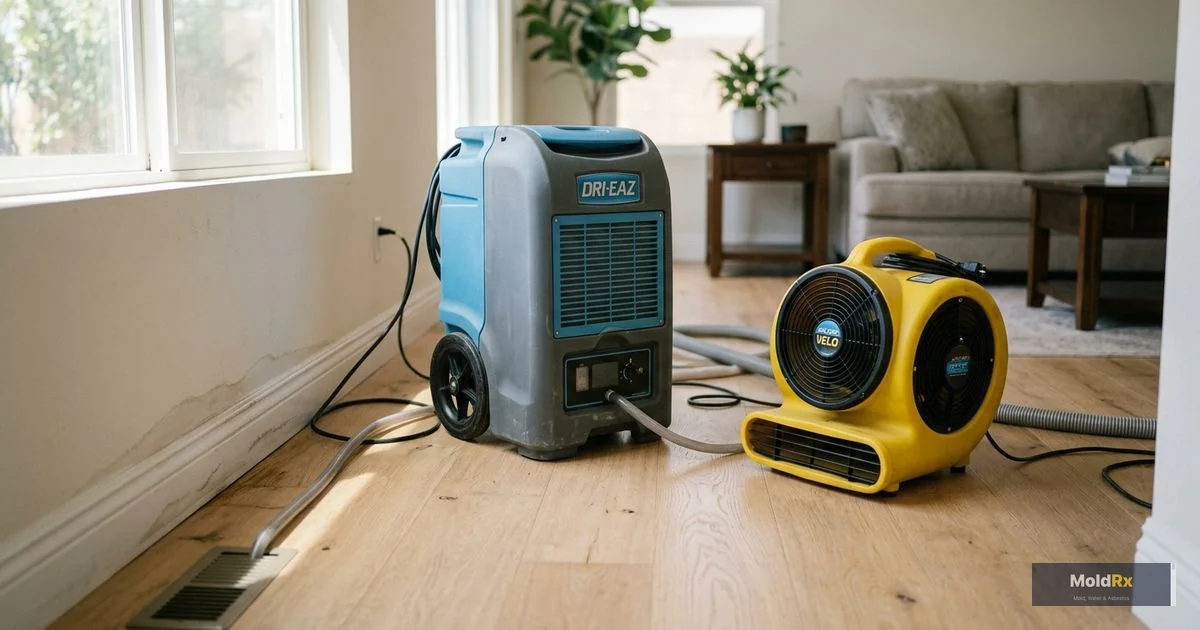
This phase separates professional restoration from amateur work. Commercial air movers create directed airflow across wet surfaces while industrial dehumidifiers capture moisture from the air. Thermal imaging cameras locate moisture pockets invisible to the naked eye. Calibrated moisture meters and hygrometers establish baseline and target readings for every affected material.
For Brea's older homes with plaster walls, concrete slabs, and original hardwood — all low-permeability materials — Class 4 specialty drying protocols are often required. This may include desiccant dehumidification systems, heat-assisted drying, and wall cavity injection systems that deliver warm, dry air directly into enclosed spaces where standard air movers cannot reach.
Daily moisture readings are documented and compared against IICRC S500 dry standards for each material type. Equipment is not removed until instrument readings confirm the structure has reached its dry standard — not until it "looks dry" or "feels dry."
Phase 4: Antimicrobial Treatment and Restoration
Once verified dry, all affected surfaces are treated with EPA-registered antimicrobial solutions per IICRC S520 protocols. Materials that cannot be restored — Category 2/3 contaminated drywall, saturated insulation, delaminated particle board — are removed, documented for insurance purposes, and replaced. The goal is pre-loss condition, verified by instrumented readings.
What Vetted Means at MoldRx
- IICRC Certification Verified — Every specialist holds current Water Damage Restoration Technician (WRT) certification at minimum. Many carry additional Applied Structural Drying (ASD) and Applied Microbial Remediation (AMRT) certifications.
- CSLB License Confirmed — Active California Contractors State License Board licensing verified before we coordinate any project.
- Insurance Coverage Validated — General liability and workers' compensation coverage confirmed.
- Cal/OSHA Compliance — For Category 2 and Category 3 events, our specialists follow Cal/OSHA PPE requirements, contaminated material handling protocols, and disposal regulations.
- Honest Scope of Work — If your damage is less severe than you feared, you will hear that. If it is worse, you will understand exactly why, what the classification is, and what needs to happen. We only send professionals who tell you what you need — not what generates the biggest invoice.
Brea Neighborhoods and ZIP Codes We Serve
MoldRx coordinates emergency water damage restoration across every Brea neighborhood:
- Original Townsite (92821) — Pre-war structures with aging clay lines and original plumbing
- Central Brea (92821) — 1950s-1970s tract homes with slab leak vulnerability
- Brea Olinda (92821) — Post-war housing on oil field terrain with variable subsurface conditions
- Olinda Ranch (92823) — Hillside properties with runoff and multi-level water migration risk
- Country Hills (92823) — Hillside homes with drainage system challenges
- Brea Trails (92823) — Modern construction with terrain-related drainage issues
- Blackstone (92821) — Newer development with builder-grade plumbing reaching maintenance age
- Carbon Canyon (92823) — Wildland-urban interface with post-fire flooding vulnerability
We also respond to emergencies in neighboring cities including Fullerton, La Habra, Yorba Linda, Placentia, and Diamond Bar.
Related Services in Brea
Water damage and mold are inseparable. In addition to water damage restoration, we coordinate Mold Removal in Brea, Asbestos Removal in Brea.
→ Learn more about remediation services in Brea
Frequently Asked Questions
How fast do I need to act on water damage in my Brea home?
Immediately. The IICRC S500 standard documents that microbial amplification begins within 24 to 48 hours under conditions typical of Brea's climate — warm temperatures and moderate humidity. Category 1 water left standing degrades to Category 2 or 3 within 48 to 72 hours as contamination develops. In Brea's older homes with concealed plumbing behind plaster walls and beneath concrete slabs, water can spread far beyond the visible damage zone before you realize the scope. Every hour of delay escalates the damage class, extends the drying timeline, and increases the probability of secondary mold contamination. Call (888) 609-8907 or request your free estimate now.
What determines the cost of water damage restoration in Brea?
The primary cost drivers are water damage category (1, 2, or 3), damage class (1 through 4), affected square footage, material types involved, and time elapsed before restoration begins. A Category 1, Class 2 event in a single room is a fundamentally different project from a Category 3, Class 4 event affecting a multi-story hillside home. Brea's older housing stock frequently involves Class 4 specialty drying requirements for plaster and concrete — which adds equipment and time compared to drying modern drywall. Accurate scoping requires on-site assessment with calibrated instruments. Contact us to discuss your specific situation.
Will my insurance cover water damage restoration in Brea?
Most homeowner's policies cover sudden and accidental water damage — a burst pipe, a failed water heater, an appliance malfunction. Gradual damage from deferred maintenance, long-running slab leaks, or ground-source flooding typically requires separate coverage or may be excluded entirely. Our vetted specialists generate comprehensive documentation from the first hour — moisture maps, thermal images, material-specific readings, drying logs with daily progress — specifically because insurance adjusters evaluate claims based on evidence quality.
How long does structural drying take in Brea homes?
Drying timelines are determined by damage class and material type, not arbitrary schedules. Class 1 events may reach dry standard in 2 to 3 days. Class 2 events typically require 3 to 5 days. Class 3 and Class 4 events — particularly common in Brea's 1950s-1970s homes with concrete slabs and plaster walls — can require 5 to 10+ days with specialty drying equipment. Equipment is removed only when calibrated moisture meter readings confirm every affected material has reached its IICRC S500 dry standard.
What makes slab leaks so dangerous in Brea?
Slab leaks are insidious because they occur beneath the concrete foundation where you cannot see them. A pinhole failure in a copper supply line pressurized at 40-80 PSI can push water continuously into the surrounding concrete and soil. The water migrates upward through the slab, saturates flooring adhesive, warps hardwood or laminate, and wicks into drywall at the slab-to-wall junction. Because the leak is concealed, damage often accumulates for weeks before symptoms appear — warped floors, musty odors, unexplained water bill increases. By that point, you may be dealing with a Class 3 or Class 4 event with mold growth already established in concealed wall cavities. This is why instrumented moisture detection — not visual inspection — is essential for Brea properties.
Is Category 3 water damage in Brea a health emergency?
Yes. Category 3 black water contains or may contain pathogenic bacteria, viruses, parasites, and toxic substances. Sewage backups, storm flooding that has contacted soil, and any standing water that has remained long enough to support microbial growth are classified Category 3 per IICRC S500. EPA guidelines and Cal/OSHA regulations require certified technicians in appropriate PPE to handle containment, extraction, antimicrobial treatment, and disposal of all contaminated materials. This is never a DIY situation. Improper handling creates serious health risks including gastrointestinal illness, respiratory infection, and skin/wound infection from bacterial exposure.
Your Brea Property Is Absorbing Damage Right Now
Water does not pause while you research contractors. It does not wait while you call your insurance agent. Right now, if moisture is present in your walls, beneath your floors, or in your structural cavities, it is migrating further, absorption is deepening, and the conditions for mold colonization are developing.
MoldRx exists because finding a qualified, honest restoration company during an emergency should not add to your stress. We only coordinate vetted, IICRC-certified specialists who follow IICRC S500 and S520 protocols, hold active CSLB licenses, and will tell you exactly what your Brea property needs — not what maximizes their invoice.
Do not wait. Request your free estimate now or call (888) 609-8907 for immediate emergency response to your Brea water damage.