Home Remediation Services in Calimesa, CA
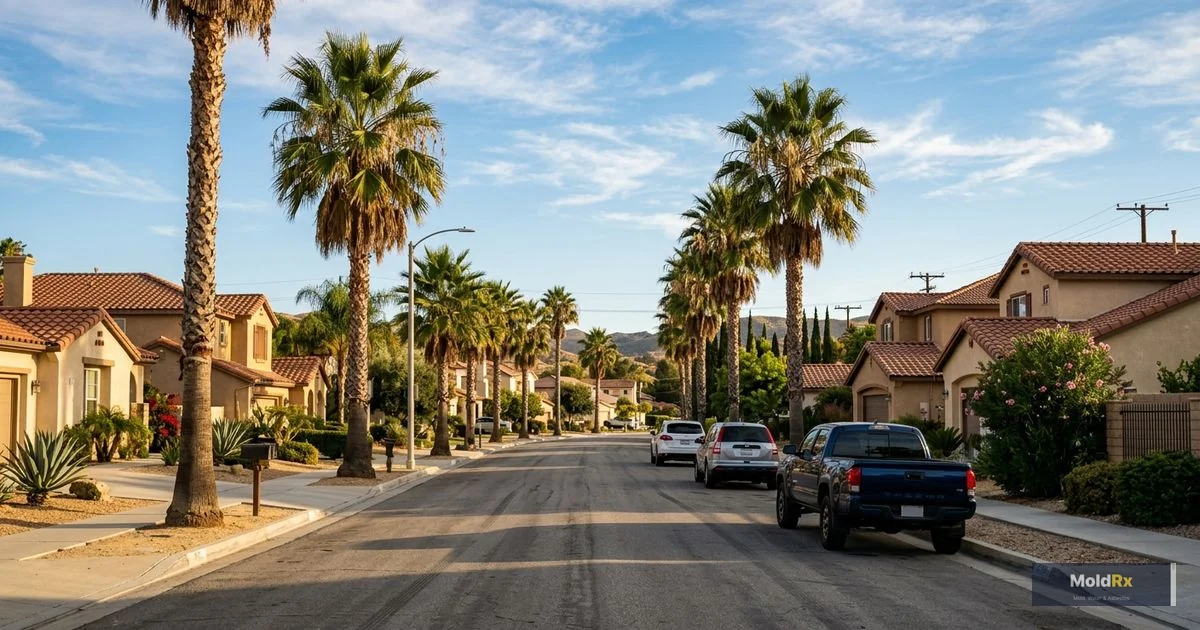
Home remediation in Calimesa covers five core services: mold removal, mold testing, water damage restoration, asbestos testing, and asbestos removal. MoldRx provides all five through a single, family-owned team serving Calimesa and the surrounding San Gorgonio Pass communities — licensed, insured, and backed by over 20 years of combined field experience.
If you're dealing with mold behind a bathroom wall, water pooling in your home after a seasonal storm, or a renovation project that uncovered something unexpected in your 1970s-era flooring — you shouldn't have to call four different companies, repeat your story to each one, and hope their work doesn't conflict. MoldRx coordinates everything under one roof. When you call (888) 609-8907, you talk to a real person who listens to your situation and sends a vetted, certified professional to handle it. No call center. No scripted upsell. Just honest guidance and qualified experts who know your area.
That matters more in Calimesa than you might think — and the reasons have everything to do with what your home is made of and what it's been exposed to.
Why Calimesa Properties Face Specific Remediation Challenges
Three factors converge to make Calimesa homes more vulnerable to mold, water damage, and material hazards than most homeowners realize: a semi-arid Mediterranean climate that swings between bone-dry summer heat and concentrated winter rainfall, a housing stock dominated by 1970s and 1980s construction with aging plumbing and HVAC systems, and a foothill geography that channels storm runoff in ways flat-lot communities never deal with.
Each of these factors creates risk on its own. Together, they create conditions where a single failure — one slow leak, one cracked slab, one overwhelmed gutter — can cascade into a remediation project within days.
Climate and Moisture
Calimesa sits in the foothills of the San Bernardino Mountains at roughly 2,500 feet of elevation, positioned at the western entrance to the San Gorgonio Pass. The semi-arid Mediterranean climate delivers hot, dry summers and mild, wet winters. Temperatures climb into the mid-80s to low 100s in summer and settle into the mid-40s to mid-60s in winter. The city receives around 12 inches of rainfall annually, with most of it arriving during the November through March rainy season.
Twelve inches may sound modest, but the rain arrives in concentrated bursts. Winter storms moving through the San Gorgonio Pass can deliver heavy rainfall in short windows — overwhelming aging gutters, saturating soil around foundations, and exposing every weak point in your home's envelope simultaneously. Flash flood advisories are not unusual for this stretch of western Riverside County.
The critical dynamic in Calimesa is the moisture swing. Summer heat bakes everything dry, causing soils to contract and pull away from foundations. When winter rains arrive, that dry, cracked soil channels water directly toward slabs and crawl spaces instead of absorbing it gradually. The cycle of expansion and contraction also stresses plumbing under and around the foundation — a major contributor to the slab leaks that Calimesa homeowners deal with regularly.
Summer humidity presents its own challenge. While outdoor conditions are dry, evaporative coolers — common in Calimesa as an alternative to traditional air conditioning — push moisture-laden air through homes. Combined with older HVAC systems that may not ventilate adequately, interior humidity can climb high enough to support mold growth on cold surfaces, behind cabinetry, and inside wall cavities where air circulation is poor. A home that feels dry outside can be harboring active moisture problems inside.
The San Gorgonio Pass wind corridor adds another factor. Strong, dry winds pull moisture from exterior surfaces rapidly, but when conditions shift and humid air returns, the rapid temperature change causes condensation on cooler interior surfaces — attic sheathing, garage walls, uninsulated pipes, and poorly ventilated bathrooms. If those surfaces stay damp even briefly, you've created a new moisture event without a single drop of rain.
Housing Stock and Age
Calimesa was incorporated in 1990, but the bulk of its residential construction dates to the 1970s and 1980s. With a current population of approximately 8,800 residents, the city's neighborhoods — Oak Valley, Mesa Verde, and Calimesa Country Club among them — represent a housing stock that is now 40 to 55 years old in many cases.
That construction timeline means specific things for your home's remediation risk:
- Plumbing is now 40 to 55 years old in many homes. Copper supply lines develop pinhole leaks over time. Galvanized steel pipes — common in 1970s construction — corrode from the inside out, narrowing flow and eventually failing. Water heaters past their 10-to-15-year service life are overdue for replacement, and when they fail, they can release 40 to 80 gallons onto your floor in minutes. Slab leaks are one of the most common service calls in Calimesa, driven by both aging pipes and the soil expansion-contraction cycle beneath foundations.
- Roofing on homes from this era — whether concrete tile, composition shingle, or built-up roofing — is approaching or well past its expected service life. The roofing material itself may still appear intact from the ground, but the underlayment beneath it degrades with decades of heat cycling. Cracked or shifted tiles combined with worn underlayment let water intrude during storms, often into attic spaces where damage goes unnoticed until staining appears on a ceiling below.
- Stucco and siding from the 1970s and 1980s develops cracks from settling, seismic activity, and decades of thermal expansion. Once cracked, water enters behind the surface and gets trapped. You can have an active mold colony growing behind your stucco for months with no visible sign on the interior walls.
- Construction-era materials present a more specific risk. Homes built in the 1970s and early 1980s in Calimesa sit squarely within the peak era of residential asbestos use. Asbestos-containing materials were commonly used in 9"x9" vinyl floor tiles and their adhesive mastic, popcorn or textured ceiling coatings, pipe insulation and duct wrap, furnace components and heat shields, and certain joint compounds on walls and ceilings. A significant number of Calimesa homes still contain these materials in original condition.
Local Terrain and Conditions
Calimesa's foothill geography creates drainage and moisture dynamics that flat desert communities don't contend with. The city sits at the transition between the San Bernardino Mountains to the north and the lower-elevation Inland Empire to the south and west. Properties on sloped lots — particularly in Oak Valley and the hillside areas near the San Timoteo Canyon — can experience grading-related water intrusion at foundations during heavy rain. Water follows gravity, and if the grade slopes toward your foundation instead of away from it, every storm pushes moisture against your slab.
The city is bordered by Yucaipa to the north, Beaumont to the east, and Moreno Valley to the southwest. The surrounding open land and canyon terrain — including San Timoteo Canyon — introduces brush fire risk and the post-fire erosion cycles that follow. After a fire clears vegetation from hillsides, the next rainy season sends sediment-laden runoff toward developed areas, overwhelming drainage systems and introducing contaminated water to properties that may have been untouched by the fire itself.
North-facing walls and shaded exterior surfaces in Calimesa retain moisture longer than south-facing exposures, creating hospitable conditions for exterior mold growth even during dry months. Properties adjacent to irrigation-fed landscapes, golf course edges near Calimesa Country Club, and areas with mature vegetation can maintain localized humidity that contradicts the surrounding dry climate.
Knowing what your home is up against is the first step. The next is understanding exactly what can be done about it — and when to call for help.
Services We Provide in Calimesa
MoldRx provides six remediation services to Calimesa homeowners and commercial property owners, all coordinated through a single point of contact. You call once. We assess, coordinate, and execute — whether your project needs one service or three working together.
This matters because mold, water damage, and asbestos problems rarely exist in isolation. Water damage leads to mold. Renovation to fix mold uncovers asbestos. A single provider who understands how these problems interconnect prevents the gaps, miscommunication, and duplicated work that happen when you're juggling multiple contractors.
Mold Removal in Calimesa
Calimesa's combination of older construction, seasonal moisture swings, and interior humidity from evaporative cooling makes mold one of the most common remediation needs in the area. Whether it's visible growth on bathroom surfaces or a hidden colony behind drywall fed by a slow slab leak, our IICRC S520-certified remediation professionals follow the same protocol: contain the affected area to prevent cross-contamination, remove contaminated materials using HEPA filtration, apply antimicrobial treatments to prevent regrowth, and conduct clearance testing to verify the space is clean.
The part that separates effective mold removal from a temporary fix is moisture source correction. We don't just remove what's visible — we identify why the mold grew in the first place and address that underlying cause. A remediation without source correction is a remediation you'll pay for twice.
We scope every job honestly. If your problem is smaller than you expected, we'll tell you. If surface cleaning is sufficient and full remediation isn't necessary, we'll tell you that too.
Water Damage Restoration in Calimesa
Water damage is the most time-sensitive remediation issue you can face. Every hour that standing water or saturated materials remain unaddressed, the damage expands — drywall wicks moisture upward, subfloor swells, and framing begins to absorb water that will take days of commercial drying to remove. After 24 to 48 hours of sustained moisture, you're no longer dealing with just water damage. You're dealing with mold.
Our water damage restoration team handles emergency extraction, structural drying with commercial-grade dehumidifiers and air movers, ongoing moisture monitoring, and full restoration of affected materials. We classify the water source — Category 1 (clean) through Category 3 (sewage or contaminated) — and the damage class to determine the right equipment, timeline, and safety protocols for your situation.
We document everything for your insurance claim: photos at every stage, moisture readings with mapped locations, daily drying logs, and a complete scope of work. When your adjuster asks for documentation, you'll have it.
Mold Testing in Calimesa
Not every mold concern requires remediation — but you can't know that without accurate information. If you notice musty odors without an obvious source, experience allergy-like symptoms that improve when you leave home, have had past water damage that may not have been fully dried, or are buying or selling a property, professional mold testing gives you clarity instead of guesswork.
Our testing specialists collect air and surface samples and send them to accredited laboratories for analysis. When results come back, we walk you through what they mean in plain language — not lab jargon — and recommend next steps. Sometimes those next steps are "nothing." If testing shows your levels are normal and no remediation is needed, we'll tell you exactly that. We don't test to generate remediation work. We test to give you accurate information so you can make good decisions.
Asbestos Testing in Calimesa
If you're planning a renovation in Calimesa — especially on a home built before 1990 — testing for asbestos-containing materials before you disturb anything is both the safe approach and the legally compliant one. You cannot visually identify asbestos. It requires laboratory analysis.
Our specialists collect bulk samples following EPA protocols and submit them to NVLAP-accredited laboratories for Polarized Light Microscopy (PLM) analysis. Common materials worth testing in Calimesa homes from the 1970s and 1980s include 9"x9" vinyl floor tiles and their adhesive mastic, popcorn or textured ceiling coatings, pipe insulation and duct wrap in utility areas, furnace components and heat shields, and joint compound on walls and ceilings.
Testing is straightforward, relatively inexpensive, and gives you a definitive answer before you start tearing anything apart. Discovering asbestos mid-renovation — after you've already disturbed it — is significantly more dangerous, more expensive, and more disruptive than discovering it beforehand.
Asbestos Removal in Calimesa
If testing confirms the presence of asbestos-containing materials, removal must be performed by licensed, certified abatement professionals. This is not optional — California law requires it, and the health risks of improper asbestos handling are serious, cumulative, and irreversible. Asbestos fibers, once airborne, can cause mesothelioma, asbestosis, and lung cancer with latency periods of 10 to 50 years. There is no safe DIY approach.
Our licensed abatement team handles removal in full compliance with EPA NESHAP regulations, OSHA 1926.1101 standards, and all California-specific notification and disposal requirements. The process includes proper advance notification to regulatory agencies, full negative-pressure containment of the work area, wet removal methods to minimize fiber release, double-bagged disposal in 6-mil polyethylene sheeting, manifested transport to approved landfill facilities, and complete documentation of every step.
Emergency Response in Calimesa
A burst supply line at 2 AM, sewage backup in your bathroom, or storm damage breaching your roof during a winter rain — some situations can't wait for a scheduled appointment. When you're standing in standing water, you need someone on the phone now, not a form submission that gets answered in the morning.
Call (888) 609-8907 directly. You'll reach a real person who will assess your situation over the phone, give you immediate steps to minimize damage while help is on the way, and coordinate a vetted emergency professional to your Calimesa property as fast as current availability allows. We'll be honest about timing — if we can be there in an hour, we'll tell you. If it's going to be three hours, we'll tell you that too, and we'll make sure you know what to do in the meantime.
Calimesa Neighborhoods and Areas We Serve
MoldRx serves every neighborhood in Calimesa — ZIP codes 92320 and 92399 — including residential, commercial, and multi-family properties of any size.
- Oak Valley — Master-planned community with homes ranging from the 1990s through recent builds; while newer than much of Calimesa, even 1990s-era homes now have aging plumbing and water heaters approaching the end of their service life
- Mesa Verde — Established neighborhood with homes from the 1970s and 1980s; aging plumbing, original HVAC systems, and potential asbestos-containing materials make this one of the higher-risk areas for remediation needs
- Calimesa Country Club — Properties adjacent to irrigated golf course landscaping face localized humidity that can keep exterior surfaces and foundations damper than surrounding areas, promoting moisture intrusion and exterior mold growth
- Singleton Road / East Calimesa — Older rural and semi-rural properties on larger lots; detached garages, accessory structures, and well water systems can develop independent moisture issues separate from the main home
- San Timoteo Canyon Area — Properties near the canyon face post-fire erosion risk, ambient moisture from seasonal creek flow, and grading challenges that can direct water toward foundations during winter storms
- County Line Road Area — Properties along the Calimesa-Yucaipa border; a mix of older ranch-style homes and newer development with varied remediation risk depending on construction era
Nearby Communities We Also Serve
MoldRx provides the same comprehensive remediation services throughout western Riverside County and the surrounding region:
- Beaumont — Adjacent city to the east with similar foothill climate and a growing housing stock that includes both newer development and older homes with construction-era risks
- Banning — Deeper into the San Gorgonio Pass with higher wind exposure and seasonal moisture challenges from mountain-adjacent terrain
- Moreno Valley — Large city to the southwest where rapid development over multiple decades created a wide spectrum of housing ages and remediation risk profiles
- Hemet — San Jacinto Valley city with older housing stock, seasonal flooding risk, and high summer temperatures that stress aging plumbing and HVAC systems
- San Jacinto — Valley floor community where groundwater levels and seasonal flooding contribute to persistent moisture and mold challenges
- Riverside — County seat with the region's most diverse housing inventory, from pre-war historic homes to modern construction, each era with distinct risk factors
- Perris — Growing Inland Empire city with a mix of older rural properties and newer tract development
- Menifee — Rapidly expanding community with newer construction but increasing water demand and infrastructure stress that affects plumbing reliability
- Corona — Western Riverside County city where coastal-influenced humidity and a varied housing stock create remediation needs year-round
- Temecula — Southern Riverside County city with a mix of newer master-planned communities and older properties in and around Old Town
View all Riverside County service areas → · View all service areas →
Why Calimesa Homeowners Choose MoldRx
MoldRx was founded by Tyler Perez and Adrian with a specific frustration: too many homeowners were getting overcharged, underserved, or flat-out misled by remediation companies more interested in the sale than the solution. Every project we take on reflects directly on our names and our reputation in this community — and that changes how we operate.
Family-Owned, Personally Accountable
We're not a franchise. We're not a national chain with a local number. We're not a lead-generation service that sells your information to the lowest bidder. When you call MoldRx, you're calling a family-owned company where the people answering the phone are the same people accountable for the result. That means no scripted responses, no call-center runaround, and no gap between what you're promised and what you receive.
Licensed, Insured, and Certified
- IICRC S520 certified for mold remediation
- Licensed and insured in California
- EPA protocol compliant for all asbestos work
- HEPA filtration on every mold remediation project
- 20+ years of combined field experience across all service areas
Honest Assessments
This is the part most remediation companies won't tell you: sometimes the problem is smaller than you think. Sometimes testing isn't necessary. Sometimes you can handle it yourself with the right guidance. We'll tell you all of that — even when it means we don't get the job.
We'd rather earn your trust on a small project and be the first call you make when a real emergency hits than inflate a scope of work to maximize a single invoice. That approach has built our reputation in western Riverside County, and it's the only way we know how to operate.
Calimesa Home Remediation FAQs
How fast can MoldRx respond to a remediation emergency in Calimesa?
Response times depend on current crew availability. For urgent water damage in Calimesa — where every hour of delay increases the scope of damage — call us directly at (888) 609-8907. We'll give you an honest answer on timing, walk you through immediate steps to minimize damage while you wait, and get a vetted professional to your property as fast as we can.
Why are Calimesa homes more prone to mold than other parts of Riverside County?
Calimesa's combination of factors is unusual for the region. The foothill location delivers concentrated winter rainfall that overwhelms aging infrastructure, while summer use of evaporative coolers pushes moisture-laden air through homes with older HVAC systems that may not ventilate adequately. Most homes were built in the 1970s and 1980s, meaning plumbing, water heaters, and roofing are all well past their expected service life. That combination of seasonal moisture swings and aging systems creates conditions where a single small leak can produce active mold growth within 24 to 48 hours.
Should I test for asbestos before renovating my Calimesa home?
If your Calimesa home was built before 1990, testing before any renovation that disturbs original materials is both the safe approach and the legally required one. Homes from the 1970s and 1980s in neighborhoods like Mesa Verde and the Singleton Road area are especially likely to contain asbestos in floor tile mastic, popcorn ceiling texture, pipe insulation, furnace components, or joint compound. You cannot identify asbestos by sight — laboratory analysis of a bulk sample is the only way to confirm. Discovering it mid-renovation, after you've already disturbed it, is significantly more dangerous and expensive. Asbestos removal must always be handled by a licensed professional.
What are the biggest water damage risks for Calimesa homes?
Slab leaks are among the most common causes of water damage in Calimesa. The soil expansion-contraction cycle — baked dry in summer, then saturated by winter rains — stresses plumbing under and around foundations. Properties on sloped lots in Oak Valley and near San Timoteo Canyon face additional grading-related water intrusion during heavy storms. Aging water heaters, original plumbing that is now 40 to 55 years old, and storm runoff from foothill terrain all compound the risk. Flash flooding during intense winter storms can overwhelm drainage systems throughout the city.
Can MoldRx handle both mold and water damage at the same Calimesa property?
Yes — and coordinating both under one team is critical because mold and water damage are connected problems. Water creates the conditions for mold. Removing mold without fixing the water source guarantees recurrence. We extract standing water, dry the structure, identify and correct the moisture source, remove contaminated materials, treat surfaces, and verify results through clearance testing — one coordinated process rather than two separate contractors working on overlapping timelines.
Does homeowner's insurance cover home remediation in Calimesa?
It depends on the cause. Water damage and resulting mold from sudden, accidental events — a burst pipe, an appliance failure, a storm breach through your roof — are typically covered under standard homeowner's policies. Damage from long-term maintenance neglect — a slow leak you didn't address, poor ventilation you never corrected — usually is not. Asbestos abatement is generally not covered by standard policies. We document every project thoroughly — moisture readings, photos, drying logs, clearance reports — to support legitimate insurance claims.
I'm buying a home in Calimesa — what remediation issues should I watch for?
Given Calimesa's housing stock age, pay particular attention to signs of past or present water intrusion: staining on ceilings or walls (especially near bathrooms and kitchens), musty odors in closets or garages, bubbling or peeling paint, and any evidence of previous repairs to plumbing or roofing. With most homes dating to the 1970s and 1980s, asbestos testing is especially important before any planned renovation. Request mold and asbestos testing during your inspection period — California requires sellers to disclose known defects, but undisclosed or undetected issues are your liability after closing. Independent testing protects you before you commit.
How long does a typical home remediation project take in Calimesa?
It depends on the service. Mold testing results typically come back within a few business days. Mold remediation for a contained area takes 2 to 5 days; larger projects involving multiple rooms or structural repairs can take a week or more. Water damage restoration requires 3 to 5 days of structural drying alone, with full restoration taking one to three weeks. Asbestos testing turnaround is similar to mold testing. Asbestos abatement timelines vary widely based on the material type and scope. We provide a realistic timeline during your assessment — not an optimistic guess.
Does MoldRx serve commercial properties and HOAs in Calimesa?
Yes. We handle residential, commercial, and multi-family properties throughout Calimesa — from single-family homes in Oak Valley to commercial spaces along County Line Road and multi-unit properties across the city. Commercial and HOA projects often require faster turnarounds, after-hours scheduling, tenant or resident notification, and documentation built for liability and compliance purposes. We adjust our process to fit the property type.
What should Calimesa homeowners do immediately after discovering water damage?
Stop the water source if it's safe to do so — shut off the main valve or turn off the failed appliance. Turn off electricity to affected areas using the breaker panel if water is near outlets. Move furniture and valuables away from standing water. Open windows for ventilation if weather permits. Do not use household vacuums on standing water — they aren't designed for it. Document everything with photos and video for your insurance claim. Then call (888) 609-8907 — the sooner professional extraction and drying begin, the less total damage you'll face and the lower the chance of secondary mold growth.
Get Started
Call (888) 609-8907 to talk to someone now, or request a free estimate online. We serve all of Calimesa and western Riverside County — residential, commercial, and multi-family.
About MoldRx → · Our Services → · All Service Areas → · Contact Us →