Emergency Water Damage Restoration in Chino, CA — MoldRx
24/7 Emergency Water Damage Restoration Serving Chino and West San Bernardino County — Call Now, We Respond Immediately
Right now, water is destroying your Chino home. Not tomorrow. Not next week. Right now. Every minute that water sits in your walls, under your floors, and inside your foundation, the damage compounds. Drywall wicks moisture upward at a rate of one inch per hour. Subfloor materials begin to swell and delaminate. Bacterial colonies establish themselves within hours. And mold — the silent catastrophe that turns a water damage incident into a five-figure remediation nightmare — begins colonizing within 24 to 48 hours in Chino's climate conditions.
This is not a situation where you can wait until morning. This is not something you can handle with fans from the garage and towels from the closet. This is a structural emergency that requires immediate professional intervention — and the difference between calling now and calling tomorrow could be the difference between a focused extraction job and a full-scale tearout of your walls, floors, and cabinetry.
MoldRx coordinates vetted, IICRC-certified water damage restoration professionals who respond to Chino emergencies around the clock. Our specialists understand Chino's housing stock, its infrastructure vulnerabilities, and exactly how fast water damage escalates in this part of San Bernardino County.
Why Chino Homes Are Dangerously Vulnerable to Water Damage
Chino is not a city where water damage is a rare occurrence. It is a city where the specific combination of aging infrastructure, legacy construction methods, climate patterns, and soil conditions creates a near-perfect environment for catastrophic water events — and for those events to accelerate into secondary damage faster than most homeowners realize.
The Aging Infrastructure Crisis
Chino incorporated in 1910, but the city's residential story is really one of three distinct building eras — and each one carries its own water damage risks.
The original development wave (1960s through 1980s) transformed Chino from a dairy farming community — once the largest milk-producing community in California — into a suburban bedroom community for the Inland Empire. Homes built during this period, which make up a substantial portion of neighborhoods like College Park, central Chino, and areas north of Riverside Drive, were constructed with materials and methods that are now at the end of their functional lifespan. Galvanized steel pipes, the standard for residential plumbing during that era, corrode from the inside out over 40 to 60 years. The corrosion builds up gradually, restricting water flow and weakening pipe walls until a failure occurs — often catastrophically, often without warning, and often in the worst possible location: inside walls, beneath slab foundations, or in crawl spaces that haven't been inspected in decades.
These same homes frequently have original water heaters that have been replaced once or twice but sit in garages or utility closets where slow leaks go undetected. A water heater that fails at 2 AM in a Chino home built in 1972 can dump 40 to 80 gallons of water across a garage floor and into adjacent living spaces before anyone wakes up. By morning, the water has migrated under walls, saturated carpet padding, and begun soaking into the concrete slab beneath.
The 2000s expansion brought newer construction to areas like The Preserve and southern Chino, built on land that was formerly dairy farmland — over 5,400 acres annexed in 2003. These homes are newer, but they carry their own risks. The soil beneath former agricultural land in the Chino Valley has been compacted and reworked repeatedly over decades of farming. This soil composition means inconsistent settling, which puts stress on foundation slabs and the water supply and drain lines running beneath them. Slab leaks in homes built on former dairy land in Chino are not uncommon, and they are among the most insidious forms of water damage because they can persist for weeks or months before visible signs appear — unexplained increases in water bills, warm spots on tile floors, the faint smell of mildew with no obvious source.
Homes built during the transitional 1990s often contain polybutylene piping, a plastic resin material used in an estimated 6 to 10 million American homes between 1978 and 1995. Polybutylene degrades when exposed to oxidants in public water supplies — particularly chlorine — causing the material to become brittle and flake from the inside. Failures are sudden and often severe, producing the kind of water volume that overwhelms a home's capacity to contain it.
Climate: The Drought-to-Deluge Cycle
Chino's semi-arid Mediterranean climate is deceptive. With annual rainfall averaging just 15 to 16 inches and summers that routinely exceed 95 degrees, water damage seems unlikely. But the climate pattern that creates Chino's water damage emergencies is precisely this contrast between extreme dryness and concentrated rainfall.
During the long dry months from April through October, soil contracts and pulls away from foundations, creating gaps. Rubber seals and gaskets in plumbing fixtures dry out and crack. Roof materials expand and contract through daily temperature swings of 30 or more degrees. Then, between November and March, Chino receives nearly all of its annual precipitation — sometimes in atmospheric river events that can drop several inches in 24 to 48 hours.
The December 2025 atmospheric river that triggered a state of emergency declaration across San Bernardino County was a stark reminder. That storm system dumped four to eight inches of rain across the Inland Empire in a matter of days, overwhelming drainage infrastructure and driving water into homes across the region. Chino homes that had been baking in dry heat for eight months suddenly faced roof leaks through cracked flashing, foundation intrusion through soil gaps, and storm drain backups that pushed water into garages and ground-level living spaces.
This is not a once-in-a-generation event. This is Chino's climate pattern. And it means that water damage here is not a question of if — it is a question of when.
The Mold Acceleration Factor
Here is where the urgency becomes critical. Mold spores are everywhere — in your air, on your surfaces, dormant and waiting. They require only two conditions to activate: moisture and time. In Chino's environment, where indoor humidity can spike dramatically during winter storm events while homes are sealed up against the rain, the conditions for mold colonization are optimal.
Within 24 hours of water exposure, mold spores begin germinating on wet surfaces. Within 48 to 72 hours, visible colonies can establish themselves behind drywall, under carpet padding, and inside wall cavities where air circulation is minimal. Within a week, a mold colony can spread through an entire wall system, releasing mycotoxins into your home's air supply and creating health hazards — particularly for children, elderly residents, and anyone with respiratory conditions.
What starts as a $3,000 to $5,000 water extraction and drying job becomes a $15,000 to $30,000 mold remediation project once colonies establish themselves in wall cavities and subfloor systems. The financial escalation is dramatic, but the health implications are worse.
This is why you cannot wait. This is why every hour matters. This is why you need to call now.
Emergency Water Damage Restoration Process for Chino Homes
When you call MoldRx for water damage in your Chino home, our vetted professionals deploy a systematic, aggressive response protocol designed to stop the damage from spreading, extract every drop of water, and dry your structure to verified safe levels before mold has any opportunity to establish itself.
Phase 1: Immediate Emergency Response and Damage Assessment (Hours 0-4)
The moment you call, the clock resets in your favor. Our Chino-area restoration specialists arrive equipped with commercial-grade extraction equipment, moisture detection technology, and the training to make rapid decisions that protect your property.
Source identification and containment comes first. Whether it is a burst supply line behind a wall, a failed water heater, a sewage backup through floor drains, or storm intrusion through the roof, the water source must be identified and stopped before extraction can be effective. Our specialists know where to look in Chino homes — the aging galvanized connections common in 1960s-1980s construction, the polybutylene joints in 1990s homes, the slab penetrations in newer Preserve-area development.
Water categorization determines the entire restoration protocol. Category 1 (clean water from supply lines) requires different handling than Category 2 (gray water from appliances or overflows) or Category 3 (black water from sewage, floodwater, or long-standing contamination). In Chino, storm-related water intrusion is frequently Category 3 due to contact with soil, agricultural residue, and storm drain contaminants — and that categorization means more aggressive extraction, disposal, and sanitization protocols.
Extraction begins immediately using truck-mounted and portable commercial pumps capable of removing thousands of gallons per hour. Weighted extraction tools pull water from carpet and padding. Submersible pumps clear standing water from flooded areas. In Chino homes with slab foundations — which is the majority — specialized extraction techniques address water that has migrated beneath flooring materials and pooled on or within the concrete surface.
Phase 2: Moisture Detection and Damage Mapping (Hours 4-12)
Water travels. A burst pipe in a hallway bathroom does not create damage only in that bathroom. Water follows gravity, capillary action, and the path of least resistance through wall cavities, along floor joists, under baseboards, and into adjacent rooms. In Chino's slab-on-grade construction, water can travel beneath tile or laminate flooring and emerge in rooms 20 or 30 feet from the original source.
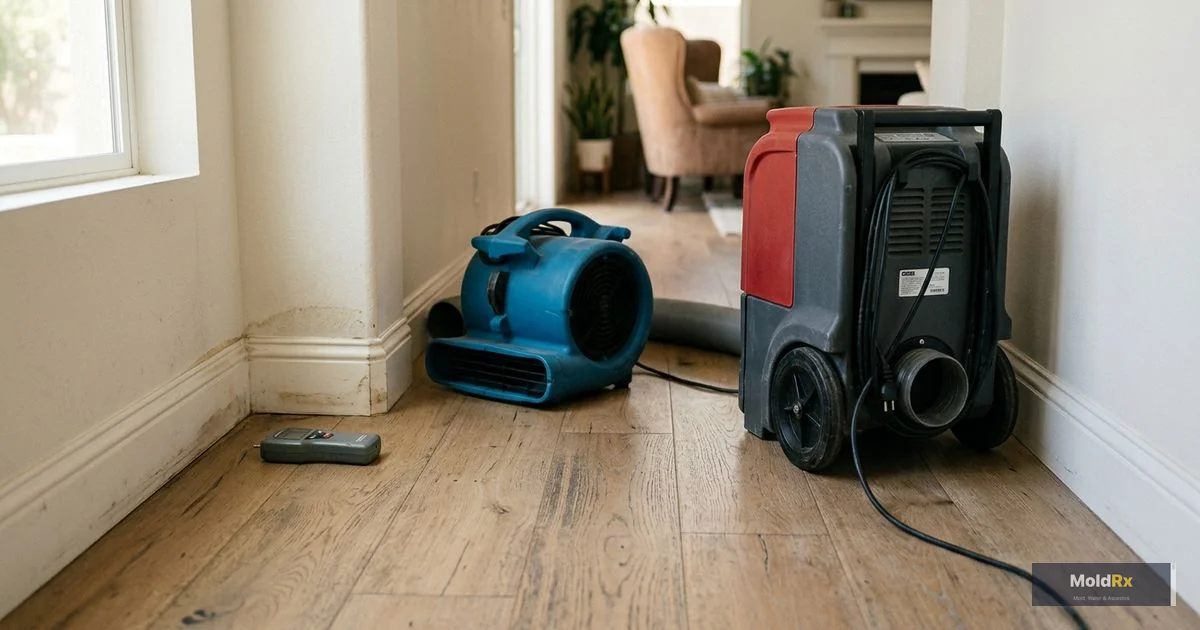
Our specialists use thermal imaging cameras to identify moisture patterns invisible to the naked eye — temperature differentials in walls and floors that reveal exactly where water has traveled. Pin-type and pinless moisture meters provide quantitative readings of moisture content in drywall, wood framing, concrete, and other structural materials. This technology creates a complete moisture map of your property, ensuring that no wet area goes undetected and untreated.
This mapping is critical. Missed moisture behind a wall or under a floor becomes a mold colony in less than a week. In Chino's older homes, where plaster walls and original hardwood floors can trap moisture in ways that modern drywall construction does not, the detection phase often reveals damage that extends well beyond what the homeowner initially observed.
Phase 3: Industrial Drying and Dehumidification (Days 1-5)
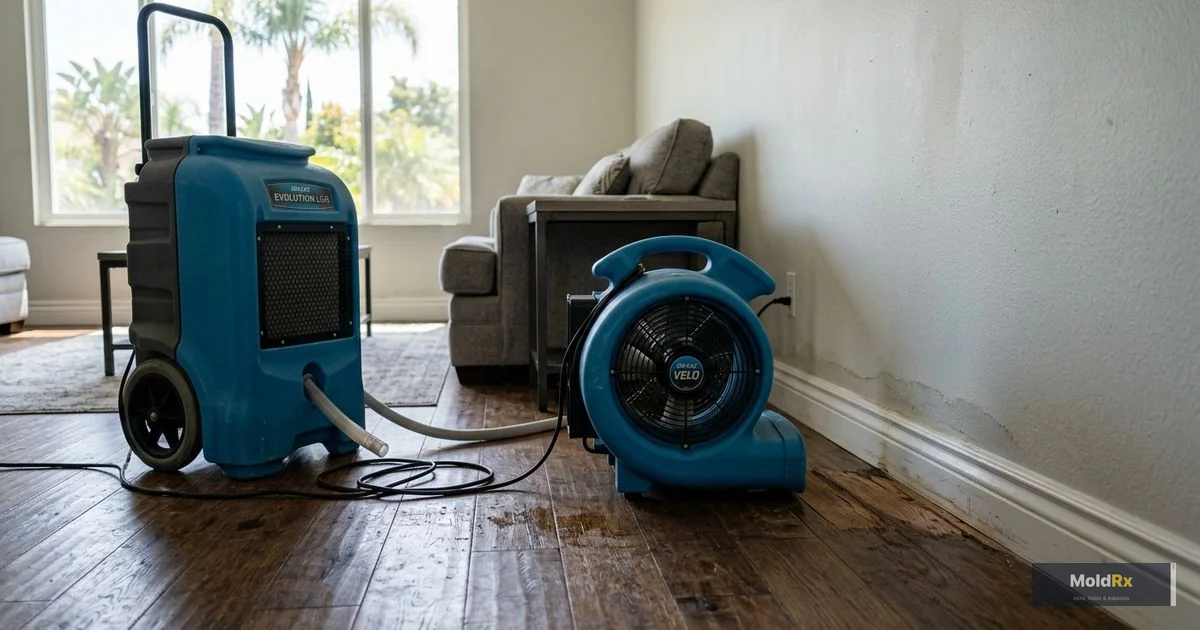
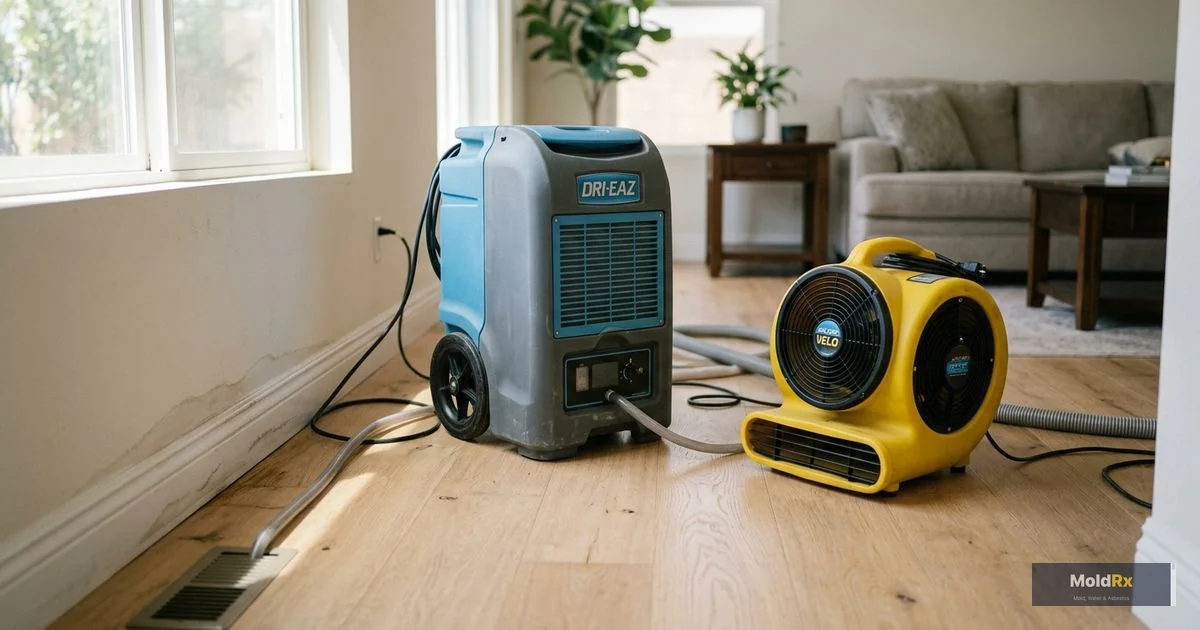
Extraction removes standing water, but moisture trapped inside building materials requires sustained, controlled drying. Our vetted professionals deploy industrial air movers — high-velocity fans that create targeted airflow across wet surfaces — in combination with commercial dehumidifiers that pull moisture from the air and building materials simultaneously.
In Chino homes, this phase requires particular attention to several construction-specific factors:
- Slab foundations retain moisture and release it slowly, extending drying times for rooms with direct slab contact
- Stucco exterior walls common in Chino construction can trap moisture between the stucco layer and interior drywall, creating hidden drying challenges
- Garage-to-living-space transitions in homes where water heaters are in garages often require drying on both sides of the common wall
- Older plaster-and-lath walls in 1960s-1970s homes dry differently than modern drywall and require adjusted airflow patterns
Moisture readings are taken daily — sometimes twice daily — to monitor drying progress and adjust equipment placement. The structure is not cleared until readings confirm that all materials have reached safe moisture levels. There are no shortcuts in this phase. Premature clearance is how mold problems start, and our professionals will not sign off until the numbers confirm the job is complete.
Phase 4: Sanitization and Antimicrobial Treatment (Day 3-6)
Depending on the water category and the materials affected, sanitization may begin during the drying phase or after drying is complete. Category 2 and Category 3 water events require antimicrobial treatment of all affected surfaces. Porous materials that were exposed to contaminated water — carpet padding, insulation, particleboard — typically require removal and disposal rather than cleaning.
In Chino homes where agricultural land use preceded residential development, storm water intrusion can carry soil-borne contaminants that require additional sanitization protocols. Our professionals apply EPA-registered antimicrobial solutions to affected structural surfaces, monitor for any signs of microbial growth during the drying process, and provide clearance documentation verifying that treated areas meet safe habitability standards.
Phase 5: Restoration and Structural Repair (Days 5-14+)
Once the structure is verified dry and sanitized, restoration work begins. This may range from minor cosmetic repairs — repainting walls, replacing sections of baseboard — to major structural work including drywall replacement, flooring installation, cabinetry repair, and reconstruction of damaged framing.
Our restoration approach prioritizes returning your Chino home to its pre-damage condition while addressing any vulnerabilities exposed by the water event. If the damage revealed corroded galvanized pipes, a deteriorating water heater connection, or inadequate drainage around your foundation, our professionals will advise you on repairs that prevent future incidents.
What You Can Expect During the Restoration Process
Immediate response, not excuses. When you call MoldRx at 3 AM because your water heater just failed and your garage is flooding into your living room, you will reach a live coordinator who dispatches professionals to your Chino home immediately. Not tomorrow morning. Not "first thing Monday." Now.
Transparent, honest assessment. Our vetted professionals tell you exactly what they find — nothing more, nothing less. If the damage is confined and manageable, you will hear that. If the damage is severe and extensive, you will hear that too, with a clear explanation of what needs to happen and why. No upselling. No fear tactics. Just the truth about your property's condition.
Thorough insurance documentation. Water damage claims require detailed evidence — timestamped photos, moisture readings at every stage, equipment logs, material inventories, and professional reports. Our specialists document everything from the moment they arrive, creating a comprehensive record that supports your insurance claim and protects you from underpayment or denial.
Mold prevention as a core priority. Every decision during the restoration process considers mold prevention. Equipment placement, drying duration, material removal decisions, antimicrobial application — all of it is guided by the understanding that the restoration fails if mold establishes itself afterward. In Chino's climate, with its humidity spikes and temperature patterns, this vigilance is not optional.
Verified completion, not guesswork. The job ends when moisture meters confirm safe levels in every affected area — not when things "look dry" or "feel dry." Verified completion is the difference between a restoration that holds and a restoration that leads to mold problems three months later.
Chino Neighborhoods and Areas We Serve
MoldRx coordinates emergency water damage restoration throughout Chino and every surrounding community. Our vetted professionals respond to emergencies across all Chino neighborhoods including:
- College Park — Homes from the 1970s-1980s with aging plumbing infrastructure and galvanized pipe systems nearing end-of-life
- The Preserve — Newer construction on former dairy farmland where soil conditions contribute to foundation settling and slab leak risk
- Los Serranos — Mixed-era homes where mature tree root systems can invade sewer laterals and cause backup-related water damage
- Chino Hills East — Established neighborhoods with 30-to-50-year-old homes experiencing the full range of aging infrastructure failures
- Rolling Ridge and Rancho del Chino — Residential areas where concentrated storm runoff creates flooding risk during atmospheric river events
- Central Chino and downtown-adjacent neighborhoods — Some of the oldest housing stock in the city, with original-era plumbing and drainage systems
We respond to emergencies across ZIP codes 91708, 91710, and surrounding areas. Our coverage extends to neighboring cities including Ontario to the west, Chino Hills to the south, Pomona to the northwest, Montclair to the north, and Eastvale to the southeast.
Whether you are in a single-family home, a multi-family property, a townhouse, or a commercial building, our vetted professionals are equipped and experienced to handle the emergency.
Related Services in Chino
Water damage rarely exists in isolation. MoldRx coordinates a full range of restoration and remediation services for Chino property owners:
- Mold Removal in Chino — Critical when water damage has persisted beyond 48 hours or when mold is already visible
- Asbestos Removal in Chino — Essential when water damage restoration in pre-1980 homes disturbs materials that may contain asbestos
-> Learn more about remediation services in Chino
Frequently Asked Questions
How quickly should I address water damage in my Chino home?
Immediately. Not tomorrow. Not this weekend. Now. Water damage escalation is measured in hours, not days. Within the first 24 hours, moisture begins migrating through wall cavities and into structural materials. Between 24 and 48 hours, mold spores begin germinating on wet surfaces. By 72 hours, visible mold colonies can establish themselves in hidden areas behind drywall and under flooring. Every hour you wait increases the scope of damage, the cost of restoration, and the risk of secondary mold contamination. Our Chino emergency response team is available 24/7, 365 days a year.
How much does water damage restoration cost in Chino?
Every water damage situation is different, and costs depend on the water category (clean, gray, or black), the affected square footage, the materials involved, the depth of saturation, and whether secondary damage like mold has begun. Minor incidents involving a small area of clean water may require minimal intervention, while major events involving contaminated water across multiple rooms require extensive extraction, drying, sanitization, and restoration. We provide detailed, transparent estimates after assessing your Chino property — contact us immediately so we can evaluate your specific situation before the damage compounds further.
Will my homeowner's insurance cover water damage restoration?
Most homeowner's policies cover sudden and accidental water damage — burst pipes, appliance failures, water heater ruptures, and similar unexpected events. Gradual damage from neglected maintenance, slow leaks that developed over time, and flood damage from external water sources typically require separate coverage or may not be covered at all. Our vetted professionals document every aspect of the restoration with timestamped photos, moisture readings, and detailed reports specifically designed to support your insurance claim and maximize your coverage.
How long does the water damage restoration process take in Chino?
Timeline depends entirely on the severity and scope of the damage. A contained incident — a single-room clean water event caught within hours — may be fully restored in 3 to 5 days. A major water event involving multiple rooms, contaminated water, or structural saturation can require 10 to 14 days for complete drying and restoration. Storm-related events that involve both water intrusion and exterior damage may extend beyond two weeks. Our specialists give you a realistic, honest timeline after the initial assessment — no false promises, no understated estimates.
Can water-damaged materials in my Chino home be saved?
Speed determines what survives. Hardwood floors, drywall, structural framing, and carpet can often be saved if professional drying begins within 24 to 48 hours of the water event. Once materials have remained saturated beyond that window, or once mold begins colonizing porous surfaces, the calculation changes. Carpet padding, particleboard, and insulation exposed to Category 2 or Category 3 water almost always require removal regardless of timing. Our professionals make honest, material-by-material assessments — saving everything that can be saved while removing everything that poses a risk.
What should I do right now if my Chino home has water damage?
Call MoldRx immediately. While you wait for our professionals to arrive: turn off the water supply if the source is a plumbing failure, move furniture and valuables away from standing water if you can do so safely, do not enter rooms with standing water if there is any risk of electrical contact, and do not attempt to use household fans or shop vacuums as a substitute for professional extraction equipment. Document what you can see with photos for insurance purposes. And above all — do not wait. The damage is getting worse every minute.
Your Chino Home Cannot Wait — Call MoldRx Now
If you are reading this page, there is a good chance water is actively damaging your Chino home right now. Maybe it is a pipe that burst an hour ago. Maybe it is a slow leak you just discovered behind a wall. Maybe your garage flooded during last night's rain and the water has already reached your living room. Whatever the source, whatever the scale — the single most important thing you can do right now is pick up the phone.
Every hour of delay increases the damage to your property, increases the cost of restoration, and increases the risk of mold contamination that turns a water emergency into a health hazard. MoldRx coordinates vetted water damage restoration professionals who know Chino's housing stock — the galvanized pipes in the 1970s homes, the polybutylene in the 1990s construction, the slab vulnerabilities in the newer developments. They respond immediately, they work around the clock, and they will not stop until your home is verified dry, clean, and safe.
No runaround. No guesswork. No waiting until morning. Contact MoldRx now and get emergency water damage restoration for your Chino home before the damage gets worse.