You’ve noticed something—maybe a musty smell, a suspicious stain, or unexplained respiratory symptoms in your family. Now you’re wondering whether you need professional mold testing or if you’re overthinking it.
The honest answer is: it depends on your situation. Mold testing isn’t always necessary, and in some cases it’s a waste of money. But in other situations, testing provides critical information you can’t get any other way. Here’s how to know which category you’re in.
When You Probably Don’t Need Testing
Let’s start with situations where mold testing may not be the best use of your money.
If you can already see visible mold growth, testing to confirm “yes, that’s mold” is often unnecessary. You already know there’s a problem. The more useful question is what to do about it—and that depends on the size and location of the growth, not a lab report confirming what your eyes already told you.
For small areas of visible mold—roughly 10 square feet or less on non-porous surfaces—the EPA guidance is that homeowners can often handle cleanup themselves with proper precautions. If the affected area is larger, involves porous materials like drywall, or keeps returning after cleaning, professional mold remediation makes sense regardless of test results.
If you’re just curious whether mold exists in your home, the answer is almost certainly yes. Mold spores are present in virtually every indoor environment—they float in through open doors and windows, ride in on clothing, and exist naturally in the air we breathe. The presence of some mold spores isn’t inherently dangerous; it’s the presence of elevated levels or active growth that creates problems.
Testing that simply confirms “mold spores exist” doesn’t tell you anything useful. Meaningful testing compares your indoor air to outdoor air, identifies whether certain mold types are elevated, and helps determine if there’s hidden growth.
When Testing Makes Sense
There are several scenarios where professional mold testing provides valuable information that's difficult or impossible to get otherwise.
You smell mold but can’t find it. Musty, earthy odors often indicate mold growth somewhere—but if you can’t locate the source, you don’t know what you’re dealing with. Air sampling can help determine whether elevated mold levels exist and sometimes point toward where hidden growth might be. This is particularly useful in homes with a persistent musty smell that doesn’t seem to have an obvious source.
Someone in your household has unexplained health symptoms. If family members are experiencing respiratory issues, allergic reactions, headaches, or other symptoms that seem worse at home, mold testing can help rule in or rule out your indoor environment as a contributing factor. This is especially important if symptoms improve when family members are away from the home and return when they come back.
You've had water damage and aren't sure if mold developed. Water damage that wasn't addressed quickly—or wasn't dried thoroughly—often leads to hidden mold growth. If you had a leak or flooding weeks or months ago and you're now wondering whether mold established itself, testing can assess whether elevated mold levels exist in the affected areas.
You’re buying or selling a home. Real estate transactions often benefit from objective mold testing. Buyers may want to confirm a home is clear before closing, or sellers may need documentation to address buyer concerns. In these situations, having laboratory results from a qualified inspector provides more credibility than visual observation alone.
You need to verify mold remediation was successful. After What Happens During Mold Remediation, clearance testing verifies success. Clearance testing compares air samples from the remediated area to unaffected areas and outdoor air. Successful remediation should result in spore levels comparable to or lower than the comparison samples. This testing confirms the work was effective before containment is removed and the area is put back into use.
You suspect hidden mold but can't access the area. Mold growing inside wall cavities, under flooring, or in other concealed spaces can be difficult to confirm without destructive investigation. Air sampling and surface sampling can sometimes indicate whether hidden growth is likely, helping you decide whether it's worth opening up walls to investigate further.
What Mold Testing Actually Involves
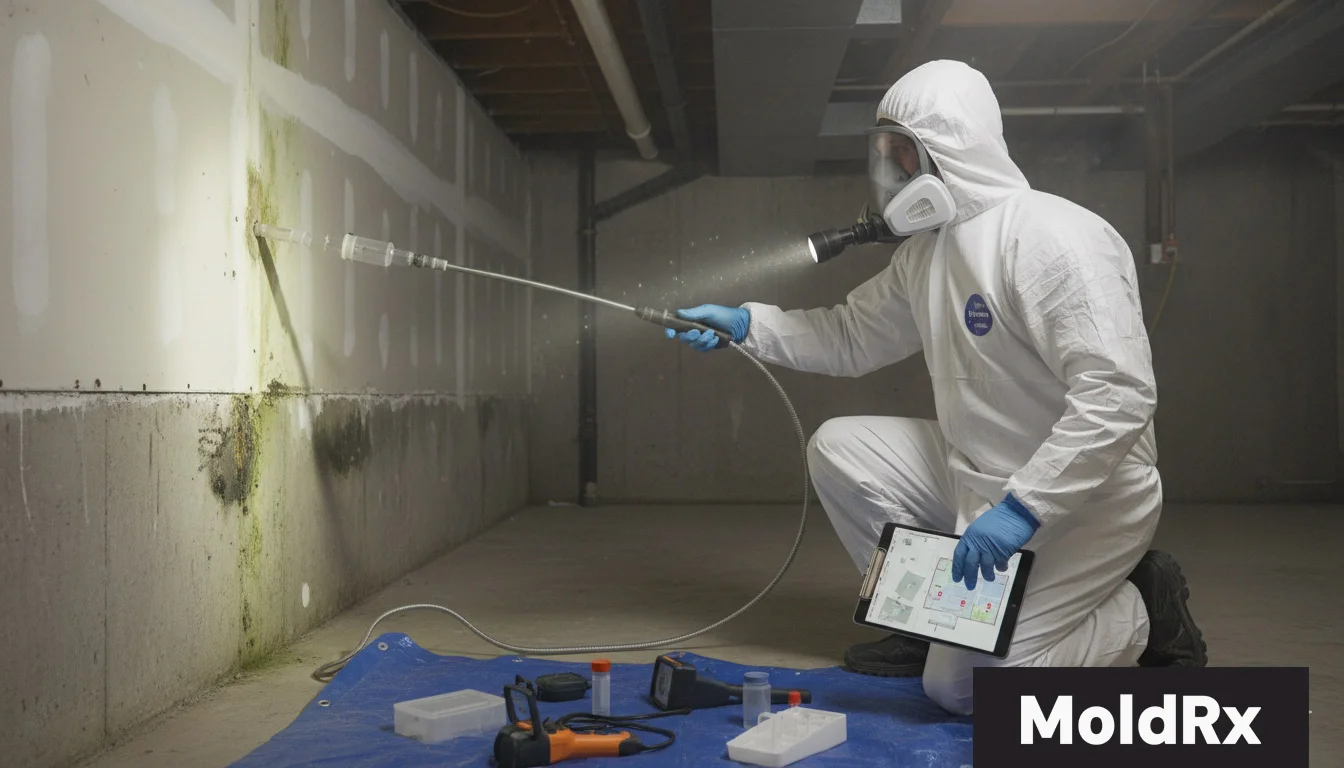
Professional mold testing typically includes one or more sampling methods, depending on the situation.
Air sampling captures airborne mold spores using a specialized pump that draws air through a collection device. Samples are typically taken both inside the home and outside for comparison. Laboratory analysis identifies the types of mold present and their concentrations. Air sampling is useful for assessing overall indoor air quality and detecting hidden mold that’s releasing spores into the air.
Surface sampling collects samples directly from materials—using tape lifts, swabs, or bulk samples—to identify what’s growing on a specific surface. This method is useful when you can see suspected mold but want to identify the type, or when you need to determine the extent of contamination on building materials.
Moisture assessment uses meters and sometimes thermal imaging to identify areas with elevated moisture content. While not mold testing per se, moisture assessment often accompanies testing because moisture is the underlying cause of mold growth. Identifying moisture sources is essential for preventing recurrence.
Samples are analyzed by accredited laboratories, and results typically include identification of mold types present and their spore counts. A qualified inspector interprets these results in context—comparing indoor to outdoor levels, noting whether certain mold types are elevated, and explaining what the findings mean for your situation.
What Testing Can and Can’t Tell You
It’s worth understanding what mold testing doesn’t do.
Testing doesn’t definitively prove health effects. While certain mold types are associated with health problems, and elevated levels can indicate poor indoor air quality, mold testing alone can’t prove that mold is causing specific symptoms. Health responses to mold vary widely between individuals, and many factors beyond mold affect indoor air quality.
Testing is a snapshot in time. Mold spore levels fluctuate based on humidity, air movement, temperature, and other factors. A single test captures conditions at one moment. Ongoing problems may require multiple tests or other forms of investigation.
Testing doesn’t replace investigation. If you have a mold problem, you also have a moisture problem. Testing can confirm mold is present, but it doesn’t identify the underlying moisture source. Addressing mold without fixing the moisture issue means the problem will return.
DIY Test Kits vs. Professional Testing
Hardware stores sell mold test kits for $10-50 that claim to detect mold in your home. These kits have significant limitations.
Most DIY kits use settle plates—petri dishes left open to collect whatever falls from the air. Because mold spores are everywhere, these tests almost always grow mold. A positive result doesn’t tell you whether your levels are abnormal; it just confirms that mold spores exist in your home, which is true of every home.
Professional testing, by contrast, quantifies spore levels and compares them to baseline measurements. It’s conducted using calibrated equipment and analyzed by accredited laboratories. The results provide context—not just “mold exists” but “here are the types present and how your levels compare to what’s normal.”
DIY kits can create false alarms (positive results that don’t indicate a problem) or false reassurance (missing actual issues because the sampling method isn’t sensitive enough). If you’re concerned enough to test, professional testing provides information you can actually act on.
Making the Decision
Here’s a simple framework for deciding whether you need mold testing:
If you can see significant mold growth, skip testing and move toward remediation. Testing confirms what you already know.
If you smell mold, have symptoms, or suspect hidden growth but can’t confirm it, testing can provide useful information about whether a problem exists and how significant it might be.
If you need documentation—for insurance, real estate transactions, or verification of remediation—professional testing provides the objective evidence you need.
If you’re just generally curious, testing may not tell you much that’s actionable. Consider whether you have specific concerns or just general anxiety about indoor air quality.
Questions About Testing?
MoldRx coordinates professional mold testing and mold remediation services throughout Orange County, Riverside County, and San Bernardino County. If you're unsure whether testing is warranted for your situation, we're happy to discuss what you're experiencing and give you honest guidance about whether testing makes sense—or whether your money is better spent elsewhere.
If testing isn’t necessary, we’ll tell you. Contact MoldRx to talk through your situation.