Mold Removal in Fontana, CA — MoldRx
IICRC-Certified Mold Removal Professionals Serving Fontana and San Bernardino County
Fontana is a city of contrasts — 1950s steel-worker bungalows near Foothill Boulevard sitting a few miles south of brand-new two-story tracts climbing toward the San Gabriel foothills. With roughly 215,000 residents across 36 square miles of the western Inland Empire, the housing stock ranges from 70-year-old slab-on-grade homes with original galvanized plumbing to 2020s production builds with builder-minimum ventilation. Both ends grow mold, just for different reasons. MoldRx only sends vetted, IICRC-certified mold removal professionals who follow IICRC S520/R520 remediation standards and EPA federal mold guidance (EPA 402-K-01-001) — specialists who understand Fontana's climate, construction eras, and the moisture dynamics of living at the base of Cajon Pass.
Request your free mold estimate — we'll assess your Fontana property and give you straight answers.
Why Mold Grows in Fontana Homes
Fontana sits at roughly 1,237 feet elevation in the western San Bernardino Valley, directly south of where the Cajon Pass funnels air between the San Gabriel and San Bernardino Mountains. The semi-arid Mediterranean climate seems hostile to mold on the surface. The reality is different. Temperature extremes, aging infrastructure, varied construction quality, and seasonal moisture create persistent hidden problems that sustain mold colonies behind walls, under slabs, and inside HVAC systems year-round.
Inland Heat, Condensation, and HVAC Stress
Summer highs in Fontana regularly reach 95-103 degrees Fahrenheit. Homeowners run air conditioning heavily from May through October, and that sustained cooling creates condensation on ductwork, around supply registers, and on cold surfaces inside wall cavities. Older HVAC systems in South Fontana's 1950s-1970s homes were never designed for this level of continuous operation. Newer systems in North Fontana tract homes are often builder-grade installations with minimal duct insulation in unconditioned attic spaces — attics that exceed 150 degrees in August. The differential between a 150-degree attic and a 75-degree conditioned space below drives moisture to condense on the cold side of ductwork, around poorly sealed boot connections, and on the underside of roof sheathing. Per IICRC S520 guidelines and EPA 402-K-01-001, mold colonizes within 24 to 48 hours once moisture and organic material are present.
Santa Ana Winds and Cajon Pass Effects
Fontana experiences 10 to 25 Santa Ana wind events per year, each lasting one to seven days. These hot, dry winds blow through the Cajon Pass from the Mojave Desert at speeds that cause structural damage across western San Bernardino County. While the winds themselves are dry, they create rapid temperature swings that stress building materials — expanding and contracting roof flashings, stucco joints, and window seals. When the event ends and marine-influenced air returns, moisture infiltrates through the micro-gaps these temperature cycles opened. In older South Fontana homes with original stucco and single-pane windows, this cycle accelerates building envelope degradation year after year.
Seasonal Rain on Aging Infrastructure
Fontana receives roughly 13 inches of annual rainfall, concentrated between November and March. That sounds modest, but winter storms hit a city where thousands of homes have plumbing, roofing, and drainage systems 40 to 70 years old. Older neighborhoods near Sierra Avenue and Foothill Boulevard have flat or low-slope roofs with deteriorated membranes, aging clay sewer laterals that back up under storm load, and slab foundations with no vapor barriers. In North Fontana's newer foothill communities, graded hillside lots channel runoff toward foundations, and retaining wall weep holes clog within a few years of construction.
Extremely Varied Housing Stock
Fontana's construction history drives its mold problem. The first expansion came in the 1940s-1950s when Kaiser Steel drew thousands of workers, producing modest homes south of Foothill Boulevard. A second wave in the 1960s-1970s filled central Fontana. After Kaiser Steel closed in 1983, the city stagnated until the 1990s-2000s Inland Empire boom added massive tracts in North Fontana — Sierra Lakes, Heritage, Southridge Village, Hunter's Ridge, and the Citrus foothill communities. One city now contains homes with galvanized plumbing and no exhaust alongside homes with PEX piping and sealed envelopes. Mold exploits both: old homes leak, new homes trap humidity.
Signs You Need Professional Mold Removal
Not every discoloration requires a remediation crew. But certain signs — especially in a city with Fontana's construction diversity — indicate the problem has moved beyond surface cleaning.
Visible Growth Beyond a Small Area
The EPA's Mold Remediation in Schools and Commercial Buildings (EPA 402-K-01-001) uses 10 square feet as the general threshold for professional remediation. In Fontana homes, visible growth commonly appears along bathroom walls, inside kitchen sink cabinets, along garage-to-house walls where insulation is minimal, and on closet walls backed by exterior stucco surfaces.
Persistent Musty Odor Without Visible Mold
A chronic musty smell near bathrooms, closets, or HVAC supply vents often signals mold in a concealed space — behind drywall, under flooring, or within ductwork. In South Fontana's older homes, that smell frequently traces to corroded cast-iron waste pipes inside wall cavities. In newer North Fontana homes, it often leads to improperly sealed duct connections in attic spaces.
Recurring Mold After Previous Cleanup
Mold that returns after cleaning means the moisture source was never resolved. Wiping bleach on a bathroom wall does nothing about the colony behind the drywall or the failed shower pan. Recurrence is especially common in Fontana's 1960s-1970s homes, where previous repair layers mask the original moisture path.
Water Damage or Staining
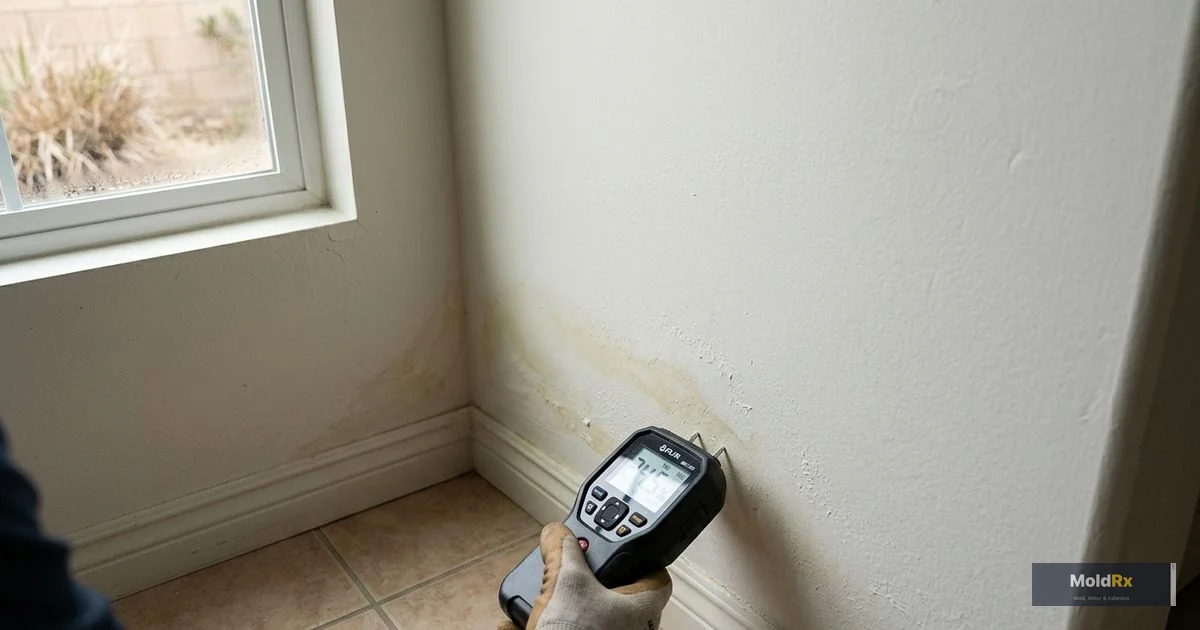
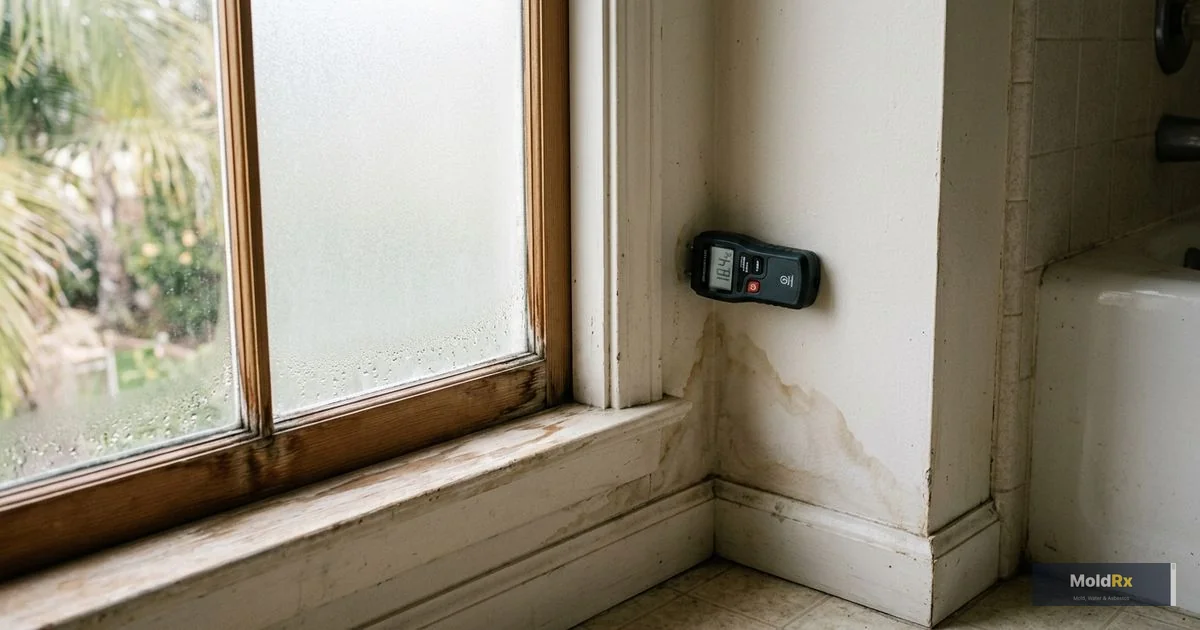
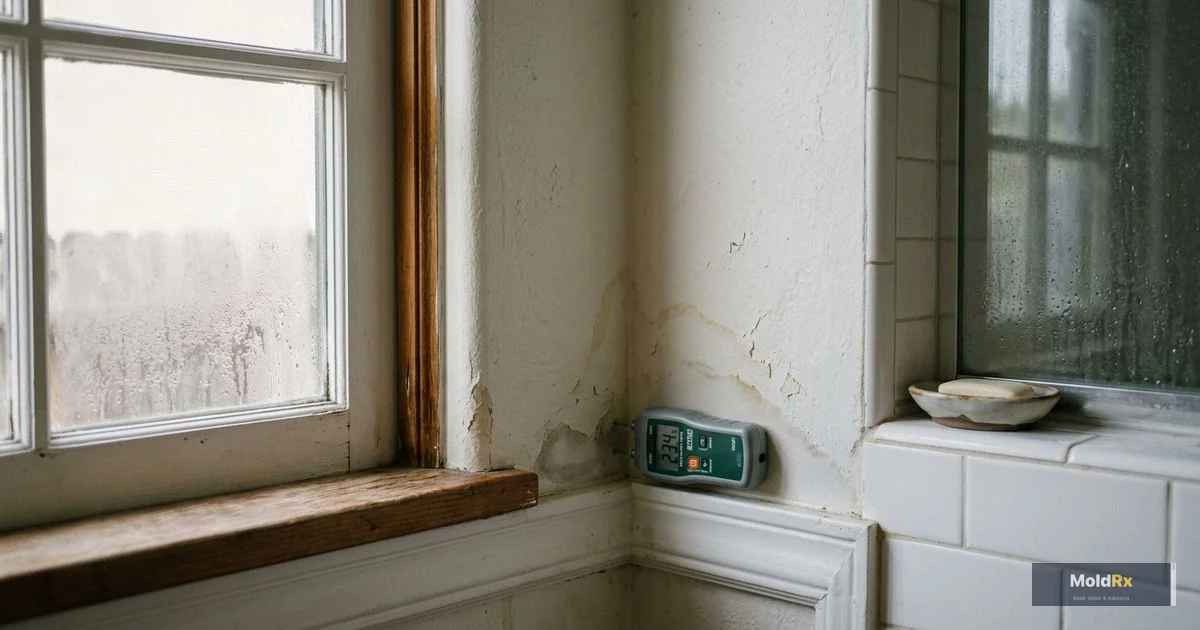
Water staining on ceilings, walls, or flooring may indicate moisture intrusion producing hidden mold. Common Fontana sources: slab leaks from shifting expansive soil, failed roof flashings after Santa Ana cycles, and condensation drip from uninsulated attic ductwork.
Health Symptoms That Worsen Indoors
Nasal congestion, persistent cough, worsening asthma, or unexplained fatigue that improve when you leave home may indicate mold exposure. The EPA and CDC both identify mold as a cause of respiratory symptoms — effects are more pronounced in children, the elderly, and anyone with chronic respiratory conditions.
Health Risks of Mold Exposure
Mold exposure is a well-documented health concern — not a marketing tactic. Understanding the actual risks helps you make informed decisions about remediation urgency.
The EPA links mold spore exposure to allergic reactions including sneezing, runny nose, red eyes, and skin rash. The CDC identifies respiratory effects including coughing, wheezing, and throat irritation. The World Health Organization's Guidelines for Indoor Air Quality: Dampness and Mould links prolonged exposure to respiratory infections and asthma exacerbation, identifying children, the elderly, and immunocompromised individuals as particularly vulnerable.
Fontana's median age is approximately 34 — a younger city with a high proportion of families with children. Children exposed to indoor mold are at increased risk of developing asthma per the WHO guidelines. For the roughly 68% of Fontana households that include children or young adults, timely mold remediation is a health decision, not optional maintenance.
Chronic exposure to Aspergillus, Stachybotrys (black mold), and Penicillium — common in Southern California indoor environments — causes respiratory irritation, headaches, and fatigue even in healthy adults. Immunocompromised residents face elevated risk of invasive fungal infections.
When DIY Mold Removal Isn't Enough
For small surface mold on non-porous materials, EPA guidance allows homeowner cleanup. But several conditions common in Fontana require professional intervention:
- Contamination exceeding 10 square feet — EPA 402-K-01-001 recommends professional remediation at this threshold
- Mold inside HVAC systems or ductwork — NADCA (National Air Duct Cleaners Association) standards apply; cleaning individual vents does nothing when the source is inside the system
- Structural involvement — Mold behind drywall, under flooring, or inside wall cavities requires controlled demolition, containment, and HEPA filtration
- Slab leak or foundation moisture — Fontana's expansive clay soils shift seasonally, cracking slab foundations and supply lines; moisture migrating through an unprotected slab feeds mold for months before visible signs appear
- Water category 2 or 3 involvement — Sewage backup or contaminated water per IICRC S500 water damage standards requires professional protocols that go beyond mold removal alone
- Insurance or real estate documentation — Professional remediation generates the records that insurers and real estate transactions require
A professional assessment tells you whether full remediation is warranted. That assessment is part of our free estimate.
How We Remove Mold in Fontana Properties
Every remediation follows IICRC S520 standards and the companion ANSI/IICRC R520 Reference Guide — the industry benchmarks recognized by insurers, public health agencies, and the courts.
1. Inspection and Moisture Mapping
Our specialists map the full scope following EPA 402-K-01-001 assessment protocols — checking behind bathroom walls where decades-old plumbing runs, inspecting under-slab moisture, mapping condensation around HVAC systems, and examining attic ductwork for insulation failure. In older South Fontana homes, assessment includes evaluating original galvanized supply lines and cast-iron waste pipes — the two most common hidden moisture sources in pre-1970 construction.
2. Containment
Physical barriers and negative air pressure isolate the affected area per IICRC S520 Condition 2 and Condition 3 containment protocols. HEPA air scrubbers capture airborne spores down to 0.3 microns. The CDC, EPA, and the WHO Guidelines for Indoor Air Quality: Dampness and Mould all emphasize protecting occupants from airborne mold during remediation. Proper containment ensures the process itself does not create a health risk for your family.
3. Removal and Treatment
Mold-damaged materials are removed following IICRC S520 procedures and Cal/OSHA permissible exposure limits under Title 8 Section 5155. Remaining surfaces are treated with EPA-registered antimicrobial solutions that eliminate residual spores and inhibit regrowth. In Fontana's older homes, this frequently involves removing multiple layers of previous repairs to reach the original contamination.
4. Moisture Correction
Removing mold without fixing the water source guarantees recurrence. Our specialists resolve the underlying cause — a corroded joint beneath a 1960s slab, a failed shower pan in a 1990s tract home, inadequate exhaust in a 1970s ranch, or condensation from uninsulated attic ductwork in a 2005 build. The fix matches the era and the problem.
5. Post-Remediation Verification
Affected areas are verified against IICRC S520 Condition 1 (normal fungal ecology) clearance standards. You receive full documentation — scope of work, materials removed, treatments applied, moisture readings, and verification results — meeting the standards insurers, real estate professionals, and San Bernardino County agencies require.
Mold Removal vs. Mold Remediation: What's the Difference?
Mold removal refers to physically eliminating mold growth — cutting out contaminated drywall, HEPA-vacuuming surfaces, applying antimicrobials.
Mold remediation is the broader process defined by IICRC S520: assessment, containment, removal, moisture correction, and post-remediation verification. Remediation addresses both the mold and the conditions that caused it, verifying return to Condition 1 (normal fungal ecology).
When MoldRx sends professionals to your Fontana property, they perform full remediation. The corroded plumbing gets traced. The failed exhaust fan gets identified. The attic condensation pattern gets documented. Any company offering "mold removal" without addressing the moisture source is selling a temporary fix.
Preventing Mold After Remediation
These prevention measures are tailored to Fontana's climate extremes, construction eras, and the specific moisture challenges of the western Inland Empire.
Manage HVAC Condensation
Fontana's summer heat means your AC runs six months of the year. Have ductwork in unconditioned attic spaces inspected for insulation integrity — damaged or missing duct insulation is one of the most common mold catalysts in North Fontana's newer homes. Replace HVAC filters monthly during summer to maintain airflow. If you see condensation on supply registers, that is a warning sign, not normal operation.
Upgrade Bathroom and Kitchen Exhaust
Many 1950s-1970s Fontana homes have original exhaust fans that no longer move adequate air — or no mechanical exhaust at all. Replace aging fans with units rated at 80 CFM or higher that vent directly outdoors. In newer homes, verify builder-installed exhaust actually terminates at the roof or soffit, not at a disconnected flex duct in the attic.
Monitor Indoor Humidity
The EPA recommends 30-50% indoor relative humidity. In Fontana, outdoor humidity runs 39-52% depending on season, but indoor levels spike with cooking, bathing, and evaporative cooling. A standalone hygrometer gives you real-time data. If readings consistently exceed 50%, a portable dehumidifier reduces risk — especially during October-November and March-April when temperatures fluctuate and HVAC systems cycle frequently.
Address Water Intrusion Within 24-48 Hours
IICRC S520 identifies 24 to 48 hours as the colonization window. In Fontana's older homes, even a slow drip behind a wall saturates drywall within days. After heavy winter rain, inspect garage ceilings, closets on exterior walls, and areas below bathrooms for staining. After Santa Ana events, check window seals and roof flashings for new gaps.
Maintain Plumbing Proactively
In South Fontana homes built before 1970, original galvanized supply lines have a 40-to-60-year service life — meaning they are at or past failure age now. A plumbing inspection with camera scope and pressure test catches developing problems before they become mold problems. In newer homes, check under-sink connections and water heater pans annually.
What Sets MoldRx Apart
-
Straight talk, not sales talk. If your mold situation is smaller than you feared, we tell you. If it is more involved, you hear that too — with documentation, not scare tactics. Honest guidance in clear language.
-
Licensed, insured, IICRC-certified. Our vetted professionals carry IICRC certifications and California contractor licensing through the CSLB (Contractors State License Board) — with field experience from 1950s slab homes in South Fontana to 2010s production builds in the San Bernardino County foothills.
-
Full documentation on every job. Scope of work, moisture source identification, materials removed, treatments applied, and post-remediation verification — meeting the standards insurers, real estate professionals, and San Bernardino County agencies require.
-
Family-owned accountability. MoldRx is not a call center. We only send vetted remediation professionals we stand behind — not whoever is available from a rotating subcontractor list.
Get your free estimate — no obligations, no pressure. Just a clear picture of your situation.
Fontana Neighborhoods We Serve
MoldRx provides mold removal across all of Fontana — ZIP codes 92335, 92336, and 92337 — covering every neighborhood, construction era, and housing type in the city.
-
South Fontana / Downtown (92335) — Fontana's oldest residential core, stretching from Arrow Boulevard south to I-10 and centered on Sierra Avenue and Foothill Boulevard. Housing dates from the 1940s Kaiser Steel era through the 1970s: slab-on-grade ranch homes, stucco bungalows, and apartment conversions. Original galvanized plumbing, flat roofs, and minimal mechanical ventilation are standard. This ZIP has the highest concentration of aging infrastructure and the greatest risk of hidden plumbing-related mold.
-
North Fontana / Sierra Lakes (92336) — Foothill communities north of Summit Avenue, including Sierra Lakes, Duncan Canyon, and portions of the Citrus development. Predominantly 1990s-2010s tract construction on graded hillside lots, 1,600 to 3,500+ square feet. Primary mold vectors: attic condensation from poorly insulated ductwork, hillside drainage toward foundations, and tightly sealed envelopes trapping interior moisture. Elevation rises toward 2,000 feet here, with greater seasonal temperature swings.
-
Hunter's Ridge / Panorama (92336) — Northwestern foothill community climbing the San Gabriel slopes to approximately 2,600 feet — the highest elevation within city limits. Newer construction exposed to direct Santa Ana wind channels from the Cajon Pass. Wind-driven temperature differentials stress building envelopes and accelerate gap-opening cycles that allow moisture infiltration after events subside.
-
Southridge Village / Jurupa Hills (92337) — South-central Fontana between I-10 and the Jurupa Hills. Mix of 1980s-1990s homes and newer infill. Jurupa Hills Regional Park and surrounding green spaces maintain higher ambient soil moisture. Older homes commonly have slab leaks from expansive clay soil, while newer homes face grading and drainage issues on hilly terrain.
-
Rancho Fontana / Summit Heights (92336) — Central-north Fontana between Baseline and Summit Avenues. A transitional zone with 1980s-1990s homes alongside newer infill. Mold issues here stem from aging HVAC systems now 30-40 years old — systems not designed for the sustained cooling loads Fontana's summers demand.
-
Heritage / Citrus Heights (92336) — Northeast foothill communities representing Fontana's newest residential development. Large production homes on former citrus land. Rapid development on agricultural soil means settling, grading inconsistencies, and immature drainage systems that channel water toward foundations during winter storms.
Nearby Communities We Also Serve
Our vetted professionals cover western San Bernardino County with CSLB licensing and IICRC credentials:
- Rancho Cucamonga — West, similar foothill construction and Santa Ana wind exposure
- Rialto — East, comparable older housing stock and Inland Empire climate
- Ontario — Southwest, shared construction eras from the Kaiser Steel period
- San Bernardino — East, county seat with diverse housing ages
- Upland — Northwest, foothill community with similar elevation and wind patterns
Related Services in Fontana
Mold rarely exists in isolation. If you need water damage restoration, testing, or own a pre-1980 property that may contain asbestos:
→ All remediation services in Fontana
Frequently Asked Questions
How long does mold remediation take in Fontana?
Most projects take 2 to 5 days. A single-bathroom issue in a newer North Fontana home may finish in a day. Multi-room remediation in an older South Fontana home with plumbing-related water damage can take a week or longer. We provide a realistic timeline after assessment.
Do I need mold testing before removal starts?
If mold is visible, testing is not always required — the priority is removal and moisture correction. Testing becomes valuable when you suspect hidden mold, need insurance documentation, or are involved in a real estate transaction.
Is mold common in newer Fontana homes?
Yes. North Fontana's foothill homes are built to modern energy codes with tighter building envelopes that reduce air exchange, trapping moisture from cooking, bathing, and daily living. Combined with builder-grade HVAC installations and attic ductwork that may not be properly insulated, newer homes develop mold in different locations — primarily around HVAC systems, in attic spaces, and behind tightly sealed bathroom walls.
What causes mold in older South Fontana homes?
Aging plumbing and inadequate ventilation. Homes built in the 1940s-1970s have galvanized supply lines and cast-iron waste pipes at or past service life. Slow leaks behind walls and under slabs create sustained moisture feeding hidden colonies. Many of these homes lack mechanical bathroom exhaust or have original fans that no longer function.
Will my homeowner's insurance cover mold removal?
Coverage depends on the cause. Mold from a sudden covered event — like a burst pipe — is often covered. Mold from gradual deterioration or deferred maintenance typically is not. Our documentation supports legitimate claims with the detail adjusters require.
Can I stay in my home during mold remediation?
Usually, yes. Containment and HEPA filtration keep spores isolated from living areas. For larger projects or if household members have respiratory conditions, we may recommend temporary relocation during the most intensive phases.
How do Santa Ana winds affect mold in my home?
Santa Ana winds are hot and dry — they do not directly cause mold. But the rapid temperature swings stress building materials, opening micro-gaps in stucco, flashings, and window seals. When normal humidity returns, moisture infiltrates through those gaps. Over years of repeated cycles, these entry points accumulate, especially in homes older than 20 years.
What is the difference between mold removal and mold remediation?
Removal is physical elimination of mold. Remediation is the complete IICRC S520 process — assessment, containment, removal, moisture correction, and post-remediation verification. MoldRx performs full remediation on every job because removal without addressing the moisture source guarantees the mold returns.
How do I know if I have mold behind my walls?
Indicators include persistent musty smell, water staining, peeling or bubbling paint, warped baseboards, and symptoms that improve when you leave. In Fontana, check behind bathroom walls where plumbing runs, inside kitchen sink cabinets, along exterior walls at baseboard level, around HVAC registers, and in garage ceilings below second-floor bathrooms.
Do you offer emergency mold removal in Fontana?
If you have experienced sudden water intrusion — a burst pipe, water heater failure, or storm flooding — time matters. Mold colonization begins within 24 to 48 hours per IICRC S520. Contact MoldRx immediately at (888) 609-8907. Fast response prevents a water damage event from becoming a full mold remediation project.
Get Mold Removal in Fontana
Mold does not wait, and Fontana's combination of extreme heat, Santa Ana wind cycles, aging plumbing in South Fontana, and sealed-tight construction in the foothills means the conditions that cause it are not going away. Whether your home is a 1950s bungalow on Sierra Avenue or a 2015 tract home in Hunter's Ridge, the rule is the same: find the moisture, fix the moisture, remove the mold, verify the work.
MoldRx only sends vetted remediation professionals who understand Fontana properties — the construction eras, the climate stressors, the infrastructure realities of a city that grew from a steel town to one of the Inland Empire's largest communities in 80 years. No guesswork. No runaround.
Call MoldRx for your free estimate — (888) 609-8907. Clear answers. Honest guidance. Work done right.