Asbestos Removal in Garden Grove, CA — MoldRx
Licensed Asbestos Removal Professionals Serving Garden Grove and Central Orange County
Asbestos is not something you deal with later, and it is not something you handle yourself. Garden Grove — a city of approximately 175,000 residents in central Orange County, incorporated in 1956, ZIPs 92840, 92841, 92843, 92844, and 92845, sitting roughly 87 feet above sea level on a flat coastal plain — was built almost entirely during the peak asbestos era. Between 1950 and 1970, Garden Grove's population exploded from just over 4,000 to more than 120,000 as developers converted citrus groves and strawberry fields into mile after mile of tract housing. Permits for single-family homes peaked in 1959 with over 3,000 new houses started in a single year. These are the homes that still line Garden Grove Boulevard, Chapman Avenue, Brookhurst Street, and Harbor Boulevard today — three-bedroom, one-bath ranch houses averaging 1,500 square feet, built when asbestos was considered a miracle material and used in everything from floor tiles to ceiling texture to pipe insulation. When those materials are disturbed during renovation or natural deterioration, they release microscopic fibers that cause fatal diseases with no cure. California law is unambiguous: asbestos abatement must be performed by licensed, certified professionals. There is no legal shortcut and no safe DIY method. MoldRx only sends vetted, licensed abatement professionals who work in full compliance with EPA NESHAP, OSHA 1926.1101, Cal/OSHA Title 8 Section 1529, and SCAQMD Rule 1403.
Request your free estimate — we will assess your Garden Grove property and explain your options.
Why Garden Grove Properties May Contain Asbestos
Garden Grove occupies 17.9 square miles of flat terrain in the geographic center of Orange County. It is bordered by Anaheim to the north, Orange and Santa Ana to the east, Westminster and Fountain Valley to the south, and Stanton and Cypress to the west. The Garden Grove Flood Control Channel and the Westminster Channel cross the city, and the flat, low-lying topography makes portions of the city susceptible to water intrusion during heavy rain — a factor that accelerates degradation of older building materials. The Mediterranean climate delivers hot, dry summers with temperatures in the mid-80s to low 90s, occasional Santa Ana wind events, and roughly 13 inches of annual rainfall concentrated in winter months. Year-round renovation activity on housing stock that is overwhelmingly 50 to 70 years old is exactly why asbestos risk here demands immediate attention.
Construction Era and Asbestos Use
Asbestos was used extensively from the 1920s through the late 1970s. The EPA began restrictions in the late 1970s, but manufacturers exhausted existing inventory into the mid-1980s. Any property built before 1980 should be presumed to contain asbestos until testing proves otherwise.
Garden Grove's construction history aligns almost perfectly with the peak asbestos era. The area was agricultural until the postwar suburban boom. Incorporation came in 1956 as thousands of families arrived seeking affordable homes near the new Disneyland, which opened in neighboring Anaheim in 1955. Developers moved fast — between 1955 and 1970, Garden Grove transformed from a farming community to a fully built-out suburb. In 1959, the Orange County Plaza (now The Promenade) opened at Chapman and Brookhurst with 60 stores, signaling the scale of growth. By 1970, virtually every parcel was developed.
The median construction year for Garden Grove housing is approximately 1964. The overwhelming majority of the city's nearly 50,000 households occupy structures built between the mid-1950s and mid-1970s — the absolute peak of asbestos use in American construction, when more than 3,000 commercial products incorporated asbestos fibers. The risk is not concentrated in one neighborhood — it spans the entire city, from West Garden Grove to Southeast Garden Grove, from the neighborhoods surrounding Christ Cathedral to the commercial corridors of Little Saigon.
Common Asbestos-Containing Materials in Garden Grove Properties
In properties built before 1980 — which describes the vast majority of Garden Grove — asbestos is commonly found in:
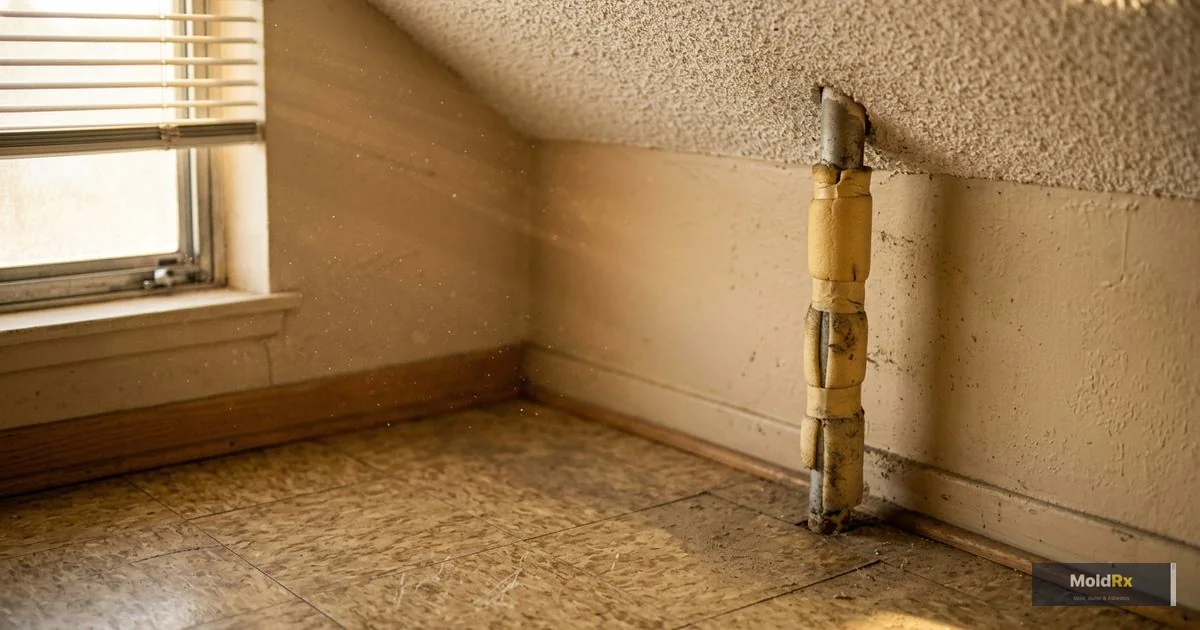
- 9x9-inch floor tiles and black mastic adhesive — found extensively in tract homes throughout Garden Grove, one of the most common ACMs in the city's housing stock
- Popcorn (acoustic) ceiling texture — prevalent across the entire housing inventory, from single-family homes to apartment complexes built in the 1960s and 1970s
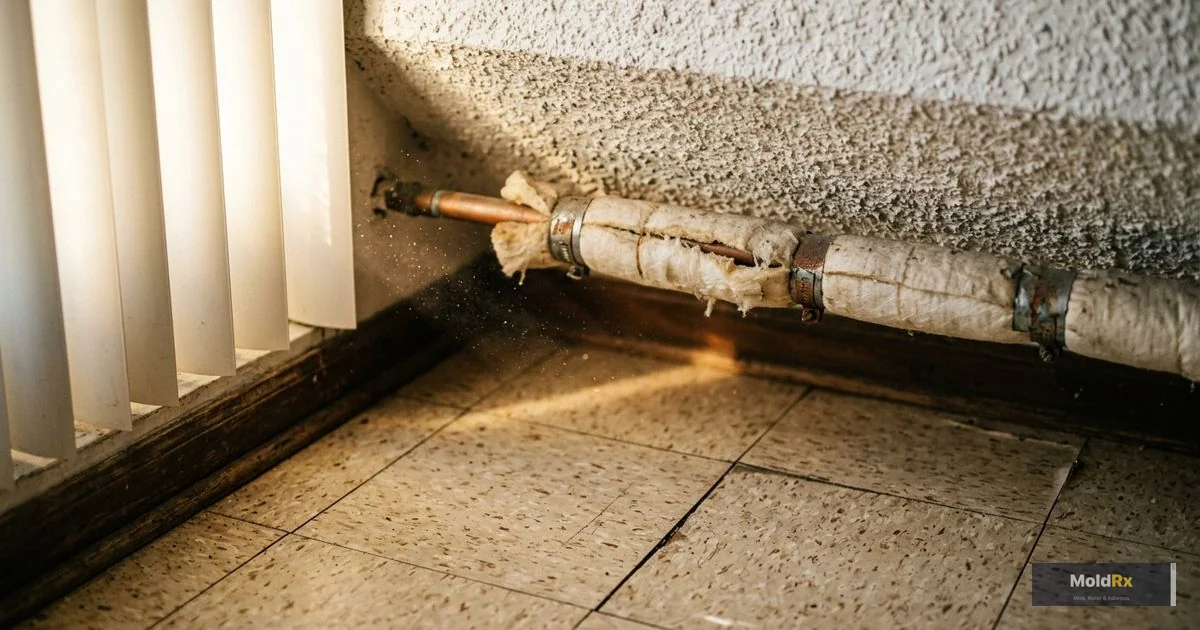
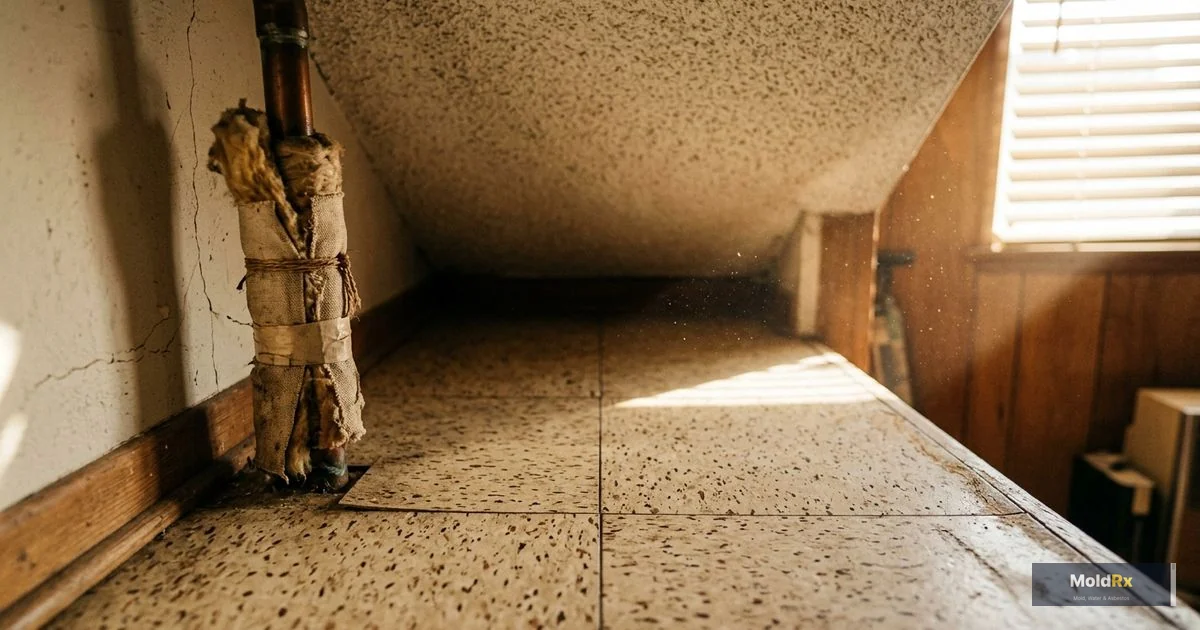
- Pipe insulation and duct wrap — in homes with original HVAC systems, particularly the 1950s-1970s tract housing that dominates Garden Grove
- Roof materials and adhesives — shingles, felts, tar products on the low-pitched composition roofs typical of midcentury ranch homes
- Textured wall coatings and joint compound — found in homes and commercial buildings across every neighborhood
- Vermiculite attic insulation — particularly Zonolite brand, contaminated with tremolite asbestos
- Exterior stucco — asbestos mixed in for strength and fire resistance, standard in 1960s Southern California construction
- Window glazing putty and caulking — in original single-pane aluminum-frame windows common throughout Garden Grove
- HVAC duct connectors and furnace components — gaskets, cement, insulation in aging systems that have served these homes for 50-plus years
- Transite siding and cement-asbestos products — on commercial structures and some residential properties
When Asbestos Becomes Dangerous
Intact, undisturbed asbestos does not automatically release fibers. The danger begins when materials are disturbed. Friable materials — those that crumble under hand pressure, like pipe insulation or sprayed ceiling texture — release fibers easily. Non-friable materials — floor tiles, transite siding — become hazardous when cut, sanded, drilled, or broken. Renovation is the most common trigger. Tearing out old flooring, scraping popcorn ceilings, or demolishing walls in a pre-1980 Garden Grove property without testing can contaminate the entire structure in minutes.
Garden Grove-Specific Risk Factors
Mass tract housing from the peak asbestos era. Garden Grove's explosive 1955-1970 buildout produced thousands of nearly identical tract homes using the same asbestos-laden materials — the same 9x9 floor tiles, the same popcorn ceiling texture, the same pipe insulation, the same roof shingles. What was found in one house on a given street is likely present in every house on that block. The sheer uniformity of construction means asbestos risk is predictable and pervasive across the entire city.
Aging housing stock approaching critical deterioration. The typical Garden Grove home is now 60 to 70 years old. Six decades of thermal cycling, settling, seismic movement, and wear have degraded original materials. Adhesives that bonded floor tiles have dried and cracked. Popcorn ceiling texture has loosened. Pipe insulation wrapping has become brittle. Materials that were stable in 1964 are increasingly friable in 2026.
Little Saigon commercial corridor. The Little Saigon district — centered along Bolsa Avenue and extending into Garden Grove's southern neighborhoods — contains hundreds of commercial properties, many housed in 1960s-era strip malls and converted residential structures. Commercial renovations, tenant improvements, and building conversions disturb original construction materials. SCAQMD Rule 1403 applies to all commercial renovation and demolition — compliance is mandatory, and fines for violations reach $20,000 per day.
Flood channel proximity and water intrusion. The Garden Grove Flood Control Channel and Westminster Channel cross the city. During heavy winter rains, water intrusion into crawl spaces, foundations, and lower building components degrades asbestos-containing materials. Moisture breaks down binders, making non-friable materials progressively more friable. Properties near the channels and in low-lying areas face elevated risk.
Diverse and densely populated neighborhoods. Garden Grove averages over 9,700 people per square mile. Homes sit on relatively small lots with close setbacks. Fiber release from improper asbestos disturbance at one property can affect neighboring homes. The density makes containment and proper abatement procedures critical.
Active renovation cycle. With home values rising and housing stock aging, Garden Grove homeowners are continuously renovating — updating kitchens, replacing flooring, removing popcorn ceilings, upgrading HVAC systems. Every one of these projects in a pre-1980 home is a potential asbestos disturbance event. Testing must come first.
When Asbestos Removal Is Required
Before renovation or demolition. SCAQMD Rule 1403 requires an asbestos survey before any renovation or demolition. Notification must be submitted for projects disturbing more than 100 square feet of ACM. If you are planning any work on a pre-1980 property — remodeling a kitchen, removing popcorn ceilings, updating HVAC, converting a garage, renovating a commercial space in the Little Saigon corridor — testing must come first. This is law, not recommendation.
When materials are damaged or deteriorating. Friable materials that are crumbling, water-damaged, or visibly deteriorating require immediate professional attention. In Garden Grove's aging housing stock, where decades of settling, seismic movement, heat cycling, and water intrusion have compromised materials, degradation is accelerating with every passing year.
Real estate transactions. California Civil Code requires sellers to disclose known asbestos hazards. In Garden Grove's active market — where midcentury tract homes turn over regularly and investors purchase properties for renovation and resale — a clean clearance report prevents costly renegotiations and protects both parties.
After professional testing confirms ACMs. No removal begins without laboratory-confirmed results from an NVLAP-accredited lab using PLM or TEM analysis.
Our Asbestos Removal Process
The professionals MoldRx sends to your Garden Grove property follow a six-phase process designed for complete compliance and maximum safety.
1. Pre-Abatement Survey and Testing. A certified inspector surveys your property, collects samples for NVLAP-accredited lab analysis following AHERA protocols. For Garden Grove, this commonly includes flooring, ceilings, pipe insulation, HVAC components, roof materials, stucco, window glazing, and attic insulation — the full complement of materials found in 1950s-1970s tract construction.
2. Regulatory Notification. SCAQMD Rule 1403 advance written notification for projects disturbing more than 100 square feet of ACM. Cal/OSHA DOSH notification and registration. All permits obtained — including City of Garden Grove building permits and, for commercial properties, coordination with applicable local requirements.
3. Containment and Worker Protection. Complete isolation with polyethylene sheeting and HEPA-filtered negative-pressure air scrubbers. Decontamination unit. Full PPE with NIOSH-approved P100 HEPA respirators per OSHA 1926.1101. In Garden Grove's densely built neighborhoods — where tract homes share fencelines and commercial buildings share party walls — containment accounts for proximity of neighboring properties. Boundary air monitoring is standard.
4. Wet Removal and Abatement. All ACMs thoroughly wetted before removal per NESHAP and OSHA. Hand tools minimize breakage. Glovebag techniques for pipe insulation. Continuous air monitoring throughout.
5. Disposal. Double-bagged in labeled 6-mil poly bags, rigid containers, warning labels. Waste manifest documents chain of custody to approved disposal landfill.
6. Air Monitoring and Clearance Testing. Independent air monitoring — TEM or PCM analysis. Clearance requires fiber concentrations below 0.01 f/cc. Complete clearance report provided as your permanent record.
Asbestos Removal vs. Encapsulation
Encapsulation — applying a sealant that binds fibers — is sometimes acceptable for non-friable materials in good condition that will not be disturbed. However, encapsulation does not eliminate the asbestos. In Garden Grove's aging tract homes — where renovation is constant, materials have endured 60-plus years of wear, and homes change hands regularly — encapsulant longevity requires careful evaluation. For homes where the goal is full renovation, kitchen or bathroom remodel, or popcorn ceiling removal, encapsulation simply delays the inevitable. Removal is often the more definitive solution. The professionals MoldRx sends will give you an honest assessment.
Get your free estimate — no obligations.
Regulations That Govern Asbestos Removal in California
Federal: EPA NESHAP. National Emission Standards for Hazardous Air Pollutants establish baseline requirements — inspection before demolition or renovation, proper notification, wet methods, disposal at approved facilities.
Federal: OSHA 1926.1101. Construction Industry Standard — PEL of 0.1 f/cc over 8-hour TWA, medical surveillance, engineering controls, containment, ventilation, PPE.
California: Cal/OSHA Title 8 Section 1529. Meets or exceeds federal OSHA — contractor registration with DOSH, AHERA-approved training (4-day initial, annual refreshers), medical monitoring. DOSH inspects active projects throughout Orange County.
Regional: SCAQMD Rule 1403. Pre-project surveys, advance notification for projects disturbing 100+ square feet of ACM, adequate wetting, proper disposal. Failure to comply can result in fines upwards of $20,000 per day. As of July 2025, updated fee schedules apply to all notifications. SCAQMD Asbestos Hot Line: (909) 396-2336.
Licensing: CSLB C-22. California requires a C-22 Asbestos Abatement license. Workers must hold ASB certification and EPA-accredited training — 40 hours initial, 8-hour annual refreshers. Every professional MoldRx sends holds required licenses and current training.
Health Risks of Asbestos Exposure
There is no safe level of asbestos exposure according to OSHA.
Mesothelioma — aggressive cancer of the lung, abdominal, or heart lining, caused almost exclusively by asbestos. Incurable in most cases. Median survival 12-21 months. Even brief, one-time exposure can trigger this disease decades later.
Asbestosis — chronic lung disease from inhaled fibers that permanently scar tissue. Progressive difficulty breathing. No cure.
Lung Cancer — asbestos significantly increases risk, multiplying dramatically with smoking.
Latency period — symptoms typically appear 10 to 50 years after exposure. A Garden Grove homeowner who disturbs ACMs while scraping a popcorn ceiling may not develop symptoms for decades. A family renovating a 1964 tract home may never connect a future diagnosis to that weekend project. The 175,000 people living in this city — in homes built almost entirely during the peak asbestos era — face exposure risks whose consequences may not appear for years. By the time symptoms appear, the damage is irreversible. Do not wait.
For authoritative information, consult the EPA asbestos page and OSHA's asbestos safety topics.
What Sets MoldRx Apart
- Licensed, certified, compliant. Every professional holds a CSLB C-22 license, EPA-accredited training, full compliance with Cal/OSHA Title 8, OSHA 1926.1101, and SCAQMD Rule 1403.
- Full regulatory documentation. SCAQMD notifications, waste manifests, NVLAP lab results, clearance reports — everything for compliance, real estate transactions, insurance, and property sales.
- Honest assessment. If encapsulation is sufficient, we say so. If materials are asbestos-free, we say that too. No upselling. No minimizing genuine hazards.
- Family-owned accountability. Every contractor verified for licensing, insurance, training, and track record before we send them to your property.
Garden Grove Neighborhoods and Areas We Serve
West Garden Grove — West of Beach Boulevard, largely separated from the rest of Garden Grove by the city of Stanton. Most homes built in the 1960s — classic ranch-style tract houses on generous lots. Now among the most desirable neighborhoods in the city, driving active renovation. Every remodel here encounters the same 1960s-era ACMs: floor tiles, popcorn ceilings, pipe wrap, and stucco. Testing before renovation is not optional.
Downtown Garden Grove and Chapman Park — The historic core along Garden Grove Boulevard and Chapman Avenue, including the oldest residential stock in the city. Homes range from the 1950s through the 1960s, with some earlier structures. The 1956 Orange County Plaza development at Chapman and Brookhurst anchored commercial growth here. Both residential and commercial properties contain asbestos from their original construction.
Southeast Garden Grove and Little Saigon — The southern neighborhoods along Westminster Boulevard and Brookhurst Street overlap with the Little Saigon commercial district — the largest Vietnamese American business hub outside of Vietnam. Commercial properties here include 1960s-era strip malls, restaurants, and retail spaces frequently undergoing tenant improvements. SCAQMD Rule 1403 requires asbestos surveys before any commercial renovation or demolition, and enforcement is active throughout the SCAQMD jurisdiction.
Christ Cathedral Area — The neighborhoods surrounding the landmark Christ Cathedral (formerly Crystal Cathedral) at Chapman and Lewis, including residential tracts built from the late 1950s through the 1960s. Standard peak-era construction with the full range of asbestos-containing materials.
Garden Grove East — East of Euclid Street toward the Orange and Santa Ana borders. Tract homes from the 1955-1970 buildout era. Same construction materials, same asbestos risk profile as the rest of the city.
Harbor Boulevard Corridor — The major north-south commercial spine connecting Garden Grove to Anaheim and the Disneyland Resort area to the north. Mixed commercial and residential properties, many dating to the 1960s. Commercial buildings along this corridor require SCAQMD Rule 1403 compliance for any renovation work.
Nearby Communities We Also Serve
MoldRx also serves Anaheim, Orange, Santa Ana, Westminster, Fountain Valley, Stanton, Cypress, Los Alamitos, Seal Beach, and properties throughout central and northwest Orange County.
Related Services in Garden Grove
-> All remediation services in Garden Grove
Frequently Asked Questions
My Garden Grove home was built in the 1960s. Should I assume it has asbestos?
Yes — assume it until testing proves otherwise. Garden Grove's 1955-1970 construction boom used asbestos extensively in floor tiles, popcorn ceilings, pipe insulation, roof materials, stucco, joint compound, and HVAC components. With a median construction year of approximately 1964, the typical Garden Grove home was built at the absolute peak of asbestos use. Do not disturb any suspect materials without professional testing first.
I am renovating a commercial property in the Little Saigon area. What are my obligations?
SCAQMD Rule 1403 requires an asbestos survey by a certified asbestos consultant before any renovation or demolition of commercial property — no exceptions. If ACMs are found, advance written notification must be submitted to SCAQMD, and removal must be performed by licensed C-22 contractors using approved methods. Failure to comply can result in fines of $20,000 per day. Many Little Saigon commercial buildings date to the 1960s and contain asbestos in floor tiles, ceiling materials, duct systems, and wall coatings.
How do I know if my Garden Grove home has asbestos?
Laboratory testing by an NVLAP-accredited lab is the only way — visual inspection cannot identify asbestos. With a median construction year of approximately 1964, the overwhelming majority of Garden Grove properties fall within the peak asbestos window. A certified inspector collects samples for PLM or TEM analysis, with results typically in three to five business days.
Is it legal to remove asbestos myself in California?
California requires C-22 licensed contractors for asbestos abatement. A narrow exemption exists for homeowners removing small quantities of non-friable asbestos from their own single-family residence, but containment, wet methods, disposal, and notification requirements still apply. In Garden Grove — where tract homes sit on small lots with close setbacks, where materials have aged for 60-plus years, and where the range of ACMs spans every building system — professional abatement is the only responsible option.
How long does asbestos removal take?
Most residential projects take two to five days. Small projects like pipe insulation may finish in one to two days. Whole-house ceiling abatement, full flooring removal, or multi-material projects take longer. SCAQMD Rule 1403 notification adds lead time — demolition projects require 14 days advance notice.
Can I stay in my home during asbestos removal?
For small, contained projects, you may remain in unaffected areas. Larger projects — multiple rooms, whole-house renovation, materials connected to HVAC — typically require temporary relocation. Your abatement team will advise based on your property specifics.
What is the difference between friable and non-friable asbestos?
Friable asbestos crumbles under hand pressure (pipe insulation, sprayed fireproofing, ceiling textures) and releases fibers with minimal disturbance. Non-friable materials have fibers bound in a solid matrix (floor tiles, transite siding, shingles) and are hazardous when cut, broken, drilled, or sanded. Both require professional handling under California law.
Will my homeowner's insurance cover asbestos removal?
Standard policies typically exclude asbestos abatement. However, if ACMs are damaged by a covered peril — fire, earthquake, storm, water intrusion — your policy may cover abatement as part of the broader claim. Given Garden Grove's seismic zone location, flood channel proximity, and aging housing stock, this is worth reviewing with your insurer.
Is encapsulation as safe as removal?
Encapsulation can work for non-friable materials in good condition that will not be disturbed. However, the asbestos remains in place. In Garden Grove — where renovation is constant, housing stock is aging rapidly, and homes change hands regularly — removal is often the more permanent solution.
Does water damage affect asbestos materials?
Yes. Water intrusion — whether from roof leaks, plumbing failures, or flooding near Garden Grove's flood control channels — degrades asbestos-containing materials. Moisture breaks down the binders that hold fibers in place, making non-friable materials progressively more friable and prone to fiber release. If your home has experienced water damage and contains pre-1980 materials, professional assessment is critical.
Get Asbestos Removal in Garden Grove
Asbestos in your Garden Grove property demands a professional response — not next month, not when the budget allows. The diseases are irreversible. The fibers are invisible. The latency period spans decades.
In a city built almost entirely during the peak asbestos era — where over 3,000 tract homes went up in 1959 alone, where the typical house is now more than 60 years old and its floor tiles are cracking, its popcorn ceilings are loosening, and its pipe insulation is turning brittle, where the Little Saigon commercial corridor contains hundreds of 1960s-era buildings undergoing constant renovation, where flood channels carry water intrusion risk into crawl spaces and foundations, where 175,000 people live in homes whose walls, floors, ceilings, and ductwork were built with materials that can kill — the risk is not theoretical. It is present in properties across ZIP codes 92840, 92841, 92843, 92844, and 92845, from West Garden Grove to the Harbor Boulevard corridor, from Chapman Park to the neighborhoods surrounding Christ Cathedral.
Whether you have confirmed ACMs, suspect asbestos, or need testing before renovating an older home or commercial property anywhere in Garden Grove, MoldRx only sends licensed, insured, and fully compliant abatement professionals. Your family's safety is not something to gamble on.
Call MoldRx for your free estimate — (888) 609-8907. Licensed. Compliant. Done right.