Emergency Water Damage Restoration in Highland, CA — MoldRx
24/7 Emergency Water Damage Restoration Serving Highland and the Inland Empire — Call (888) 609-8907 Now
You are reading this because water is inside your Highland home or business right now — or it was there recently and you are not sure what to do next. Either way, the clock is already running against you.
Water damage in Highland is not a scheduling problem. It is a structural emergency. Every hour that water sits inside your walls, pools beneath your flooring, or saturates the slab foundation beneath your home, the damage compounds — drywall dissolves from the core outward, subfloor delaminates beyond salvage, insulation collapses under its own saturated weight, and mold colonies germinate inside wall cavities within 24 to 48 hours. The EPA and IICRC S520 confirm that timeline. In Highland's extreme summer heat — where attic temperatures exceed 140 degrees and wall cavities bake above 95 degrees — germination can begin in as few as 12 to 18 hours.
Highland sits at the base of the San Bernardino Mountains. That is not a marketing description. It is the single most important factor in your water damage risk. Every storm that hits those mountains sends runoff directly downhill toward your property. The Line Fire burn scar above your city has turned charred mountainside soil into a debris flow accelerator. And the 56,000 residents living in homes built primarily during the 1960s through 1990s are sitting on plumbing systems that are at or past catastrophic failure age.
MoldRx only sends vetted water damage restoration professionals who hold current IICRC S500 certification — the national standard governing water damage inspection, extraction, drying, and restoration. Every technician carries CSLB licensing, follows Cal/OSHA safety protocols, and complies with EPA guidelines for contaminated water handling. We do not operate as a lead aggregator. We do not send random contractors. When we put a team in your home, our reputation goes with them.
Call now for emergency water damage restoration — (888) 609-8907. Every hour you wait, the damage gets worse.
Why Water Damage in Highland Is a Different Emergency
Highland occupies a narrow belt of foothill slopes skirting the southern base of the San Bernardino Mountains, extending west over ten miles from the gorge of the Santa Ana River. The city is divided into three distinct areas — Highland, East Highland, and West Highland — each with different terrain, different housing stock, and different water damage risk profiles. What they share is a geographic reality that no other Inland Empire community faces at the same scale: the mountains are directly above you, and everything that comes off those mountains — rainfall, runoff, mud, debris — flows directly toward your home.
The Line Fire Burn Scar: Highland's Active Emergency
In September 2024, the Line Fire scorched thousands of acres in the San Bernardino Mountains directly above Highland. That burn scar fundamentally changed your water damage risk profile. Fire destroys the vegetation that holds soil in place and creates a hydrophobic layer in the soil itself — water hits the charred surface and instead of absorbing, it sheets off at high velocity carrying sediment, ash, rocks, and debris directly downslope.
The San Bernardino County Flood Control District launched a large-scale emergency response specifically to protect Highland — removing more than 80,000 cubic yards of sediment and burn debris from flood basins, city streets, and critical waterways. That number tells you everything about the scale of the threat.
In late December 2025, that threat materialized. Heavy storms triggered flooding, mud flows, and road closures across San Bernardino County's mountain and foothill communities. Highland was directly impacted. Evacuation warnings were issued for areas along the Line Fire burn scar — specifically the community of Highland just south of Greenspot Road between Church and Merris streets. In September 2025, a strong thunderstorm packing 50 mph wind gusts and torrential rain carved a path through Highland, Redlands, Yucaipa, and up into Lake Arrowhead.
These are not once-in-a-generation events. They are the new baseline. The burn scar will remain active for three to five years. Every rainstorm that hits those slopes sends contaminated runoff — Category 3 under IICRC S500 — toward Highland properties. That runoff carries ash, charred soil, road debris, and biological contamination. It does not matter whether your home sits in a mapped FEMA flood zone. If you are downslope from the burn scar, you are in the path.
Mountain Runoff: Gravity Does Not Negotiate
Even without the burn scar, Highland's geography funnels mountain runoff through residential neighborhoods. The city receives approximately 16 to 18 inches of annual rainfall — but that number drastically understates the water exposure. The San Bernardino Mountains above Highland receive significantly more precipitation, including snowpack that melts in spring. All of that water flows downhill. Through natural washes, through drainage channels, through streets that serve as improvised waterways during heavy storms — directly into Highland's residential areas.
East Highland, sitting closest to the mountain base and the mouth of the Santa Ana River gorge, faces the most direct exposure. Properties along Greenspot Road, near City Creek, and in neighborhoods backing up to foothill slopes receive runoff first and fastest. But the water does not stop at the first row of houses. It continues downhill through West Highland, across Base Line, and into lower-elevation areas where it accumulates.
Flash flooding in Highland is not theoretical. It happens during every significant rain event. The soil that has been baking in 100-degree heat for six to eight months cannot absorb water efficiently when winter storms arrive. That water runs across the surface, concentrates in drainage paths, and enters homes through foundations, garage doors, window wells, and any crack or gap in the building envelope.
1960s-1980s Housing Stock — Plus Newer Foothill Construction at Risk
Highland's residential development happened in two major waves. The first and largest wave occurred from the early 1960s through the late 1980s, producing the tract homes and ranch-style properties that make up the majority of the city's housing stock. These homes are now 35 to 65 years old, with plumbing systems at or past catastrophic failure age.
Copper supply lines installed during this era are cracking at solder joints from decades of extreme thermal cycling — Highland's summer highs exceed 100 degrees and winter nights drop into the 30s. That is thousands of expansion-contraction cycles grinding at every joint, every fitting, every connection point. Galvanized drain lines have corroded from the inside, restricting flow and developing pinhole leaks. Cast iron waste lines are cracking. Original water heaters have been replaced, but the supply connections, drain pans, and gas lines are often original equipment that has been deteriorating for half a century.
Polybutylene supply lines — installed in homes built between 1978 and 1995, covering a significant portion of Highland's construction window — are a documented catastrophic failure risk. This plastic piping material deteriorates internally when exposed to chlorine and oxidants in municipal water. Failures occur without warning — a fitting gives way, a pipe splits along its length, and water floods your home at full municipal pressure.
The second wave of development brought newer foothill communities in East Highland and the Greenspot area — homes built from the mid-1990s through the 2010s. These properties are now 10 to 30 years old. Water heaters are reaching end-of-life. Slab foundations on shifting foothill soil are developing stress fractures. And these homes sit closest to the mountain base, receiving the most direct exposure to runoff, debris flow, and the Line Fire burn scar's ongoing threat.
Extreme Heat Accelerates Every Phase of Damage
Highland's semi-arid Mediterranean climate produces summer highs of 95 to 108 degrees Fahrenheit, with peak days exceeding 110 degrees. Winter brings mild days in the 50s and 60s with overnight temperatures in the 30s and low 40s. Annual rainfall of 16 to 18 inches arrives almost entirely between November and March — often in intense bursts that overwhelm drainage systems designed for average conditions.
That extreme heat is not your ally after water damage. A saturated wall assembly in a Highland home during a July afternoon becomes an incubator for mold. Relative humidity inside that wall cavity exceeds 90 percent while outdoor humidity sits at 15 percent. Temperature inside the wall exceeds 95 degrees. Combined, those conditions compress the standard 24-to-48-hour mold germination window down to 12 to 18 hours.
The temperature swings between summer and winter also accelerate plumbing failure. Every cycle of extreme heat followed by cold nights stresses pipe joints, solder connections, and flexible fittings. Highland's plumbing systems endure more thermal punishment than homes in coastal communities — and they fail earlier because of it.
The 24-to-48-Hour Mold Window Is Not Flexible
Mold colonization begins within 24 to 48 hours of moisture exposure. The EPA and IICRC S520 confirm this timeline. In Highland's extreme summer heat, germination can begin in 12 to 18 hours inside sealed wall cavities. Stachybotrys chartarum — black mold — can colonize within 48 to 72 hours on saturated drywall.
The Inland Empire's dry outdoor air is irrelevant. Moisture inside a sealed wall cavity creates its own microclimate — relative humidity exceeding 90 percent while outdoor humidity sits at 15 percent. Every hour without professional extraction narrows the window between a water damage restoration and a combined water-plus-mold remediation project that dramatically increases scope and cost.
Box fans and open windows do not work. In Highland's summer heat, opening windows raises interior temperatures and accelerates mold germination in saturated materials. The dry outdoor air cannot reach moisture trapped inside wall cavities. And if the water source is burn scar runoff — contaminated Category 3 water — fans spread that contamination through your HVAC system and into every room.
Professional drying within the first 24 hours is the single most effective mold prevention measure available.
Request your free estimate now — (888) 609-8907. We document everything for your insurance claim from minute one.
Water Damage Categories and Classes: What You Are Dealing With
The IICRC S500 standard classifies water damage by contamination level and physical scope. Understanding your classification determines safety protocols, equipment requirements, and which materials can be saved versus what must be removed.
Category 1 (Clean Water) — from a sanitary source: broken supply line, water heater inlet, ice maker connection. Not an immediate health threat, but degrades to Category 2 or Category 3 within 48 to 72 hours if not extracted. In Highland's extreme summer heat, this degradation accelerates significantly — a clean water event on Monday morning can become contaminated water by Tuesday night.
Category 2 (Gray Water) — significant contamination from washing machine overflow, dishwasher discharge, HVAC condensate overflow, or toilet overflow without solids. Requires antimicrobial treatment. Contacted porous materials — carpet pad, particleboard, unsealed drywall — typically require removal.
Category 3 (Black Water) — the most hazardous classification. Sewage backups, burn scar runoff, mountain debris flow, storm drain backup, and any standing water present long enough to support pathogen growth. Burn scar runoff entering Highland homes is Category 3 without exception — it carries ash, charred soil, road debris, sediment, and bacterial contamination. Full PPE required. All contacted porous materials removed. No exceptions.
The IICRC S500 also classifies physical scope into four classes:
- Class 1 — minimal absorption, small area affected
- Class 2 — significant absorption across a room with wall wicking, common in Highland supply line failures where water travels along slab foundations beneath flooring
- Class 3 — water from overhead saturating walls, ceilings, insulation, and floors simultaneously, the most common class in water heater failures in interior closets and HVAC condensation failures
- Class 4 — specialty drying of low-permeability materials: concrete slabs, hardwood flooring, plaster walls in older homes, frequent in Highland slab leak scenarios where moisture migrates through aging foundations and in homes where burn scar runoff has saturated concrete foundations from the exterior
Our Water Damage Restoration Process
Every water damage event is different, but the IICRC S500 protocol provides the systematic framework our vetted professionals follow on every Highland job.
1. Emergency Response and Assessment — Technicians identify the water source, classify the water category (Categories 1 through 3) and damage class (Classes 1 through 4), and map the full extent of moisture intrusion using thermal imaging and penetrating moisture meters. In Highland's mixed housing stock — 1960s tract homes alongside newer foothill construction — hidden pathways through original framing, aging insulation, and decades of modified plumbing runs mean moisture routinely migrates far beyond the visible damage zone. For burn scar runoff intrusion, assessment includes contamination testing because the debris load varies by storm event.
2. Water Extraction — Standing water is removed immediately using truck-mounted and portable extraction units. Submersible pumps handle deep standing water from runoff and debris flow events. For supply line failures in older homes, extraction targets wall cavities, subfloor assemblies, and insulation in ceiling spaces. Burn scar runoff requires extraction of both water and sediment — the two are inseparable, and the sediment carries the contamination. Every gallon removed reduces drying time and limits secondary damage.
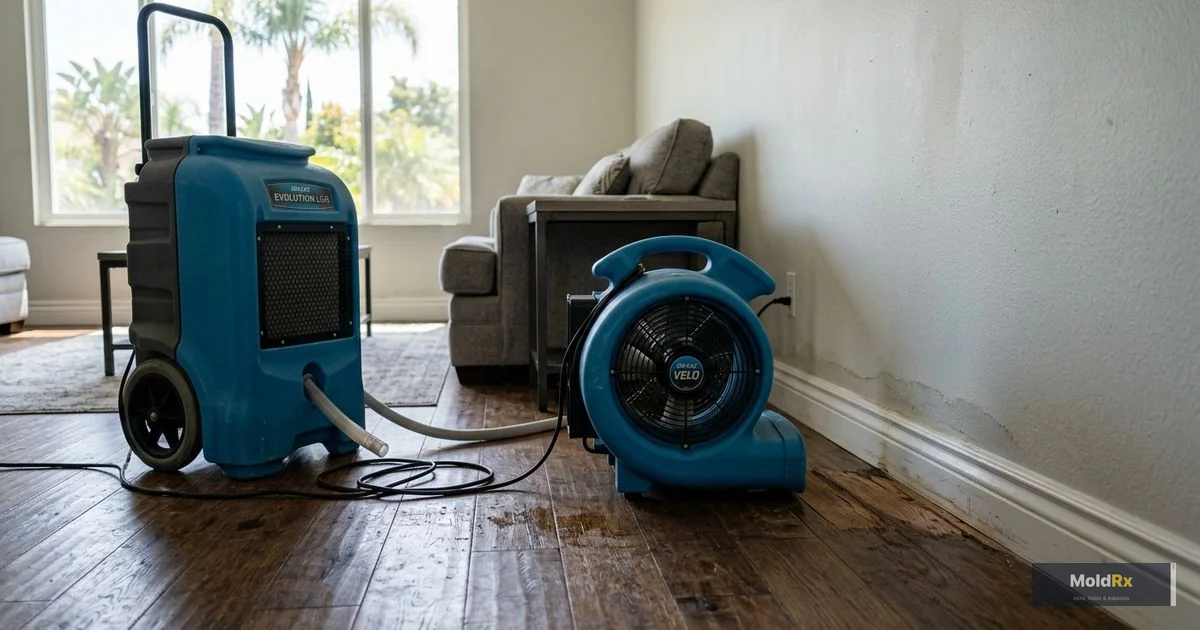
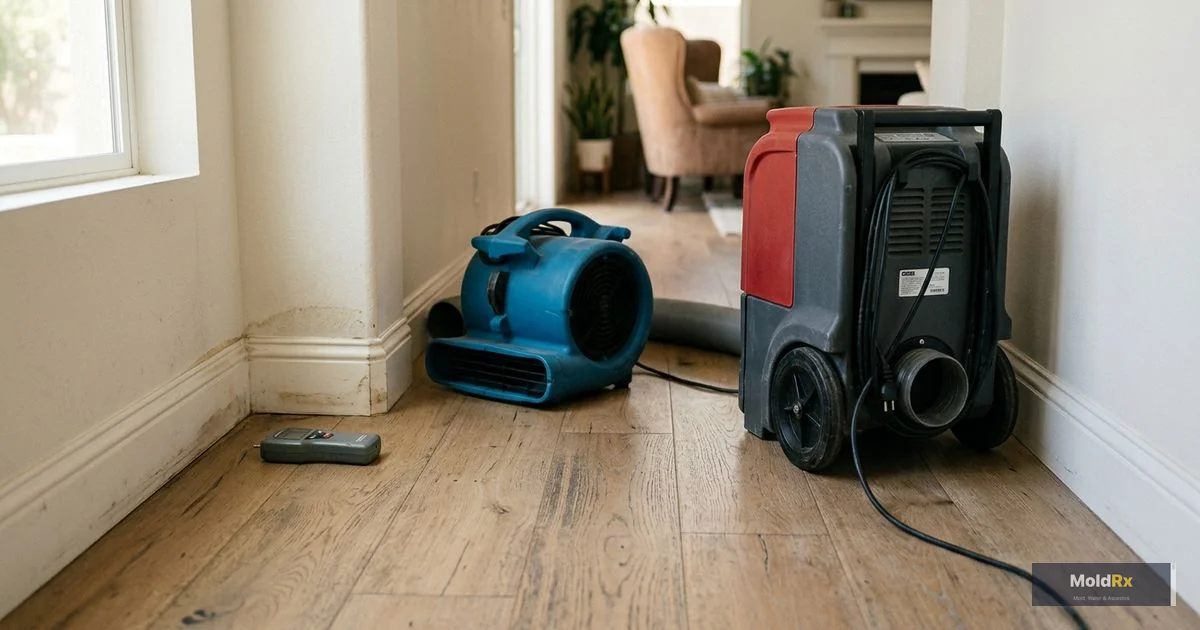
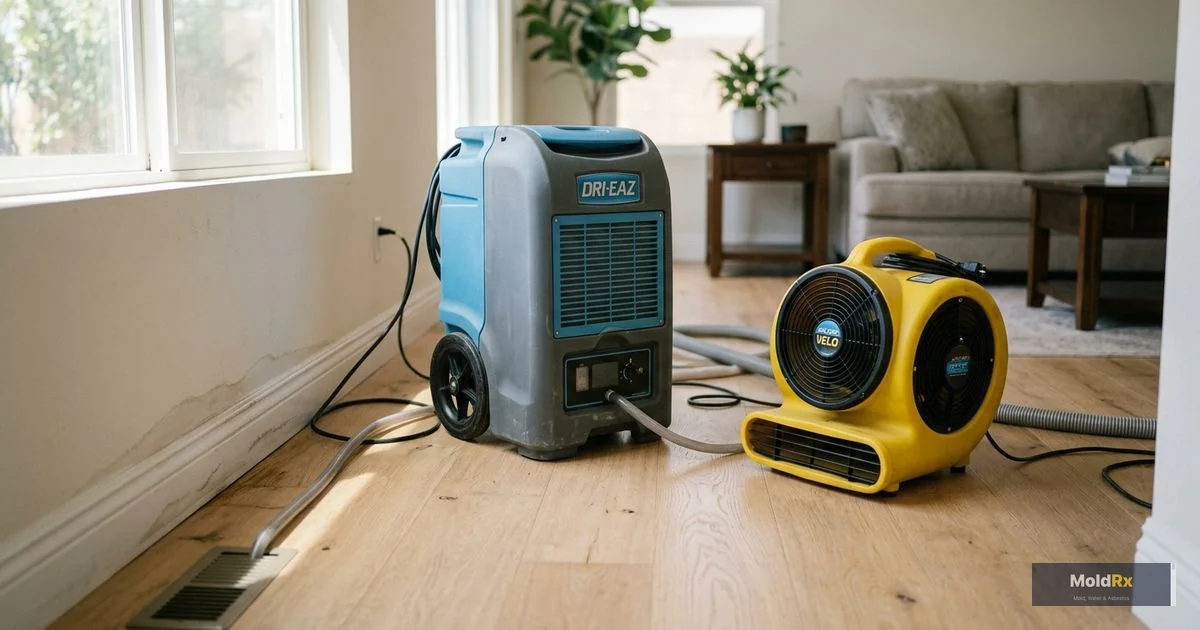
3. Structural Drying and Dehumidification — Commercial-grade dehumidifiers and high-velocity air movers positioned according to psychrometric calculations calibrated for Highland's Inland Empire foothill climate. Highland's typically low outdoor humidity can be leveraged to accelerate drying when properly managed — but improper technique risks overdrying and secondary cracking in materials, especially during summer when ambient temperatures exceed 100 degrees. Wall cavities receive directed airflow through injection drying systems. Slab drying mats address moisture migrating through concrete foundations.
4. Moisture Monitoring and Documentation — Daily moisture readings using pin-type and pinless meters, thermo-hygrometers, and thermal imaging. Every reading logged with timestamps for your insurance adjuster per IICRC S500 standards. In older Highland homes with slab-on-grade foundations and multiple flooring layers, specialized monitoring ensures moisture trapped in dense assemblies is fully addressed. For newer foothill construction, monitoring focuses on moisture that may have entered through foundation-soil interfaces during runoff events.
5. Cleaning, Sanitizing, and Antimicrobial Treatment — Category 2 and Category 3 losses require antimicrobial application to all contacted structural materials. HEPA air scrubbers filter airborne contaminants. Burn scar runoff contamination requires enhanced protocols — sediment removal, surface cleaning, antimicrobial treatment, and air quality verification. All protocols comply with Cal/OSHA safety requirements and IICRC S500/IICRC S520 standards.
6. Restoration and Rebuild — All rebuild work performed by CSLB-licensed professionals. In pre-1980 Highland properties, material removal requires awareness of potential asbestos-containing materials — popcorn ceilings, vinyl flooring, pipe insulation, and textured wall compounds from the 1960s and 1970s are common asbestos sources. Testing before disturbance is standard protocol per EPA and Cal/OSHA regulations.
Insurance Documentation Starts the Moment We Arrive
Delayed response can result in denied claims — insurers argue that secondary damage resulted from failure to mitigate. Professional documentation beginning the moment technicians arrive establishes the timeline insurers need. Most homeowner's policies cover sudden and accidental water damage. Flood damage from mountain runoff, burn scar debris flow, and storm drain overflow typically requires separate flood insurance — and given the active Line Fire burn scar, Highland property owners should verify their coverage immediately.
Our documentation includes timestamped photographs, water category and damage class classification per IICRC S500, daily moisture readings, equipment placement records, drying progress reports, and final verification readings — the objective evidence your adjuster needs to validate the claim.
What to Do Right Now Before We Arrive
- Shut off the water source if you can reach the shutoff safely. For slab leaks, turn off the main supply at the meter. For appliance failures, close the supply valve behind the unit. For water heater ruptures, close the cold water inlet valve.
- Turn off electricity to affected areas at the breaker panel. Never step into standing water near active outlets or electrical connections.
- If water is entering from outside — burn scar runoff, surface flooding, or storm drain backup — do not attempt to block it with towels or barriers. Move to higher ground within the structure, protect yourself and your family first, and call emergency services if the flow is rapid.
- Move valuables to dry ground. Remove documents, photos, electronics, and irreplaceable items from affected rooms.
- Document everything with photos and video before moving anything. This evidence is critical for your insurance claim.
- Do not use a household vacuum on standing water — shock hazard.
- Do not run fans or your HVAC system. You risk spreading contaminated moisture — especially burn scar debris — through ductwork and into unaffected rooms.
- Do not open windows in summer — Highland's extreme heat accelerates mold germination in saturated materials. The dry outdoor air cannot reach moisture trapped inside wall cavities.
- Do not pull up flooring yourself in pre-1980 homes — disturbing original vinyl flooring or adhesives may release asbestos fibers.
Then call (888) 609-8907 immediately.
What Sets MoldRx Apart
- We only send vetted professionals. MoldRx does not operate as a lead aggregator or blind referral service. When we put a team in your home, our reputation goes with them. Every professional has been vetted for CSLB licensing, IICRC S500 certification, insurance, and work quality. If something is not right, you call us directly.
- Fast emergency response. Water damage is the most time-sensitive restoration service that exists. The faster extraction begins, the more of your property we save and the lower the total cost.
- IICRC S500-certified technicians only. Every technician holds current certification and understands Highland's specific conditions — the mountain runoff, the burn scar contamination, the extreme heat, the mixed housing stock from 1960s tract homes to newer foothill construction. Not general handymen guessing at dry times.
- Complete insurance documentation. From the first photo to the final moisture reading, every step documented per IICRC S500 standards with timestamped evidence your adjuster can verify.
- Psychrometric drying science calibrated for Highland's Inland Empire foothill climate — leveraging low outdoor humidity while managing the extreme heat that can cause secondary damage to materials if drying protocols are not properly controlled.
- Burn scar contamination expertise. Our vetted professionals understand the unique hazards of post-fire runoff — sediment contamination, ash residue, enhanced antimicrobial requirements — and follow appropriate protocols.
Highland Neighborhoods We Serve
MoldRx provides emergency water damage restoration throughout Highland and the surrounding Inland Empire communities:
- East Highland / Greenspot — The neighborhoods closest to the mountain base and the Line Fire burn scar. Newer foothill construction from the 1990s through 2010s alongside older 1960s and 1970s homes. These properties face the most direct exposure to mountain runoff, debris flow, and burn scar contamination. Flash flood risk during any significant storm event. Water heaters in 1990s-2000s homes reaching failure age. Slab foundations on foothill soil developing stress fractures.
- Central Highland / Highland Avenue Corridor — The commercial and residential core of the city, with consistent 1970s and 1980s tract home construction. Original plumbing systems now 40 to 55 years old and at peak failure age. Supply line failures, slab leaks, and water heater ruptures are the primary emergency calls. Commercial properties along Highland Avenue face flat-roof ponding and aging drainage infrastructure.
- West Highland / Base Line Corridor — Lower-elevation neighborhoods that receive accumulated runoff from higher terrain to the east and north. The 1960s and 1970s housing stock here has the oldest plumbing in the city. Properties along Base Line face both plumbing failure risk and surface flooding during storm events as water concentrates in the lower terrain.
- Highland Hills — Elevated residential area with 1970s through 1990s construction. Sloped terrain creates drainage patterns that channel runoff toward downhill properties. The combination of slope, aging plumbing, and proximity to mountain terrain creates compound risk during storm events.
- Neighborhoods near Crafton Hills College — Southern Highland, transitioning toward the Redlands border. Mix of 1970s construction and newer development. Properties on higher ground face less runoff risk but the same aging-plumbing vulnerability as the rest of the city.
- Santa Ana River Gorge Area — Properties near the eastern approach to the Santa Ana River gorge face unique exposure to channel overflow and river corridor runoff during major storm events. This area receives drainage from both mountain slopes and upstream watershed.
Coverage includes Highland ZIP codes 92346 and 92404 plus neighboring communities including San Bernardino, Redlands, Yucaipa, Loma Linda, and the mountain communities to the north.
Related Services
- Mold Removal in Highland — If the 24-to-48-hour mold window has passed, IICRC S520 remediation is the next step.
- Asbestos Removal in Highland — Licensed abatement required under Cal/OSHA and EPA regulations when asbestos-containing materials are disturbed during restoration.
-> Learn more about remediation services in Highland
Frequently Asked Questions
How quickly do you respond to water damage emergencies in Highland?
We treat every call as an emergency. Highland sits within our core Inland Empire coverage area. The 24-to-48-hour mold window confirmed by the EPA and IICRC S520 is not flexible — and Highland's extreme summer heat compresses that window to as few as 12 to 18 hours inside sealed wall cavities. Extraction that starts within the first few hours saves exponentially more material and costs exponentially less than extraction that starts the next day.
What should I do first when I discover water damage?
Stop the water source if you safely can. Turn off electricity to affected areas at the breaker panel. Then call (888) 609-8907 immediately. Do not attempt to dry the area with fans or by opening windows — in Highland's summer heat, this accelerates mold growth inside saturated wall cavities. If the water is burn scar runoff, do not enter contaminated standing water without protective equipment.
Does homeowner's insurance cover water damage restoration?
Most policies cover sudden and accidental water damage — burst pipes, failed appliances, water heater ruptures, polybutylene pipe failures. Flood damage from mountain runoff, burn scar debris flow, and storm drain overflow typically requires separate flood insurance. Given the active Line Fire burn scar above Highland, we strongly recommend verifying your coverage immediately. We document every aspect of the restoration per IICRC S500 standards to support your claim from minute one.
Is burn scar runoff more dangerous than regular water damage?
Yes. Burn scar runoff is classified as Category 3 under IICRC S500 — the most hazardous category. It carries ash, charred soil, sediment, road debris, and bacterial contamination from every surface it crosses. The hydrophobic soil created by fire means this water moves faster and carries more debris than normal storm runoff. All contacted porous materials must be removed. Enhanced antimicrobial treatment is required. Full PPE for workers. There is no drying your way through Category 3 contamination — affected materials come out.
How long does water damage restoration take?
A contained Category 1 event in one room may reach dry standard in three to five days. A major event involving multiple rooms, Category 3 burn scar runoff, or slab leak saturation that has been migrating through your foundation for weeks can require one to three weeks. We do not rush the process — incomplete drying leads to mold, and IICRC S520 mold remediation costs far more than doing the drying right the first time.
Will you work with my insurance adjuster?
Yes. We provide complete technical documentation — photos, moisture readings, drying logs, equipment records, verification data — directly to your adjuster per IICRC S500 standards. For burn scar runoff events, documentation includes contamination assessment and sediment analysis that supports the Category 3 classification your adjuster needs to see. Documentation begins the moment our team arrives.
Do I need mold testing after water damage?
If professional drying began within 24 hours and moisture readings confirm dry standard, testing may not be necessary. But if response was delayed, if Highland's extreme heat may have compressed the mold window, or if Category 2/Category 3 water was involved — including any burn scar runoff — we strongly recommend post-restoration mold testing to confirm no colonization occurred.
Get Emergency Water Damage Restoration in Highland Now
Water damage is an active emergency that gets worse with every hour. The materials in your home are absorbing water right now. Mold spores are finding the moisture they need. Whether it is a burst supply line in a 1970s tract home, a polybutylene pipe failure in a 1980s property, a slab leak that has been saturating your foundation for weeks, a water heater that just dumped 50 gallons across your garage floor, burn scar runoff from the Line Fire pushing contaminated debris flow against your foundation, or flash flooding from a thunderstorm like the September 2025 event that carved through Highland with 50 mph winds and torrential rain — waiting makes everything worse. In Highland's extreme heat, the 24-to-48-hour mold window compresses to as few as 12 to 18 hours inside sealed wall cavities.
MoldRx only sends vetted water damage restoration professionals who follow IICRC S500 standards, carry current CSLB licensing, and understand Highland's unique position at the base of the San Bernardino Mountains — the mountain runoff, the active Line Fire burn scar, the extreme Inland Empire climate, the mixed housing stock from 1960s tract homes to newer foothill construction, and the burn scar contamination protocols that define water damage restoration in Highland right now. Every technician complies with Cal/OSHA safety standards and EPA guidelines for contaminated water handling. Full documentation for your insurance claim starts the moment we arrive.
Every hour matters. Do not wait.
Call MoldRx now for emergency water damage restoration — (888) 609-8907. Fast response. Professional extraction. Complete insurance documentation.