Document everything from the moment you discover water damage — before you clean anything. That single piece of advice separates homeowners who receive full insurance settlements from those who fight for months over underpayments. Your insurer doesn't pay claims based on what happened. They pay based on what you can prove happened.
Adjusters evaluate evidence. When documentation is thorough, objective, and well-organized, claims move faster and settlements reflect the actual scope of damage. When it's thin or disorganized, adjusters have room to dispute scope, question timelines, and reduce payouts. This guide covers exactly what to document, how to document it, and when. If you're dealing with active water damage right now, also see our guide on what to do in the first 24 hours after water damage.
Step 1: Photograph and Video Everything Before You Clean Anything
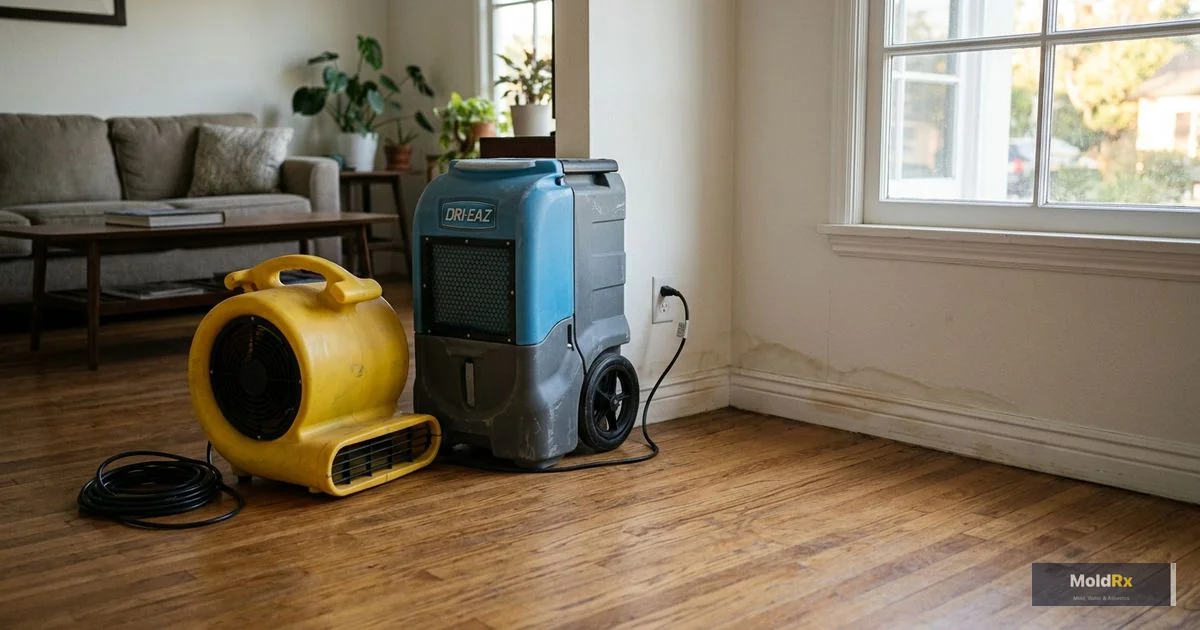
This is the most important documentation step, and the one most homeowners skip or rush through. Once you've addressed immediate safety concerns — shutting off the water source, turning off electricity to affected areas if safe to do so — pick up your phone and record before you touch anything else.
Your goal is to create an uneditable visual record of the damage in its original state. This evidence establishes the scope of the event and supports the "sudden and accidental" classification that your insurance policy requires for coverage.
What to Photograph
The water source. If you can identify where the water came from — a burst pipe, a failed appliance hose, a ruptured water heater — photograph it from multiple angles. Get close-up shots of the failure point and wider shots showing its location in the home. This is critical evidence. The source determines whether your damage is covered (sudden pipe burst) or excluded (gradual leak from corroded fitting).
Standing water and water lines. Photograph standing water in every affected area. Capture water lines on walls — place a ruler, tape measure, or common object like a credit card next to the water line to establish scale. These measurements matter when adjusters calculate the volume of water involved and the extent of material damage.
Every affected room and area. Don't limit documentation to the obvious damage. Water travels — through walls, under flooring, into adjacent rooms, and down to lower levels. Photograph:
- The primary damage area from multiple angles (at least four corners of each room)
- Adjacent rooms, even if they appear dry — damage may become visible later
- Hallways, closets, and spaces between the water source and the visible damage
- The room or area directly below the damage (water follows gravity)
- Ceilings, baseboards, and areas where walls meet floors
Damaged materials and belongings. Photograph damaged drywall, flooring, cabinetry, trim, and any structural elements showing water exposure. For personal property — furniture, electronics, clothing, documents — photograph each item individually before moving it. If items are submerged or sitting in water, photograph them in place first.
Pre-existing conditions. If areas of your home were in good condition before the water event, any photos you have from before the damage (real estate listings, renovation photos, holiday photos with rooms in the background) become valuable evidence of prior condition.
Photo Tips That Matter
Use your phone's standard camera app at its highest resolution — no portrait mode, no filters, no editing. Verify that your camera's timestamp and location metadata are enabled, as this data proves when and where each photo was taken. Shoot with full lighting (turn on every light, use flash in dark spaces), and for each area take both wide shots (full room context) and close-ups (specific damage detail). Place a ruler or credit card next to damage for scale. Don't delete anything — even a blurry photo's timestamp has value.
Video Documentation
Walk through every affected area recording continuous video. Narrate as you go — state the date and time at the beginning, describe what you're seeing, and identify rooms and specific damage. Video captures what photos miss: the sound of running water, the extent of saturation when you step on carpet, water actively dripping, and the overall scope in a way individual photos can't convey. Record at least one full walkthrough before any cleanup begins, and additional videos as restoration reveals hidden damage.
Step 2: Build a Detailed Written Timeline
A written timeline is the backbone of your claim narrative. It establishes when damage occurred, when you discovered it, how quickly you responded, and what actions you took — all facts your adjuster evaluates.
Start your timeline the moment you discover the damage and continue updating it throughout the restoration process. Include:
- Date and time of discovery — when you first noticed water, what drew your attention to it, and what you observed
- Immediate actions taken — shutting off the water source, turning off electricity, moving belongings, contacting emergency services if applicable
- Date and time you contacted your insurance company — the claim number assigned, the name of the representative you spoke with, and what they told you
- Date and time you contacted a restoration company — who you called, when they arrived, what they found during their initial assessment
- Every action taken during mitigation and restoration — water extraction start/end times, material removal, equipment setup, daily drying activities
- All communication with your insurance company — every phone call, email, and in-person interaction, with dates, times, names, and summaries of what was discussed
- Adjuster visit dates and findings — when they came, what they inspected, what they said, what they requested
Write this timeline contemporaneously — as events happen, not from memory days later. A timeline written in real time carries far more weight than one reconstructed after the fact. Use your phone's notes app, a notebook, or a simple document. The format doesn't matter. The completeness and accuracy do.
Step 3: Get Professional Documentation — Moisture Readings, Drying Logs, and Scope of Work
This is where claims are won or lost. Homeowner photos and timelines establish the narrative. Professional documentation provides the objective, technical evidence that adjusters need to approve the full scope of work and associated costs.
When you engage a qualified water damage restoration company, they produce documentation that no homeowner can replicate on their own.
Moisture Assessment and Thermal Imaging
Professional restorers use calibrated moisture meters and infrared thermal imaging cameras to measure moisture content in every affected material — drywall, framing, subfloor, concrete, insulation. These readings establish the full scope of water intrusion, including areas where damage isn't visible. Water travels through wall cavities, along framing, and under flooring in ways that aren't apparent from surface inspection. An adjuster may only see the obvious damage. Moisture readings and thermal images document what's happening inside walls, under tile, and behind cabinetry — creating a baseline map of the entire intrusion that's difficult to dispute because it's based on objective measurement, not opinion.
Daily Drying Logs
Professional restorers take moisture readings throughout drying — typically daily — logging readings at each monitoring point, equipment in use with run times, ambient conditions, and materials removed. These logs serve two critical purposes: they demonstrate proper, consistent mitigation (proving you met your policy's duty to mitigate), and they justify the drying duration and equipment. If your insurer questions why drying took five days instead of three, the moisture logs show exactly why.
Scope of Work
The restoration company's scope is a detailed, line-item document covering every task required to restore your property — water extraction, material removal, structural drying, cleaning, antimicrobial treatment, reconstruction, and any mold remediation needed. Most restoration companies use Xactimate, the same estimating platform your adjuster uses, which streamlines settlement. When scope and estimate align, claims move quickly. When there's a gap, the professional scope — backed by moisture data — provides the basis for negotiation.
Step 4: Document All Expenses and Losses
Your policy covers more than just the physical restoration. Most homeowner's policies include coverage for personal property damage and additional living expenses (ALE) — but only with documentation.
Personal Property Inventory
Create a detailed inventory of every damaged item: description, brand/model, approximate age, and estimated replacement cost. Photograph each item before disposal. Your policy pays either actual cash value (depreciated) or replacement cost depending on coverage type — either way, a detailed inventory with photos supports the calculation.
Additional Living Expenses (ALE)
If your home is uninhabitable during restoration, ALE coverage reimburses costs above your normal living expenses — hotel stays, restaurant meals, laundry, pet boarding. Save every receipt and keep a running log with dates. ALE doesn't reimburse expenses you'd incur anyway, so documentation must distinguish between displacement costs and normal living costs.
Mitigation and Emergency Expenses
Save receipts for everything you spend on immediate mitigation: equipment rentals, cleaning supplies, protective gear. Your policy covers reasonable mitigation expenses, but "reasonable" requires receipts and context — a timeline entry explaining why you rented a wet/dry vacuum at 11 PM connects the expense to the emergency.
Step 5: Understand What Adjusters Are Actually Looking For
Insurance adjusters evaluate water damage claims against specific criteria. Understanding what they're looking for helps you provide the right evidence.
Cause of loss. Was the damage sudden and accidental (covered) or gradual and maintenance-related (excluded)? Your documentation of the water source, the condition of the failed component, and your response timeline all inform this determination. Photos of the failed pipe, the burst hose, or the ruptured water heater — taken before repair — are essential. For more on how the type of water event affects your claim, see our guide on water damage categories explained.
Timeline and response. How quickly did you discover and respond? A timeline showing discovery at 6 AM, source shut off at 6:05, documentation started at 6:15, insurer called at 8 AM, and restoration company on site by noon tells adjusters the response was well-managed. Gaps invite questions.
Scope of damage. Professional moisture readings documenting damage behind walls and under floors establish scope that visual inspection alone underestimates. Your documentation provides the basis for getting the full scope approved.
Mitigation adequacy. Drying logs, equipment records, and progress photos demonstrate proper mitigation. This matters especially if mold develops — documented professional drying proves you met your duty to mitigate, keeping mold coverage intact.
Cost justification. Line-item scopes, equipment logs, and industry-standard estimates (Xactimate) give adjusters the justification they need. Vague or undocumented costs get questioned or denied.
Common Documentation Mistakes That Cost Homeowners Money
These errors weaken claims, invite disputes, and result in underpayment or denial. Every one is avoidable.
Cleaning up before documenting. The most expensive mistake. Once you mop up water or tear out materials, the original evidence is gone. Photos and videos from before cleanup are the only record of the damage as it existed.
Discarding materials before the adjuster inspects. Damaged drywall, flooring, and personal property are evidence. Don't dispose of anything until your adjuster has documented it or explicitly approved disposal. If materials must be removed for drying access, photograph them in place and after removal.
Incomplete photo coverage. Photographing only the worst room while ignoring adjacent areas. Water damage is rarely contained to one space. Document every room, closet, and level water could have reached.
No timestamps or written records. Photos without metadata can be challenged. "I think I called the insurance company on Tuesday" is weaker than "Called claims line at 9:12 AM Tuesday, March 3. Spoke with Janet. Claim #WD-2026-45891." Write everything down as it happens — including every conversation with your insurer.
Skipping professional documentation. Without moisture readings, drying logs, and a scope of work, you're relying on the adjuster's single-visit assessment as the sole basis for settlement. Professional documentation often identifies 20-40% more affected area than visual inspection alone.
Waiting too long to document mold. Mold appearing within days of a covered water loss is clearly related. Mold discovered weeks later is harder to connect — and easier for your insurer to attribute to failure to mitigate. Understanding how water damage leads to mold helps you anticipate and document this connection.
Accepting the first offer without review. If your professional documentation shows a larger scope or higher costs than the adjuster's estimate, you have the right and the evidence to negotiate.
Frequently Asked Questions
What should I photograph first after water damage?
The water source. Identifying and documenting the cause of the loss — a burst pipe, failed appliance, ruptured fitting — is the most important piece of evidence for your claim. It establishes whether the damage falls under covered (sudden and accidental) or excluded (gradual, maintenance-related) categories. After the source, photograph standing water with scale references, then systematically document every affected area.
How many photos should I take for an insurance claim?
There is no upper limit, and more is always better. A thorough documentation effort for a single-room water damage event might produce 50-100 photos and several minutes of video. Multi-room events can require hundreds of photos. Take wide shots, close-ups, and detail shots of every affected area. Storage is free — a missed photo can cost you thousands in an underpaid claim.
Can I use my phone to document water damage?
Yes. Modern smartphones produce more than adequate photos and video for insurance purposes. They embed timestamps and GPS coordinates automatically, they're always accessible, and they require no special knowledge. Use the standard camera app — no filters, no portrait mode, no editing.
Should I document damage even if I'm not sure I'll file a claim?
Yes. Document everything regardless. You have a limited window to capture damage in its original state, and you can't recreate that evidence later. The decision to file a claim can be made after you understand the scope and costs involved. The decision to document must be made immediately.
What if I already cleaned up before taking photos?
Document the current state thoroughly — whatever remains is still valuable. Photograph any damage still visible: water stains, warping, discoloration, material deterioration. Contact a restoration company for professional moisture readings, which can detect hidden water damage that may not be visible on the surface. Be honest with your adjuster about the timeline. Partial documentation is better than none, and professional moisture data can fill significant gaps.
Do I need to keep damaged items?
Yes, until your adjuster has inspected them or explicitly approved disposal. Damaged materials — drywall, flooring, insulation, personal property — are evidence. If you must remove materials before the adjuster visits (for drying access, safety, or to prevent mold), photograph everything thoroughly in place and after removal. Store removed materials in a garage or covered area if possible, and inform your adjuster that materials were removed with photo documentation.
How do professional moisture readings help my insurance claim?
They transform your claim from subjective to objective. Instead of "the wall was really wet," your documentation shows "drywall at measurement point 7 registered 89% moisture content on day one, decreasing to 14% by day four." This data establishes full scope (including non-visible damage), justifies the drying timeline, and proves proper mitigation — all factors adjusters evaluate when determining settlements.
What if my adjuster's estimate is lower than the restoration company's?
This is common, and it's exactly why professional documentation matters. Your restoration company's scope of work — supported by moisture readings, thermal imaging, drying logs, and detailed measurements — provides the evidence to request reconsideration. Present the discrepancy with supporting data and ask your adjuster to reconcile the difference. If the gap persists, most California policies include an appraisal clause, and you can also consult a public adjuster. For more on navigating the claims process, see our guide on water damage insurance claims in California.
How does mold documentation work for insurance claims?
Mold resulting from a covered water event is typically covered under your policy's mold sub-limit. To maintain that coverage, you need documentation connecting the mold to the original water event — timestamps showing mold appeared within days of the loss, not weeks or months later. You also need evidence that professional drying was performed promptly, demonstrating you met your duty to mitigate. If mold develops despite documented professional drying, that documentation proves the mold wasn't caused by your negligence — keeping coverage intact.
Is there an app or tool I should use for documentation?
Your phone's native camera app is the best tool for photos and video — it embeds metadata reliably and requires no setup. For the written timeline, any notes app or even a physical notebook works. The format matters less than the content and consistency. Some homeowners use cloud-based document apps (Google Drive, iCloud, Dropbox) to organize and back up their documentation — this is a good practice for ensuring nothing is lost, but it's not required for the claim itself.
Protect Your Claim With the Right Documentation
The quality of your documentation directly determines the quality of your insurance settlement. Thorough, timestamped, professionally supported evidence leaves adjusters with the data they need to approve claims fully. Thin documentation leaves room for dispute, underpayment, and denial.
You can produce strong documentation yourself — photos, video, timelines, and receipts are all within any homeowner's capability. But the professional layer — moisture readings, thermal imaging, drying logs, and a detailed scope of work — provides the objective, technical evidence that transforms a claim from "the homeowner says" to "the data shows."
MoldRx coordinates water damage restoration and mold remediation services throughout Orange County, Riverside County, and San Bernardino County — including the comprehensive documentation that adjusters need to approve claims at their full, legitimate scope. Every project includes moisture mapping, daily drying logs, progress photography, and a detailed scope of work prepared in Xactimate format.
Call (888) 609-8907 or request a free estimate to talk with a MoldRx specialist about your water damage, your documentation needs, and the steps that protect both your property and your insurance claim.
Water Damage Restoration → · Mold Removal → · Free Estimate →