Mold begins colonizing wet building materials within 24 to 48 hours of water damage if those materials aren't dried properly. That's not a worst-case scenario — it's what happens under normal indoor conditions when moisture stays where it shouldn't. The connection between water intrusion and mold growth isn't speculative. It's a biological process that follows predictable rules, and understanding those rules is the difference between a water damage cleanup and a mold remediation project.
If you're reading this after a water event, the most important thing to know is that time is the variable you can still control. Water damage that gets dried quickly and thoroughly almost never becomes a mold problem. Water damage that doesn't get dried — or doesn't get dried in the right places — almost always does.
This guide explains how water creates the conditions mold needs, what happens at each stage, where the hidden risks are, and why the relationship between water damage restoration and mold remediation matters more than most property owners realize.
The Science: Why Water Damage and Mold Are Biologically Linked
Mold isn't something that invades your home from outside after water damage. The spores are already there — a normal component of indoor and outdoor air, present in virtually every building, settling on surfaces and remaining dormant. Under normal dry conditions, they're harmless background noise.
What changes after water damage is the environment those spores land in. Mold needs four things to grow:
- Moisture — the critical variable that water damage provides
- An organic food source — drywall paper, wood, carpet fibers, insulation, dust
- Temperatures between roughly 40°F and 100°F — with optimal growth between 77°F and 86°F
- Oxygen — present in every room of your home
Three of those four conditions exist permanently in every building. The only missing ingredient under normal circumstances is sustained moisture. Water damage supplies it.
This is why the connection between water damage and mold isn't a risk factor — it's a cause-and-effect relationship. When building materials get wet and stay wet, mold growth isn't a question of if. It's a question of when, and the answer is measured in hours, not weeks.
The Timeline: From Water Event to Active Mold Colony
Understanding the progression from water intrusion to established mold helps explain why response speed matters so much — and why delays of even a day or two can fundamentally change the outcome. For a deeper look at the speed of mold colonization specifically, see our guide on how fast mold grows after water damage.
Hours 0-24: Absorption and Saturation
The moment water contacts building materials, absorption begins. Drywall can absorb water several inches above the visible waterline through capillary action — a process called wicking. Carpet padding acts like a sponge, holding many times its weight in water. Wood framing absorbs moisture and swells. Insulation inside wall cavities becomes saturated.
During this phase, dormant mold spores that are already present on these surfaces begin to encounter the moisture they need. No visible mold exists yet, and no colonization has started. This is your highest-leverage intervention window. Proper extraction and drying initiated during this phase can prevent mold growth entirely.
Hours 24-48: Germination Begins
Mold spores on surfaces that have remained wet for 24 hours or more begin to germinate. They extend microscopic filaments called hyphae into the material they're sitting on — literally rooting into drywall paper, wood grain, or carpet fiber. This process is invisible to the naked eye but represents the beginning of active colonization.
At this stage, the growth is still reversible with aggressive drying. If materials are brought below the moisture threshold mold needs — typically below 60% moisture content — germination stalls and the process stops. But the window is closing. Every hour that materials remain wet, colonization progresses further.
Days 3-12: Visible Growth Appears
Mold colonies that established themselves in the first 48 hours now become visible. You may see discoloration on walls, fuzzy growth on baseboards, dark spots on drywall, or staining on carpet. A musty odor often becomes noticeable — the result of microbial volatile organic compounds (MVOCs) that growing mold produces.
Once mold reaches the visible stage, drying alone is no longer sufficient. The mold has already colonized the material. You're no longer preventing mold — you're dealing with an active mold problem that requires remediation: containment, removal of affected materials, HEPA filtration, and antimicrobial treatment.
Weeks 2-4: Spreading and Secondary Colonization
Established colonies produce massive quantities of spores that become airborne and travel through the building — via HVAC systems, natural air currents, and open pathways between rooms. What began as a single affected area behind a wet wall can become a multi-room problem, spreading to adjacent rooms and even upper floors through wall cavities that act as vertical highways for airborne spores.
Beyond One Month: Structural and Systemic Damage
Long-term colonization causes structural degradation — wood framing loses integrity, drywall crumbles, insulation becomes permanently contaminated, and HVAC ductwork harbors colonies that redistribute spores every time the system runs. What started as a water damage event has become a building health crisis requiring extensive remediation.
Why Professional Drying Prevents Mold
The difference between water damage that stays a water damage problem and water damage that becomes a mold problem almost always comes down to how thoroughly and quickly the affected area was dried.
Professional water damage restoration isn't just about removing visible water. It's a systematic process designed to eliminate moisture from every material and space the water reached, including the ones you can't see.
What Professional Drying Actually Involves
Moisture mapping uses specialized meters and thermal imaging to identify exactly where water has traveled. Water follows gravity, capillary action, and the path of least resistance — a leak in one location can saturate materials ten or fifteen feet away. Moisture mapping reveals the full extent, not just the obvious wet spots.
Industrial extraction equipment removes standing water and pulls moisture from carpet, padding, and other saturated materials far more effectively than household wet/dry vacuums. Commercial extractors can remove water that has soaked deep into materials.
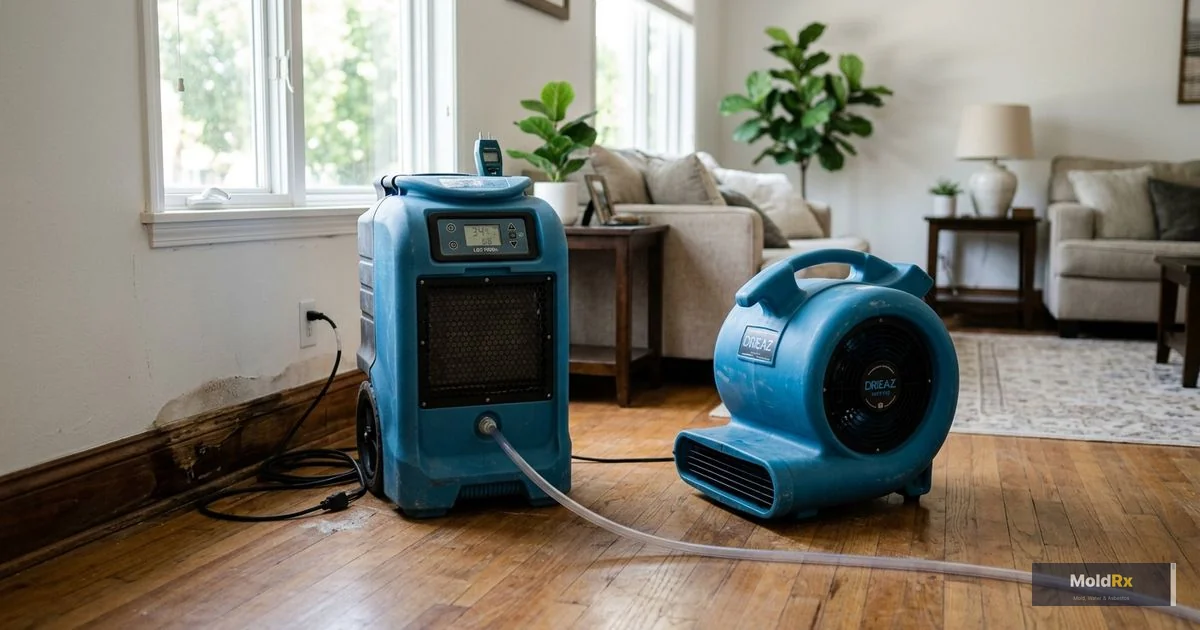
Commercial dehumidifiers and air movers create specific airflow patterns and humidity differentials that force moisture out of wall cavities, subfloors, and other enclosed spaces where household equipment can't reach. This isn't comparable to running a box fan from the hardware store.
Daily moisture monitoring tracks drying progress with quantitative measurements. Technicians take readings throughout the affected area every day, adjusting equipment placement as materials dry. The process continues until all materials reach acceptable moisture levels — not until things look dry, but until they measure dry.
This systematic approach is why professional drying prevents mold. It addresses moisture in every location water reached, verifies that drying is complete with objective measurements, and finishes the job within the critical window before mold colonization advances beyond the reversible stage.
What Happens When Water Damage Isn't Dried Properly
The scenarios that lead to mold after water damage follow a predictable pattern.
Surface Drying Without Structural Drying
This is the most common mistake. The visible water gets cleaned up, fans run for a day or two, and the surface feels dry. But moisture trapped inside wall cavities, beneath flooring, and in insulation hasn't been addressed. These enclosed spaces have minimal airflow and take far longer to dry than exposed surfaces.
The surface looks fine. The structure behind it is still wet. Mold grows where the moisture is — behind the drywall, under the flooring, inside the wall cavity — and it may be weeks or months before any sign appears on the visible side.
Delayed Response
Every hour matters in the first 48 hours after water damage. A pipe that bursts on Friday evening and isn't addressed until Monday morning has given mold 60+ hours of ideal growing conditions. If you're unsure what to prioritize, our guide on what to do in the first 24 hours after water damage walks through the critical steps in order.
The delay doesn't need to be dramatic. Even 24 hours of inaction — waiting to see if things "dry out on their own" — can push the situation past the prevention window and into mold territory.
Incomplete Water Removal
Removing water from the floor but leaving saturated carpet padding in place. Drying a bathroom but not addressing the wet wall cavity shared with the adjacent bedroom. Cleaning up a kitchen flood but not checking whether water migrated under cabinetry. Each of these leaves moisture behind in exactly the hidden, enclosed spaces where mold thrives.
Ignoring Category 2 or Category 3 Water
Water from a sewage backup, exterior flood, or washing machine overflow carries contaminants that actually accelerate mold growth. These water damage categories dictate different protocols — contaminated water that isn't properly disinfected creates conditions where mold colonizes even faster than it would from clean water.
Hidden Moisture Means Hidden Mold
Mold grows where moisture is, not where you can see it. And after water damage, moisture is almost always present in places you can't see.
Inside Wall Cavities
When water soaks into drywall — whether from a pipe leak, a roof intrusion, or exterior flooding — it saturates the back side of the drywall, the insulation behind it, and potentially the wood framing. The painted front surface of the wall may dry within a day. The cavity behind it can stay wet for weeks, especially without airflow.
Mold colonizes the back face of the drywall and the paper facing of insulation — surfaces hidden from view. The first sign from outside may be paint bubbling, musty odors, or dark staining bleeding through the wall surface. By that point, the mold has been growing for a long time.
Under Flooring
Water that pools on a floor and gets mopped up still leaves moisture beneath the flooring surface. Hardwood and laminate flooring trap water between the floor material and the subfloor. Carpet padding can hold enormous amounts of water even after the carpet surface feels dry. Vinyl and tile can trap moisture underneath with no visible indication.
The subfloor — typically plywood or OSB — absorbs water readily and dries slowly. In a slab-on-grade construction common in Southern California, moisture can become trapped between the slab and the flooring material with virtually no way to evaporate without active intervention.
Behind Cabinetry and Built-Ins
Kitchen and bathroom floods often send water behind cabinets, under vanities, and into enclosed spaces that don't get checked during surface cleanup. These areas combine moisture, organic materials, and poor airflow — the perfect formula for hidden mold.
In HVAC Systems
If water damage affects return air ducts, air handler compartments, or supply runs, moisture inside the HVAC system can support mold that gets distributed throughout the building every time the system operates — one of the mechanisms by which a localized water event becomes a building-wide mold problem.
Why One Company for Both Matters
Water damage restoration and mold remediation are treated as separate services by the restoration industry. But from the property owner's perspective, they're two phases of the same problem — and having a single team that handles both creates meaningful advantages.
Continuity of Knowledge
The team that dried your property knows exactly where the water went, which materials were affected, how long they were wet, and how drying progressed. If mold develops — in a hidden cavity that was wet longer than expected — that team already has the context. A separate mold company starts from zero, often requiring invasive investigation to figure out what the drying team already knew.
Prevention-First Approach
A company that handles both water damage and mold has a direct incentive to dry your property thoroughly the first time — because they know exactly what happens when drying fails. Their drying protocols are informed by mold remediation experience. They know which materials, locations, and conditions are most likely to develop mold, and they target those areas with extra attention during drying.
No Gaps Between Services
When water damage and mold are handled by different companies, there's often a gap — scheduling delays, re-assessment, new contracts, second mobilizations. With a single provider, if monitoring during drying reveals a developing mold issue, the response is immediate rather than delayed by the logistics of bringing in a new team.
Clear Accountability
When two companies are involved, liability questions arise. The mold company says drying was inadequate. The drying company says mold was pre-existing. A single company that handles both can't point fingers — the accountability is clear, and the incentive is to get the job done right from start to finish.
MoldRx coordinates both water damage restoration and mold remediation as integrated services, precisely because we've seen too many cases where the gap between the two created worse outcomes for property owners.
Frequently Asked Questions
Does water damage always cause mold?
Not always — but it will if the affected materials aren't dried within approximately 48 hours. Mold growth after water damage isn't random. It's a direct consequence of building materials staying wet long enough for dormant spores to germinate. Proper drying within the critical window prevents mold in the vast majority of cases.
How long after water damage does mold start?
Mold spores can begin germinating on wet surfaces within 24 to 48 hours. Visible mold typically appears within 3 to 12 days. The exact timing depends on temperature, humidity, material type, and airflow conditions. For a detailed breakdown, see how fast mold grows after water damage.
Can I prevent mold after water damage by running fans?
Fans help dry exposed surfaces, but they don't address moisture trapped inside wall cavities, under flooring, or in insulation. Surface drying without structural drying is one of the most common reasons water damage leads to mold. Professional drying uses commercial dehumidifiers, air movers, and moisture monitoring to dry the entire affected area — not just what you can see.
Is mold after water damage covered by insurance?
Most homeowners insurance policies cover mold resulting from a sudden, accidental water event — like a burst pipe or appliance failure. Mold from long-term neglect or gradual leaks is typically excluded. Filing promptly and documenting professional drying efforts strengthens your coverage position. Your restoration company can provide the documentation your insurer needs.
How do I know if water damage caused mold behind my walls?
The most reliable indicators are a persistent musty smell, paint bubbling or peeling, discoloration bleeding through walls, or unexplained respiratory symptoms. If you had water damage in the area — even months ago — and notice any of these signs, investigation is warranted. See our guide on signs of mold behind walls for a detailed breakdown.
Can I clean up water damage myself and avoid mold?
It depends on the scope. Small, contained incidents with clean water can be handled by homeowners who act quickly and dry thoroughly. Larger events, contaminated water, water that reached wall cavities, or any situation where materials have been wet for more than 24 hours generally require professional equipment. Our guide on handling water damage yourself covers the decision in detail.
What does mold from water damage smell like?
Mold produces microbial volatile organic compounds (MVOCs) that create a distinctive musty, earthy odor — often described as smelling like a damp basement or wet cardboard. The smell is strongest in enclosed or poorly ventilated spaces. If you notice a musty odor after water damage, colonization has likely progressed beyond the early stages.
How long does professional drying take after water damage?
Professional drying typically takes 3 to 5 days for moderate water damage, though complex situations can take longer. The process continues until moisture readings in all affected materials reach acceptable levels — not until things appear dry, but until instruments confirm they're dry. That thoroughness is what prevents mold.
If I had water damage months ago and didn't do anything, do I have mold?
If building materials got wet and were never properly dried, the probability of mold growth is high — especially in hidden spaces like wall cavities, under flooring, and behind cabinetry. Mold growing for months is typically well-established and may have spread beyond the original area. Professional assessment with moisture meters and, if indicated, mold testing can determine the current situation.
Is mold after water damage dangerous?
Active mold produces airborne spores and MVOCs that can trigger respiratory symptoms, allergic reactions, headaches, and aggravate asthma. Children, elderly individuals, and people with compromised immune systems are more vulnerable. The risk increases with colony size and duration of exposure.
The Bottom Line: Water Damage and Mold Are the Same Problem
Every mold remediation project MoldRx has been involved with started with water — a burst pipe, a roof leak, a slab leak, a slow drip behind a wall that went unnoticed for months. The mold was always the second chapter of a story that began with water.
Treating water damage and mold as separate problems doesn't work. The water creates the conditions. The mold is the consequence. Preventing the consequence means addressing the conditions — completely, quickly, and with the thoroughness that only proper equipment and moisture verification can provide.
If you're dealing with water damage now, the clock is running. Fast, thorough drying is the single most effective thing you can do to prevent a mold problem. If your water damage happened days, weeks, or months ago and you're not sure whether it was dried properly — or you're noticing signs that suggest mold may already be growing — professional assessment can tell you exactly where you stand.
Call (888) 609-8907 or request a free estimate to speak with a MoldRx specialist about your situation. We coordinate water damage restoration and mold remediation as integrated services across Orange County, Riverside County, and San Bernardino County — because stopping mold starts with stopping the water.