Emergency Water Damage Restoration in Huntington Beach, CA -- MoldRx
Vetted, IICRC S500-Certified Specialists Serving Huntington Beach and Coastal Orange County -- 24/7
Water is inside your Huntington Beach property right now, and it is not waiting for you to figure out a plan. It is wicking into drywall. Warping subfloor. Saturating insulation behind walls you cannot see. In a coastal city where ambient humidity regularly exceeds 70%, the window between "water damage" and "mold colonization" is not the standard 48 hours -- it is shorter. 24 to 48 hours is the outer limit. In Surf City's salt-heavy, moisture-laden air, that clock runs faster than anywhere inland. If water has entered your home, stop reading and call.
Call (888) 609-8907 now for emergency water damage response in Huntington Beach.
MoldRx does not perform restoration work ourselves. We vet the specialists who do. Every water damage professional we send to your Huntington Beach property has been screened for IICRC S500 certification, proper CSLB licensing, verified insurance, and documented experience handling the exact building types, coastal conditions, and water-damage scenarios that define this city. You get the right crew -- not whoever happens to answer the phone at 2 AM.
Why Water Damage in Huntington Beach Is a Different Emergency
Huntington Beach is not a generic Southern California suburb. It is ten miles of direct Pacific Ocean coastline, 203,000 residents, and a housing stock overwhelmingly built between the 1950s and 1970s -- the exact era when this city exploded from a small beach town into the fastest-growing city in the continental United States. That combination of coastal environment and aging construction creates water damage conditions you will not find in Riverside, San Bernardino, or even most of inland Orange County.
The 1950s-1970s Building Boom and What It Left Behind
The city's population surged from roughly 11,000 in 1950 to over 115,000 by 1970. Tens of thousands of homes went up in a compressed window -- tract homes, ranch-style houses, and planned communities that now define neighborhoods from Edwards Hill to Goldenwest to Huntington Harbour.
Those homes are now 50 to 70+ years old, with plumbing systems -- galvanized steel, early copper supply lines, cast iron drain pipes -- at or well past their expected lifespan. What makes this infrastructure uniquely vulnerable is the coastal environment it has been sitting in for half a century.
The failure points converging right now:
- Galvanized and early copper supply lines corroded by decades of salt-air exposure and coastal water chemistry, developing pinhole leaks that run undetected inside walls for weeks
- Cast iron drain pipes reaching catastrophic failure age -- these pipes have a 50-80 year lifespan, and thousands of Huntington Beach homes are hitting that window simultaneously
- Slab leaks caused by sandy soil shifting, decades of ground settlement, and pipes stressed by the same corrosive conditions that eat everything metal near the coast
- Water heater failures in garages and utility closets -- the salt air accelerates tank corrosion, shortening the already-limited 10-15 year lifespan of standard residential units
- Original and second-generation appliance connections -- washing machine supply hoses, dishwasher lines, refrigerator ice-maker feeds -- brittle from age and salt exposure
Ocean Humidity: The Accelerant That Changes Everything
Huntington Beach sits directly on the Pacific -- not five miles inland, not buffered by a mesa, directly on it. Morning marine layer rolls through Sunset Beach, Huntington Harbour, and the Bolsa Chica corridor almost daily from May through September, pushing relative humidity past 80%. Even in drier months, humidity hovers around 65-75%.
In a dry inland city, a supply-line leak behind a wall might take five to seven days to generate visible mold. In Huntington Beach, that timeline compresses dramatically. Wet building materials cannot shed moisture when the surrounding air is already saturated. Opening windows lets more humid ocean air in. The physics of evaporation require a vapor-pressure differential that does not exist in a coastal home without commercial-grade dehumidification. The environment is working against you from the moment water enters your home.
Bolsa Chica, Huntington Harbour, and Flood Exposure
Huntington Beach has documented flood history stretching back to 1825. The city's geography creates multiple flooding vectors that most homeowners do not fully appreciate until water is inside their property:
- The Bolsa Chica Wetlands and lowland corridor -- properties near the Ecological Reserve sit at some of the city's lowest elevations, with oil extraction-induced subsidence dropping ground levels further. In January 2023, king tides surged across Bolsa Chica State Beach and onto PCH, closing all lanes between Warner Avenue and Seapoint Street.
- Huntington Harbour -- roughly 3,000 homes in designated flood zones with triple exposure: Pacific Ocean, Bolsa Chica wetlands, and the East Garden Grove-Wintersburg Channel. Properties face genuine tidal and storm-surge intrusion.
- The Santa Ana River corridor -- the southern boundary where low-lying properties face riverine flood risk during major rain events.
- Storm-drain overwhelm -- the Huntington Beach Channel, Talbert Channel, and East Garden Grove-Wintersburg Channel all drain through the city. Heavy winter storms (November through March) can overwhelm these systems, flooding streets and ground-floor properties.
The February 1998 storms caused two to three feet of standing water in a mobile home park. Heavy rains in February 2024 closed a portion of PCH. These are recurring events in a city where sea level rise will continue to elevate flood zones.
The bottom line: water damage in Huntington Beach escalates faster, penetrates deeper, and creates secondary mold problems sooner than in almost any other city in Southern California. A Category 1 clean-water leak that might be manageable with quick action inland becomes a race against mold colonization here. You need vetted specialists who understand this city -- not a generic franchise running the same playbook they use in Phoenix.
Request your free estimate now -- or call (888) 609-8907 for immediate emergency response.](tel:8886098907)
The IICRC S500 Restoration Process Our Vetted Specialists Follow
The professionals MoldRx sends to your Huntington Beach property do not improvise. They follow the IICRC S500 Standard and Reference Guide for Professional Water Damage Restoration -- the ANSI-accredited, industry-recognized protocol that defines how this work must be performed. Here is what that process looks like applied to Huntington Beach's specific conditions.
Step 1: Emergency Response and Loss Assessment
When you call (888) 609-8907, we deploy a vetted specialist to your Huntington Beach property for immediate assessment. They will:
- Identify and stop the water source -- whether it is a corroded supply line in a 1960s ranch home, a failed water heater in a Huntington Harbour garage, an appliance malfunction, roof intrusion during a winter storm, sewage backup from aging cast iron drains, or tidal/flood intrusion near Bolsa Chica
- Classify the water category per IICRC S500 standards:
- Category 1 (Clean Water): Originates from a sanitary source -- broken supply lines, sink overflows, toilet-tank cracks, melting ice. Lowest contamination risk but still demands rapid extraction, especially in Huntington Beach's humidity.
- Category 2 (Gray Water): Contains significant contamination that can cause illness -- dishwasher discharge, washing machine overflow, sump pump failure, HVAC condensate backups. Requires enhanced PPE and antimicrobial protocols.
- Category 3 (Black Water): Grossly contaminated water -- sewage backups from failing cast iron lines, floodwater from the Huntington Beach Channel or Santa Ana River corridor, storm-drain intrusion, ocean surge in Huntington Harbour, or any Category 1 or 2 water that has been sitting long enough to degrade. Cal/OSHA hazmat protocols apply. This is the most dangerous scenario and requires immediate professional intervention.
- Determine the damage class per IICRC standards: Class 1 (minimal absorption, small area) through Class 4 (specialty drying -- water trapped in hardwood, concrete slabs, plaster walls). Class 4 is common in Huntington Beach's slab-on-grade construction where moisture migrates laterally beneath flooring.
- Map the full moisture footprint using infrared thermal imaging and penetrating moisture meters -- essential in older homes where water follows invisible paths through original framing and under slab foundations
- Document everything with timestamped photography, moisture readings, and written reports for insurance claims
Step 2: Water Extraction
Standing water is removed immediately using truck-mounted and portable extraction units. In Huntington Beach's older homes -- many with original hardwood over plywood subfloor, or carpet over concrete slab -- extraction must be thorough. Water that pools on a slab will not evaporate in this coastal climate. It will sit there, wicking into adjacent materials, degrading category hour by hour.
Speed is everything. Every hour water remains in contact with building materials increases the damage class and elevates the contamination category (Category 1 degrades to Category 2, then Category 3). In Huntington Beach's humidity, that degradation timeline is compressed. Partial extraction is not extraction -- it is a mold problem waiting to announce itself.
Step 3: Structural Drying and Dehumidification
This is where Huntington Beach's coastal environment separates competent restoration from the kind that generates a mold problem two months later.
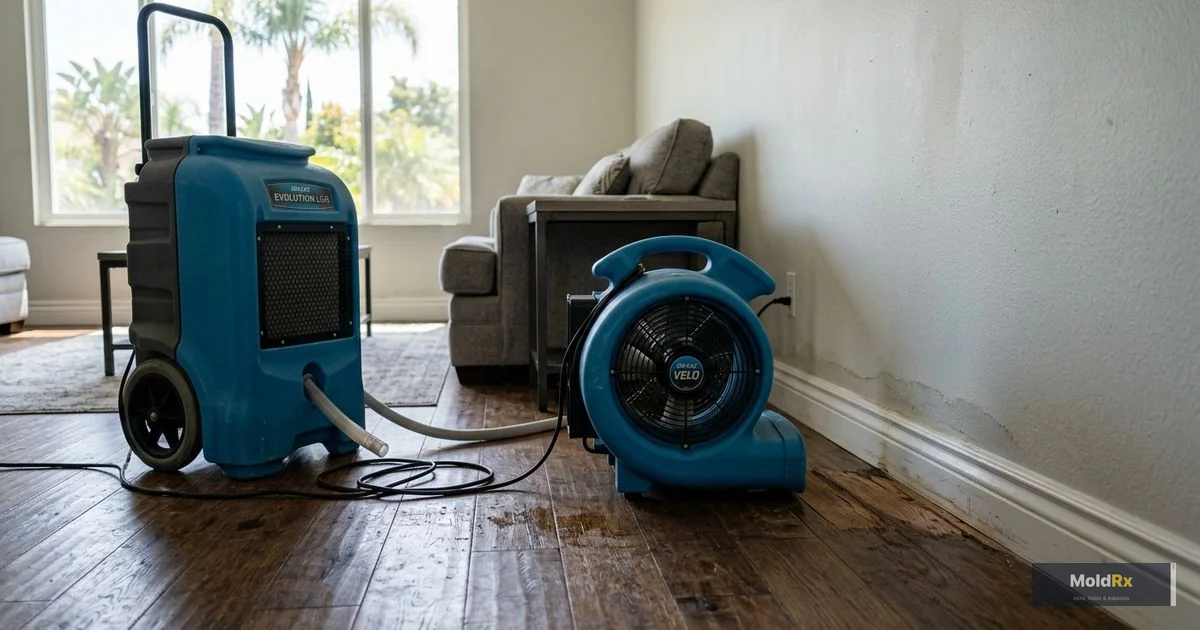
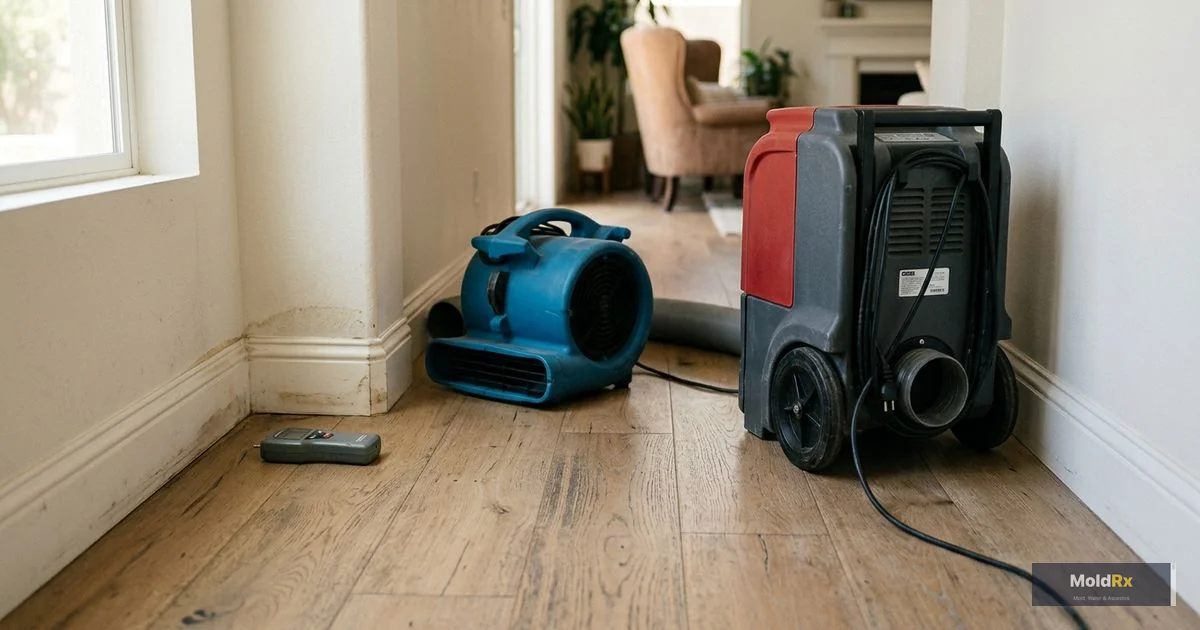
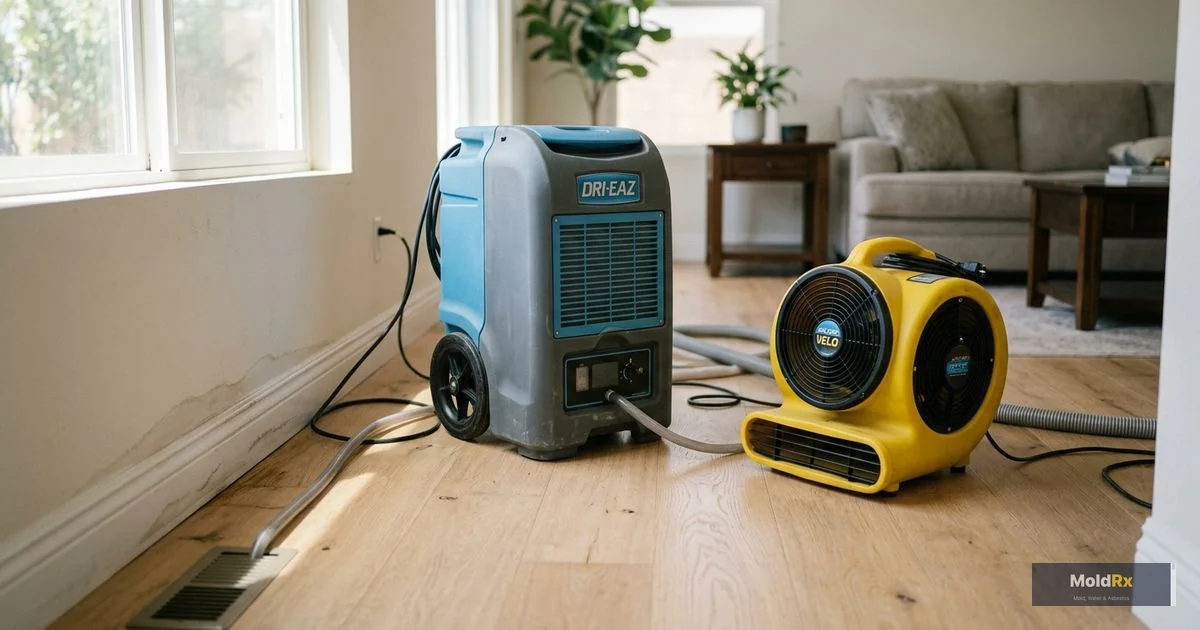
Our vetted specialists deploy commercial-grade LGR (low-grain refrigerant) dehumidifiers and high-velocity air movers calibrated for Huntington Beach's coastal humidity. A configuration that works in Temecula will underperform in a Huntington Harbour home where the air carries 75%+ relative humidity through every gap and seam.
Drying is monitored daily with calibrated moisture meters and hygrometers, documenting psychrometric readings to verify progress toward IICRC S500 drying goals for each material type. In Class 4 situations involving concrete-slab construction and original hardwood floors, specialty techniques like desiccant dehumidification may be required. Drying is complete when instrument readings confirm all affected materials have returned to equilibrium moisture content -- not when the carpet feels dry to your bare feet.
Step 4: Cleaning, Sanitization, and Antimicrobial Treatment
Once the structure is verified dry, the contamination level dictates what comes next:
- Category 1 losses: Cleaning and drying may be sufficient for salvageable materials
- Category 2 losses: All affected porous materials that cannot be adequately cleaned must be removed. Semi-porous materials require antimicrobial treatment. EPA-registered antimicrobial products are applied per label instructions.
- Category 3 losses: All affected porous materials are removed and discarded -- no exceptions. Drywall, insulation, carpet, pad, and any organic material that contacted contaminated water is gone. Structural framing is cleaned, treated with antimicrobials, and verified before reconstruction begins. In sewage-backup scenarios -- increasingly common as Huntington Beach's 1960s-era cast iron sewer lines reach end-of-life -- IICRC S520 mold remediation protocols may run concurrently if microbial growth is identified during the process.
Step 5: Reconstruction and Restoration
The final phase returns your property to pre-loss condition: drywall replacement, flooring reinstallation, painting, trim work, and structural repairs. For older Huntington Beach homes with original materials -- plaster walls, hardwood floors, custom tile -- our vetted specialists match existing finishes while ensuring restored areas meet current building standards.
What Category and Class Mean for Your Huntington Beach Property
Understanding the IICRC classification system protects you from being oversold on work you do not need -- or undersold on work that will come back to haunt you.
| Classification | What It Means | Common Huntington Beach Scenarios |
|---|---|---|
| Category 1 | Clean water from a sanitary source | Corroded supply line burst, toilet-tank crack, water heater supply failure |
| Category 2 | Contaminated water causing potential illness | Washing machine discharge, dishwasher backup, HVAC condensate overflow |
| Category 3 | Grossly contaminated / black water | Sewage backup from failing cast iron lines, flood intrusion near Bolsa Chica or Huntington Harbour, storm-drain overflow, any stagnant water 48+ hours |
| Class 1 | Minimal absorption, small area | Pinhole leak caught early, limited to one room with tile or vinyl flooring |
| Class 2 | Significant absorption, water wicking up walls | Burst supply line with carpet, water spreading to adjacent rooms |
| Class 3 | Greatest absorption, water from overhead | Roof leak during winter storm saturating ceiling, walls, and flooring across multiple rooms |
| Class 4 | Specialty drying -- low-permeance materials | Water trapped beneath original hardwood, inside concrete slab, behind plaster walls -- extremely common in Huntington Beach's 1950s-1970s homes |
Cutting corners on a high-category, high-class loss virtually guarantees a mold remediation project within weeks -- far more disruptive and costly than doing the water damage restoration right the first time.
Common Water Damage Scenarios in Huntington Beach
These are not hypothetical. These are the situations our vetted specialists respond to in this city, week after week.
The Corroded Supply Line: A Goldenwest homeowner notices a soft spot in the hallway floor. The copper supply line behind the wall -- original to the 1967 construction -- has been leaking for weeks. Pinhole corrosion from decades of salt-air exposure worked through the pipe wall. Moisture meters reveal the leak traveled eight feet in both directions, saturating drywall, subfloor, and insulation. Class 2, Category 1 trending toward Category 2 given the duration. Five-day structural drying protocol with LGR dehumidifiers compensating for coastal humidity.
The Water Heater Failure: A Seacliff homeowner wakes to two inches of water from a ruptured tank. Salt-air-accelerated corrosion caused the failure -- the unit was only eight years old. Water migrated into the hallway, kitchen, and family room, contacting stored chemicals on the garage floor and reclassifying from Category 1 to Category 2. Extraction and a Class 2 drying protocol targeting the slab, baseboards, and lower cabinets.
The Storm-Drain Backup: A property near the Huntington Beach Channel takes floodwater during a January rainstorm when storm drains are overwhelmed. Immediately Category 3 / black water. All affected porous materials removed. Cal/OSHA protocols. EPA-registered antimicrobial treatment of all structural surfaces. Full reconstruction after verified drying.
Tidal Intrusion in Huntington Harbour: Ocean water enters a ground-floor living space during a king-tide event. Category 3 by default -- saltwater carrying marine biological material. The salt content creates a specialty drying challenge: salt is hygroscopic, continuously reabsorbing atmospheric moisture even after extraction. Affected materials must be cleaned of salt residue before drying can succeed. Our vetted specialists understand this coastal-specific dynamic.
Huntington Beach Neighborhoods We Serve
Our vetted water damage restoration specialists respond to emergencies throughout all of Huntington Beach, including:
- Huntington Harbour and Sunset Beach -- waterfront and harbour-adjacent properties with tidal and flood exposure
- Bolsa Chica -- low-elevation properties near the wetlands corridor and PCH
- Downtown HB and the Main Street corridor
- Seacliff -- the coastal bluff neighborhood south of the pier
- Edwards Hill -- one of the city's original neighborhoods with some of the oldest housing stock
- Goldenwest -- the large residential area centered on Goldenwest Street
- South Huntington -- bordering the Santa Ana River and Newport Beach
- Huntington Central Park adjacent neighborhoods
- Old Town and Newland areas
- Commercial properties along Beach Boulevard, Edinger Avenue, and the Bella Terra corridor
We cover all Huntington Beach ZIP codes: 92646, 92647, 92648, and 92649.
We also respond to water damage emergencies in neighboring communities, including Fountain Valley, Westminster, Garden Grove, Costa Mesa, Newport Beach, and Seal Beach.
Request your free estimate now -- or call (888) 609-8907 for immediate emergency response.](tel:8886098907)
Why MoldRx -- And Why "Vetted" Is Not a Marketing Word
Dozens of restoration companies will answer the phone and promise to be at your Huntington Beach property within the hour. Some are excellent. Some are not licensed, not insured, and not accountable when you discover mold two months later. MoldRx does not perform restoration ourselves. We vet the people who do, and we only send specialists who meet every one of these criteria:
- IICRC S500 certification for water damage restoration -- the ANSI-accredited standard that defines how this work is performed
- IICRC S520 certification for mold remediation -- because in Huntington Beach's coastal humidity, water damage and mold overlap constantly
- Active CSLB contractor's license in good standing with the California State License Board
- Verified general liability and workers' compensation insurance -- protecting you from liability if an accident occurs on your property
- Documented experience with the specific building types in Huntington Beach: 1950s-1970s ranch homes, slab-on-grade construction, Huntington Harbour waterfront properties, and the coastal-specific corrosion and humidity conditions that define this city
- Cal/OSHA compliance for worker safety protocols, particularly critical in Category 3 / black-water scenarios involving sewage or floodwater
- EPA-compliant antimicrobial protocols -- using only registered products applied per label instructions
When we say "vetted," we mean verified credentials, confirmed CSLB licensing, checked insurance currency, and validated work quality -- per IICRC S500 and EPA guidelines. We only send professionals we would trust in our own homes.
Insurance and Documentation
Most Huntington Beach homeowner policies cover sudden and accidental water damage -- a burst pipe, a failed water heater, an appliance malfunction. What they typically do not cover is gradual damage from deferred maintenance (that slow pinhole leak you did not know about for six months), and standard policies almost never cover flood damage. Flood damage requires a separate NFIP or private flood policy -- highly relevant for Huntington Beach properties in Huntington Harbour, near Bolsa Chica, along the Santa Ana River corridor, or in any FEMA-designated flood zone.
Our vetted specialists understand what insurance adjusters need to process your claim without unnecessary delays:
- Timestamped photo and video documentation of all affected areas before, during, and after restoration
- Moisture readings and psychrometric data supporting the drying protocol and confirming completion per IICRC S500 standards
- Itemized scope of work with IICRC-standard line items that adjusters can process without pushback
- Category and class determination documented per IICRC S500 -- this classification directly affects what your policy covers and the approved scope of restoration
- Material inventories for content claims -- particularly important when stored items in garages, closets, or ground-floor spaces are affected by flood or sewage events
Our vetted specialists produce the records your carrier needs because they have done this hundreds of times.
Frequently Asked Questions
How fast can a vetted specialist reach my Huntington Beach property?
For active water emergencies, our goal is same-day deployment -- often within hours. Call (888) 609-8907 any time, day or night. Water damage does not wait for business hours and neither do we. Huntington Beach's coastal humidity means every hour of delay increases mold risk disproportionately compared to inland areas.
What is the difference between Category 1, 2, and 3 water damage?
Category 1 is clean water from a sanitary source (supply line break, toilet tank, water heater supply). Category 2 is contaminated water that can cause illness (appliance discharge, washing machine overflow, HVAC condensate). Category 3 is grossly contaminated black water (sewage backup, floodwater, ocean intrusion, any water stagnant for 48+ hours). The category determines safety protocols, PPE requirements, and whether porous materials can be saved or must be removed. Categories are defined by the IICRC S500 standard.
My Huntington Beach home is from the 1960s. Does that affect restoration?
Significantly. These homes often have original galvanized or early copper plumbing, cast iron drain lines, lath-and-plaster walls, and construction techniques that create hidden pathways for water migration. Salt-air corrosion over 60 years has weakened joints and connections throughout. Our vetted specialists have specific experience with this era of construction and know where water hides, how it travels, and which materials can be saved.
I live in Huntington Harbour. Is flood damage covered differently?
Yes. Standard homeowner's policies do not cover flood damage. Huntington Harbour properties in FEMA-designated flood zones require a separate flood policy (NFIP or private). If your damage resulted from tidal surge or storm flooding rather than plumbing failure, the claim process is different. Our vetted specialists document the water source precisely because this determination affects which policy responds.
How long does structural drying take in Huntington Beach?
Longer than inland areas. Huntington Beach's coastal humidity means drying equipment must work harder and longer to achieve IICRC S500 drying goals. A Class 2 loss that might dry in three to four days in Riverside may require five to seven days in a beachside Huntington Beach home. Class 4 losses involving slab-on-grade construction or original hardwood can take longer. Our vetted specialists monitor daily with calibrated instruments and do not pull equipment until readings confirm all affected materials have reached equilibrium moisture content. There are no shortcuts that do not create mold problems later.
What about mold -- should I be worried?
If water has been present in your Huntington Beach home for more than 24 hours, microbial amplification has likely begun -- even if you cannot see it. Mold colonizes behind walls, under flooring, and inside wall cavities where it is invisible without moisture meters and direct inspection. In Huntington Beach's coastal humidity, the timeline from water exposure to active mold growth is compressed. Our vetted specialists are dual-certified in IICRC S500 (water damage) and IICRC S520 (mold remediation) because in coastal Orange County, these two problems are inseparable.
How do I know the drying is actually complete?
Legitimate restoration per IICRC S500 standards requires documented moisture readings confirming all affected materials have returned to normal equilibrium moisture content -- not "it feels dry." Our vetted specialists provide daily moisture logs and final readings. If a contractor wants to pull equipment without showing you meter readings, that is a red flag. Incomplete drying is the leading cause of post-restoration mold growth, and in Huntington Beach's humidity, the margin for error is zero.
Related Services in Huntington Beach
Water damage and mold are rarely isolated problems in coastal Orange County. When one appears, the other is usually close behind. MoldRx connects Huntington Beach property owners with vetted specialists for:
-> Learn more about remediation services in Huntington Beach
Water Is in Your Huntington Beach Home Right Now. Here Is What to Do.
Every hour you wait, the damage category escalates, the restoration scope expands, the cost increases, and Huntington Beach's coastal humidity pushes mold colonization closer to the point where a water damage project becomes a full remediation. This is not a scare tactic. It is building science applied to a city that sits directly on the Pacific Ocean, built on 1950s-1970s construction, with salt-corroded plumbing and ambient moisture levels that turn every water intrusion into a race against biology.
You need a vetted, IICRC S500-certified specialist who knows Huntington Beach's aging housing stock, coastal humidity dynamics, slab-on-grade construction, Huntington Harbour flood exposure, and the specific ways water damage behaves differently here than anywhere inland. MoldRx only sends professionals who meet that standard -- because sending anything less to a Huntington Beach emergency is not something we are willing to do.
Get your free estimate now -- or pick up the phone.
Call (888) 609-8907 for emergency water damage restoration in Huntington Beach.
No runaround. No upselling. Just vetted professionals, honest answers, and the urgency this situation demands.