Emergency Water Damage Restoration in Irvine, CA — MoldRx
24/7 Emergency Water Damage Restoration Serving Irvine and Central Orange County — Call Now, We Respond Immediately
Right now, water is destroying your Irvine property. Every minute you wait, that water is soaking deeper into your subfloor, saturating your drywall, and creating the exact conditions mold needs to colonize your home. This is not something that can wait until morning. This is not something you can dry with towels and fans. If you have standing water, active leaking, or visible moisture damage in your Irvine home or condo, you need professional extraction and structural drying started within hours — not days.
MoldRx coordinates emergency water damage restoration through vetted specialists who understand Irvine properties inside and out — from 1970s-era Woodbridge homes with aging polybutylene plumbing to high-density condominiums in Spectrum and Portola Springs where a single unit leak can cascade through multiple floors. We respond 24/7 because water damage does not operate on business hours.
Do not wait. Contact MoldRx now for emergency water damage restoration in Irvine.
Why Water Damage in Irvine Demands Immediate Emergency Response
Irvine's reputation as one of America's safest and most meticulously master-planned cities creates a dangerous false sense of security when it comes to water damage. With a population exceeding 310,000 and over 120,000 housing units — more than 56% of which are renter-occupied apartments and condominiums — the sheer density of multi-unit housing in Irvine means water damage events escalate faster and affect more people than in typical suburban communities.
Here is the reality most Irvine homeowners and condo owners do not fully grasp until it is too late: mold begins colonizing wet building materials within 24 to 48 hours. In Irvine's moderate coastal humidity — averaging around 65% — those conditions are even more favorable for rapid mold proliferation. What starts as a burst pipe at 2 a.m. becomes a mold remediation project by the end of the week if professional drying does not begin immediately.
The Construction Timeline Problem
Irvine's development spans over five decades, and each era introduced its own water damage vulnerabilities:
1970s-1980s communities (Woodbridge, University Park, Turtle Rock, Westpark): These neighborhoods are now 40 to 50 years old. Many still have original polybutylene pipes — a plumbing material installed widely in the 1980s that is now known to deteriorate from the inside out, causing sudden catastrophic failures without warning. Copper supply lines in these homes are susceptible to pinhole leaks caused by decades of exposure to Irvine Ranch Water District water chemistry. Original water heaters in garages have long exceeded their lifespan. Slab foundations have shifted over decades, stressing pipe connections and creating slow leaks that go undetected for months behind walls and under flooring.
1990s-2000s communities (Northwood, Quail Hill, Oak Creek): These homes feature improved but not invulnerable plumbing. PEX piping connections can fail. Water pressure fluctuations stress joints. Settlement cracks in slabs create pathways for moisture intrusion. HVAC condensate lines clog and overflow into attics, ceilings, and wall cavities.
2010s-2020s communities (Portola Springs, Stonegate, Orchard Hills, Great Park, Cypress Village, Eastwood): Modern construction does not mean water-damage-proof. Appliance failures — dishwashers, washing machines, refrigerator ice maker lines — are the leading cause of sudden flooding in newer Irvine homes. Multi-story construction means a second-floor washing machine failure sends water cascading through walls, ceilings, and flooring on every level below. The damage is often hidden inside wall cavities long before it becomes visible.
Irvine's High-Density Condo Problem
With nearly 44% of Irvine's housing stock consisting of condominiums, townhomes, and apartments, water damage in multi-unit buildings is one of the most common and most devastating scenarios our specialists encounter. A single supply line failure in an upper-floor unit can flood multiple units below within minutes. Shared plumbing risers in older condo complexes mean one corroded pipe affects an entire building stack.
The complications multiply fast:
- Multiple units affected simultaneously require coordinated extraction and drying across several residences
- HOA responsibility disputes over shared plumbing versus unit-owner plumbing delay response times while water continues destroying property
- Shared walls and ceiling cavities trap moisture in spaces that are difficult to access and dry without professional equipment
- Insurance coordination between unit-owner policies, HOA master policies, and neighbor policies adds layers of complexity that require meticulous documentation from the start
This is exactly why speed matters. The difference between a two-unit dryout and a six-unit mold remediation project is often measured in hours, not days.
Climate and Storm Exposure
Irvine's semi-arid Mediterranean climate delivers approximately 12 inches of annual rainfall, concentrated almost entirely between November and March. The city's 287 sunny days per year breed complacency — aging roof flashing, deteriorated window seals, and clogged drainage systems go unnoticed until a winter storm exposes every vulnerability simultaneously.
When those storms arrive, they often come in intense, concentrated bursts that overwhelm municipal drainage systems, HOA-maintained landscape irrigation infrastructure, and individual property drainage. Low-lying areas near the San Diego Creek channel, Jeffrey Open Space Trail, and the Irvine Ranch Natural Landmarks boundaries experience stormwater pooling and intrusion.
Additionally, Irvine's extensive HOA-maintained landscape irrigation systems present a unique risk. When community irrigation main lines break or timer malfunctions cause overnight over-watering, water flows toward foundations, into garages, and through any crack or gap in the building envelope. These events typically happen at night and are not discovered until morning — giving water hours of unimpeded access to building materials.
Common Causes of Emergency Water Damage in Irvine
Every water damage emergency in Irvine falls into one of these categories, and each demands a different response protocol:
- Polybutylene and aging pipe failures in pre-2000 homes — sudden, high-volume flooding that can release hundreds of gallons before the main shutoff is reached
- Slab leaks from foundation shifting and copper pipe corrosion — slow destroyers that saturate subflooring and promote hidden mold colonies for weeks before detection
- Water heater failures — catastrophic tank ruptures that dump 40 to 80 gallons instantly, typically in garages where water migrates into adjacent living spaces
- Appliance malfunctions — dishwasher supply lines, washing machine hoses, and refrigerator ice maker connections that fail without warning
- Condo and multi-unit cascading floods — upper-floor failures that damage multiple units through gravity and shared wall cavities
- HVAC condensate overflow — clogged drain lines that dump water into attics, ceilings, and interior walls
- Storm and irrigation flooding — seasonal rain events and irrigation system failures that exploit foundation cracks, window seals, and drainage deficiencies
- Sewage backups — the most hazardous category, requiring specialized contamination protocols and biohazard handling
Our Emergency Water Damage Restoration Process in Irvine
When you call MoldRx about water damage in your Irvine property, this is not a next-day appointment. This is an emergency response protocol designed to stop destruction, eliminate moisture, and prevent the secondary mold damage that turns a restoration project into a gut-and-rebuild nightmare.
Phase 1: Immediate Emergency Response and Damage Assessment
Our vetted specialists arrive with the understanding that every hour of delay compounds the damage exponentially. The first actions are always the same:
- Stop the water source if it is still active — main shutoffs, supply valve closures, emergency plumbing coordination
- Document everything immediately with photos, video, and written observations for insurance purposes — this documentation begins before any work starts, not after
- Deploy moisture meters and thermal imaging to map the full extent of water migration — water travels through wall cavities, under flooring, and along structural members far beyond the visible wet area
- Classify the water category: Category 1 (clean water from supply lines), Category 2 (grey water from appliances or HVAC), or Category 3 (black water from sewage or external flooding) — each category dictates completely different safety protocols, equipment requirements, and material salvageability
In multi-unit Irvine condos, this assessment extends to adjacent units, shared walls, and building common areas. Our specialists coordinate with HOA management and neighboring residents to ensure the full scope of damage is identified immediately — not discovered weeks later when mold appears in a neighbor's closet.
Phase 2: Emergency Water Extraction
Standing water is the enemy. Every minute it remains in contact with building materials, it is being absorbed deeper into subfloors, drywall, insulation, and structural wood. Our specialists deploy commercial-grade extraction equipment including:
- Truck-mounted extraction units capable of removing thousands of gallons per hour
- Portable submersible pumps for areas with significant standing water
- Weighted extraction tools that pull water from carpet padding without requiring removal
- Hard surface extractors designed for the engineered hardwood and laminate flooring common in newer Irvine construction
Speed during extraction is the single most important factor in determining how much of your property can be saved versus replaced. In Irvine homes with engineered hardwood flooring — standard in most construction since the 2000s — the difference between a 4-hour response and a 24-hour response is often the difference between saving $15,000 worth of flooring and replacing it entirely.
Phase 3: Structural Drying and Dehumidification
This is the phase that separates professional restoration from amateur attempts — and it is where most DIY efforts and cut-rate contractors fail catastrophically.
Removing visible water is only the beginning. Moisture trapped inside wall cavities, beneath floating floors, within ceiling assemblies, and absorbed into structural lumber must be systematically extracted using industrial equipment:
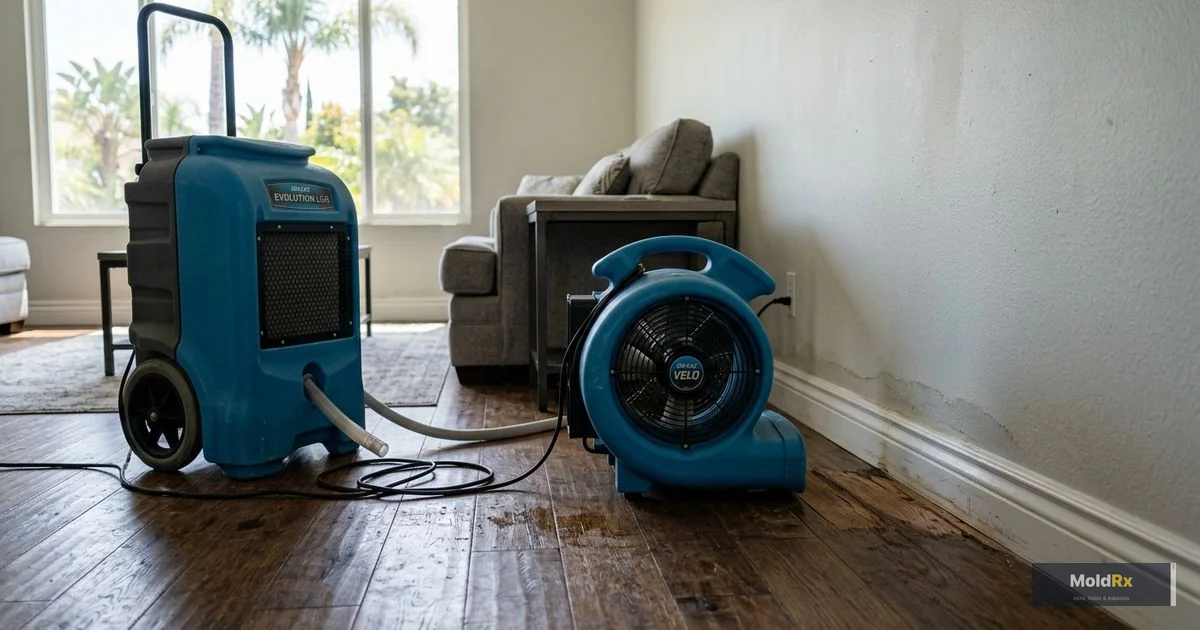
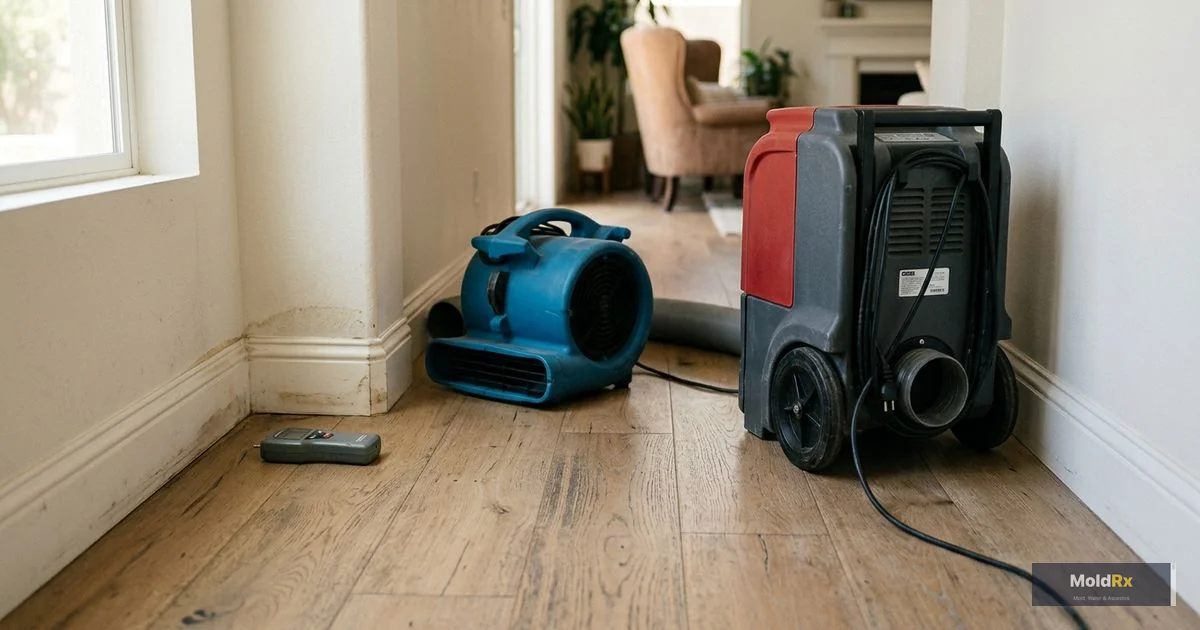
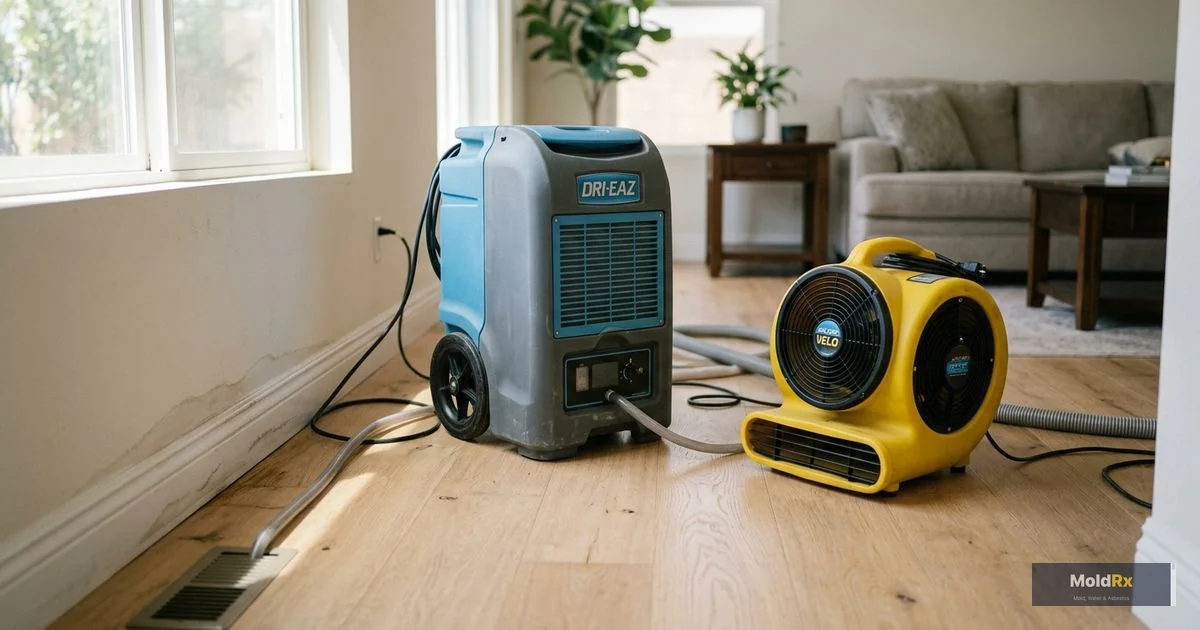
- Commercial air movers positioned strategically to create airflow patterns that draw moisture from materials
- Industrial dehumidifiers that capture moisture from the air, preventing it from reabsorbing into adjacent materials
- Injectidry systems that force dry air into wall cavities, under cabinets, and into other enclosed spaces where conventional drying cannot reach
- Daily moisture monitoring with calibrated meters to document drying progress and ensure every material reaches the moisture content specified by IICRC S500 standards
In Irvine's average humidity of around 65%, uncontrolled drying — opening windows, running household fans — actually slows the process and can introduce additional moisture. Professional drying in a controlled environment is not optional. It is the only way to reach verified dry conditions that prevent mold growth.
This phase cannot be rushed. Depending on the extent of saturation, structural drying typically takes 3 to 5 days for moderate events and up to 10 to 14 days for severe flooding. Cutting drying short to speed up reconstruction is how mold problems start — and a mold remediation project will cost several times more than doing the drying correctly the first time.
Phase 4: Cleaning, Sanitization, and Restoration
Once moisture meters confirm that all materials have reached acceptable dryness levels:
- Antimicrobial treatment is applied to all affected surfaces to eliminate bacteria and prevent mold colonization
- Salvageable materials — drywall that dried within parameters, structural wood that maintained integrity, flooring that did not delaminate — are cleaned and preserved
- Non-salvageable materials — saturated insulation, compromised drywall, delaminated flooring, any material exposed to Category 3 contamination — are removed, properly disposed of, and replaced
- Air quality verification confirms the indoor environment is safe for occupancy
- Final documentation package is compiled with all moisture readings, photos, work performed, and materials used — ready for insurance submission
What to Expect When You Call MoldRx for Irvine Water Damage
-
Immediate response — not a callback tomorrow. Water damage is an active emergency. Our vetted professionals understand that and respond accordingly, day or night.
-
Brutal honesty about what you are facing. If the damage is less severe than you feared, you will hear that. If it is worse — if the slab leak has been running for weeks, if mold is already present, if the subfloor is compromised — you will hear that too. No sugarcoating, no upselling, no manufactured urgency beyond what genuinely exists.
-
Clear communication throughout every phase. You will receive daily moisture readings, timeline updates, and explanations of every decision point. You will understand what is happening in your property and why each step matters.
-
Meticulous insurance documentation from minute one. Water damage insurance claims require detailed evidence — photos, moisture maps, equipment logs, material inventories, and itemized work records. Our specialists produce this documentation as a standard part of every job, not as an afterthought you have to request.
-
Mold prevention as the non-negotiable priority. Every decision during restoration — drying duration, material removal thresholds, antimicrobial application — is made with one overriding goal: ensuring mold does not become your next problem. In Irvine's climate, this is not a theoretical concern. It is a near-certainty if drying is inadequate.
Irvine Neighborhoods and Areas We Serve
Our vetted water damage restoration specialists respond to emergencies across every Irvine neighborhood and community:
Established communities: Woodbridge, University Park, Turtle Rock, Westpark, Northwood, Northwood Pointe, El Camino Real, College Park, Walnut, Rancho San Joaquin, and Culverdale.
Newer developments: Quail Hill, Portola Springs, Stonegate, Orchard Hills, Great Park, Cypress Village, Eastwood, Pavilion Park, Beacon Park, and Cadence Park.
Commercial and mixed-use areas: Irvine Spectrum, Irvine Business Complex, University Research Park, and the Irvine Medical and Science Complex along Alton Parkway.
We cover ZIP codes 92602, 92603, 92604, 92606, 92612, 92614, 92617, 92618, and 92620.
We also respond to water damage emergencies in neighboring Central Orange County communities including Tustin, Lake Forest, Laguna Hills, Laguna Woods, Costa Mesa, Newport Beach, Orange, and Santa Ana.
Related Services in Irvine
Water damage and mold go hand in hand. If water damage is not addressed with proper urgency and thoroughness, mold remediation becomes the inevitable next step. We also offer Mold Removal in Irvine, Asbestos Removal in Irvine services to Irvine property owners.
→ Learn more about remediation services in Irvine
Frequently Asked Questions
How fast can you respond to a water damage emergency in Irvine?
We treat every water damage call as an active emergency because that is exactly what it is. Our vetted specialists respond to Irvine properties as quickly as possible — the goal is always to begin extraction within hours of your call, not the next business day. Nights, weekends, and holidays included. The speed of initial response is the single biggest factor in determining total damage and total restoration cost.
My Irvine condo has water damage coming from the unit above me. What do I do?
First, document everything with photos and video immediately. Notify your HOA and the upstairs unit owner. Then call MoldRx. Multi-unit water damage in Irvine condos is one of the most complex scenarios we handle — it involves coordination between multiple unit owners, HOA management, and potentially several insurance policies. Our specialists are experienced in navigating these situations and provide the documentation all parties need. Do not wait for the HOA to figure out responsibility before starting mitigation. Water does not pause for bureaucracy.
Will my homeowner's insurance cover water damage restoration in Irvine?
Most homeowner's and condo-owner's policies cover sudden and accidental water damage — burst pipes, appliance failures, water heater ruptures. Gradual damage from long-term neglected maintenance, and external flooding, typically require separate coverage or are excluded. The critical factor is documentation. Insurers need detailed evidence of the damage, the cause, and the restoration work performed. Our specialists produce comprehensive documentation — moisture maps, photos, daily readings, equipment logs, and itemized reports — as a standard part of every emergency response.
How long does water damage restoration take in an Irvine home?
It depends entirely on the severity and extent of water intrusion. A contained appliance failure affecting one room may require 3 to 5 days of drying and minimal reconstruction. A major pipe failure flooding multiple rooms or a multi-unit condo event can require 10 to 14 days of structural drying followed by reconstruction. We provide realistic timelines after the initial assessment — not optimistic estimates designed to win the job. Rushing drying to finish faster is how mold problems start.
Can I stay in my Irvine home during water damage restoration?
In many cases, yes — especially for contained events affecting one or two rooms. For major flooding events, Category 3 contamination (sewage), or situations where large portions of the home require drying equipment, temporary relocation may be necessary for both safety and comfort. If your homeowner's policy includes loss-of-use coverage, temporary housing expenses are typically covered. Our specialists will give you an honest assessment of livability during restoration.
I found water damage that looks like it has been there for a while. Is it too late?
It is never too late to stop ongoing damage, but it is critical to act immediately. Long-term undetected water damage — from slow slab leaks, hidden pipe failures, or chronic condensation — often involves mold growth behind walls and structural deterioration that is not visible from the surface. Our assessment uses moisture meters and thermal imaging to determine the full extent, and we will tell you honestly what you are dealing with. The longer it has been wet, the more likely mold remediation will be needed alongside water damage restoration.
Act Now — Every Hour of Delay Costs You More
If you are reading this page because you have water damage in your Irvine property right now, understand this: the damage is getting worse as you read. Water is migrating further into your building materials. Mold spores are preparing to colonize. Structural components are absorbing moisture that will compromise their integrity. The cost of restoration is increasing with every hour that passes.
MoldRx coordinates water damage restoration through vetted professionals who know Irvine properties — the polybutylene pipes in Woodbridge, the multi-story condos in Spectrum, the engineered hardwood in Portola Springs, the slab foundations in University Park. We respond immediately because that is what water damage demands.
Contact MoldRx now for emergency water damage restoration in Irvine. 24/7 response. Honest assessment. Professional execution. No delay, no runaround — just the urgent, qualified response your property needs right now.