Emergency Water Damage Restoration in Laguna Beach, CA — MoldRx
Vetted Water Damage Restoration Specialists Serving Laguna Beach and South Orange County — Call (888) 609-8907 Now
If water is inside your Laguna Beach home right now, stop reading and call us: (888) 609-8907. Every minute counts. Laguna Beach sits at the intersection of steep canyon terrain, aging hillside construction, and relentless coastal humidity. That combination means water damage here does not behave the way it does five miles inland. It moves faster, penetrates deeper, and breeds secondary damage — especially mold — within 24 to 48 hours. You do not have time to compare quotes or wait until morning. You need vetted professionals who understand this specific city, this specific coastline, and the catastrophic chain reaction that starts the moment water enters a structure in a salt-air environment.
MoldRx only sends vetted, IICRC-certified restoration specialists. We do not dispatch random subcontractors. Every professional we coordinate has documented experience with the IICRC S500 Standard for Professional Water Damage Restoration and the IICRC S520 Standard for Professional Mold Remediation, holds appropriate CSLB licensing for California restoration work, and carries the training, equipment, and coastal-property expertise that Laguna Beach demands.
Request Your Free Emergency Estimate or Call (888) 609-8907
Why Laguna Beach Water Damage Is a Genuine Emergency
This is not a city where you can afford to "wait and see." Laguna Beach has roughly 23,000 residents spread across 8.8 square miles of some of the most geologically active, humidity-saturated terrain in Southern California. The factors that make this community beautiful are the same ones that make water damage here uniquely destructive.
Canyon Terrain and Landslide History
Laguna Beach is built into canyons. Laguna Canyon, Bluebird Canyon, Emerald Canyon, El Morro Canyon — the city's topography funnels water downhill at dangerous velocities during storms. This is not theoretical. It is documented history:
- October 1978: The Bluebird Canyon landslide — triggered by saturated soil after heavy rainfall — destroyed 21 homes and damaged dozens more. Sixty-nine residences were involved in existing or potential sliding within the Topanga Formation bedrock.
- June 2005: A second catastrophic Bluebird Canyon landslide destroyed or severely damaged 19 homes and forced the evacuation of 345 residences. Investigators determined elevated groundwater from the 2004-2005 winter rainfall season initiated the failure.
- February 2019: Flash flooding closed Laguna Canyon Road between Canyon Acres and El Toro Road. Low-lying areas of Laguna Canyon and the Sun Valley neighborhood were evacuated.
- December 2021: Flash flooding forced a rapid closure of outbound Laguna Canyon Road near the Willow Staging Area.
The pattern is unmistakable. When water saturates the terrain beneath and around Laguna Beach homes, structures do not just get wet — they can lose their foundations. And long before you reach landslide-level saturation, the moisture migrating through your walls, subfloors, and foundation is already destroying your property from the inside.
Salt Air Corrosion and Coastal Humidity
Laguna Beach's annual average humidity hovers around 65%, spiking significantly higher during marine layer season from May through September. That baseline humidity means your home is already operating in a high-moisture environment before a single drop of unwanted water enters. When a pipe bursts or a roof leak develops, the ambient conditions actively work against you. Moisture does not evaporate naturally here the way it does in Riverside or San Bernardino. It lingers. It migrates into wall cavities. It feeds microbial growth.
Salt air accelerates corrosion on copper plumbing, galvanized pipes, water heater tanks, HVAC condensate lines, and roofing fasteners. A pinhole leak that might take months to cause visible damage in an inland city can compromise structural materials in Laguna Beach within weeks. By the time you notice discoloration on a wall or a musty smell in a closet, the damage behind that wall may already be extensive.
Aging Housing Stock
A significant portion of Laguna Beach homes date from the 1920s through the 1970s. Temple Hills — one of the city's first residential neighborhoods — saw development as early as 1924. The Tree Streets contain historic homes from the 1920s and 1930s. Mystic Hills was built out from the 1920s through the 1960s. Much of the Village, North Laguna, and South Laguna housing stock was constructed in the post-war decades.
These older homes carry predictable vulnerabilities:
- Original cast iron and galvanized drain lines with 50-80+ years of corrosion and mineral buildup
- Aging copper supply lines weakened by decades of salt-air exposure, prone to pinhole leaks and joint failures
- Outdated water heaters well past their 10-15 year expected lifespan
- Foundation drainage systems that were never engineered for the runoff volumes produced by modern hardscaping and climate-intensified storms
- Slab-on-grade construction on hillside lots where soil movement creates chronic stress on under-slab plumbing
When water enters these structures, it encounters materials and construction methods that are far less forgiving than modern building standards. Plaster walls absorb water differently than modern drywall. Old-growth framing lumber, while dense, can harbor moisture in ways that are invisible until serious structural damage has occurred. There is no margin for a delayed response.
Water Damage Categories and Classes: What You Are Dealing With
Understanding the severity of your water damage is the first step toward stopping it. The IICRC S500 standard — the industry authority recognized by insurers, adjusters, and the EPA — classifies water damage along two axes: contamination category and evaporation class. Knowing where your situation falls determines every decision that follows.
Contamination Categories (1 through 3)
Category 1 — Clean Water. Water from a sanitary source: broken supply lines, sink overflows, melting ice, falling rainwater, toilet tank leaks. Least dangerous at the point of origin, but in Laguna Beach's humid environment, it does not stay Category 1 for long. Standing clean water not extracted within 24-48 hours degrades as microbial colonization begins. Monday's Category 1 event becomes Wednesday's Category 2.
Category 2 — Gray Water. Significant contamination that could cause illness if contacted or consumed. Dishwasher or washing machine discharge, toilet overflows with urine, sump pump failures. Requires aggressive extraction, antimicrobial treatment, and protective protocols.
Category 3 — Black Water. Grossly contaminated water containing pathogenic, toxigenic, or harmful agents. Sewage backups, storm-drain floodwater, toilet overflows involving feces, and any standing water that has remained long enough to support dangerous microbial growth. Category 3 is a health emergency requiring full PPE per Cal/OSHA standards, containment, and removal of all contacted porous materials. In Laguna Beach, storm-driven canyon flooding frequently introduces Category 3 contaminants. Never assume floodwater is "just rain."
Evaporation Classes (1 through 4)
Class 1 — Minimal absorption. Part of a room affected. Fastest to dry.
Class 2 — Entire room affected. Moisture wicked up walls to less than 24 inches. Structural materials require commercial dehumidification.
Class 3 — Water from overhead or walls saturated beyond 24 inches. Ceilings, subfloors, and insulation affected. Demands maximum air movement and dehumidification.
Class 4 — Specialty drying: materials with low porosity trapping deep moisture — hardwood floors, plaster walls, concrete, stone. Many older Laguna Beach homes fall into Class 4, requiring extended drying and specialized low-grain-refrigerant dehumidifiers.
If you are unsure what category or class you are dealing with, do not guess. Call (888) 609-8907 or request your free estimate and get a professional assessment before the situation escalates.
Our Emergency Water Damage Restoration Process
Every water damage situation in Laguna Beach is different — a slab leak in a 1950s cottage on Catalina Street demands a different approach than storm flooding in a Laguna Canyon home or a burst pipe in a Top of the World hillside residence. But our vetted specialists follow a rigorous, IICRC S500-compliant process adapted to the specific property, water category, and coastal conditions.
Phase 1: Emergency Response and Assessment
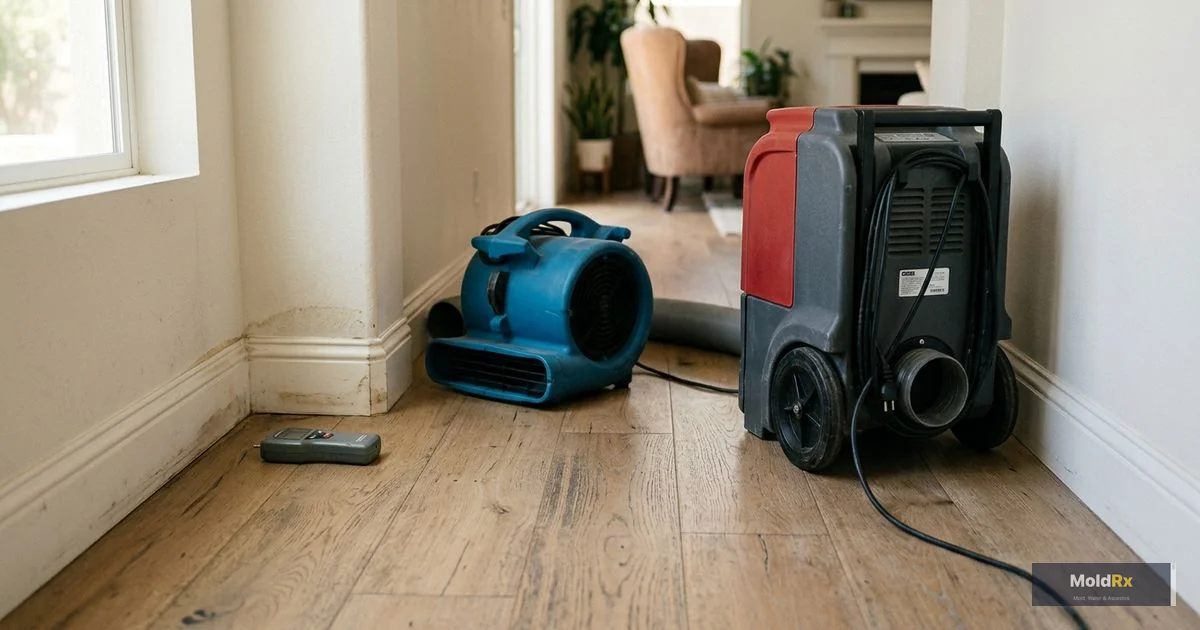
The clock is running. Our vetted specialists arrive with moisture meters, thermal imaging cameras, and hygrometers to map the full extent of water intrusion — not just what you can see, but what is hidden inside wall cavities, beneath flooring, and structural assemblies. They identify the source, classify the contamination category (Categories 1-3) and evaporation class (Classes 1-4), and document everything with photographs, moisture readings, and written observations. This documentation is the foundation of your insurance claim.
Phase 2: Water Extraction and Source Control
Standing water is removed immediately using truck-mounted and portable extraction units. In Laguna Beach, this step is ruthlessly time-sensitive — coastal humidity means every hour of delay adds measurable moisture absorption into surrounding materials. If the source is ongoing (active pipe break, continuing roof leak), our specialists coordinate source control simultaneously. You cannot dry a structure still taking on water.
Phase 3: Structural Drying and Dehumidification
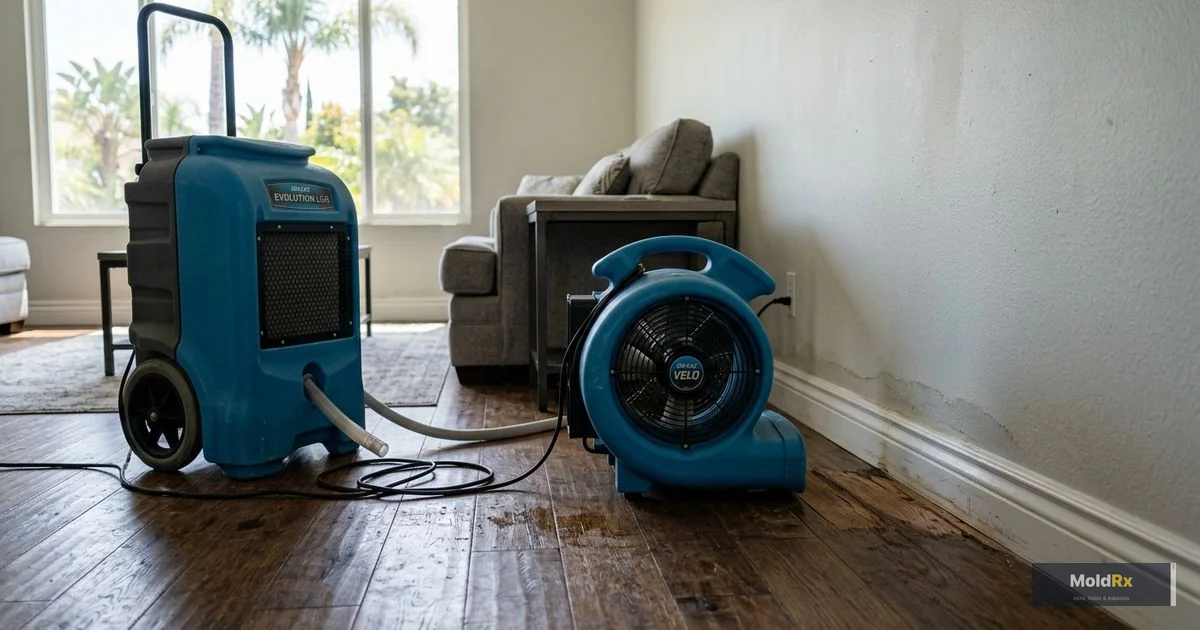
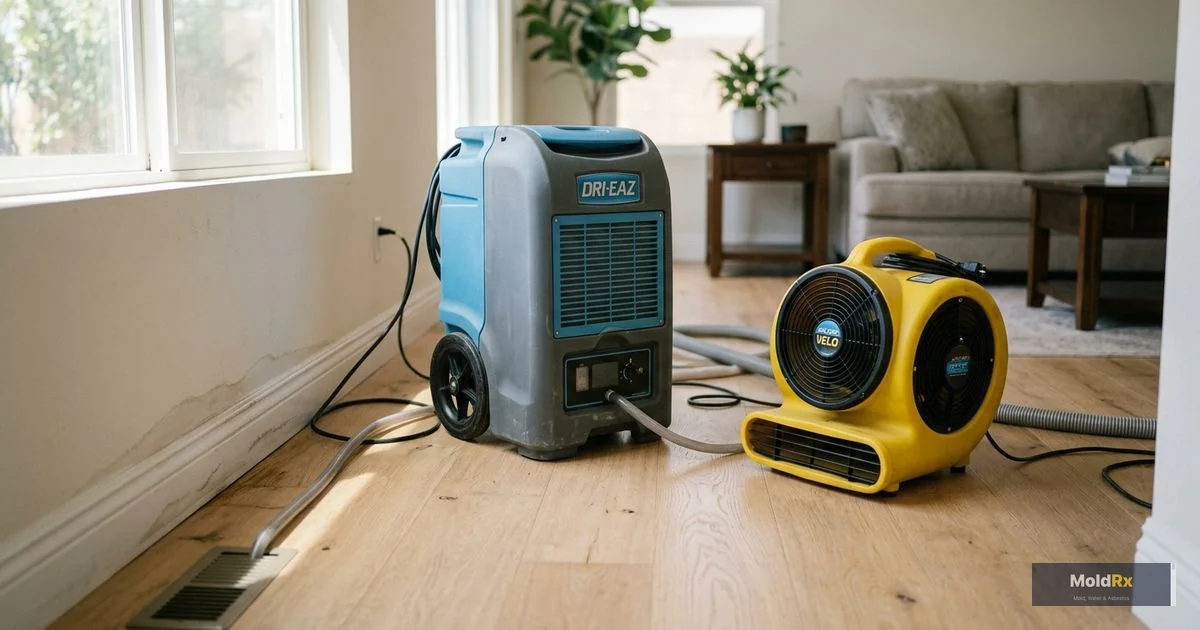
This is where coastal restoration separates from inland work. In Laguna Beach, opening windows during marine layer season can actually introduce more moisture. Our specialists deploy commercial-grade dehumidifiers — including low-grain refrigerant units for Class 4 hardwood and plaster scenarios — alongside high-velocity air movers creating calculated airflow patterns through affected cavities. Moisture readings are taken daily until every monitored point returns to dry standard. In Laguna Beach's climate, this phase consistently requires more time and equipment than identical damage would inland.
Phase 4: Cleaning, Antimicrobial Treatment, and Sanitization
All affected surfaces are cleaned and treated with EPA-registered antimicrobial solutions. For Category 2 and Category 3 events, this includes HEPA vacuuming, antimicrobial application to structural cavities, and air scrubbing. Cal/OSHA worker safety protocols are observed throughout.
Phase 5: Restoration and Reconstruction
Restoration may range from minor drywall and flooring repairs to full reconstruction of damaged rooms. Porous materials that contacted Category 3 water or show mold growth are removed per IICRC S520 protocols. The objective is returning your home to pre-loss condition or better.
What Makes Laguna Beach Properties Different
Generic water damage restoration does not account for the realities of this city. Here is what our vetted specialists factor into every Laguna Beach job.
Hillside Drainage and Foundation Vulnerability
Homes in Top of the World, Temple Hills, Arch Beach Heights, and Mystic Hills sit on slopes where water follows gravity into foundations, crawl spaces, and retaining wall assemblies. After heavy rainfall, subsurface water migration can continue for weeks. A home that appears dry at the surface may be accumulating moisture at the foundation level — invisible without professional moisture mapping.
Slab Leaks from Soil Movement
The same Topanga Formation bedrock that produced the Bluebird Canyon landslides creates ongoing micro-movement in hillside soils. Over decades, this stresses under-slab plumbing, producing slow leaks that saturate concrete foundations from below. By the time you see warped flooring or a spike in your water bill, the concrete may have been absorbing moisture for months. These are Class 4 drying scenarios requiring specialized equipment and extended timelines.
Mold Proliferation in Coastal Conditions
The EPA identifies moisture control as the primary strategy for mold prevention, and the IICRC S520 standard defines remediation protocols when prevention fails. Laguna Beach's baseline humidity, moderate year-round temperatures, and organic materials in older construction create near-ideal conditions for colonization. Aspergillus, Penicillium, Cladosporium, and Stachybotrys (black mold) can establish colonies on wet drywall, wood, or insulation within 24-48 hours. Every hour of extraction delay opens the window for a secondary mold problem more expensive than the water damage itself.
Historic and Vintage Construction Challenges
- Plaster-and-lath walls retain moisture differently than modern drywall, requiring longer drying times and monitoring for hidden mold between lath and framing
- Single-pane windows and minimal insulation in pre-1970s construction allow moisture migration between spaces, complicating drying
- Original hardwood floors can cup, buckle, or delaminate if dried incorrectly — restoration requires controlled drying rates calibrated to the specific wood species
- Knob-and-tube or early Romex wiring in the oldest homes creates electrical safety concerns when water enters wall cavities
Laguna Beach Neighborhoods We Serve
Our vetted water damage restoration professionals respond to emergencies throughout all of Laguna Beach, including:
- Downtown Village — The city's commercial and cultural core, with mixed residential above retail and dense cottage-style housing on surrounding streets
- North Laguna — Beachfront and hillside homes along Cliff Drive, with significant exposure to salt spray and coastal erosion
- South Laguna — Residential community with homes dating from the 1950s-1970s, many on steep lots with drainage challenges
- Laguna Canyon — Low-lying canyon floor properties with documented flash-flooding risk and periodic road closures during storms
- Top of the World — Elevated hillside neighborhood with panoramic views and homes exposed to wind-driven rain and runoff from higher terrain
- Temple Hills — One of Laguna Beach's earliest residential areas (development beginning 1924), with aging infrastructure and hillside soil-movement concerns
- Arch Beach Heights — Sloped neighborhood above Victoria Beach with mid-century housing stock
- Woods Cove — Coastal enclave with older homes near sea level
- Victoria Beach — Beachfront properties with direct salt-air exposure and storm-surge vulnerability
- Three Arch Bay — Gated community with homes from the 1930s onward, coastal bluff location
- Bluebird Canyon — The epicenter of Laguna Beach's two most destructive landslides, with ongoing geological monitoring and heightened water-management concerns
- Mystic Hills — Hillside homes built from the 1920s through the 1960s on terrain requiring careful drainage management
We cover ZIP codes 92651 and 92652, as well as neighboring communities including Dana Point to the south, Laguna Niguel and Aliso Viejo to the east, and Newport Beach and Corona del Mar to the north.
What You Should Do Right Now If You Have Water Damage
If water is actively entering your home or you have discovered standing water, take these steps immediately:
- Ensure personal safety first. If water is near electrical outlets, panels, or appliances, do not walk through it. Turn off electricity at the breaker if you can reach it safely. If you cannot, stay out and call for help.
- Stop the water source if possible. Shut off the main water supply valve if the source is a pipe, fixture, or appliance. If the source is weather-related, move to step 3.
- Call (888) 609-8907 immediately. The sooner a vetted specialist is en route, the less damage you will sustain. Do not wait to "see if it stops" or "dry it yourself with fans." Household fans and towels cannot address the moisture that has already migrated into walls, subfloors, and structural cavities.
- Document what you can. Take photographs and video of the water, the source (if visible), and affected areas. This supports your insurance claim. But do not delay calling in order to document — extraction speed matters more.
- Do not attempt to remove Category 2 or Category 3 water yourself. Gray water and black water carry biological and chemical contaminants that require professional protective equipment and disposal procedures compliant with Cal/OSHA and EPA regulations.
Insurance Documentation and Claims Support
Water damage claims are among the most disputed homeowner insurance claims in coastal Orange County. Our vetted specialists provide what adjusters need as standard practice:
- Timestamped photographs of the water source, affected areas, and damaged materials before extraction
- Moisture readings from affected and unaffected areas establishing baseline comparisons
- Daily drying logs with equipment placement, environmental conditions, and moisture reduction data
- Classification documentation identifying water category (1-3) and class (1-4) per IICRC S500
- Itemized scope of work for all extraction, drying, cleaning, and restoration activities
This documentation is standard on every project — not an afterthought or add-on.
Related Emergency Services in Laguna Beach
Water damage rarely exists in isolation. Our vetted professionals also coordinate:
- Mold Removal in Laguna Beach — When water damage leads to mold colonization, remediation per IICRC S520 protocols prevents the problem from spreading
- **** — Air and surface sampling to identify mold species and concentration levels after a water event
- **** — Critical for pre-1980s homes where water damage may have disturbed asbestos-containing materials in insulation, flooring, or pipe wrap
- Asbestos Removal in Laguna Beach — Licensed abatement when water-damaged materials test positive for asbestos, handled under Cal/OSHA and EPA regulatory requirements
Learn more about remediation services in Laguna Beach
Frequently Asked Questions
How fast do you respond to water damage emergencies in Laguna Beach?
24/7 emergency response. Extraction speed directly determines the scope of damage — a burst pipe addressed within two hours produces dramatically less structural damage and mold risk than the same event addressed in twelve. In Laguna Beach's humid coastal environment, that compression matters even more.
What categories and classes of water damage do you handle?
All of them. Categories 1 through 3 (clean water through black water) and Classes 1 through 4, including the specialty drying scenarios common in older Laguna Beach homes with plaster walls, hardwood floors, and concrete slabs. Every project follows IICRC S500 protocols matched to the specific situation.
Will my homeowner's insurance cover this?
Most policies cover sudden and accidental water damage — burst pipes, appliance failures, storm damage. Gradual damage from deferred maintenance and ground-level flooding typically require separate coverage. We cannot make coverage determinations, but our documentation is designed to give adjusters exactly what they need to process your claim. The faster you call, the stronger your documentation.
How long does water damage restoration take in Laguna Beach?
Minor Class 1 events: 3-5 days. Major Class 3 or Class 4 events with structural drying and material replacement: 1-3 weeks. Laguna Beach's coastal humidity consistently extends drying timelines compared to inland. We provide a realistic timeline after initial assessment — not an optimistic guess.
Can water-damaged materials in older Laguna Beach homes be saved?
Often yes — if professional drying starts within 24-48 hours. Original hardwood, structural framing, and some plaster walls can be restored with proper Class 4 techniques. Materials that contacted Category 3 water, show mold growth, or were saturated for extended periods typically require replacement. Our specialists give honest assessments: we do not replace what can be saved, and we do not leave in place what should come out.
What about mold after water damage?
Mold is the most common secondary consequence here. The EPA and IICRC S520 are clear: moisture control is the primary prevention strategy. Extraction within 24-48 hours drops colonization risk significantly. If water has been present longer, or was Category 2 or 3, post-remediation mold testing is strongly recommended. Our specialists coordinate both water damage restoration and mold remediation through a single point of contact.
Do your specialists hold IICRC certifications?
Yes. MoldRx only sends vetted professionals with current IICRC certifications aligned with the IICRC S500 (water damage) and IICRC S520 (mold remediation) standards — ANSI-accredited consensus standards recognized by insurers, attorneys, and regulatory agencies. We verify credentials.
Stop the Damage Now — Call Laguna Beach Emergency Water Restoration
Water damage in Laguna Beach is not a problem that gets better with time. It gets worse. Every hour, moisture migrates deeper into structural materials. Every day, the probability of secondary mold colonization increases. Every week of delay expands the scope, the cost, and the disruption to your life.
MoldRx only sends vetted, IICRC-certified restoration specialists who understand Laguna Beach's canyon terrain, coastal humidity, aging housing stock, and the geological realities that make water damage here more dangerous than almost anywhere else in Orange County. We give you an honest assessment, clear communication, and thorough documentation — no pressure, no inflated scope, no contractors who disappear mid-project.
Your next step is simple. Pick one:
- Call now: (888) 609-8907 — 24/7 emergency response, talk to a real person immediately
- Request your free estimate online — We will contact you promptly to assess your situation
- Already called someone else? If you are not confident in the response you are getting, call us for a second opinion. Water damage is too urgent and too consequential for guesswork.
(888) 609-8907 — Vetted Specialists. Honest Assessment. Laguna Beach Emergency Response.