Asbestos Removal in Laguna Woods, CA — MoldRx
Licensed Asbestos Removal Professionals Serving Laguna Woods and South Orange County
Laguna Woods has an asbestos problem that is not theoretical. It is built into the walls, ceilings, floors, and pipe systems of nearly every unit in this community. Construction began in 1963. The first residents moved in on September 10, 1964. Building continued through the mid-1970s. That entire construction window falls within the peak era of asbestos use in American residential building materials. Every co-op in United Mutual, every condo in Third Mutual, and every unit in The Towers was built with materials that almost certainly contain asbestos. And here is what makes Laguna Woods uniquely dangerous: the population is overwhelmingly elderly, with a median age above 74 and nearly 80 percent of residents over 65. Elderly lungs are more vulnerable to asbestos fibers. The diseases asbestos causes — mesothelioma, asbestosis, lung cancer — are already devastating. In an aging population with existing respiratory vulnerabilities, the consequences of improper asbestos disturbance are catastrophic and irreversible. MoldRx only sends vetted, licensed abatement professionals who work in full compliance with EPA NESHAP, OSHA 1926.1101, and Cal/OSHA Title 8 regulations.
Request your free estimate — we will assess your Laguna Woods property and explain exactly what needs to happen.
Why Laguna Woods Properties Contain Asbestos
About 90 percent of Laguna Woods consists of Laguna Woods Village, formerly Leisure World — a private, gated, age-restricted retirement community and the single largest concentration of 1960s-1970s residential construction in Orange County. Asbestos exposure here is not a question of "if" but "where" and "how much."
Construction Timeline and Asbestos Saturation
Developer Ross Cortese purchased 3,500 acres of the Moulton Ranch in 1962. Construction began in spring 1963 with an initial phase of 530 units, and the first ten homeowners moved in on September 10, 1964. Building continued through the mid-1970s — co-ops in United Mutual dating to the 1960s, condominiums in Third Mutual built through the 1970s, and The Towers (Mutual No. 50) adding two high-rise buildings with 311 units.
The 1960s and early 1970s represent the absolute peak of asbestos use in American construction — manufacturers incorporated asbestos into insulation, flooring, ceiling texture, joint compound, roofing, pipe wrap, duct systems, and adhesives. There were no restrictions and no warnings.
By the time the EPA began restricting asbestos in the late 1970s, all 12,736 units across 2,100 acres were already built with materials from the era when asbestos content was at its highest. The community incorporated as Orange County's 32nd city on March 24, 1999, but the buildings remain products of the 1960s and 1970s — now 50 to 63 years old.
Common Asbestos-Containing Materials in Laguna Woods Properties
In Laguna Woods Village units built between 1964 and the mid-1970s, asbestos is commonly found in:
- Popcorn (acoustic) ceiling texture — applied in virtually every unit, one of the highest-concentration ACMs in residential properties
- 9x9-inch vinyl floor tiles and black mastic adhesive — the most widespread residential ACM nationwide
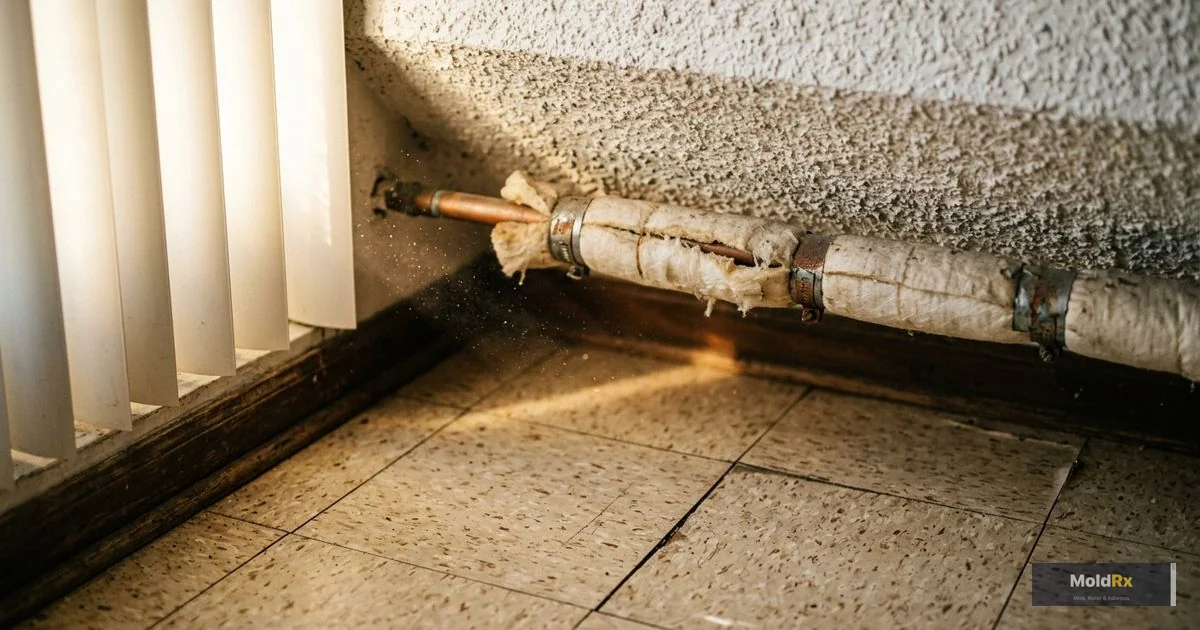
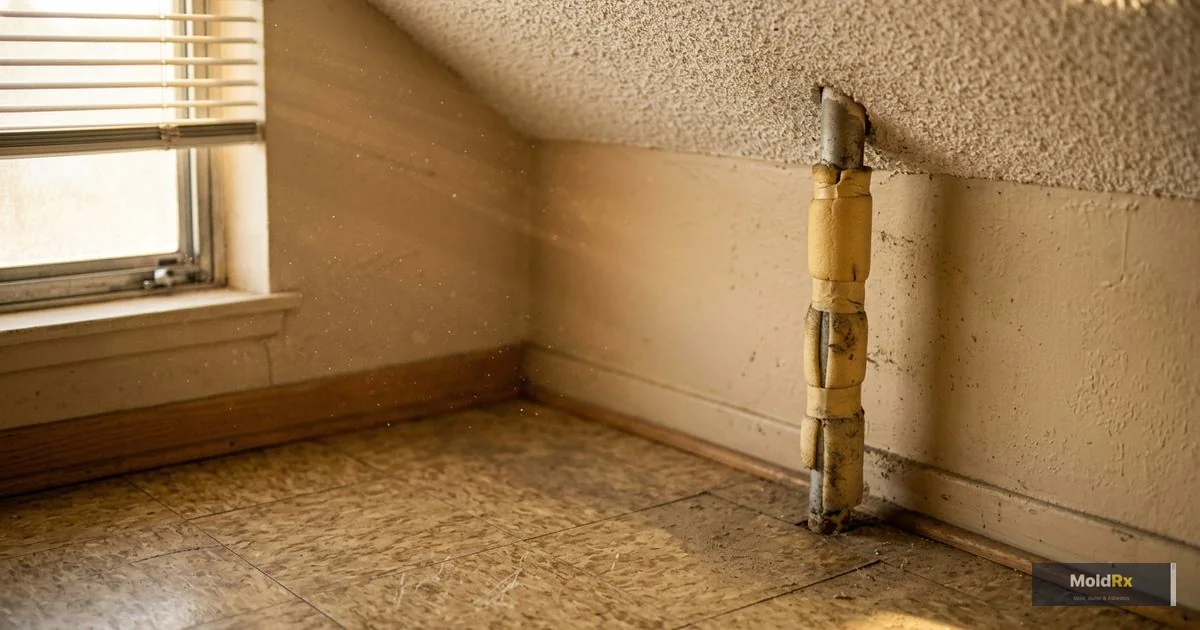
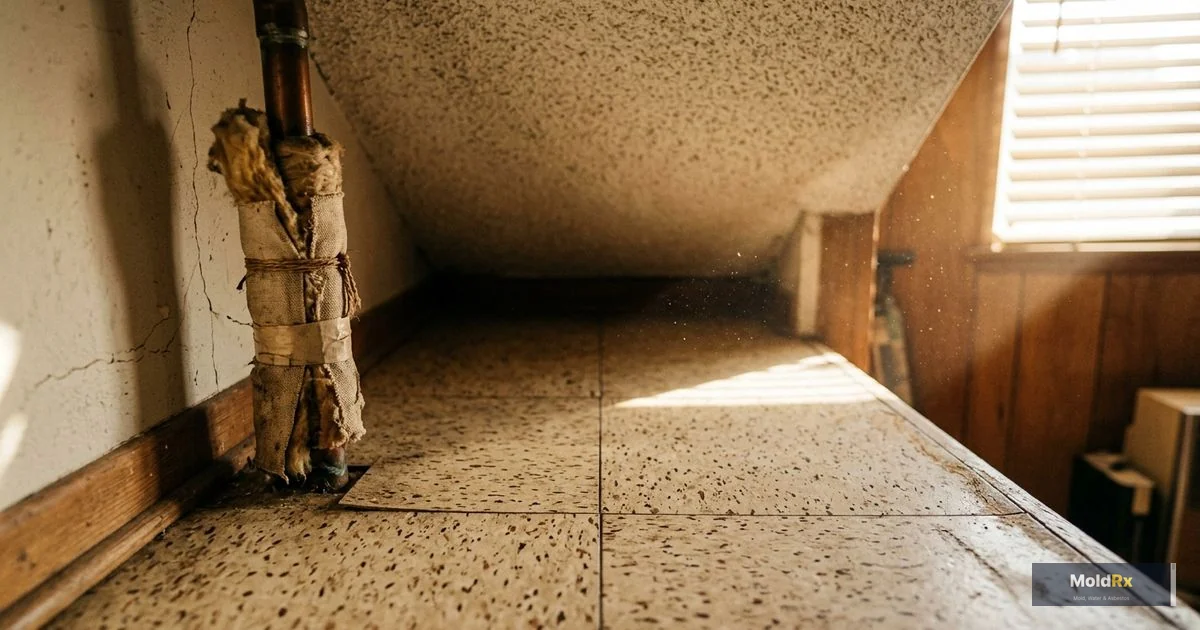
- Pipe insulation and duct wrap — on hot water pipes, heating systems, and HVAC ductwork
- Joint compound and drywall mud — nearly all brands contained asbestos during this construction period
- Textured wall coatings and plaster — spray-applied or troweled finishes
- Roofing materials and shingles — on both individual units and shared structures
- Vermiculite attic insulation — particularly Zonolite brand, frequently contaminated with tremolite asbestos
- Electrical panel components, gaskets, and furnace cement — in original heating and electrical systems
- Window glazing compound and caulking — original window installations throughout the community
When Asbestos Becomes Dangerous
Intact, undisturbed asbestos materials do not automatically release fibers. The danger begins when materials are disturbed. Friable materials — those that crumble under hand pressure, like pipe insulation or sprayed-on ceiling texture — release fibers easily. Non-friable materials — bound in a solid matrix, like floor tiles — become hazardous when cut, sanded, drilled, or degraded by age. In Laguna Woods, where every building material is five to six decades old, degradation is happening now. Ceiling textures crack. Floor tiles become brittle. Pipe insulation crumbles. Age alone is turning stable materials into active hazards.
Laguna Woods-Specific Risk Factors
Laguna Woods presents a combination of risk factors that no other community in Orange County shares:
An elderly and medically vulnerable population. The 2020 census recorded 17,644 residents with a median age above 74 — nearly 80 percent are 65 or older. Aging lungs have reduced capacity to clear inhaled fibers, pre-existing respiratory conditions compound the damage, and immune system decline reduces the body's ability to suppress the cellular changes that lead to mesothelioma and lung cancer. For an 80-year-old resident exposed during a poorly handled renovation, the consequences can manifest far more rapidly than in a younger person.
Shared-wall construction across the entire community. Laguna Woods Village consists almost entirely of attached units — co-ops, condominiums, and high-rises sharing walls, ceilings, floors, and mechanical systems. When one unit's renovation disturbs asbestos, fibers migrate through shared wall cavities, ductwork, and plumbing chases into adjacent units. Your neighbor's contractor scraping popcorn ceiling without testing can contaminate your home.
The co-op ownership structure. United Mutual's 6,323 co-op units operate under a cooperative model where the corporation owns all real property. The mutual's board, not the individual resident, may need to authorize structural work — and building-wide asbestos management affects all members simultaneously.
Marine layer moisture and material degradation. Laguna Woods sits in South Orange County's Mediterranean climate zone, bordered by Laguna Hills, Aliso Viejo, and Laguna Beach. The marine layer regularly pushes moisture inland, and decades of fog-moisture cycling accelerate deterioration of aging building materials — increasing the likelihood that friable ACMs become airborne.
Massive renovation activity in aging stock. Units built in the 1960s need everything updated — plumbing, electrical (many still have original aluminum wiring), radiant heating, kitchens, bathrooms, accessibility modifications. Every one of these projects should begin with asbestos testing. The volume of renovation across 12,736 aging units creates community-wide exposure risk if testing is skipped.
When Asbestos Removal Is Required
Before Any Renovation or Demolition
California law and SCAQMD Rule 1403 require an asbestos survey before any renovation or demolition. In Laguna Woods, where virtually every unit contains ACMs, this is a critical safety requirement. Notification must be submitted to SCAQMD at least 10 working days before demolition. Failure to comply can result in fines exceeding $20,000 per day and criminal prosecution. Kitchen updates, flooring replacement, popcorn ceiling removal, accessibility modifications, plumbing work — any project that disturbs original materials requires testing first. Your mutual board may also require documentation before approving renovation plans.
When Materials Are Damaged or Deteriorating
In buildings now 50 to 63 years old, deterioration is expected. Crumbling pipe insulation, cracking ceiling texture, peeling floor tiles, and deteriorating duct wrap demand immediate professional assessment. Water intrusion from aging plumbing or roof leaks accelerates ACM degradation — and in attached units, water damage in one unit can destabilize ACMs in adjacent units.
Real Estate Transactions
California Civil Code requires sellers to disclose known asbestos hazards. Buyers in Laguna Woods increasingly require testing as part of due diligence. A clean clearance report is a significant transaction asset; undisclosed ACMs can derail sales and create legal liability.
After Professional Testing Confirms ACMs
No removal should begin without laboratory-confirmed results from an NVLAP-accredited lab using PLM or TEM analysis. Visual inspection cannot identify asbestos. Only after testing confirms the presence and condition of ACMs can a proper abatement plan be developed.
Our Asbestos Removal Process
Asbestos abatement is among the most heavily regulated construction activities in California. The professionals MoldRx sends to your Laguna Woods property follow a six-phase process designed for complete compliance and maximum safety — with specific protocols for shared-wall, elderly-resident realities.
1. Pre-Abatement Survey and Testing
A certified inspector surveys your property, identifies suspect materials, and collects samples for NVLAP-accredited laboratory analysis (PLM or TEM). The survey follows AHERA protocols and documents every material tested, its location, condition, and asbestos content. In Laguna Woods, where multiple ACMs are likely present in a single unit, thorough surveying prevents mid-project surprises.
2. Regulatory Notification
SCAQMD Rule 1403 notification is submitted through the online application at least 10 working days in advance for demolition and non-exempt renovation. DOSH notification is also filed. All permits are obtained from day one. Mutual board or HOA approval is coordinated simultaneously.
3. Containment and Worker Protection
The work area is isolated using polyethylene sheeting and HEPA-filtered negative-pressure air scrubbers. Workers wear full PPE including NIOSH-approved respirators with P100 HEPA filters per OSHA 1926.1101. In Laguna Woods' attached-unit community, barriers seal every doorway, window, HVAC register, and penetration point — preventing fiber migration into adjacent units. Neighboring residents are notified and common-area protection installed where needed.
4. Wet Removal and Abatement
All ACMs are thoroughly wetted before removal to suppress fiber release — a core NESHAP and OSHA requirement. Materials are carefully removed using hand tools to minimize breakage. For pipe insulation, glovebag techniques allow removal without exposing surrounding areas. Continuous air monitoring tracks fiber levels throughout the process.
5. Disposal
Removed waste is double-bagged in labeled 6-mil polyethylene bags, placed in rigid containers, and transported to approved disposal landfills. A waste manifest documents the chain of custody — a legal document that protects you and satisfies mutual/HOA record-keeping requirements.
6. Air Monitoring and Clearance Testing
An independent air monitoring professional collects samples analyzed by TEM or PCM. Clearance requires fiber concentrations below 0.01 f/cc. Only after clearance confirmation is containment dismantled. You receive a complete clearance report — your permanent record that the work was performed safely.
Asbestos Removal vs. Encapsulation
Not every asbestos situation requires full removal. Encapsulation — applying a sealant that binds fibers in place — is sometimes acceptable for non-friable materials in good condition that will not be disturbed.
However, encapsulation does not eliminate the asbestos. In Laguna Woods, neighboring units sharing wall cavities may undergo renovation that disturbs encapsulated materials from the other side, and mutual-managed maintenance can unexpectedly breach encapsulated areas. California requires full removal before demolition. The professionals MoldRx sends will give you an honest assessment: if encapsulation is sufficient, they will tell you. If removal is safer — and in Laguna Woods, it often is — they will explain why.
Get your free estimate — no obligations, no pressure.
Regulations That Govern Asbestos Removal in California
Asbestos abatement operates under a layered regulatory framework. These laws protect you, your family, your neighbors, and the workers performing the abatement.
Federal: EPA NESHAP
The National Emission Standards for Hazardous Air Pollutants under the Clean Air Act establish baseline federal requirements — inspection before demolition or renovation, proper notification, wet methods during removal, and disposal at approved facilities.
Federal: OSHA 1926.1101
OSHA's Construction Industry Standard (29 CFR 1926.1101) protects workers — establishing a PEL of 0.1 f/cc over an 8-hour TWA, requiring medical surveillance and EPA-accredited training (40 hours initial plus 8-hour annual refreshers), and dictating engineering controls including containment and negative pressure.
California: Cal/OSHA Title 8 Section 1529
California's asbestos standard meets or exceeds federal OSHA. Section 1529 establishes contractor registration with DOSH, employee training, medical monitoring, and project notification. DOSH actively inspects abatement projects throughout Orange County.
Regional: SCAQMD Rule 1403
Laguna Woods falls within the South Coast Air Quality Management District. Rule 1403 governs asbestos emissions from demolition and renovation — requiring pre-project surveys, advance notification at least 10 working days before demolition, specific removal procedures, and proper waste handling. Penalties include fines exceeding $20,000 per day and criminal prosecution. Asbestos hotline: 909-396-2336.
Federal: AHERA
The Asbestos Hazard Emergency Response Act establishes protocols for asbestos inspection, assessment, and management planning that guide the survey process identifying ACMs before work begins.
Licensing: CSLB C-22 Requirements
California law requires asbestos abatement be performed by contractors holding a C-22 Asbestos Abatement license from the CSLB. Workers must hold current ASB certification and complete EPA-accredited training. Every professional MoldRx sends holds the required C-22 license and current certifications — verified before they set foot in your property.
Health Risks of Asbestos Exposure
Asbestos exposure causes serious, often fatal diseases. There is no safe level of exposure according to OSHA. For Laguna Woods' predominantly elderly population, the health stakes are even higher.
Mesothelioma
An aggressive cancer of the lung lining, abdomen, or heart — caused almost exclusively by asbestos exposure. Incurable in most cases, with median survival of 12 to 21 months. Mesothelioma incidence rates are highest in older populations, and even brief exposure can trigger it. In elderly individuals with reduced immune function, the disease may progress more aggressively.
Asbestosis
A chronic lung disease caused by inhaling asbestos fibers that permanently scar lung tissue. There is no cure. For elderly residents already managing age-related respiratory decline or COPD, asbestosis compounds existing breathing difficulties and accelerates functional decline.
Lung Cancer
Asbestos exposure significantly increases lung cancer risk, multiplied further in combination with any smoking history.
Latency Period and Elderly Vulnerability
Asbestos-related diseases typically appear 10 to 50 years after exposure — but in an 80-year-old, damage can manifest more rapidly and with fewer treatment options. The diseases are irreversible. Prevention through proper abatement is the only defense.
For authoritative information, consult the EPA asbestos page, OSHA's asbestos safety topics, and the California OEHHA asbestos fact sheet.
What Sets MoldRx Apart
- Licensed, certified, compliant. Every professional holds a CSLB C-22 license, EPA-accredited training, current ASB certification, and works in full compliance with Cal/OSHA Title 8, SCAQMD Rule 1403, and federal NESHAP.
- Full regulatory documentation. SCAQMD notifications, waste manifests, NVLAP lab results, and clearance reports — everything you need for compliance, mutual/HOA records, real estate transactions, or insurance claims.
- Honest assessment. If encapsulation is sufficient, we will tell you. If removal is necessary, you will understand why. No upselling, no minimizing genuine hazards.
- Family-owned accountability. Every contractor is verified for licensing, insurance, training, and track record before they set foot in your home.
- Senior-focused communication. Clear, plain language. No jargon, no pressure. We coordinate with family members, property managers, and mutual boards as needed.
Laguna Woods Neighborhoods and Areas We Serve
MoldRx sends licensed asbestos abatement professionals throughout Laguna Woods Village and the surrounding South Orange County area. Each section of the Village carries its own construction date and asbestos profile.
United Laguna Woods Mutual (Co-ops) — The original 6,323 co-op units built in the 1960s — the oldest homes in Laguna Woods Village with the highest asbestos probability. Original popcorn ceilings, floor tiles, pipe insulation, and duct wrap are now 55 to 63 years old. Every renovation requires comprehensive testing. The cooperative ownership structure means the mutual board must be involved in abatement decisions.
Third Laguna Hills Mutual (Condos) — The 6,102 condominium units built through the 1970s. Still constructed during peak asbestos years. Condo ownership gives more direct control over interior work, but shared walls and mechanical systems require coordination with the mutual and adjacent owners during abatement.
Laguna Woods Mutual No. 50 — The Towers — Two high-rise buildings with 311 condominium units. High-rise construction from this era commonly incorporated asbestos in fireproofing, mechanical insulation, and elevator shaft materials. Vertical stacking means disturbance on one floor can affect units above and below through shared mechanical chases.
Common Areas and Shared Facilities — Seven clubhouses, pool buildings, equestrian center, golf course structures, and over 250 club meeting spaces — all built during the same 1960s-1970s timeframe. These community buildings may contain ACMs in commercial-grade flooring, acoustic tiles, fireproofing, and mechanical insulation.
Nearby Communities We Also Serve
MoldRx also serves Laguna Hills, Aliso Viejo, Laguna Beach, Laguna Niguel, Mission Viejo, Dana Point, San Juan Capistrano, Rancho Santa Margarita, Lake Forest, Irvine, and properties throughout South Orange County — ZIP code 92637 and surrounding areas.
Related Services in Laguna Woods
-> All remediation services in Laguna Woods
Frequently Asked Questions
Is it legal to remove asbestos myself in Laguna Woods?
California law requires asbestos abatement be performed by C-22 licensed contractors. A narrow exemption exists for homeowners removing small quantities of non-friable asbestos, but containment, wet methods, disposal, and SCAQMD notification requirements still apply. In Laguna Woods Village, co-op residents in United Mutual do not own their unit — the corporation does — so the homeowner exemption may not apply. Condo owners face HOA restrictions and CC&R requirements that effectively prohibit DIY asbestos work. Improper removal can contaminate your unit and your neighbors' units and result in substantial fines.
Do I need my mutual board or HOA approval before asbestos removal?
In most cases, yes. United Mutual co-op residents must obtain board approval for any work affecting building structure. Third Mutual and Towers condo owners typically submit renovation plans including asbestos survey results to their mutual board before work begins. The approval process generally requires documentation of the licensed contractor, scope of work, containment plan, and timeline. Start early — board review can add weeks to your timeline.
What about shared walls — can my neighbor's renovation expose me to asbestos?
Yes. When a neighboring unit's contractor disturbs ACMs without proper containment, fibers can migrate through shared wall cavities, plumbing chases, and HVAC ductwork into adjacent units. If a neighbor is planning renovation on a shared wall, ask your mutual board whether an asbestos survey was completed and proper containment is planned.
How do I know if my Laguna Woods unit has asbestos?
If your unit was built between 1964 and the mid-1970s — which covers virtually every unit in Laguna Woods Village — asbestos-containing materials are extremely likely. Visual inspection cannot identify asbestos. The only confirmation is laboratory testing by an NVLAP-accredited lab. A certified inspector collects samples, with results in three to five business days.
How long does asbestos removal take in Laguna Woods?
Most residential projects take two to five days depending on scope. Small projects like pipe insulation removal may be completed in one to two days. Larger projects involving full popcorn ceiling abatement or whole-unit floor tile removal take longer. SCAQMD Rule 1403 requires at least 10 working days advance notice, and mutual board approval adds lead time. Plan accordingly.
Can I stay in my unit during asbestos removal?
For small, contained projects limited to one room, you may remain in unaffected areas. Larger projects typically require temporary relocation. For elderly residents with mobility limitations or medical equipment needs, the abatement team coordinates timing to minimize disruption. Adjacent unit residents may also need notification depending on scope.
What materials commonly contain asbestos in Laguna Woods units?
The most common ACMs include popcorn ceiling texture, 9x9-inch vinyl floor tiles and black mastic, pipe and duct insulation, joint compound, textured wall coatings, roofing materials, vermiculite insulation, furnace cement and gaskets, and window glazing compound. In 1960s units, multiple ACMs are typically present simultaneously.
What happens to the asbestos waste after removal?
Removed waste is double-bagged in labeled 6-mil polyethylene bags, placed in rigid containers, and transported by licensed haulers to approved landfills. A waste manifest documents chain of custody — a legal document you receive as part of your project records, satisfying mutual/HOA requirements and protecting you in future transactions.
Will my homeowner's insurance cover asbestos removal?
Standard policies typically exclude asbestos abatement. However, if ACMs are damaged by a covered peril (fire, storm, water damage), your policy may cover abatement as part of the claim. In Laguna Woods Village, your mutual's master insurance may also apply, particularly for common areas. Co-op residents should check with United Mutual's management office about corporation-level coverage.
Is encapsulation safe enough for Laguna Woods units?
Encapsulation can work for non-friable materials in good condition that will not be disturbed. However, in Laguna Woods' shared-wall community — where neighboring renovations and mutual-managed repairs can unexpectedly breach encapsulated areas — removal is often more reliable. For materials in 60-year-old buildings already showing deterioration, encapsulation is a temporary fix for a permanent problem.
Get Asbestos Removal in Laguna Woods
This is not a problem that gets better with time. Every year that passes, the materials in your Laguna Woods unit get older, more brittle, and more dangerous. Every renovation your neighbor starts without proper testing increases your exposure risk. The diseases asbestos causes are irreversible, incurable, and fatal. In a community where the average resident is 78 years old, there is no time to waste and zero margin for error.
Whether you have confirmed ACMs, suspect your unit contains asbestos, need testing before renovation, or are concerned about a neighbor's construction activity, MoldRx only sends licensed, insured, and fully compliant abatement professionals. Shared walls mean shared risk. An elderly population means heightened vulnerability. Your safety demands professionals who get it right the first time.
Call MoldRx for your free estimate — (888) 609-8907. Licensed. Compliant. Done right.