Emergency Water Damage Restoration in Laguna Woods, CA -- MoldRx
Vetted, IICRC S500-Certified Specialists Serving Laguna Woods and South Orange County -- 24/7
Water is inside your Laguna Woods home right now, and every minute it stays there it is causing damage you cannot see. It is wicking into shared walls. It is saturating subfloor beneath your carpet. It is seeping into the drywall cavity between your unit and your neighbor's. Within 24 to 48 hours, mold colonization begins -- and in a community where the average resident is over 74 years old, airborne mold spores are not just a property problem. They are a health emergency. If you are reading this because water has already entered your home, stop scrolling and call.
Call (888) 609-8907 now for emergency water damage response in Laguna Woods.
MoldRx does not perform restoration work ourselves. We vet the specialists who do. Every water damage professional we send to your Laguna Woods property has been screened for IICRC S500 certification, proper CSLB licensing, verified insurance, and documented experience handling the exact building types, shared-wall construction, and aging infrastructure that define Laguna Woods Village. You get the right crew -- not whoever happens to answer the phone.
Why Water Damage in Laguna Woods Is a Different Kind of Emergency
Laguna Woods is not a typical Orange County suburb. It is the largest 55+ active-adult community on the West Coast -- and its age, construction, and resident demographics create water damage scenarios that demand specialized knowledge most restoration companies simply do not have.
12,736 Units Built Between 1964 and 1981 -- Infrastructure at the Breaking Point
Laguna Woods Village began as Leisure World, with construction starting in the spring of 1964. The first 530 units launched what would become a massive phased development spanning nearly two decades. The community's three housing mutuals tell the story of that timeline:
- United Laguna Woods Mutual -- co-op units built in the 1960s, the oldest homes in the Village. These units carry plumbing infrastructure that is now over 60 years old.
- Third Laguna Hills Mutual -- condominiums and garden villas built in the 1970s. Plumbing here is 45 to 55+ years old.
- Mutual No. Fifty (The Towers) -- 309 units across two high-rise condominium buildings.
That construction era means predictable, converging failures:
- Galvanized steel supply lines -- standard in 1960s construction -- corrode from the inside out. From the outside, the pipe looks fine. Inside, decades of mineral buildup and rust have narrowed the interior diameter to a fraction of its original size. These pipes do not leak gradually. They fail catastrophically, flooding a unit in minutes.
- Cast iron drain and sewer lines -- common throughout the Village -- develop cracks, joint separations, and complete bellied sections after six decades of service. A failed cast iron drain under a slab foundation can send sewage-contaminated water upward through floor penetrations before anyone realizes what has happened.
- Original water heaters have been replaced once or twice by now, but replacement water heaters installed in the 2000s and 2010s are themselves approaching or past their 10-15 year lifespan. Water heater failure is one of the most common causes of sudden, large-volume flooding in Laguna Woods.
- Polybutylene piping, used in some later-phase construction, deteriorates when exposed to chlorine in municipal water. Failures are sudden, without warning, and typically occur at fittings and joints.
Shared Walls, Shared Ceilings, Shared Catastrophe
This is the factor that makes water damage in Laguna Woods fundamentally different from a single-family home in Mission Viejo or Rancho Santa Margarita. The overwhelming majority of Laguna Woods Village's 12,736 units are attached -- co-ops, condominiums, and manor units sharing walls, ceilings, floors, and plumbing infrastructure.
When a supply line bursts in an upstairs unit, the water does not respect property boundaries. It travels through shared wall cavities, drops through ceiling penetrations, pools on the slab of the unit below, and migrates laterally into adjacent units through common framing. A single pipe failure can damage two, three, four units simultaneously -- each with its own insurance policy, its own resident, and its own set of belongings.
For the Laguna Woods Village management, mutual boards, and property managers reading this: water damage here is almost never a single-unit problem. The specialists we vet understand multi-unit triage, IICRC S500 protocols for shared structures, and the documentation requirements that mutual insurance carriers demand.
Marine Layer, Coastal Humidity, and Mold Acceleration
Laguna Woods sits roughly five miles inland from the Pacific -- close enough for persistent marine-layer influence. Morning fog blankets the community regularly, average humidity hovers around 63%, and climbs above 70% during the May-June marine-layer season. Annual rainfall averages roughly 13 inches, concentrated in intense winter bursts between November and March that overwhelm aging drainage systems and flat roofing on 1960s-era structures.
This matters because water-saturated drywall, carpet pad, and subfloor cannot dry naturally when the ambient air is already moisture-laden. In drier inland communities, a small leak might take a week to generate visible mold. In Laguna Woods, that timeline compresses dramatically. The marine layer feeds the problem instead of helping solve it.
Professional structural drying with commercial dehumidifiers calibrated for coastal-adjacent humidity is not optional here. Opening windows will not save you.
Elderly Residents and Health-Critical Urgency
The 2020 Census placed Laguna Woods' median age at 74.9 years -- the highest of any city in Orange County. This is not a demographic footnote. It is a medical reality that changes the urgency calculus of every water damage event.
Mold exposure that might cause mild irritation in a healthy 35-year-old can trigger serious respiratory complications in residents over 70 -- particularly those with COPD, asthma, or compromised immune systems. Category 3 (black water) exposure from sewage backups carries bacterial and viral contamination that poses genuine infection risk to elderly residents.
Speed of response in Laguna Woods is not just about protecting property. It is about protecting people who are medically vulnerable. Every hour of delay increases health exposure for residents who can least afford it.
The IICRC S500 Restoration Process Our Vetted Specialists Follow
The professionals MoldRx sends to your Laguna Woods property do not freelance the process. They follow the IICRC S500 Standard and Reference Guide for Professional Water Damage Restoration -- the ANSI-accredited, industry-recognized protocol that defines how this work must be done. Here is what that looks like in a Laguna Woods Village unit.
Step 1: Emergency Response and Loss Assessment
When you call (888) 609-8907, we deploy a vetted specialist to your Laguna Woods property for immediate assessment. They will:
- Identify and stop the water source -- whether it is a burst galvanized supply line, failed water heater, cast iron drain collapse, appliance malfunction, roof intrusion from a winter storm, or sewage backup through aging sewer laterals
- Classify the water category per IICRC S500 standards:
- Category 1 (Clean Water): Originates from a sanitary source -- broken supply lines, sink overflows, toilet-tank cracks. Lowest contamination risk but still demands rapid extraction before it degrades.
- Category 2 (Gray Water): Contains significant contamination that can cause illness -- dishwasher or washing machine discharge, toilet overflows with urine, HVAC condensate line failures. Requires enhanced PPE and antimicrobial protocols.
- Category 3 (Black Water): Grossly contaminated water -- sewage backups through deteriorated cast iron lines, storm-drain intrusion, any Category 1 or 2 water that has been sitting long enough to degrade. Cal/OSHA hazmat protocols apply. This is the most dangerous scenario, and with elderly residents present, it demands immediate professional intervention. No exceptions.
- Determine the damage class per IICRC standards:
- Class 1: Least amount of water absorption -- small area, minimal material saturation
- Class 2: Significant absorption into carpets, cushions, and wicking up walls to 24 inches
- Class 3: Greatest absorption -- water from overhead, saturating ceilings, walls, insulation, carpet, and subfloor. Common in Laguna Woods multi-story units where upstairs plumbing failures cascade downward.
- Class 4: Specialty drying situations involving hardwood, plaster, concrete, or stone -- materials with very low permeance that trap moisture. Relevant in older Laguna Woods units with original plaster walls and concrete slab construction.
- Map the full moisture footprint using infrared thermal imaging and penetrating moisture meters -- critical in Laguna Woods' slab-on-grade construction where water travels laterally beneath flooring and through shared walls into adjacent units
- Document everything with timestamped photography and written reports for insurance and mutual records
Step 2: Water Extraction
Standing water is removed immediately using truck-mounted and portable extraction units. For Laguna Woods condos and co-ops, where access through gated entry points, narrow community roadways, and shared-wall construction requires careful logistics, our specialists use targeted extraction equipment that removes water without creating additional damage to adjacent units.
Speed is everything in this phase. Every hour water remains in contact with building materials increases the damage class, elevates the contamination category (Category 1 degrades to Category 2, then Category 3 over time), and expands the scope of restoration. In a community where 60-year-old galvanized pipes can release significant water volume in minutes, the difference between a two-hour response and a twelve-hour response is often the difference between restoring one unit and remediating four.
Step 3: Structural Drying and Dehumidification
This phase separates competent restoration from the kind that creates mold problems six weeks later -- problems that are especially dangerous for Laguna Woods' elderly residents.
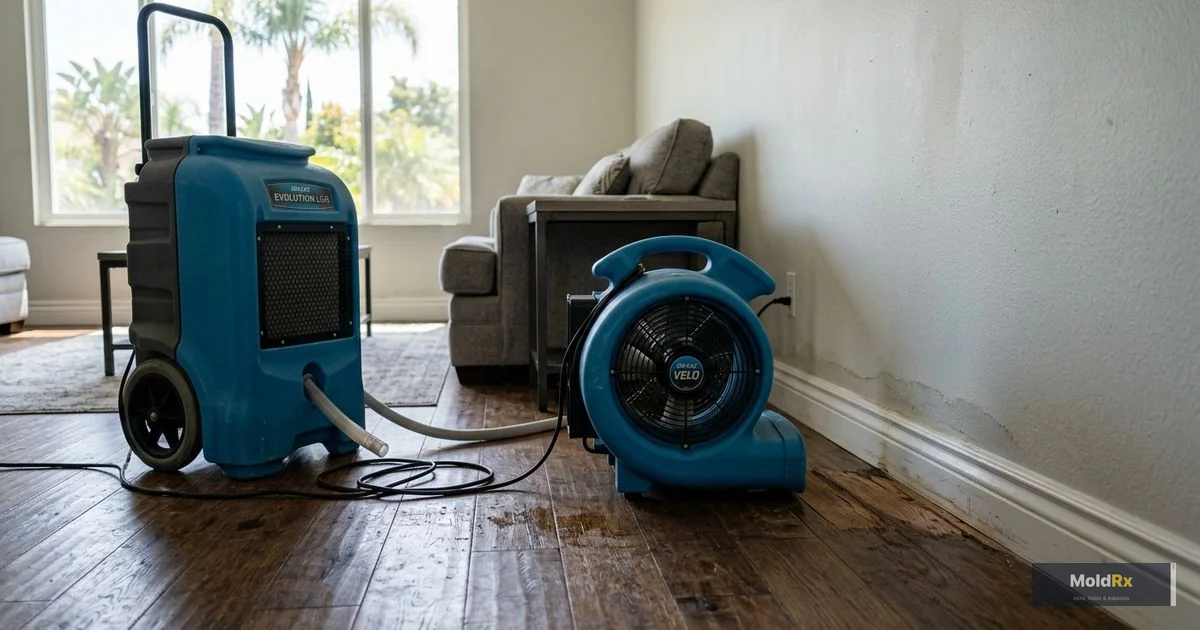
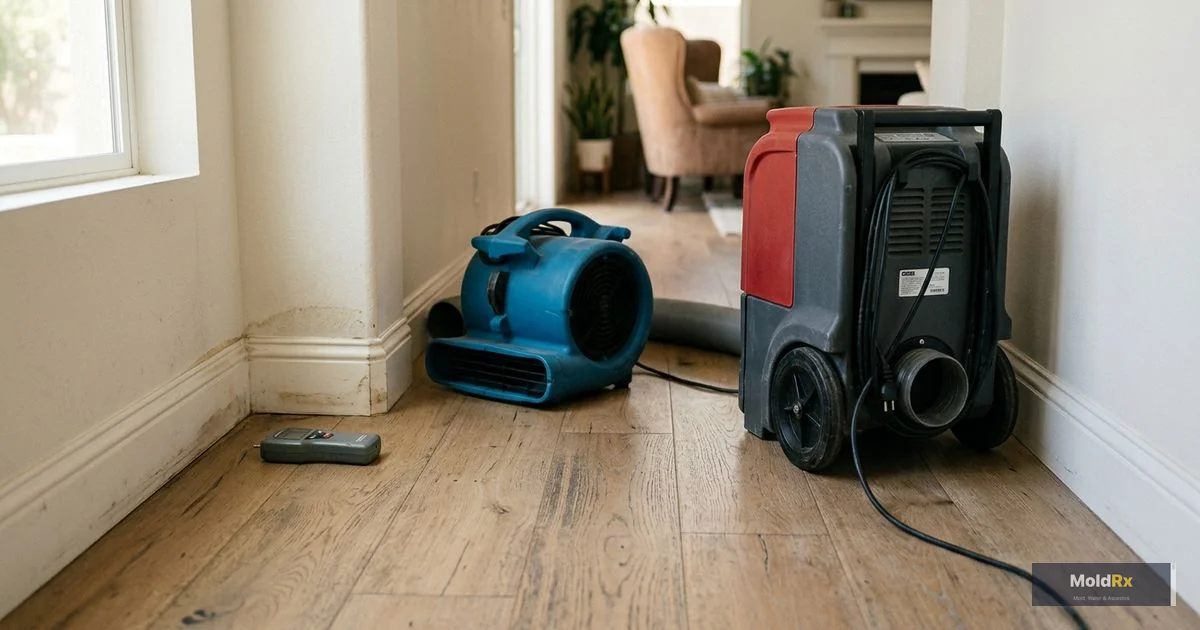
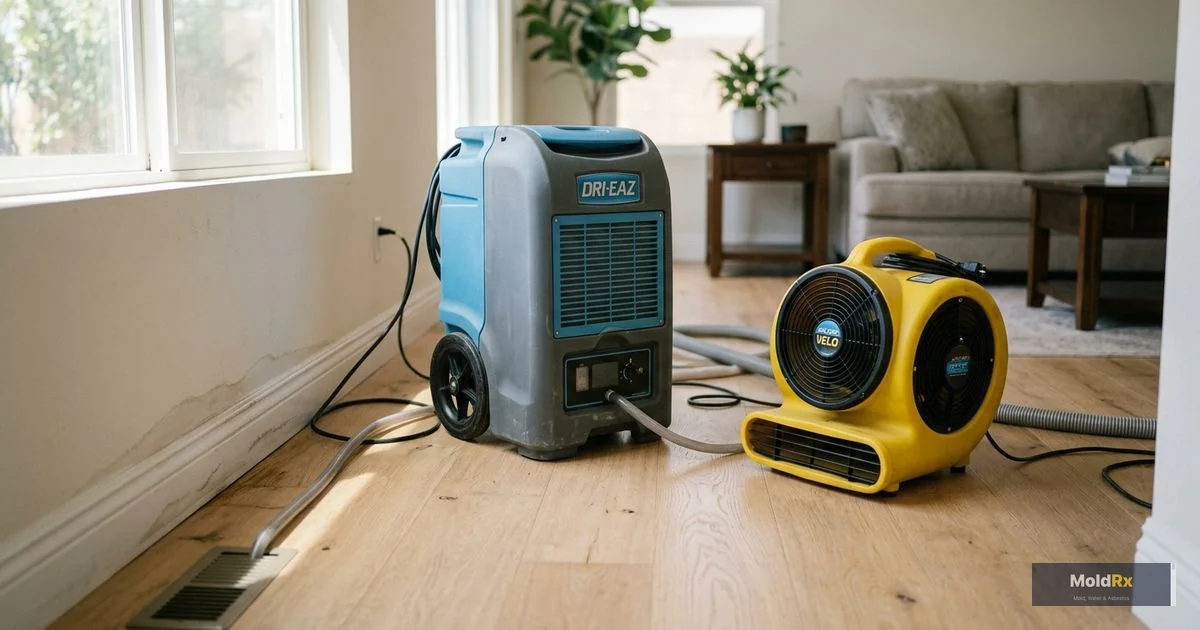
Our vetted specialists deploy commercial-grade LGR (low-grain refrigerant) dehumidifiers and high-velocity air movers in configurations calculated for each affected space. In Laguna Woods, where marine-layer humidity regularly elevates ambient moisture levels above 70%, the drying protocol must compensate for conditions that actively work against you. Standard residential dehumidifiers cannot do this work.
Drying is monitored daily with calibrated moisture meters and hygrometers. The specialists document psychrometric readings to verify conditions are progressing toward IICRC S500 drying goals for each material type. Drying is not complete when the carpet feels dry to the touch. It is complete when instrument readings confirm all affected materials have returned to normal equilibrium moisture content.
In Class 4 situations involving Laguna Woods' concrete slab construction or original plaster walls, specialty techniques like desiccant dehumidification or heat drying may be required. These older materials trap moisture far longer than modern drywall.
Step 4: Cleaning, Sanitization, and Antimicrobial Treatment
Once the structure is dry, the contamination level dictates what comes next:
- Category 1 losses: Cleaning and drying may be sufficient for salvageable materials
- Category 2 losses: All affected porous materials that cannot be adequately cleaned must be removed. Semi-porous materials require antimicrobial treatment. EPA-registered antimicrobial products are used per label instructions.
- Category 3 losses: All affected porous materials are removed and discarded -- no exceptions. This includes drywall, insulation, carpet, pad, and any organic material that contacted the contaminated water. Structural framing is cleaned, treated, and verified before reconstruction begins. In sewage-backup scenarios -- increasingly relevant in Laguna Woods where cast iron sewer lines from the 1960s are past their functional lifespan -- IICRC S520 mold remediation protocols may run concurrently if microbial growth is identified.
Elderly immune systems are less forgiving of residual contamination. Our vetted specialists treat this phase with the thoroughness that Laguna Woods residents deserve -- not the shortcuts that leave problems for later.
Step 5: Reconstruction and Restoration
The final phase returns your property to pre-loss condition: drywall replacement, flooring reinstallation, painting, trim work, and structural repairs identified during drying. Our vetted specialists coordinate this work to minimize disruption -- critical in Laguna Woods Village, where displaced elderly residents face compounded stress and mutual management timelines add coordination requirements.
Important for Laguna Woods residents: 1960s and 1970s homes may contain asbestos in original flooring, insulation, popcorn ceilings, and pipe insulation. If asbestos-containing materials are suspected during restoration, our specialists follow proper testing and abatement protocols per EPA and Cal/OSHA regulations before disturbing them. Non-negotiable.
What Category and Class Mean for Your Laguna Woods Property
Understanding the IICRC classification system helps you make informed decisions and protects you from being oversold -- or undersold -- on restoration scope.
| Classification | What It Means | Common Laguna Woods Scenarios |
|---|---|---|
| Category 1 | Clean water from a sanitary source | Burst galvanized supply line, water heater tank failure, toilet-tank crack |
| Category 2 | Contaminated water causing potential illness | Washing machine overflow, dishwasher backup, HVAC condensate line failure |
| Category 3 | Grossly contaminated / black water | Sewage backup through failed cast iron drain, storm intrusion, any stagnant water 48+ hours |
| Class 1 | Minimal absorption, small area | Leak caught early, limited to one room with hard-surface flooring |
| Class 2 | Significant absorption, water wicking up walls | Supply line burst in a co-op unit with carpet, water reaching adjacent units through shared walls |
| Class 3 | Greatest absorption, water from overhead | Upstairs unit plumbing failure saturating ceiling, walls, and flooring of unit below |
| Class 4 | Specialty drying -- low-permeance materials | Water trapped in concrete slab, original plaster walls, hardwood flooring |
The higher the category and class, the more complex, time-consuming, and costly the restoration. But cutting corners on a Category 3 / Class 3 loss to save money in the short term virtually guarantees a mold remediation project within weeks -- one that puts elderly residents at direct respiratory risk and costs significantly more than doing it right the first time.
Laguna Woods Areas We Serve
Our vetted water damage restoration specialists respond to emergencies throughout the entire Laguna Woods Village community, including:
- United Mutual co-op units -- the original 1960s construction across all cooperative mutuals
- Third Mutual condominiums and garden villas -- the 1970s-era units throughout the community
- Mutual No. Fifty (The Towers) -- both high-rise condominium buildings
- All fourteen gated entry areas, from Gate 1 near Clubhouse 1 to Gate 14 near El Toro Road
- Properties near the Clubhouse 1 fitness and pool complex, the 27-hole golf course, the equestrian center, and all seven clubhouse areas
- Units along Moulton Parkway, El Toro Road, and the interior community roadways
We cover ZIP code 92637 and serve the full Laguna Woods city limits.
We also respond to water damage emergencies in neighboring South Orange County communities, including Laguna Hills, Aliso Viejo, Mission Viejo, Laguna Niguel, and Irvine.
Request your free estimate now -- or call (888) 609-8907 for immediate emergency response.](tel:8886098907)
Why MoldRx -- And Why "Vetted" Is Not a Marketing Word
There are dozens of restoration companies in Orange County that will answer the phone at 2 AM and promise to be at your Laguna Woods property within the hour. Some of them are excellent. Some of them are not licensed, not insured, not trained, and not accountable when they leave moisture behind your walls and you discover mold two months later -- mold that puts an elderly resident in respiratory distress.
MoldRx exists because Tyler and Adrian -- co-founders with over 40 years of combined remediation and business experience -- saw that problem firsthand and built a solution. We do not perform restoration ourselves. We vet the people who do, and we only send specialists who meet every one of these criteria:
- IICRC S500 certification for water damage restoration
- IICRC S520 certification for mold remediation (because water damage and mold overlap constantly -- especially in Laguna Woods' humid, marine-layer-influenced microclimate)
- Active CSLB contractor's license in good standing with the California State License Board
- Verified general liability and workers' compensation insurance -- protecting you from liability if an accident occurs on your property
- Documented experience with the specific building types in Laguna Woods Village: 1960s co-ops, 1970s condominiums, shared-wall construction, slab-on-grade foundations, multi-unit mutual properties
- Cal/OSHA compliance for worker safety protocols, particularly critical in Category 3 / black-water scenarios involving elderly residents
When we say "vetted," we mean we have verified every credential, called references, and confirmed that these specialists do the work the right way -- per IICRC S500 and EPA guidelines, with proper documentation, honest communication, and accountability. In a community where the median resident is 74 years old, sending anything less is not something we are willing to do.
Insurance and Documentation
Most Laguna Woods homeowner and co-op policies cover sudden and accidental water damage -- a burst pipe, a failed water heater, an appliance malfunction. What they typically do not cover is gradual damage from deferred maintenance, and standard policies almost never cover external flood damage (which requires a separate NFIP or private flood policy).
Our vetted specialists understand what insurance adjusters need:
- Timestamped photo and video documentation of all affected areas before, during, and after restoration
- Moisture readings and psychrometric data supporting the drying protocol and confirming completion
- Itemized scope of work with IICRC-standard line items that adjusters can process without pushback
- Category and class determination documented per IICRC S500 standards -- this directly affects what your policy will cover
For multi-unit situations -- common given the shared-wall construction -- documentation requirements multiply. A single pipe failure can trigger the mutual's master policy, individual unit-owner policies, and adjacent unit-owner policies simultaneously. Our specialists produce the records every carrier requires and coordinate with Village Management Services when common-area elements are affected.
Frequently Asked Questions
How fast can a vetted specialist reach my Laguna Woods property?
For active water emergencies, our goal is same-day deployment -- often within hours. Call (888) 609-8907 any time, day or night. Water damage does not wait for business hours and neither do we. Our specialists are familiar with Laguna Woods Village's gated entry procedures and coordinate with community security for rapid access.
I am elderly and live alone. Will your specialists explain everything clearly and help me understand what is happening?
Yes. Our vetted professionals understand that clear, patient communication is essential -- especially for residents managing an emergency on their own. They will explain every step of the process in plain language, provide written documentation of all findings and recommendations, and coordinate with family members or designated contacts if you authorize it. Nobody gets talked over, rushed, or pressured.
Water is coming through my shared wall from the unit next door. What do I do first?
Document the water intrusion with photos and video immediately. Contact your mutual's management office and your neighbor (if reachable) to report the situation. Do not attempt to cut into the shared wall yourself. Then call (888) 609-8907. Shared-wall water migration in Laguna Woods' attached housing affects multiple units simultaneously and requires a coordinated response that accounts for both properties. Our specialists handle multi-unit triage regularly in communities like yours.
My unit has original 1960s plumbing. Should I be worried about a sudden failure?
Galvanized steel supply lines from the 1960s have a typical service life of 40-50 years. If your unit has not been repiped, those lines are now over 60 years old -- well past their expected lifespan. Cast iron drain lines face similar deterioration. A sudden, catastrophic failure is not a matter of if but when. Having MoldRx's number saved means vetted specialists can be deployed immediately rather than losing critical hours searching for help during an emergency.
The drying equipment is loud. How long does it need to run?
Commercial air movers and dehumidifiers run 24/7 during the drying phase, typically 3-7 days depending on damage class. The equipment cannot be turned off at night without extending drying and dramatically increasing mold risk. Our vetted specialists work with Village management to communicate timelines and, where possible, arrange temporary accommodations if displacement is medically necessary. Honest communication up front prevents conflict later.
How do I know the drying is actually complete and not just "good enough"?
Legitimate restoration per IICRC S500 standards requires documented moisture readings confirming that all affected materials have returned to normal equilibrium moisture content. Our vetted specialists provide these readings to you. If a contractor tells you "it feels dry" or wants to pull equipment after two days without showing you meter readings, that is a red flag. Incomplete drying is the number-one cause of post-restoration mold growth -- and in Laguna Woods' humid microclimate, the margin for error is smaller than in drier inland areas.
My water heater flooded my unit and water went into the unit below. Who is responsible?
Liability depends on the cause, the mutual's CC&Rs, master policy provisions, and individual unit-owner policy terms. Our specialists document everything per IICRC S500 standards to support the insurance process for all parties. Contact your insurance carrier and mutual management office immediately.
What about mold -- is it already growing?
If you can see standing water or feel dampness and it has been more than 24-48 hours, microbial amplification has likely begun -- even if you cannot see it yet. Mold colonizes behind walls, under flooring, and inside wall cavities where you will not detect it without moisture meters and visual inspection. In Laguna Woods' marine-layer humidity, that timeline can compress further. Our vetted specialists are dual-certified in IICRC S500 (water damage) and IICRC S520 (mold remediation) specifically because these two problems are inseparable in practice -- and because the health stakes for elderly residents are too high to treat mold as an afterthought.
Could my 1960s-era unit have asbestos that gets disturbed during restoration?
Yes. Homes built in the 1960s and 1970s commonly contain asbestos in floor tiles, pipe insulation, popcorn ceilings, and joint compound. Our vetted specialists identify suspected asbestos-containing materials and recommend proper testing before any demolition or removal. If asbestos is confirmed, certified abatement procedures follow EPA and Cal/OSHA regulations. This step is never skipped.
Related Services in Laguna Woods
Water damage and mold are rarely isolated problems. When one appears, the other is usually close behind -- especially in a 60-year-old community with marine-layer humidity. MoldRx connects Laguna Woods property owners with vetted specialists for:
-> Learn more about remediation services in Laguna Woods
Water Is in Your Laguna Woods Home Right Now. Here Is What to Do.
Every hour you wait, the damage category escalates, the restoration scope expands, the cost increases, and mold gets closer to establishing a foothold that turns a water damage project into a full remediation -- one with direct health consequences for residents in their 70s, 80s, and 90s. This is not a scare tactic. It is building science, and it is medical reality.
You need a vetted, IICRC S500-certified specialist who knows Laguna Woods Village's 1960s co-ops, 1970s condominiums, shared-wall construction, galvanized and cast iron plumbing, marine-layer humidity, and the medical urgency that elderly residents add to every water damage event. MoldRx only sends professionals who meet that standard -- because sending anything less to a community like Laguna Woods is not something we are willing to do.
Get your free estimate now -- or pick up the phone.
Call (888) 609-8907 for emergency water damage restoration in Laguna Woods.
No runaround. No upselling. Just vetted professionals, honest answers, and the urgency this situation demands.