Pipe Insulation Is One of the Most Dangerous Forms of Asbestos in Your Building
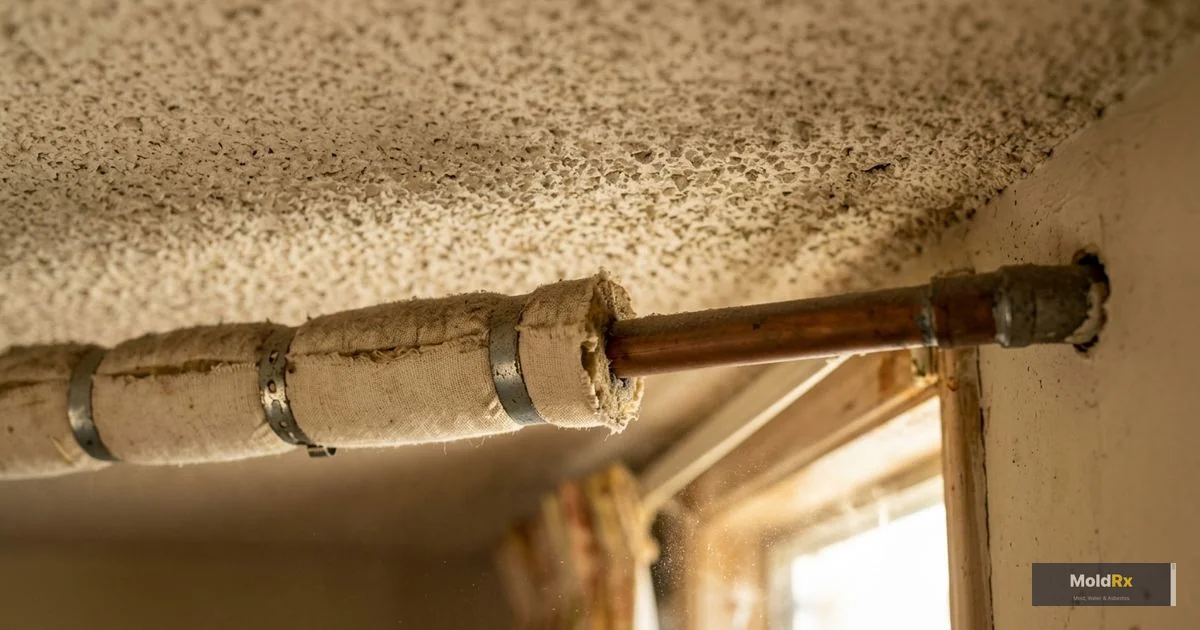
If you've found old insulation wrapped around pipes in your basement, crawl space, or utility room, you may be looking at one of the most hazardous asbestos-containing materials that exists in residential and commercial buildings. Asbestos pipe insulation is often friable — a technical term meaning it can be crumbled, pulverized, or reduced to powder by hand pressure alone. That matters because friable materials release microscopic asbestos fibers far more readily than bound materials like floor tiles or cement siding.
Unlike asbestos floor tiles that lock fibers within a vinyl matrix or popcorn ceilings where fibers are embedded in a dried compound, pipe insulation is frequently loose, deteriorating, and easy to damage accidentally. Brushing against it in a crawl space, bumping it while retrieving stored items, or even vibration from the pipes themselves can release fibers into the air you're breathing.
You cannot confirm asbestos by looking at pipe insulation. The only definitive answer comes from professional laboratory testing. But understanding what asbestos pipe insulation looks like, where it's found, and why it demands respect can prevent you from making a dangerous and irreversible mistake.
Types of Asbestos Pipe Insulation
Asbestos was used in pipe insulation in several distinct forms. Knowing the main types helps you recognize suspect materials — though visual identification is never a substitute for laboratory analysis.
Corrugated Air-Cell Insulation
This is one of the most recognizable forms of asbestos pipe insulation. Corrugated air-cell insulation consists of layers of corrugated cardboard-like material wrapped around the pipe, typically covered with an outer layer of canvas, paper, or cloth. The corrugated layers create air pockets that provide thermal insulation.
It was widely used from the early 1900s through the 1970s, particularly on hot water pipes and steam lines. The corrugated layers frequently contain chrysotile (white asbestos) or amosite (brown asbestos). This type of insulation is highly friable, especially as it ages — the layered structure deteriorates and the material flakes apart easily.
Magnesia Block Insulation
Magnesia block insulation — also called 85% magnesia — was one of the most common high-temperature pipe insulation products of the 20th century. It consists of preformed half-cylinder sections (blocks) of calcium silicate and magnesium carbonate mixed with asbestos fibers, typically clamped or wired around pipes and covered with canvas or a plaster-like jacket.
The blocks are white to light gray, chalky in appearance, and extremely friable when damaged. Intact magnesia blocks with their outer jacket in place may appear relatively benign, but any crack, break, or deterioration of the jacket exposes the asbestos-laden core material. This insulation was standard on boilers, high-temperature pipes, and steam lines in buildings constructed from the 1920s through the 1970s.
Fibrous Pipe Wrap
Fibrous pipe wrap is a blanket-style insulation made of asbestos fibers woven or compressed into a flexible mat or tape, then wrapped around pipes in spiral layers. It may be covered with canvas, paper, foil, or left partially exposed. The material is often white, gray, or tan and has a distinctly fibrous, almost cloth-like texture.
This form is especially dangerous because the fibrous surface sheds easily. Even slight physical contact — a hand brushing past, a stored box pushed against it — can dislodge fibers. Fibrous wrap was commonly used on smaller-diameter pipes, domestic hot water lines, and as a supplemental wrap over other insulation types.
Asbestos-Containing Duct Tape and Joint Compound
Even when the main pipe insulation itself doesn't contain asbestos, the tape used to seal joints between insulation segments and the compound applied to seams frequently does. White or gray cloth tape around pipe insulation joints and the putty-like compound used to seal insulation ends are both common asbestos sources. These materials are easy to overlook but just as hazardous as the insulation itself.
Where Asbestos Pipe Insulation Is Found
Asbestos pipe insulation isn't scattered randomly through a building. It was applied to specific systems for specific thermal and safety reasons. Knowing where to look helps you assess your property's risk profile.
Boiler Rooms and Mechanical Rooms
Boilers and their associated piping are the most common location for asbestos pipe insulation. Steam boilers, hot water boilers, and their distribution pipes were almost universally insulated with asbestos-containing materials in buildings constructed before 1980. The high operating temperatures made asbestos insulation a practical choice — it was heat-resistant, fire-retardant, and inexpensive.
If your building has an older boiler system and the pipes running from it are wrapped in any form of insulation, assume it contains asbestos until testing proves otherwise.
Basements
Basement ceiling pipes — the hot water lines, heating distribution pipes, and sometimes cold water lines running overhead — are one of the most frequently encountered locations for asbestos pipe insulation in residential buildings. These pipes are often visible and accessible, which paradoxically makes them more dangerous: homeowners and contractors brush against them, hang items from them, and disturb them during basement projects without realizing what they're touching.
Crawl Spaces
Crawl spaces beneath older homes commonly contain insulated pipes, particularly hot water lines and heating system pipes. The confined, poorly lit conditions make it easy to bump into or damage pipe insulation while navigating the space. Maintenance workers, plumbers, and electricians working in crawl spaces are especially at risk of disturbing asbestos pipe insulation.
Utility and Laundry Rooms
Hot water heater connections, heating system pipes, and steam pipes passing through utility rooms and laundry areas are common locations. In many older homes, these are the only rooms where pipes are exposed and insulation is visible.
Steam and Hot Water Distribution Lines
In commercial buildings, apartment complexes, and older institutional structures, asbestos pipe insulation often runs throughout the building along steam and hot water distribution lines — through corridors, above drop ceilings, along walls, and through vertical chases between floors. The total volume of asbestos-containing insulation in a commercial building can be substantial.
Pipe Penetrations and Connections
Even in buildings where main pipe runs have been re-insulated with modern materials, short sections of original asbestos insulation often remain at pipe penetrations through walls and floors, at valve connections, at elbow joints and T-connections, and at points where pipes are difficult to access. These remnant sections are easy to miss during partial re-insulation projects and represent an ongoing hazard.
Visual Identification Clues
You cannot confirm asbestos through visual inspection — only laboratory analysis can do that. But the following characteristics can help you identify pipe insulation that warrants professional assessment and testing before any disturbance.
Age of the building. If your property was built before 1980, California regulations presume that thermal insulation materials contain asbestos until testing proves otherwise. This presumption exists for good reason — asbestos pipe insulation was standard practice during this era. Understanding indicators of asbestos in your property can help you assess the broader risk picture.
White, gray, or light-colored wrapping. Asbestos pipe insulation is most commonly white, off-white, gray, or light tan. A bright white, chalky material on older pipes is a strong visual indicator — though color alone is never definitive.
Canvas or cloth outer covering. Many forms of asbestos pipe insulation were finished with a canvas, cloth, or paper outer jacket. If you see pipes wrapped in what looks like an old fabric or canvas sleeve over a thicker insulation layer, that's a material that needs testing.
Corrugated or layered structure. If the insulation shows visible corrugated layers — similar to corrugated cardboard but made of mineral material — you're likely looking at corrugated air-cell insulation, which has a very high probability of containing asbestos.
Chalky, powdery, or crumbly texture. Asbestos pipe insulation that's deteriorating often develops a chalky or powdery surface. If you can see material that looks like it would crumble at the slightest touch, that's a serious concern — it means the material is actively friable.
Preformed half-cylinder sections. Insulation that appears to be rigid, molded sections clamped or wired around the pipe — rather than a flexible wrap — is likely magnesia block or a similar product with a high probability of asbestos content.
Fibrous texture. If the insulation has a visible fibrous or cloth-like quality — individual fibers visible at edges, tears, or damaged areas — treat it as suspect.
Deterioration, damage, or debris. Insulation that's falling apart, missing sections, visibly damaged, or leaving debris on surfaces below it demands immediate attention. Deteriorating asbestos insulation is actively releasing fibers.
Why Pipe Insulation Is Especially Dangerous
Not all asbestos-containing materials present the same level of risk. Asbestos pipe insulation is considered among the most hazardous for several reasons, and understanding why asbestos is dangerous in general provides important context.
Friability: The Critical Factor
The fundamental danger of asbestos pipe insulation is its friability. The EPA defines a friable asbestos-containing material as one that can be crumbled, pulverized, or reduced to powder by hand pressure. Most forms of pipe insulation — especially corrugated air-cell, magnesia block, and fibrous wrap — meet this definition, particularly as they age and deteriorate.
Friable materials release fibers far more easily than non-friable ones. A floor tile needs to be broken, sanded, or ground to release significant fibers. Pipe insulation can release fibers from a light touch, a vibration, or simply from gravity pulling deteriorating material apart.
Easy to Damage Accidentally
Pipe insulation in basements, crawl spaces, and utility rooms is routinely bumped, brushed against, and disturbed by people who don't realize what they're touching. Homeowners reaching for stored items, plumbers working on adjacent pipes, electricians running wire, pest control technicians navigating crawl spaces — all of these activities can disturb asbestos pipe insulation and release fibers without anyone recognizing what happened.
High Fiber Concentration
Many asbestos pipe insulation products contained very high percentages of asbestos — some magnesia block products were up to 15% asbestos by weight, and some fibrous wraps were nearly pure asbestos fiber. This is significantly higher than the typical 1% to 10% found in products like floor tiles or ceiling texture. Higher concentration means more fibers released per unit of material disturbed.
Continuous Deterioration
Pipe insulation deteriorates over time from thermal cycling (repeated heating and cooling), moisture exposure, vibration from the pipes themselves, and simple aging. This deterioration is ongoing — the material doesn't reach a stable state and stop. An insulation section that was in fair condition five years ago may be actively crumbling today. Without regular monitoring, the degradation can go unnoticed until significant contamination has occurred.
Location Compounds the Risk
Asbestos pipe insulation is typically found in enclosed, poorly ventilated spaces — basements, crawl spaces, mechanical rooms, and above drop ceilings. These are precisely the conditions where released fibers concentrate rather than disperse. In a crawl space with minimal air movement, disturbed asbestos fibers can remain airborne at dangerous concentrations for extended periods.
What to Do If You Find Suspect Pipe Insulation
If you've identified pipe insulation in your property that matches the descriptions above — or if you simply have insulated pipes in a building constructed before 1980 — here's the straightforward path forward.
Do Not Touch It
This is the most important instruction in this entire guide. Do not touch, poke, prod, pull, scrape, or in any way physically contact suspect pipe insulation. Do not attempt to take a sample yourself. Do not try to wrap it in plastic or tape. Do not allow anyone else to disturb it — including contractors, maintenance workers, or family members — until it has been professionally assessed.
The impulse to investigate is natural. Resist it. A single handful of crumbled asbestos pipe insulation can release millions of microscopic fibers.
Restrict Access to the Area
If the insulation is in an area that people normally access — a basement used for storage or laundry, a crawl space entered for maintenance — limit access until professional assessment is complete. If the insulation appears damaged or deteriorating, this step is especially important.
Do Not Attempt to Clean Up Debris
If you see insulation debris — pieces that have fallen, dust or powder on surfaces below insulated pipes — do not sweep it, vacuum it, or wipe it up. Standard cleaning methods spread fibers rather than containing them. Only HEPA-filtered equipment designed for asbestos work, operated by trained professionals, should be used.
Get Professional Testing
Contact a licensed asbestos inspector for professional assessment and sampling. A qualified inspector will evaluate the insulation type, condition, and extent, then collect samples using wet methods and containment procedures that minimize fiber release during sampling. Samples go to an NVLAP-accredited laboratory for polarized light microscopy analysis. Call (888) 609-8907 to talk to a real person about your situation.
Understand Your Options After Testing
If testing confirms asbestos, your options depend on the material's condition and your plans for the space.
Management in place — If the insulation is in reasonable condition, undisturbed, and in an area that won't be accessed regularly, monitoring and management may be appropriate. This requires periodic professional inspections to track deterioration and clear labeling to prevent accidental disturbance.
Encapsulation — Applying a specialized sealant that binds fibers and prevents release. This can be effective for insulation that's in fair condition but showing early signs of deterioration. Encapsulation doesn't remove the asbestos — it's still there — and future work on the pipes will still require professional abatement.
Professional removal — When insulation is badly deteriorated, in a high-traffic area, or needs to be removed for renovation or pipe work, professional asbestos removal by a licensed C-22 abatement contractor is the necessary path. The process involves full containment, negative air pressure, HEPA filtration, wet removal methods, post-removal air monitoring, and proper disposal as hazardous waste.
Professional removal is never a DIY project. The consequences of improper removal — widespread fiber contamination, health exposure, regulatory violations, and cleanup costs — are severe and irreversible.
California Regulations for Asbestos Pipe Insulation
California's asbestos regulations are among the most comprehensive in the country and directly affect how pipe insulation must be handled. Properties in older California homes are subject to specific requirements that every property owner should understand.
Cal/OSHA Presumption — California's occupational safety regulations presume that thermal system insulation — which explicitly includes pipe insulation — in buildings constructed before 1980 contains asbestos until laboratory testing proves otherwise. This isn't a suggestion. It's a regulatory presumption that contractors and employers must follow.
SCAQMD Rule 1403 — The South Coast Air Quality Management District requires asbestos surveys before renovation or demolition work. Any project that would disturb pipe insulation in a pre-1980 building triggers this requirement.
Contractor Obligations — A plumber, HVAC technician, or general contractor who encounters suspect pipe insulation during work is legally required to stop and address the asbestos hazard before proceeding. A contractor who cuts through or removes old pipe insulation without testing results is violating Cal/OSHA regulations.
Disposal Requirements — Asbestos-containing pipe insulation removed during abatement must be wetted, double-bagged in labeled 6-mil polyethylene bags, transported by a licensed hazardous waste hauler, and disposed of at an approved facility.
Notification — Projects involving removal of asbestos-containing materials require advance notification to the relevant air quality management district. Your licensed abatement contractor handles this filing. For details on the removal process itself, see our comprehensive guide.
10 Frequently Asked Questions
1. How can I tell if my pipe insulation contains asbestos?
You cannot tell by looking. The fibers are microscopic and embedded within the insulation material. However, pipe insulation in buildings constructed before 1980 — particularly corrugated wrapping, chalky white block insulation, or fibrous tape and wrap — has a high probability of containing asbestos. The only way to confirm is professional laboratory testing by a licensed inspector using polarized light microscopy.
2. Is it safe to be in a room with asbestos pipe insulation?
It depends entirely on the condition of the material. Intact, undisturbed asbestos pipe insulation that has its outer jacket in good condition presents lower risk because fibers aren't being actively released. However, if the insulation is deteriorating, crumbling, or damaged — or if you're in a confined space like a crawl space where any released fibers concentrate — the risk increases significantly. Professional assessment can determine the actual condition and risk level.
3. Can I wrap asbestos pipe insulation in plastic or tape to contain it?
Do not attempt this yourself. Wrapping deteriorating asbestos insulation requires proper containment procedures to prevent fiber release during the process. What seems like a simple fix can actually disturb the material and release fibers. A licensed professional can perform encapsulation or enclosure using proper methods and materials designed for the purpose.
4. My plumber says the pipe insulation needs to come off to do the repair. What do I do?
Stop the plumbing work until the insulation has been tested. If testing confirms asbestos, a licensed C-22 abatement contractor must remove the insulation from the affected section before the plumber can proceed. This is a legal requirement under Cal/OSHA — not optional. The abatement contractor can typically remove insulation from the specific repair area without abating the entire system, keeping the scope and cost manageable.
5. Does asbestos pipe insulation need to be removed if it's in good condition?
Not necessarily. The EPA's guidance is that asbestos-containing materials in good condition are often safest left in place. If the insulation is intact, the outer jacket is undamaged, the material isn't deteriorating, and the area isn't subject to regular traffic or disturbance, management in place with periodic monitoring is a legitimate option. Removal creates its own risks and should be undertaken when the condition of the material or the needs of the property require it.
6. How much does it cost to test pipe insulation for asbestos?
We don't publish pricing because scope varies significantly. Testing insulation on a single pipe section is different from surveying an entire basement mechanical system with boilers, distribution lines, and multiple insulation types. Call (888) 609-8907 for an honest estimate based on your specific situation. Professional testing is always far less expensive than the consequences of disturbing asbestos without knowing what you're dealing with.
7. I accidentally touched pipe insulation in my basement. Am I in danger?
A single brief contact is unlikely to cause significant health effects — asbestos-related diseases are associated with repeated or prolonged exposure, not isolated incidents. However, do not touch the insulation again and avoid the area until it's been assessed. If you disturbed the material enough to visibly damage it or create dust, restrict access to the area and contact a licensed professional. Don't ignore it, but don't panic either.
8. Can my general contractor remove asbestos pipe insulation?
Not unless they hold a C-22 asbestos abatement contractor license in California. General contractors, plumbers, HVAC technicians, and other trades are not licensed to remove asbestos-containing materials. If asbestos pipe insulation needs to be removed, a licensed abatement contractor must perform the work using regulated containment, removal, and disposal procedures.
9. My home was built in 1985. Could the pipe insulation still contain asbestos?
Possibly. Asbestos pipe insulation products were manufactured through the late 1970s, but existing inventory continued to be installed into the 1980s. Additionally, some specialty insulation products continued to contain asbestos after the major regulatory actions of the late 1970s. If your pipes have insulation that appears to be original to the construction and you don't have documentation confirming it's asbestos-free, testing before disturbance is a reasonable precaution.
10. What should I do if I find pipe insulation debris on the floor of my basement or crawl space?
Do not touch it, sweep it, or vacuum it with a standard vacuum. Debris from deteriorating pipe insulation may contain asbestos fibers, and disturbing it with brooms or standard vacuums spreads those fibers rather than containing them. Restrict access to the area and contact a licensed asbestos professional for assessment. If testing confirms asbestos, the debris will be cleaned up using HEPA-filtered equipment and wet methods as part of the professional response.
Don't Guess — Get Professional Assessment Before Any Contact
Asbestos pipe insulation is not a material that tolerates half-measures or good intentions. Its friable nature means that the margin between "undisturbed" and "releasing fibers into the air" is razor-thin. Unlike floor tiles you can walk on safely for decades or ceilings that stay above your head, pipe insulation in basements, crawl spaces, and utility rooms is at constant risk of accidental disturbance — and the consequences of that disturbance are serious, cumulative, and irreversible.
If you have insulated pipes in a pre-1980 building, the responsible path is simple: don't touch it, get it tested, and let the results guide your decisions. Professional asbestos testing gives you definitive answers. Professional assessment tells you whether removal, encapsulation, or management in place is the right approach for your specific situation.
MoldRx coordinates professional asbestos testing and removal services throughout Orange County, Riverside County, and San Bernardino County. Our vetted specialists follow EPA sampling protocols, use NVLAP-accredited laboratories, and give you honest guidance — not a sales pitch.
Call (888) 609-8907 to talk to a real person about your pipe insulation. Or request a free estimate online and we'll get back to you promptly. No scripts, no pressure — just the answers you need to make a safe, informed decision.