You found mold in your bathroom. Or water pooling under the kitchen sink. Or discoloration spreading across a basement wall. The first question is always the same: can I deal with this myself, or do I need to hire someone?
The dividing line isn't whether you're handy. It's the size of the affected area, the type of surface the mold or water has reached, and whether the underlying moisture source is something you can identify and fix. Get those three factors right and the answer usually becomes clear — no guesswork, no scare tactics, no unnecessary spending.
This guide covers mold, water damage, and asbestos separately, because the DIY thresholds are different for each. We'll be honest about when you don't need professional help — and equally honest about when skipping it creates a bigger, more expensive problem later.
Mold: The DIY Zone
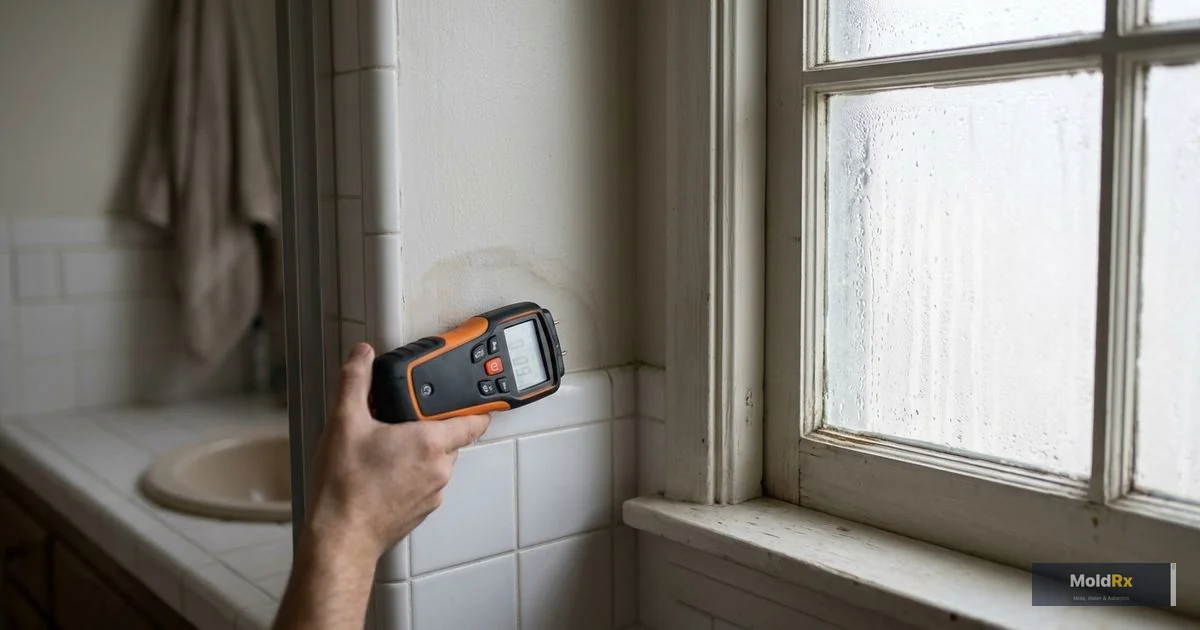
Not all mold requires a remediation crew. Small amounts of surface mold on non-porous materials are a cleaning job, not a remediation project. Here's when you can handle it yourself.
It's on a non-porous surface. Tile, glass, metal, porcelain, sealed countertops, fiberglass shower surrounds — mold sits on top of these materials rather than growing into them. A scrub brush with detergent and water physically removes the colony. No specialized chemicals needed.
The affected area is small. The EPA and the IICRC S520 standard both use approximately 10 square feet as the threshold — roughly a 3x3-foot area. Below this size, the risk from disturbing the mold during cleaning is minimal, and household methods can address the problem effectively.
You can see it and reach it. The mold is visible, accessible, and on a surface you can clean. There's no guessing about what's behind the wall or under the floor. What you see is what there is.
You know the moisture source and can fix it. Maybe the exhaust fan wasn't running during showers, condensation was forming on a window, or a drip under the sink kept a cabinet damp. If you can identify and correct the moisture source, the mold won't return after cleaning.
No one in the household has respiratory symptoms. If everyone is healthy and the mold is limited to what's described above, the health risk from a small DIY cleanup is negligible.
How to handle DIY mold cleanup properly
If your situation checks every box above, here's the right approach. Detergent and water — not bleach — on non-porous surfaces. Scrub thoroughly to physically remove the mold, don't just wipe. Dry the area completely. Fix the moisture source. Monitor for 4-6 weeks to confirm it doesn't return. For a deeper look at what happens when it does come back, read our guide on why mold keeps coming back after cleaning.
That's it. No need to call anyone.
Mold: The Professional Zone
Once any of the following factors apply, the situation has moved beyond what DIY methods can safely address. This isn't about selling services — it's about physics, biology, and the limitations of household equipment.
The area exceeds 10 square feet
Disturbing mold over a large area without containment and HEPA air filtration releases millions of spores into the air. Those spores travel through doorways, HVAC systems, and air currents to colonize new areas of your home. Professional remediation uses sealed containment zones and negative air pressure to prevent this — something you cannot replicate with plastic sheeting and tape from the hardware store.
The mold is on porous materials
Drywall, wood framing, carpet, carpet padding, ceiling tiles, insulation — mold grows into these materials, not just on them. Root structures called hyphae penetrate the material, and no amount of surface scrubbing reaches them. Contaminated porous materials must be physically removed within a containment zone, following IICRC S520 protocols. Cleaning the surface of moldy drywall is like mowing a weed without pulling the root.
The moisture source is hidden or structural
If you can't identify where the moisture is coming from — a hidden leak behind a wall, a failed shower pan, condensation in a wall cavity — the mold will return after any cleanup until the source is found and corrected. Professionals use moisture meters, thermal imaging, and exploratory openings to trace water paths you can't see.
The mold keeps coming back
If you've cleaned it once and it returned, that's your answer. Recurring mold means the moisture source is still active, the mold has penetrated deeper than cleaning reached, or both. One recurrence is enough to justify professional assessment.
You smell mold but can't see it
A persistent musty odor without a visible source means mold is growing somewhere you can't access — inside wall cavities, beneath flooring, behind cabinetry. Learn more about how professionals detect hidden mold. You can't clean what you can't find.
Someone in the household has symptoms
Respiratory issues, allergic reactions, or symptoms that improve when leaving the house — stop DIY attempts and get professional assessment. Disturbing mold without proper containment when someone is already symptomatic makes the situation worse.
Water Damage: The DIY Zone
Water damage follows similar principles, but with an added variable: the type of water. The restoration industry classifies water into three categories, and this classification matters more than almost any other factor. For the full breakdown, see water damage categories explained.
You can handle water damage yourself when all of the following are true:
- The water is Category 1 (clean water) — from a broken supply line, overflowing sink or tub, or rainwater that hasn't contacted stored materials
- The affected area is small and contained — one room, less than about 10 square feet of material damage
- You discovered it immediately and can begin cleanup within hours — not days
- The affected materials are hard surfaces — tile, vinyl, concrete, sealed surfaces — not wall cavities, subfloor, insulation, or carpet padding
- You can stop the water source and it won't recur
If all five conditions are met, the cleanup process involves extracting standing water with a wet/dry vacuum, removing any saturated soft materials (towels, rugs), cleaning and disinfecting the area, and drying thoroughly with fans and a dehumidifier. Speed matters — mold can begin growing within 24 to 48 hours of water exposure.
Water Damage: The Professional Zone
Water damage escalates beyond DIY capability faster than mold, because water spreads in ways you can't see and the damage compounds with every hour of delay.
The water is contaminated
Category 2 (gray water) from washing machines, dishwashers, or toilet overflow contains contaminants requiring rigorous cleanup protocols and protective equipment. Category 3 (black water) — sewage, exterior floodwater, or long-stagnant water — is hazardous and should never be handled without professional equipment and training. No exceptions.
Water has reached wall cavities, subfloor, or insulation
If water has migrated behind walls, under flooring, or into ceiling structures, fans pointed at the surface won't dry it. Water trapped in wall cavities persists for weeks, fueling mold growth and structural damage. Professional restoration uses cavity-drying equipment, injection-point air movers, and continuous moisture monitoring to verify materials reach safe moisture levels — not just feel dry to the touch.
Multiple rooms or floors are affected
A burst pipe that sends water through a ceiling, a dishwasher leak that spreads under adjacent flooring, or any event affecting more than one room — these require commercial extraction equipment, multiple air movers, industrial dehumidifiers, and a coordinated drying plan. Deploying this equipment effectively requires training, not just rental. For guidance on the overall process, read our guide to water damage restoration explained.
The water has been sitting for more than 24-48 hours
Clean water doesn't stay clean. Category 1 water contacting building materials begins picking up contaminants within hours and can escalate to Category 2 within 24-48 hours. If you don't know when the intrusion started or water has been present for more than a day, professional assessment determines what you're actually dealing with.
You're filing an insurance claim
If the damage warrants a claim, professional documentation is essential. Restoration companies produce moisture readings, photo documentation, equipment logs, and scope-of-work reports that adjusters require. DIY repairs are difficult to claim retroactively, and inadequate cleanup that leads to later mold can complicate coverage. See our guide on water damage insurance claims in California.
Asbestos: Never DIY
This one is straightforward. There is no DIY zone for asbestos. Not a small one. Not a "just this one tile" exception. Not even a "I'll wear a mask" workaround.
Asbestos fibers are microscopic and once airborne can remain suspended for hours. Inhaled fibers lodge permanently in lung tissue and can cause mesothelioma, lung cancer, and asbestosis — with symptoms appearing 10 to 50 years after exposure. There is no safe threshold of exposure for mesothelioma risk.
In California, asbestos removal is regulated under SCAQMD Rule 1403, Cal/OSHA regulations, and EPA NESHAP requirements. Licensed contractors must follow specific containment, removal, and disposal protocols. Improper handling carries significant legal liability in addition to the health risks.
If your home was built before 1980 and you're planning any renovation or disturbance of building materials — get an asbestos survey first. If asbestos-containing materials are in good condition and won't be disturbed, leave them in place and monitor their condition. If they need to be removed, that is exclusively a job for licensed asbestos abatement professionals. Learn more about what asbestos is, where it's found, and when it's dangerous.
The Decision Framework
When you're standing in front of a mold or water damage situation trying to decide what to do, walk through these questions in order.
Step 1: What am I dealing with?
- Mold on a non-porous surface, under 10 sq ft, moisture source known and fixable — DIY is appropriate
- Mold on porous materials, over 10 sq ft, moisture source unknown, or recurring — call a professional
- Water damage, Category 1, small area, caught immediately, hard surfaces only — DIY is appropriate
- Water damage, Category 2 or 3, large area, structural penetration, or sitting more than 24-48 hours — call a professional
- Anything involving asbestos — call a professional, no exceptions
Step 2: Am I being honest about the scope?
The most common mistake is underestimating what you can't see. Visible mold on a wall often means more mold behind it. Water on the floor often means water in the subfloor and wall cavities below. If there's any uncertainty about what's behind the surface, professional assessment resolves it.
Step 3: Do I have the right equipment — and can I verify my own work?
For mold: detergent, scrub brushes, proper ventilation, and the ability to monitor for recurrence. For water damage: a wet/dry vacuum, fans, a dehumidifier, and ideally a moisture meter to verify materials have actually dried. Without verification, you're guessing — and hidden moisture you missed today becomes the mold problem you discover in three months. Professionals use moisture meters, thermal imaging, and independent clearance testing to confirm their work was effective.
What DIY Done Wrong Looks Like
We see the aftermath of failed DIY attempts regularly. These are the patterns that turn manageable problems into expensive ones.
Bleach on drywall mold. The homeowner scrubs visible mold off drywall with bleach. The surface looks clean. But the water in the bleach solution soaks through the drywall, delivering moisture to root structures on the other side. The mold returns within weeks, larger than before. After two or three cycles, what would have been a contained remediation now requires extensive wall cavity work. Read more about why bleach fails on porous materials.
"It felt dry" after water damage. The homeowner mops up water, runs fans for a day, and puts everything back together. The surface felt dry. But the subfloor retained moisture well above the threshold where mold begins growing. Three months later, a musty smell develops. Six months later, the flooring buckles. Behind the walls, mold has been growing since week two.
Cleaning mold without fixing the leak. A homeowner cleans mold off a bathroom wall three times over six months. On the fourth occurrence, a professional finds a failed shower pan leaking into the wall cavity for over a year. A plumbing repair that would have cost a few hundred dollars has created a project ten or twenty times that cost because the source was never investigated.
Ripping out moldy materials without containment. A homeowner tears out moldy drywall with doors open, HVAC running, no plastic sheeting, no HEPA filtration. Millions of spores circulate throughout the house. Within a month, mold appears in rooms that were previously clean. A problem confined to one wall is now a whole-house issue.
Frequently Asked Questions
Can I remove mold myself if it's less than 10 square feet?
Yes — if it's on a non-porous surface, the moisture source is identified and fixable, and no one in the household has respiratory symptoms. Use detergent and water (not bleach), scrub the surface thoroughly, dry the area completely, fix the moisture source, and monitor for 4-6 weeks. If it returns, the situation needs professional assessment.
What's the 10 square foot rule for mold?
The EPA's guidance to homeowners uses approximately 10 square feet as the threshold below which homeowners can typically handle mold cleanup themselves. The IICRC S520 standard for professional mold remediation uses a similar benchmark. Above this size, the risk of spreading contamination during cleanup without professional containment and HEPA filtration increases significantly.
Is bleach effective for killing mold?
On non-porous surfaces like tile, bleach works — but detergent and water are equally effective because you're physically removing the mold, not just killing it. On porous materials like drywall and wood, bleach is counterproductive. It whitens the visible mold but doesn't reach root structures inside the material. The water in the solution soaks into the material, feeding surviving roots. The mold returns, often worse than before.
When should I call a professional for water damage?
Call a professional when the water is Category 2 or 3 (contaminated), when it has reached wall cavities or subfloor, when multiple rooms are affected, when the water has been sitting for more than 24-48 hours, or when you plan to file an insurance claim. Small, immediately-discovered clean water spills on hard surfaces are the only situations where DIY is reliably appropriate.
Can I test for mold myself with a home test kit?
Home test kits have significant limitations. Most are settle-plate tests that confirm mold spores exist in the air — which they do everywhere, always. They can't tell you whether levels are elevated, what species are present, or where a problem is located. Professional air sampling and surface sampling provides actionable data. If the mold is visible and small, you don't need testing — just clean it.
How do I know if water damage is Category 1, 2, or 3?
Category depends on the source. Category 1: clean water from supply lines, tubs, sinks, or rainwater. Category 2: gray water from washing machines, dishwashers, or toilet overflow. Category 3: black water from sewage, exterior flooding, or long-stagnant water. Categories escalate over time — clean water left untreated for 24-48 hours transitions toward Category 2 as it picks up contaminants from building materials. See our full water damage categories guide.
Is it safe to remove one asbestos tile myself?
No. A single floor tile can release thousands of microscopic fibers when broken. California law requires licensed contractors for asbestos removal, and the health risks — mesothelioma, lung cancer, asbestosis — have no safe exposure level. If you suspect asbestos in any building material, get it tested before disturbing it.
How much does professional mold remediation cost compared to DIY?
Costs vary based on scope, materials, and moisture source. What we can say: professional remediation done right the first time is almost always less expensive than DIY cleanup followed by the larger remediation that becomes necessary when the DIY approach fails. The real comparison isn't "professional vs. DIY" — it's "professional now vs. professional later after the problem has spread." Request a free estimate for your specific situation.
What if I'm not sure whether my situation is DIY or professional?
Get an assessment. A qualified professional can evaluate the scope, identify hidden moisture or contamination, and give you honest guidance. If the situation is genuinely manageable as DIY, a good company will tell you that. At MoldRx, we'd rather tell you to handle it yourself than sell you services you don't need.
Will my insurance cover professional remediation if I tried DIY first?
It depends on the policy. Some policies cover mold remediation resulting from a covered water loss. If DIY cleanup was attempted first and the situation worsened, insurers may argue the damage was worsened by improper response. If your damage is likely to result in a claim, professional restoration from the beginning provides the documentation and proper protocols that insurers expect.
Make the Right Call
If your situation fits clearly in the DIY zone — small area, non-porous surface, clean water, known moisture source — handle it yourself and save the money. We mean that. Not every mold patch or water spill needs a remediation company.
But if the area is large, the mold is on drywall, the water has reached places you can't see, the moisture source is a mystery, or anything involves asbestos — professional assessment costs you nothing and gives you clarity. The worst outcome isn't spending money on remediation. It's spending money on remediation after months of DIY attempts have let the problem grow.
MoldRx coordinates professional mold remediation and water damage restoration with IICRC-certified specialists throughout Orange County, Riverside County, and San Bernardino County. If you're looking at a situation and aren't sure which side of the line it falls on, we'll tell you straight.
Call (888) 609-8907 to talk to a real person — no scripts, no pressure, just honest guidance about whether you need us or not. Or request a free estimate online and we'll follow up on your schedule.