You found a store-bought mold test kit at the hardware store for twenty dollars, and the logic seems sound: put the kit out, wait a few days, see if mold grows. If it does, you have a problem. If it doesn't, you're fine. It feels like a straightforward way to get a quick answer without scheduling an inspection or spending hundreds of dollars.
Here's the problem: home mold test kits will almost always show mold -- because mold spores are present in virtually every indoor environment on earth. A positive result doesn't mean you have a mold problem. It means you have air in your house. These kits cannot measure spore concentrations, cannot compare indoor levels to outdoor baselines, cannot identify the species that matter, and cannot locate a moisture source. They give you a result that looks like an answer but lacks the context to make it meaningful.
This isn't to say every dollar spent on a DIY kit is wasted. There are narrow situations where they offer marginal value. But understanding what these kits actually measure -- and what they leave out -- is critical before you act on their results. If you're still deciding whether any kind of mold testing makes sense for your situation, our guide on whether you need a mold test is a good starting point.
Types of Home Mold Test Kits
Not all DIY mold kits work the same way. The three main types sold in stores and online use different collection methods, and each has its own set of limitations.
Settle Plate (Petri Dish) Kits
The most common type at hardware stores. You open a petri dish containing nutrient agar, set it on a counter, and leave it exposed for 48 hours to several days. Spores that drift down and land on the agar germinate into visible colonies. Some kits include mail-in lab analysis; others have you count colonies and compare to a chart.
The fundamental problem: settle plates are passive gravity collectors. They capture whatever falls on them -- ambient indoor spores, spores drifting in from outside, spores stirred up when you walked past. There is no controlled volume of air being sampled and no way to calculate a concentration. The result is a petri dish with mold growing on it and no reliable way to determine whether the amount is normal or abnormal for your home.
Cassette-Based Sampling Kits
These kits use a cassette that attaches to a pump. Air is drawn through at a controlled flow rate, spores are captured on a collection surface, and you mail the cassette to a lab. This is closer to professional air sampling, and results include spore counts per cubic meter -- real quantitative data.
The limitation is context: you're collecting one sample, in one location, at one point in time, without an outdoor control. A report showing 2,400 Cladosporium spores per cubic meter sounds specific, but without knowing whether outdoor levels that day were 3,000 or 300, you cannot tell whether the indoor number is normal, elevated, or actually low.
Swab and Tape Lift Kits
You press a swab or adhesive strip against a visible surface -- a discolored patch on drywall, a stain on a ceiling tile -- and mail it to a lab that identifies the mold genus present.
Swab kits are the most defensible DIY option for one specific purpose: confirming whether a visible substance is actually mold versus mildew, mineral deposits, or staining. The limitation is that identifying mold on a surface doesn't tell you anything about the scope of the problem, whether the moisture source is active, or what air quality looks like in the rest of the home. It answers "what is this spot?" and nothing else.
Why Home Mold Test Kits Fail: Six Critical Gaps
DIY kits lack the context that makes mold data actionable. Here are the six things they systematically miss.
1. No Outdoor Comparison Baseline
This is the single most important limitation. Professional mold testing always includes at least one outdoor control sample collected under the same conditions as the indoor samples. The outdoor sample establishes what's normal for your area on that specific day. Indoor results are interpreted relative to this baseline.
Mold spores are a normal component of outdoor air -- Cladosporium, Alternaria, basidiospores, and Penicillium/Aspergillus types are present year-round in Southern California at varying concentrations. Those same spores are present indoors because outdoor air enters through doors, windows, and HVAC intake. Finding them inside doesn't indicate a problem. Finding them at concentrations significantly higher than outside -- that's the signal that something is generating spores indoors.
A DIY kit gives you a number (or a petri dish with colonies) and no outdoor reference point. An indoor Aspergillus/Penicillium count of 1,500 spores/m3 could be completely normal if outdoor levels are 2,000 -- or a serious red flag if outdoor levels are 100. Without the baseline, you cannot tell the difference. Our guide on how to read mold test results explains why the indoor-to-outdoor ratio is the foundation of meaningful interpretation.
2. No Volumetric Spore Count (Settle Plates)
Settle plate kits -- the most widely sold type -- don't measure spore concentration at all. They measure how many spores happened to settle on a small surface over an arbitrary time period, influenced by air currents, HVAC activity, foot traffic, and random chance. Two identical kits placed three feet apart in the same room can produce wildly different colony counts.
Professional air sampling uses calibrated pumps that draw a known volume of air (typically 75 liters) through a collection device, producing a quantitative measurement in spores per cubic meter. A settle plate colony count has no defined unit and no reproducibility.
3. No Meaningful Species Identification
Some DIY kits advertise "lab analysis" that includes species identification. In practice, the identification is often limited to broad genus-level categories that don't distinguish between species that matter and harmless background noise.
Professional laboratories using AIHA-accredited methods employ trained microscopists who differentiate between dozens of genera and flag specific indicators of concern -- distinguishing Stachybotrys (which almost always indicates active water damage) from Cladosporium (the most common outdoor mold, typically meaningless indoors at normal levels). A DIY lab report that says "Aspergillus detected" without concentration data, outdoor comparison, or site conditions is not actionable. Aspergillus is everywhere. The question is whether its indoor concentration is abnormal -- and a DIY kit can't answer that.
4. No Moisture Assessment
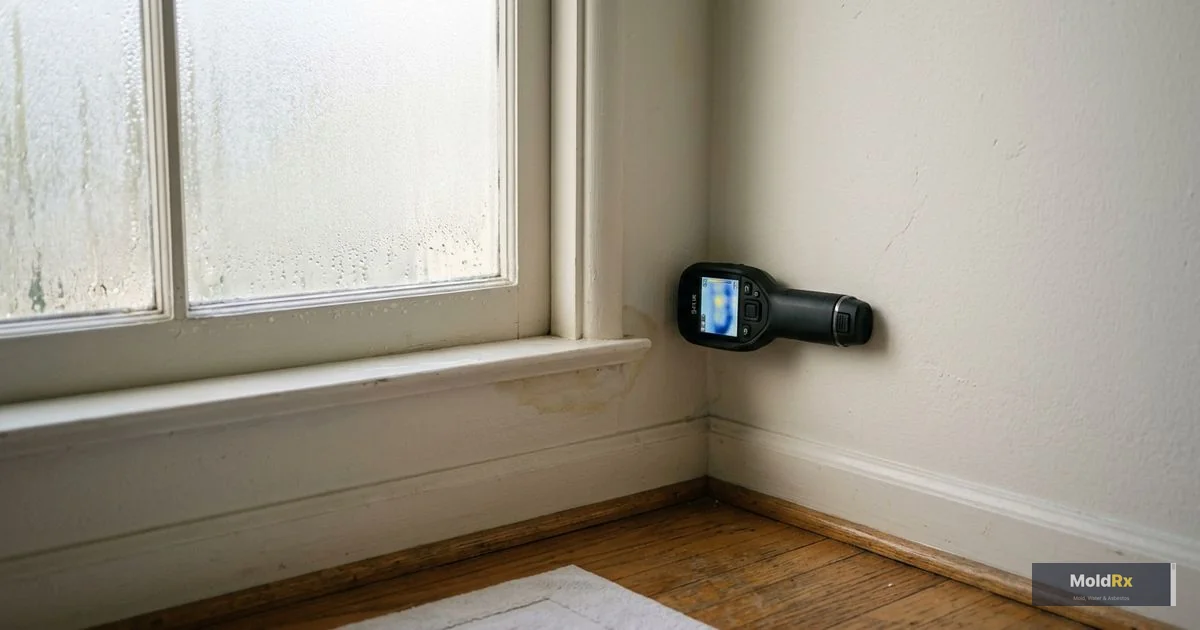
Mold is a moisture problem. Every legitimate mold investigation includes a moisture assessment -- checking building materials with moisture meters and thermal imaging to identify active water sources and conditions conducive to growth.
A kit on your kitchen counter tells you nothing about whether the wall behind your shower has 35 percent moisture content or whether your HVAC condensate line is dripping into a wall cavity. Even if the kit correctly suggests elevated mold, it provides zero guidance on where the moisture is or what needs to be fixed. And if you don't fix the moisture, any remediation is temporary.
5. No Source Identification
Professional mold inspectors don't just measure spores -- they investigate. They trace moisture paths, examine building systems, check behind access panels, and use thermal cameras to identify hidden water intrusion. A DIY kit tells you nothing about where the mold is or why it's growing. Even the best-case scenario -- a cassette kit that shows genuinely elevated Stachybotrys -- leaves you with the critical question: where is it? The test kit got you to "you probably have a problem" but left you no closer to solving it.
6. Settle Plates Grow Whatever Lands on Them
Petri dish kits use nutrient-rich agar designed to encourage mold growth. Expose the dish to indoor air and you're creating ideal growth conditions for whatever spores land on it. After a few days, you'll see colonies -- because mold spores are in the air of every building on earth.
Kit instructions sometimes provide a colony count threshold: fewer than X colonies is "normal," more is "elevated." These thresholds have no scientific basis. They don't account for outdoor levels, room size, ventilation, or species. A dish with eight colonies of Cladosporium near an open window is meaningless. A dish with two colonies of Stachybotrys in a sealed bathroom is a significant finding. The colony count alone tells you nothing.
Professional Testing vs. DIY Kits: What's Actually Different
The price difference between a $20 kit and a professional inspection reflects a fundamentally different approach to answering "do I have a mold problem?"
| Factor | DIY Settle Plate Kit | DIY Cassette Kit | Professional Air Sampling |
|---|---|---|---|
| Spore concentration | No -- colony count only | Yes -- spores/m3 | Yes -- spores/m3 |
| Outdoor control sample | No | No (unless you buy two kits) | Yes -- always included |
| Species identification | Limited/genus only | Genus-level via lab | Genus-level via AIHA-accredited lab with trained microscopist |
| Volumetric measurement | No | Yes | Yes |
| Multiple sample locations | Only if you buy multiple kits | Only if you buy multiple kits | Standard practice -- multiple rooms plus problem areas |
| Moisture assessment | No | No | Yes -- moisture meters, thermal imaging |
| Source investigation | No | No | Yes -- visual inspection, building knowledge, moisture tracing |
| Interpretation by certified professional | No | Sometimes basic lab notes | Yes -- full report with context and recommendations |
| Indoor/outdoor ratio analysis | No | No | Yes -- the foundation of meaningful interpretation |
| Actionable recommendations | No | No | Yes -- specific next steps based on findings |
The gap isn't about better equipment -- it's about methodology. Professional testing is designed around comparison, context, and investigation. DIY kits provide isolated data points without the framework to make them meaningful. Our guide on types of mold testing covers how each method serves a different purpose within a professional assessment.
When a DIY Kit Might Actually Be Useful
Fairness requires acknowledging the narrow situations where a DIY test has some value.
Confirming a Visible Substance Is Mold
If you have a discolored spot and genuinely don't know whether it's mold, mildew, or mineral deposits, a swab kit can confirm the identity. You're not asking "do I have a mold problem?" -- you're asking "is this specific spot mold?" That's a question a surface sample can answer.
Providing a Rough Screening Before Committing to Professional Testing
If you're on the fence about whether to hire an inspector, a cassette-based kit with lab analysis can provide a data point. If results show elevated levels of an indicator species like Stachybotrys, that confirms professional investigation is warranted. The danger is in the opposite direction: a normal-looking result from a single DIY sample does not reliably rule out a problem and shouldn't justify skipping professional assessment when other evidence (odor, water history, symptoms) suggests one is needed.
Curiosity, Not Decision-Making
If you're interested in mold as a subject and want to see what grows on a petri dish in your house, a settle plate kit is an interesting experiment. Just don't make decisions about remediation, real estate transactions, or your family's health based on the result.
The Real Cost of a Misleading Result
The $20 kit feels like a smart way to save money, but consider what a misleading result actually costs.
A false sense of security. The kit shows minimal growth, so you conclude there's no problem. Meanwhile, Stachybotrys is growing behind drywall fed by a slow roof leak. By the time it's visible, remediation that would have cost $3,000 now costs $12,000.
Unnecessary panic. The kit shows robust growth -- because the agar did what agar does. You call a remediation company in alarm. Some companies (not the ethical ones) will quote you for work you don't need based on a result that was essentially a normal reading of indoor air.
A decision bottleneck. You're buying or selling a home and the DIY kit shows mold -- or doesn't. Either way, the result isn't accepted by real estate professionals, lenders, or insurance companies. You need professional testing anyway, and you've added delay while introducing a data point that confuses rather than clarifies.
In each scenario, the DIY kit didn't save money. It added cost. The question isn't whether $20 is less than $400. It's whether the information you get for $20 is worth anything at all in guiding a real decision.
What Professional Mold Testing Actually Looks Like
A qualified mold inspector -- ideally holding ACAC or MICRO certification and using an AIHA-accredited laboratory -- begins with a visual and moisture inspection before collecting a single air sample. They examine the building as a system: where water enters, travels, and accumulates. The inspection determines where to sample and what to look for.
Air samples are collected using calibrated pumps from multiple indoor locations plus at least one outdoor control. If concealed mold is suspected, the inspector may add wall cavity samples, surface tape lifts, or bulk material samples. Everything goes to an accredited lab where trained analysts identify spore types and concentrations under a microscope.
The final report tells you whether you have a problem, where it is, what's causing it, and what to do about it. That's the difference between data and answers. Our guide on how to find a qualified mold inspector covers what credentials, equipment, and practices to look for.
Frequently Asked Questions
Are home mold test kits accurate?
They're technically accurate in a narrow sense -- a settle plate grows whatever lands on it, and a cassette captures whatever spores pass through it. The problem isn't accuracy in capturing spores; it's the absence of context needed to interpret the result. Without an outdoor comparison, volumetric measurement, moisture assessment, and professional interpretation, the raw data doesn't answer the question you care about: do I have a mold problem? Our guide on whether mold testing can produce wrong results covers the broader limitations of all testing methods, including professional ones.
Is a DIY mold test kit worth the money?
For most situations, no. A $20 settle plate kit will almost certainly show mold growth, which tells you nothing useful. A $100-150 cassette kit gives you better data but still lacks outdoor comparison and professional interpretation. If you're going to spend money on mold testing, a professional assessment that can actually guide decisions is more cost-effective than a kit that raises questions it can't answer.
Can a home mold test kit detect black mold?
Settle plate kits are particularly poor at detecting Stachybotrys ("black mold"). It produces heavy, sticky spores that don't readily become airborne or settle on passive collection surfaces -- a settle plate may never capture them even if a colony is growing in the next room. Cassette kits have a better chance, but a single sample in one location can still miss it. Professional inspectors use targeted surface and wall cavity sampling to find Stachybotrys, and they know any detection in an air sample is significant precisely because it's so hard to capture. Our guide on black mold vs. regular mold explains why detection method matters.
What should I do if my DIY test kit shows mold?
Don't panic. Mold growth on a settle plate is expected -- it means spores were in your air, which is true of every home. If a cassette kit shows elevated levels, schedule a professional inspection rather than calling a remediation company. A professional can determine whether the result reflects a genuine indoor problem, outdoor infiltration, or testing artifacts.
What should I do if my DIY test kit shows no mold?
Don't assume your home is mold-free. A negative settle plate may mean conditions were unfavorable, the dish was in a low-airflow location, or the species present didn't thrive on that agar. If you have a musty smell, visible water damage, or health symptoms that improve when you leave, a negative DIY result does not rule out a problem. Professional testing with multiple sample locations is far more reliable for ruling out concealed contamination.
Do insurance companies or real estate agents accept DIY mold test results?
Generally, no. Insurance companies require professional testing by a certified inspector using an accredited lab. Real estate transactions in California typically require professional inspection reports. A DIY result lacks the methodology, credentials, and chain-of-custody documentation these contexts require.
How do store-bought mold tests compare to professional testing?
They measure different things at different levels of reliability. A store-bought settle plate measures colony growth with no volumetric control, no outdoor comparison, and no professional interpretation. A professional assessment includes calibrated sampling, outdoor controls, multiple locations, moisture investigation, and certified interpretation. The comparison table earlier in this article breaks down the specific differences.
Can I use a DIY kit as a follow-up after professional mold remediation?
This is not recommended. Post-remediation clearance testing should be performed by an independent, certified inspector using the same professional methodology as the initial assessment. A DIY kit cannot provide the quantitative, comparable data needed to confirm remediation was effective. If your remediation company suggests a DIY kit for clearance, that's a red flag.
Are more expensive DIY kits better than cheap ones?
Higher-priced cassette kits with AIHA-accredited lab analysis do produce better data than a $10 settle plate -- quantitative spore counts and more reliable species identification. However, even the best DIY cassette kit shares the fundamental limitation of every DIY approach: one sample, one location, no outdoor control, no moisture assessment, and no professional interpretation. Better data without context is still data you can't act on confidently.
When should I skip the DIY kit and go straight to a professional?
Go straight to a professional if you have a persistent musty smell, visible water damage, a known water event within the past year, health symptoms that improve when you leave home, a real estate transaction, or insurance documentation needs. In these situations, a DIY kit adds delay without useful information. Our guide on when mold testing is worth it helps you decide.
The Bottom Line: Test Kits Detect Spores, Not Problems
Mold spores are everywhere. The question has never been "is mold present?" -- the answer is always yes. The question is whether indoor levels are abnormal compared to outdoor conditions, whether the species indicate active indoor growth, whether a moisture source is feeding it, and where the problem is so it can be fixed.
Home mold test kits detect spores. They cannot detect problems. The decisions you'll make -- whether to remediate, buy or sell a home, investigate further -- require context that only a professional assessment provides.
If you're dealing with a potential mold concern in your Southern California home, MoldRx provides professional mold testing and mold removal with certified inspectors, AIHA-accredited laboratory analysis, and the investigation methodology that turns data into answers.
Call (888) 609-8907 or request a free estimate to schedule a professional mold assessment.