The Single Most Important Rule
Your mold inspector and your mold remediation company should always be different companies. Always. This is the single most important rule in the entire mold industry, and it's the one that homeowners violate most often -- usually because they don't know better, and sometimes because a remediation company steered them into it.
The logic is straightforward: the company that profits from finding more mold should not be the same company that decides how much mold you have. When one company performs the inspection, writes the scope of work, performs the remediation, and then tests its own work for clearance, there is no independent check on anything they tell you. Every finding, every recommendation, and every "all clear" serves their financial interest.
An independent mold inspector works for you. They have no stake in whether you need remediation, how extensive the work is, or which company performs it. Their only job is to give you an accurate picture of what's happening in your home.
Why Separation of Testing and Remediation Matters
The conflict of interest when one company handles both testing and remediation is not subtle. It operates at every stage.
At the inspection stage, a company that also performs remediation has a financial incentive to find problems -- and to characterize those problems as larger, more widespread, and more urgent than they may actually be. If the same company that inspects your home will profit from a $5,000 or $15,000 remediation project, the inspection isn't independent. It's a sales call.
At the scoping stage, an independent inspector's report creates a scope of work that any qualified remediation company can bid on -- giving you the ability to compare quotes against an objective assessment. When the remediation company writes its own scope based on its own inspection, you have no independent benchmark.
At the clearance stage, clearance testing verifies the remediation was successful. If the remediation company performs its own clearance testing, they are grading their own homework. Independent clearance testing removes this incentive entirely.
Industry standards agree. The IICRC S520 Standard explicitly recommends that assessment and remediation be performed by separate parties. The ACAC requires separation as part of its ethics standards. Many insurance companies will not accept clearance testing from the same company that performed the remediation.
If a company pushes back on this separation -- if they tell you it's "more convenient" to handle everything -- treat that as your first and most important red flag. For more on how dishonest contractors exploit this, read our guide on remediation scams.
Your Qualified Mold Inspector Checklist
Before you hire anyone, verify each of these. A qualified inspector should meet every item on this list -- not most of them, all of them.
- Independent from remediation companies. No ownership, partnership, referral fee, or financial relationship with any company that performs mold removal.
- Holds recognized certification. ACAC CMI/CIE or MICRO CMI -- not just "years of experience."
- Carries professional liability and general liability insurance. Ask for current certificates.
- Uses an AIHA-accredited laboratory. The lab that analyzes your samples should meet the highest quality standards.
- Collects outdoor control samples. Indoor results without outdoor baselines are uninterpretable.
- Uses professional moisture detection equipment. Moisture meters and thermal imaging -- not just a visual walkthrough.
- Provides a comprehensive written report. Photographs, moisture data, lab results with interpretation, conclusions, and remediation recommendations.
- Explains the process before starting. A good inspector tells you what they'll do, how long it will take, and what the report will include -- before arriving at your property.
Print this list. Bring it to the phone call. If a prospective inspector can't satisfy every item, keep looking.
What a Qualified Mold Inspector Does
A qualified inspector performs a systematic evaluation of your home's indoor environment, identifies actual or potential mold contamination, determines the moisture sources driving it, and documents everything in a report you and any remediation company can rely on.
Visual assessment. The inspector examines the property systematically -- looking for visible mold growth, water staining, discoloration, warped materials, and other indicators of moisture intrusion. They check high-risk areas: bathrooms, kitchens, crawl spaces, attics, around windows, under sinks, and behind appliances.
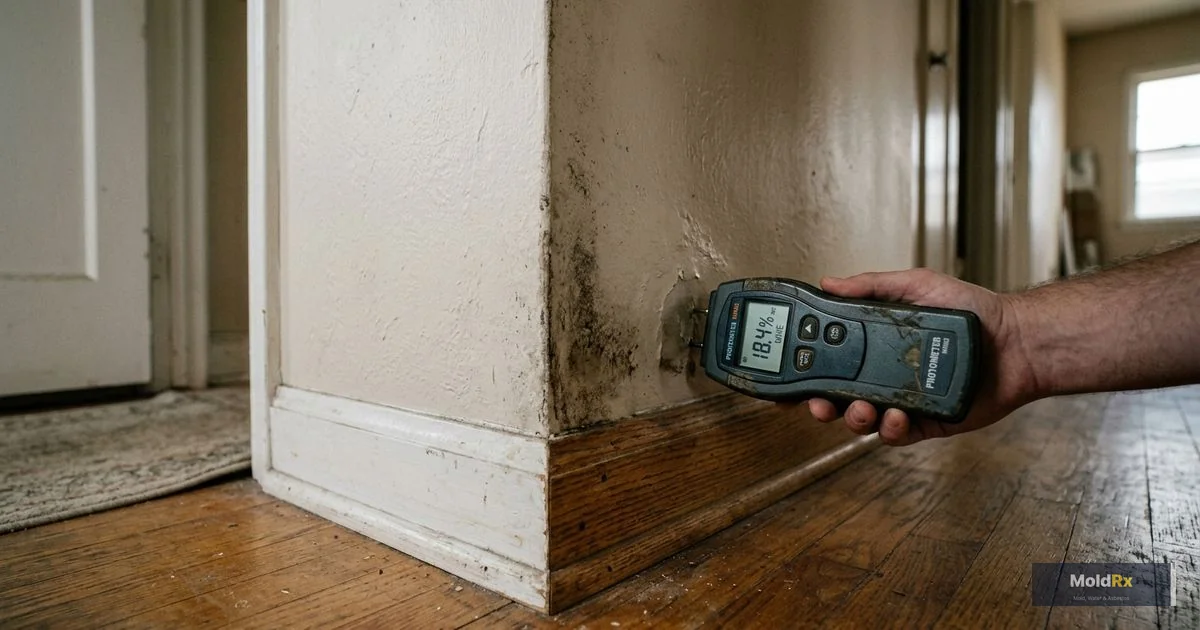
Moisture mapping. Using professional-grade moisture meters and thermal imaging cameras, the inspector measures moisture levels throughout the structure. This data identifies where conditions are favorable for mold growth even when visible mold is not present and helps pinpoint the moisture source that any remediation plan must address.
Air and surface sampling. When warranted, the inspector collects air samples, surface samples, or both and sends them to an AIHA-accredited laboratory for analysis. The inspector determines which type of sampling is appropriate based on the situation -- not every inspection requires every type of test.
Source identification. Perhaps the most valuable part of a good inspection is identifying why the mold is growing. The inspector investigates potential sources: plumbing leaks, roof leaks, condensation, foundation drainage issues, HVAC problems, or elevated humidity. Without identifying the source, any remediation is temporary.
Documentation and reporting. The entire inspection is documented in a written report with findings, photographs, moisture readings, laboratory results, conclusions about the scope and severity of contamination, and recommendations for remediation or further investigation.
Certifications to Look For
Not everyone who calls themselves a mold inspector has the credentials to do the job properly. Here are the certifications that matter.
ACAC CMI / CIE
The ACAC (American Council for Accredited Certification) CMI (Council-certified Microbial Investigator) is one of the most rigorous certifications for mold inspection professionals. It requires documented education, field experience, a comprehensive examination, ethics adherence, and continuing education. The ACAC also offers the CIE (Council-certified Indoor Environmentalist), covering a broader range of indoor air quality issues.
ACAC certifications are designed specifically for the assessment side of the industry -- not remediation. The ACAC's ethics standards require separation of assessment and remediation, meaning a CMI-certified inspector has committed to independence as a professional obligation.
MICRO CMI
The MICRO (Mold Inspection Consulting and Remediation Organization) CMI (Certified Mold Inspector) certification focuses specifically on mold inspection and assessment, with an emphasis on practical inspection methodology, sampling protocols, and report writing. Like the ACAC, MICRO emphasizes separation of inspection and remediation as a professional standard.
State licensing
Licensing requirements for mold inspectors vary by state. Some states require specific mold assessor licenses; others have no requirements at all. In California, there is currently no state-specific mold inspector license, which makes third-party certifications like ACAC and MICRO even more important. Regardless of your state's requirements, verify that the inspector carries professional liability (E&O) and general liability insurance.
IICRC certifications: context matters
IICRC certifications like S520 and WRT are primarily oriented toward the remediation side of the industry -- they're designed for technicians performing the work, not inspectors evaluating it. IICRC certification alone doesn't signal specialization in independent inspection the way ACAC or MICRO credentials do. An inspector who holds both IICRC and ACAC/MICRO certifications has a strong combination. For more on how remediation certifications fit the picture, see our dedicated guide.
Questions to Ask Before Hiring
These questions will tell you whether you're dealing with a qualified independent professional or someone you should avoid.
-
Are you independent from any remediation company? The inspector should have no financial relationship with any remediation company -- no referral fees, no ownership stakes, no "preferred partnerships." If they hesitate or qualify the answer, move on.
-
What certifications do you hold? Look for ACAC CMI/CIE or MICRO CMI. Ask to see proof. If they can't name a recognized certifying body, that's not enough.
-
Do you carry professional liability insurance? Also called errors and omissions (E&O) insurance, this protects you if the inspector's findings are materially incorrect. Ask to see the certificate.
-
What does your inspection include? The answer should cover visual assessment, moisture mapping with professional equipment, sampling as appropriate, laboratory analysis through an AIHA-accredited lab, and a written report.
-
Which laboratory do you use, and is it AIHA-accredited? AIHA accreditation means the lab meets rigorous quality standards. Non-accredited labs undermine the credibility of the entire inspection.
-
How many samples will you collect, and where? They should explain their sampling strategy and always collect at least one outdoor control sample for comparison. One or two indoor samples is often insufficient for larger homes.
-
When will I receive the report? Expect a written report within 3 to 5 business days, including findings, photographs, moisture readings, laboratory results with interpretation, and recommendations.
-
Will your report provide a scope of work for remediation if needed? A good report gives remediation companies the information they need to bid accurately -- and gives you the ability to compare those bids against an independent standard.
Red Flags in Mold Inspection
Any one of these is reason to reconsider. Multiple red flags together should send you looking elsewhere.
They also offer remediation services. If the same business entity profits from both inspection and remediation, the conflict of interest exists regardless of "separate divisions" or "different teams."
They guarantee to find mold before inspecting. No legitimate inspector guarantees a specific outcome before conducting the assessment. If someone tells you they'll "definitely find something" before setting foot in your home, they've already decided on the conclusion.
They use scare tactics. A professional inspector presents findings factually. If someone describes your home as a "toxic environment" before collecting samples, they're using fear to manipulate your decision-making.
They don't use laboratory analysis. Definitive mold identification and quantification require lab analysis. Visual-only inspections lack the objective data that makes findings defensible and actionable.
They skip outdoor control samples. Indoor air quality data is meaningless without a comparison point. An inspector who skips outdoor controls cannot determine whether your indoor mold levels are actually elevated.
They provide the report verbally. You need a written document with photographs, data, lab results, and professional conclusions. Verbal summaries are not reports.
Their price seems too low. Professional inspection requires expensive equipment, certified personnel, and lab analysis. Dramatically low prices usually mean skipped steps -- fewer samples, non-accredited labs, or minimal time on site.
What a Good Inspection Report Looks Like
A professional mold inspection report is the document you'll use to make every decision that follows -- which remediation company to hire, what scope of work to approve, and whether the final clearance results are credible. A thin report with vague findings undermines the entire purpose of hiring an independent inspector.
At minimum, the report should contain:
- Property and project information. Address, date of inspection, name and credentials of the inspector, and the reason for the inspection.
- Room-by-room narrative of findings with photographs. Each area inspected should be described with specific observations -- not "mold was observed" but where it was observed, what materials were affected, the approximate extent, and supporting photographs.
- Documented moisture readings. Moisture data presented in a table or floor plan map format, showing which areas have elevated readings and which are within normal range. This data is critical for identifying the moisture source.
- The full laboratory report. The original lab report from the AIHA-accredited laboratory, not a summary. This should include spore counts by type, comparison to outdoor controls, and the lab's own analysis.
- The inspector's interpretation of results. Lab data without professional interpretation is just numbers. The inspector should explain what the results mean in plain language -- which findings are concerning, which are normal, and what the data says about your indoor environment.
- Clear conclusions. Does a mold problem exist? How extensive is it? What's causing it? The inspector should state their professional conclusions directly, not leave you to figure it out.
- Recommendations for remediation or further investigation. If remediation is warranted, the report should describe the scope in enough detail for remediation companies to prepare accurate bids. If further investigation is needed -- opening a wall, testing an HVAC system -- the report should explain why.
How Inspector Findings Feed Into Remediation
A good mold inspection creates the roadmap for solving the problem.
Step 1: Independent inspection. Your inspector evaluates the property, collects samples, and delivers a comprehensive report.
Step 2: Share the report with remediation companies. You take the report to two or three qualified remediation companies. Each provides a bid based on the same objective assessment -- apples to apples.
Step 3: Remediation. The company you select executes the scope of work following IICRC S520 protocols -- containment, HEPA filtration, material removal, moisture source correction.
Step 4: Independent clearance testing. Your original inspector -- or another independent professional -- collects post-remediation samples to verify the work was successful.
Step 5: Resolution. If clearance passes, the project moves to reconstruction. If it fails, the remediation company performs additional work and the inspector retests -- at the remediation company's expense.
This process works because no single party controls the entire chain. The inspector provides objective data. The remediation company executes the work. The inspector verifies the result.
Frequently Asked Questions
Can my home inspector also be my mold inspector?
General home inspectors and mold inspectors are different specialties. A home inspector may flag visible mold or moisture during a standard inspection, but they typically don't carry the equipment, certifications, or laboratory relationships needed for a professional mold assessment. If your home inspector identifies potential mold issues, hire a dedicated mold inspector with ACAC or MICRO credentials.
What's the difference between a mold inspector and a mold assessor?
The terms are often used interchangeably. In some states they have distinct legal definitions -- a mold assessor may have a broader scope that includes developing remediation protocols and performing clearance testing. Regardless of title, what matters is certifications, experience, and independence from remediation companies.
Should the same inspector do the initial inspection and the clearance testing?
Yes, this is often preferable. They're already familiar with your property and can compare conditions directly. As long as the inspector is independent from the remediation company, using the same person for both is perfectly appropriate.
How do I verify an inspector's certifications?
ACAC, MICRO, and IICRC all maintain online directories. Ask the inspector for their certification number and verify it directly through the certifying organization's website.
Do I need a mold inspection if I can already see mold?
An independent inspection still provides value even with visible mold: it determines whether contamination extends beyond what's visible, identifies the moisture source, establishes baseline data for clearance comparison, and creates a documented scope that prevents remediation companies from inflating the project. For smaller areas, read our guide on whether you need a mold test.
What if my inspector and my remediation company disagree on the scope?
This happens occasionally and is actually a sign that the separation is working. You now have two professional perspectives to evaluate rather than one self-interested one. If the disagreement is significant, a second independent opinion can help resolve it.
Can I use an inspector recommended by my remediation company?
This defeats the purpose of separation. Find your inspector through certifying body directories, independent reviews, or referrals from your insurance company, real estate agent, or attorney -- anyone whose interests align with yours.
How long does a mold inspection take?
A thorough inspection for an average-sized home takes 2 to 4 hours on site. Laboratory analysis adds 2 to 5 business days. Be skeptical of inspectors who promise to be in and out in 30 minutes.
What should I do with my report if it shows no mold problem?
Keep it. A clean report is valuable documentation for real estate transactions, insurance records, or future reference. If the inspector identified moisture conditions that could lead to future problems, follow their prevention recommendations -- addressing moisture before it causes mold is always less expensive than remediating after the fact.
How much does an independent mold inspection cost?
Cost varies based on property size, number of samples collected, and complexity. The only way to get an accurate estimate is to describe your situation and ask for a quote specifying what's included -- how many samples, which type of testing, and what the report covers.
Ready to Get an Honest Assessment?
Finding a qualified, independent mold inspector comes down to three things: verified credentials, genuine independence from remediation companies, and a commitment to objective documentation. The inspector you hire should work for you, answer to you, and have no financial interest in the outcome beyond delivering an accurate report.
If you're dealing with a suspected mold issue and need guidance on next steps -- whether that's independent mold testing, understanding your results, or connecting with qualified remediation professionals -- call (888) 609-8907 or request a free estimate online. We'll help you understand your situation and make informed decisions about your home.