You called a plumber because you found mold on the wall and assumed there had to be a leak. The plumber opened the wall, checked every pipe, ran pressure tests — and found nothing. No leak. No broken fitting. No failed seal. Everything is dry.
But the mold is right there. Growing. Spreading.
You don't need a leak to get mold. Condensation alone — warm humid air meeting a cold surface — creates enough sustained moisture for mold to colonize and spread. No dripping pipe, no roof penetration, no plumbing failure. Just physics: water vapor in the air hitting a surface cold enough to convert that vapor into liquid water, keeping building materials damp enough to grow mold indefinitely.
Condensation mold confuses homeowners because they've been taught that mold means water damage, and water damage means a leak. When the leak doesn't exist, they assume the mold isn't serious or keep searching for plumbing failures that were never there. Meanwhile, the condensation continues and the mold grows.
This article explains what condensation mold is, why it's common in Southern California, where to look for it, and how to fix it permanently.
What Condensation Mold Is and Why It Gets Misdiagnosed
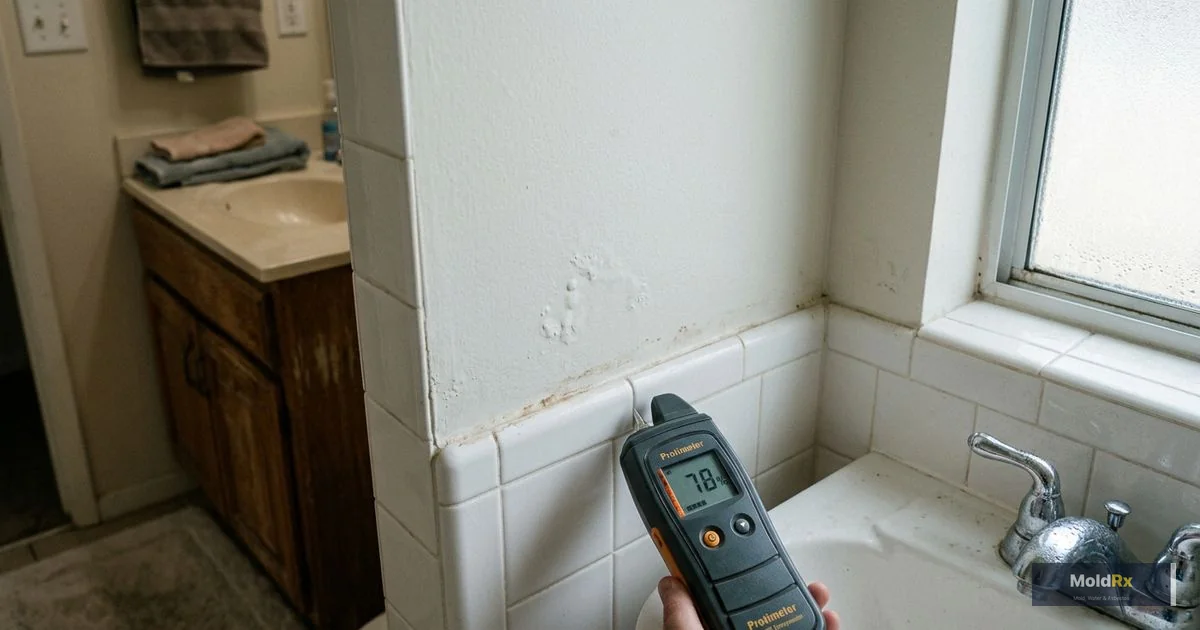
Condensation mold is mold growth sustained entirely by moisture from condensation — not a leak, flood, or plumbing failure. The water source is the air itself. Warm, humid air contacts a surface cooler than its dew point, and water vapor condenses into liquid droplets. Those droplets keep the surface chronically damp — exactly what mold needs to germinate and spread.
Most homeowners and many contractors associate mold with active water intrusion. When no leak exists, people call more plumbers, authorize more exploratory openings, and spend money looking for a problem that isn't there. Others conclude the mold isn't serious because "there's no water problem." Both conclusions are wrong.
Condensation is a water problem — just one created by temperature differentials and humidity rather than failed plumbing. It produces the same outcome: sustained moisture on building materials, mold growth, material degradation, and indoor air quality problems. And because the moisture source never goes away on its own (a plumber can fix a leak, but no one can "fix" the dew point), condensation mold keeps returning after cleaning until you change the conditions that create it.
The Science: Dew Point, Cold Surfaces, and Warm Humid Air
The dew point is the temperature at which air becomes saturated and water vapor condenses into liquid. Warm air holds more moisture than cool air. When warm, humid air contacts a surface at or below its dew point temperature, water condenses — the same process that puts droplets on a cold glass on a warm day.
What that means for your home:
- 75 degrees F indoor air at 60% RH has a dew point around 60 degrees F. Any surface at or below 60 degrees collects condensation.
- 72 degrees F at 50% RH drops the dew point to roughly 52 degrees F — harder to reach, fewer surfaces affected.
- 78 degrees F at 70% RH pushes the dew point to roughly 67 degrees F — at which point nearly every exterior-facing surface will sweat.
The critical insight: condensation doesn't require extreme humidity. It requires a gap between air temperature and surface temperature wide enough to hit the dew point. A home with moderate humidity (55-60%) and poor insulation on exterior walls can produce chronic condensation, even in Southern California. The wall doesn't have to be freezing — just cooler than the dew point of the air touching it.
Once condensation forms, the cycle is self-reinforcing. Damp materials lose insulating value, becoming colder, attracting more condensation. The surface stays perpetually damp. Within 24 to 48 hours of sustained dampness, mold spores can germinate. Within a week, visible colonies can appear.
Where Condensation Mold Shows Up in SoCal Homes
Condensation mold follows cold surfaces. These are the most common locations.
Exterior Walls — Especially North-Facing
The most common condensation mold location. North-facing walls receive little direct sunlight, staying cooler throughout the day. That cold transfers through the wall to the interior surface — especially in pre-1980 homes with minimal or no wall insulation. The indoor surface can be 10 to 15 degrees cooler than room air. When humidity rises even moderately, condensation forms. Mold appears as dark patches in corners, along baseboards, or behind furniture pushed against the wall. You may also notice signs of mold behind the wall itself, growing on the backside of the drywall.
Windows and Window Frames
Single-pane and aluminum-framed windows are condensation magnets. Glass insulates poorly, aluminum conducts heat rapidly, and the surface temperature drops well below dew point on cool mornings. Condensation collects on the glass, runs to the sill, and saturates surrounding drywall and trim. The mold around your windows often isn't from rain leaking through — it's from condensation on the coldest surface in the wall assembly.
Uninsulated Cold Water Pipes
Cold water supply lines in garages, crawl spaces, utility closets, and wall cavities sweat constantly, dripping condensation onto surrounding materials. The drip pattern looks exactly like a leak — water stains below, damp insulation, mold on framing. This is one of the most common reasons plumbers get called for "leaks" that don't exist. The pipe isn't leaking. It's sweating.
AC Supply Vents and Ductwork
Cold air through metal ducts and registers chills surrounding surfaces below dew point. If duct insulation is thin, damaged, or missing, condensation forms on the exterior of the ductwork and drips. At supply registers, condensation rings are a classic sign — dark circles of mold radiating from the vent. This is closely related to mold in HVAC systems and ducts, where condensation inside ductwork sustains colonies that blow spores into the living space.
Closets on Exterior Walls
Closed doors and packed contents block airflow. The exterior wall behind the closet is the coldest surface in the room. Warm humid air enters from the living space, can't circulate, and condenses on the cold back wall. Homeowners find mold on clothing, shoes, leather goods, and the wall itself. The assumption is a hidden leak — but it's almost always condensation.
Metal Door Frames and Thresholds
Metal conducts heat faster than any common building material. Metal door frames on exterior doors and garage entries get cold when outdoor temperatures drop. The interior side sweats, and moisture runs into the surrounding wall assembly. Mold develops in adjacent drywall and framing, hidden until damage shows through the paint.
Garage Ceilings
When living space sits above an unconditioned garage, the ceiling separates cold garage air from warm air above. Without proper insulation and air sealing, warm moist air migrates through the assembly and condenses on the cold side — the same dynamic that causes attic mold.
SoCal-Specific Condensation Patterns
Southern California's climate creates condensation dynamics that are part of what makes these homes more vulnerable to mold than their reputation suggests.
Marine Layer Mornings
Coastal communities regularly experience marine layer incursions that bring cool, moisture-saturated air inland overnight and into mid-morning. Outdoor relative humidity during these events routinely exceeds 80%. That moist air enters homes through open windows, door gaps, and envelope imperfections, contacting interior surfaces that cooled overnight. Condensation forms on walls, windows, and other cool surfaces. By afternoon, the marine layer burns off — but the surfaces were wet for hours. Repeated daily, they never fully dry. Mold establishes.
Santa Ana Wind Temperature Swings
Santa Ana winds create rapid temperature swings — sometimes 20 to 30 degrees within hours. Homeowners open windows during the hot phase (the air feels dry), letting indoor air absorb moisture from everyday activities. When temperatures plummet overnight after the winds stop, that absorbed moisture condenses on every cold surface in the house.
HVAC Cycling in Inland Communities
Inland communities — Riverside, Corona, Redlands, San Bernardino, Temecula — drive heavy AC use during extreme summer heat. AC systems cool ductwork, vents, and nearby surfaces well below ambient temperature. When the system cycles off, warm interior air contacts those still-cold surfaces and condensation forms. Exterior walls absorb enormous heat outside while being cooled inside, creating interstitial condensation within the wall assembly — invisible until mold reaches the surface or produces a musty smell you can't trace.
Why the Plumber Can't Find the Leak
The plumber isn't wrong, and you're not crazy. You found mold and reasonably assumed a leak. The plumber tested and correctly found none. Both observations are accurate — there's mold and there's no leak. The missing piece is that condensation is the moisture source, and plumbers don't evaluate for condensation because it isn't a plumbing problem.
How to tell condensation from a leak:
- Mold appears on the wall surface, not from behind it. Leak-driven mold grows from the back forward. Condensation mold starts on the visible surface.
- Mold follows cold surfaces — corners, exterior walls, windows, AC vents. Leak-driven mold follows water paths regardless of temperature.
- The pattern is diffuse rather than concentrated. A leak produces a focused wet spot. Condensation produces broad, even dampness.
- No water stain trail. Leaks leave directional gravity-driven staining. Condensation moisture is evenly distributed.
- Surface is damp but the wall cavity is dry. A moisture meter reading that's elevated at the surface but dry behind the wall points to condensation.
- The problem tracks weather patterns. Worsens during marine layer season, after Santa Anas, or during heavy AC use — and improves during dry weather.
If this matches your situation, stop looking for the leak. The fix is environmental, not plumbing.
Fixing Condensation Mold
Cleaning condensation mold without fixing the conditions that create it guarantees recurrence. You have to change the physics: raise surface temperatures, lower humidity, improve air circulation. Here's how, in order of impact.
1. Insulation: Raise Cold Surface Temperatures
The most effective single fix. Insulating a cold surface raises its temperature above the dew point. No condensation, no moisture, no mold.
Priority targets: exterior walls (especially north-facing — many pre-1980 SoCal homes have no wall insulation), cold water pipes (foam insulation is cheap and effective), HVAC ductwork in unconditioned spaces (R-6 minimum, R-8 preferred), metal door frames (thermal break insulation), and garage ceilings below living spaces (faced batts or spray foam, air-sealed).
2. Ventilation: Move Humid Air Out
Exhaust moisture at the source. Bathroom fans should be vented to the exterior (not the attic) and run 20 minutes after showers. Kitchen range hoods should vent outside — recirculating hoods don't remove moisture. Closets on exterior walls need louvered doors or ventilation slots. In tightly sealed homes, mechanical ventilation (HRV or ERV systems) exchanges air without wasting energy.
3. Humidity Control: Keep Indoor RH Below 50%
Maintaining 30-50% relative humidity keeps the dew point low enough that most surfaces won't reach condensation temperature. Our full guide on humidity control for Southern California homes covers measurement and room-by-room strategies. Start with a digital hygrometer ($10-$25) in the problem room. Use a dehumidifier during marine layer season. Vent dryers to the exterior. Monitor humidifiers during Santa Ana events — they can push indoor humidity above safe levels.
4. Air Sealing: Stop Warm Air from Reaching Cold Surfaces
Air sealing prevents warm, moist indoor air from migrating into wall cavities, attics, and other areas where it condenses on cold surfaces. Seal attic penetrations (wiring, plumbing, ductwork, recessed lights), exterior wall penetrations (outlets, switches), garage ceiling penetrations, and window and door frames. This is especially important for interstitial condensation — the kind that happens inside the wall where you can't see it.
5. Address Existing Mold
Fixing condensation conditions prevents future growth but doesn't eliminate established colonies. Surface mold on non-porous materials can be cleaned with detergent and water. But condensation mold on drywall, wood framing, or insulation has likely penetrated into the material and may require professional mold remediation. If you're unsure about the extent — especially if mold keeps recurring in the same spot — professional mold testing can determine whether contamination has spread beyond what's visible, including to the hidden side of the wall.
Frequently Asked Questions
Can condensation really cause mold without any leak?
Yes. Condensation produces liquid water on surfaces — the same liquid water a leak would. Mold doesn't distinguish between water from a pipe and water from condensation. Condensation that recurs daily from marine layer humidity, HVAC cycling, or poor insulation keeps surfaces perpetually damp, which is more than enough for mold to establish and spread. Many mold problems in Southern California homes have no leak anywhere in the building.
Why does my wall get wet in the morning but dry by afternoon?
Marine layer condensation. Cool, humid marine air moves inland overnight, raising outdoor humidity above 80%. That moisture enters your home and condenses on cool interior surfaces. By afternoon, the marine layer burns off and surfaces dry — but if this cycle repeats daily, the surfaces never fully dry between events, and mold establishes. This is extremely common in coastal Southern California communities.
Will a dehumidifier fix condensation mold?
A dehumidifier lowers humidity, which lowers the dew point, which reduces condensation. It can be effective when humidity is the primary driver. But it won't solve the problem if the underlying issue is poor insulation (cold surfaces) or inadequate ventilation. The best approach combines humidity control with insulation and ventilation improvements. A dehumidifier also does nothing about mold that's already growing — that needs separate treatment.
Why does mold keep growing in my closet even though there's no water?
Closets on exterior walls are condensation traps. The exterior wall is cold, the door blocks air circulation, and packed contents restrict airflow. Warm humid air condenses on the cold back wall. There's no liquid water source — the water comes from humid air condensing on a cold surface. Fix it with louvered doors, keeping items off the back wall, insulating the exterior wall, and keeping room humidity below 50%.
Can condensation mold make you sick?
Condensation mold produces the same spores as mold from any other moisture source. Sustained exposure can cause or worsen respiratory symptoms, allergic reactions, sinus congestion, headaches, and asthma — particularly in children, elderly household members, and immunocompromised individuals. The health risk depends on the species, the extent of the colony, and duration of exposure, not how the mold got its water.
Should I open windows to reduce condensation?
It depends. Opening windows when outdoor air is dry and temperate can help. But opening them during marine layer events lets moisture-saturated air in, making condensation worse. During Santa Ana winds, the hot dry air absorbs indoor moisture — then when temperatures drop overnight, it all condenses. Mechanical ventilation (exhaust fans, HVAC) provides consistent humidity control regardless of outdoor conditions.
My AC vents have dark rings around them. Is that mold?
Almost certainly. Dark rings radiating from supply registers are a classic condensation mold sign. Cold air from the vent chills the surrounding surface below dew point. The fix involves proper vent boot insulation, intact ductwork insulation, and indoor humidity control. If the rings are extensive, the drywall may need professional assessment. This is related to — but distinct from — mold growing inside the AC unit itself.
How much does it cost to fix condensation problems?
It depends on the driver. Pipe insulation costs under $50 for a DIY project. Wall cavity insulation runs several hundred to a few thousand dollars. Window replacement is a larger investment. Whole-house dehumidification typically runs $1,500 to $3,000 installed. The cost of not fixing it — ongoing mold growth, material damage, and eventual remediation — almost always exceeds the cost of addressing condensation conditions early.
When should I call a professional instead of handling it myself?
Call a professional when mold covers more than about 10 square feet, when it's on porous materials like drywall or wood, when you suspect hidden growth in wall cavities, when it keeps returning after cleaning, or when household members have health symptoms. Professional mold testing can quantify the contamination and determine if it's spread to concealed areas. Professional mold removal includes containment, HEPA filtration, material removal, and clearance testing — protocols that ensure the contamination is eliminated, not just cleaned from the surface.
Is condensation mold covered by homeowners insurance?
Generally, no. Most homeowners insurance policies exclude mold caused by condensation, maintenance issues, or long-term moisture accumulation. Insurance typically covers mold that results from a sudden, accidental event — like a burst pipe or storm damage. Condensation is classified as a maintenance issue. This makes addressing the condensation conditions early even more important: waiting means paying for both the environmental corrections and the remediation out of pocket.
Stop Looking for a Leak That Doesn't Exist
If you've been chasing a phantom leak while mold keeps growing on your walls, windows, or ceilings, condensation is almost certainly the answer. The moisture source isn't broken plumbing — it's the interaction between your indoor air and the cold surfaces in your home.
The fix is environmental: insulate cold surfaces, ventilate humid air at the source, control indoor humidity, and seal air pathways. These are permanent solutions. Combine them with proper removal of existing mold, and the problem is resolved for good. Our mold prevention checklist covers the ongoing maintenance that keeps it from returning.
MoldRx provides professional mold testing and mold remediation throughout Southern California. If you're dealing with mold that keeps appearing despite no identifiable leak, we can assess whether condensation is the cause, determine the extent of contamination, and recommend the right combination of remediation and environmental corrections.
Call (888) 609-8907 to talk through what you're seeing — no scripts, no scare tactics, just straight answers about whether your situation sounds like condensation mold and what the next step should be. Or request a free estimate online and we'll follow up on your schedule.