Your mold test came back positive. The report shows elevated spore counts, unfamiliar Latin names, and language that makes it clear something is wrong inside your home. The immediate question is obvious: what do you do now?
A positive mold test means your indoor spore levels are elevated above outdoor baselines, which indicates an active mold source somewhere inside the building. Your next step depends on what was found and how elevated it is. A slightly elevated Aspergillus/Penicillium count calls for a different response than Stachybotrys detected across multiple rooms. Both are "positive" results, but they represent very different situations with different timelines, costs, and urgency levels.
This guide walks through exactly what to do after a positive mold test -- from understanding what your specific results mean, to choosing a remediation company, to verifying the problem is actually resolved. If you need help interpreting the report itself, start with our companion guide on how to read mold test results.
First: Do Not Panic
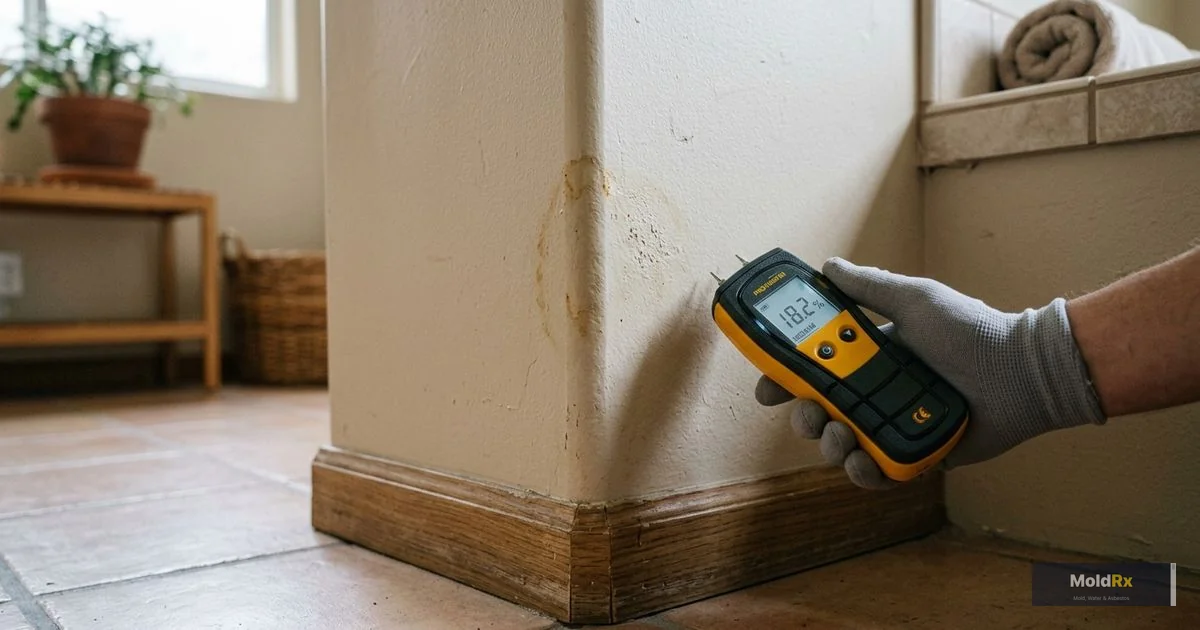
A positive mold test is not a condemnation of your home. It's diagnostic information -- the same way an elevated blood pressure reading tells your doctor something needs attention without meaning you're in immediate danger.
Mold spores are always present in indoor air. A "positive" result means the indoor concentrations or species profile differs meaningfully from the outdoor baseline, suggesting an indoor growth source that needs to be addressed. It doesn't mean your home is full of toxic mold.
The vast majority of positive tests lead to manageable remediation projects -- removing a section of drywall behind a bathroom vanity, addressing a slow leak that fed growth inside a wall cavity. Very few involve whole-home contamination. What matters now is responding methodically rather than reactively. Homeowners who rush to tear out drywall or bleach surfaces often make the situation worse.
Understanding Your Specific Results
Not all positive results are equal. The severity and urgency of your situation depends on three factors: which species were found, how elevated the counts are, and how many locations are affected. If you haven't already reviewed your report in detail, our guide on how to read mold test results explains the terminology and structure.
Slightly Elevated Results
Indoor spore counts are moderately higher than the outdoor control -- perhaps two to four times the outdoor baseline -- with common species like Aspergillus/Penicillium or Cladosporium making up the majority. No water-damage indicator species detected.
What this typically means: A developing or localized moisture issue -- condensation inside a wall, a slow plumbing leak, elevated humidity -- is feeding mold growth on a building material. The problem is real but likely contained.
Urgency level: Moderate. Address within weeks, not months. Growth continues as long as the moisture source persists, and what's localized today can become widespread if left unchecked. But you have time to make informed decisions.
Significantly Elevated Results
Indoor counts are five to ten times or more the outdoor baseline, often driven by high concentrations of Aspergillus/Penicillium. Multiple rooms may show elevation. No Stachybotrys or Chaetomium, but the sheer volume of indoor spores points to a substantial growth source.
What this typically means: An established mold colony -- likely concealed behind walls, under flooring, or in another hidden space -- has been growing for some time. The moisture source may be ongoing.
Urgency level: High. Professional remediation is warranted. Containment protocols, HEPA filtration, and removal of affected materials will be necessary. Begin selecting a remediation company promptly.
Stachybotrys or Chaetomium Detected
Any detection of Stachybotrys (commonly called "black mold") or Chaetomium in an indoor air sample is significant regardless of concentration. These species grow almost exclusively on cellulose-rich building materials that have been saturated for an extended period, and they are rarely found in outdoor air. Because Stachybotrys produces heavy, sticky spores that resist becoming airborne, even a small count typically indicates a larger colony than the number alone suggests.
What this typically means: Established water damage with active mold growth on structural or finish materials. The moisture source may be a past event that was never properly dried or an ongoing leak.
Urgency level: High. Professional mold remediation is appropriate. This is not a situation where investigation alone is sufficient -- the contaminated materials need to be identified, contained, and removed by a qualified contractor. Our guide on what happens during mold remediation explains the full process.
Step-by-Step Action Plan
Here is the sequence that takes you from a positive test result to a resolved, verified outcome.
Step 1: Review Your Results With the Inspector
If a professional inspector collected your samples, your first step is a conversation with them. A qualified inspector interprets the lab data in the context of what they observed during the inspection -- moisture readings, visual findings, building conditions.
Ask your inspector which specific results concern them and why, where they believe the source is located, whether additional investigation (surface swabs, wall cavity samples, targeted moisture mapping) is warranted, and what scope of remediation they anticipate. Their professional opinion on the likely scale of work helps you evaluate the remediation proposals you'll collect in later steps.
If your test was a DIY kit or basic screening, consider hiring a professional inspector for a follow-up assessment. A positive test tells you something is producing spores indoors -- a professional investigation tells you where and why.
Step 2: Identify the Moisture Source
Mold cannot grow without moisture. Any remediation that removes mold without addressing its water source will fail -- the mold will return.
Common moisture sources behind positive test results include:
- Plumbing leaks -- slow drips behind walls, under sinks, or at supply line connections
- Roof leaks -- flashing failures, damaged shingles, or compromised roof penetrations
- Condensation -- poor insulation, inadequate ventilation, or HVAC issues creating moisture on cold surfaces
- Past water events -- a flood, burst pipe, or appliance failure that was cleaned up but never properly dried
- Foundation moisture -- slab leaks, rising damp, or groundwater intrusion through the foundation
Your inspector may identify the source during the initial assessment; if not, the remediation contractor will typically locate it during their scope evaluation. Either way, the moisture source must be corrected before or simultaneously with mold removal. Our article on why mold keeps coming back explains this principle in detail.
Step 3: Get a Remediation Scope of Work
A scope of work is a written document that defines exactly what the remediation will involve. For straightforward situations, the inspector who performed the testing may write it. For larger projects, get proposals from multiple contractors.
A credible scope should include a containment plan, a material removal plan specifying what will be taken out and how far beyond visible damage the removal extends, HEPA air filtration, antimicrobial treatment of structural framing, moisture source correction, and an independent clearance testing protocol. If a contractor provides a verbal estimate without a written scope, that's a red flag.
Step 4: Choose a Remediation Company
This decision matters as much as any other part of the process. The wrong company can spread contamination, fail to address the root cause, or skip the verification step that proves the work solved the problem.
Look for IICRC credentials (AMRT or WRT designations), an appropriate California contractor's license, a detailed written scope following IICRC S520 standards, and a clear expectation of independent third-party clearance testing. Any company that resists independent verification is telling you something.
One critical principle: the testing company and remediation company should be different entities. The company that identifies a problem should not be the same company that profits from fixing it. If your testing company offers to remediate, or your remediation company offers to do its own clearance testing, find someone else for one of those roles.
Our guide on how to choose a mold remediation company covers red flags and green flags in much greater detail.
Step 5: Remediation
Once the scope is agreed upon, remediation follows a systematic protocol: containment of the affected area with polyethylene sheeting and negative air pressure, removal of contaminated porous materials (drywall, insulation, carpet), HEPA vacuuming and continuous air scrubbing, antimicrobial treatment of structural framing and non-removable surfaces, and drying to verified moisture levels before reconstruction begins.
For a complete walkthrough of what to expect, see our guide on what happens during mold remediation.
Step 6: Clearance Testing
Clearance testing is performed by an independent third-party inspector -- not the remediation company -- after the work is complete but before the area is reconstructed. The inspector collects air samples and compares them to outdoor baselines using the same methodology as the original test. If indoor levels are consistent with outdoor levels and no anomalous species are present, the area passes. If it doesn't, the remediation company addresses whatever the testing identified.
Do not allow reconstruction to begin before clearance is achieved. Sealing contaminated materials behind new drywall puts you right back where you started. Understanding clearance testing explains the process and what passing looks like.
What NOT to Do After a Positive Mold Test
The actions you avoid are as important as the ones you take. These are the most common mistakes homeowners make after receiving positive test results.
Do Not Start Cleaning Without Containment
Disturbing mold without proper containment -- sealed barriers, negative air pressure, HEPA filtration -- releases spores into the air and can spread contamination from a localized area to the rest of the home. Surface cleaning doesn't address mold growing inside wall cavities or within porous substrates. You can make visible mold disappear while leaving the actual problem untouched.
If you can see mold, leave it undisturbed until a professional can contain and address it properly. Our comparison of DIY vs. professional remediation covers when homeowner cleaning is appropriate and when it isn't.
Do Not Ignore It
"It's probably not that bad" is a common response, especially without visible mold or obvious symptoms. But positive test results exist precisely to identify problems you can't see. Mold growing inside a wall cavity, beneath flooring, or behind cabinetry is invisible during daily life -- the test is the tool that revealed it.
Mold growth is progressive. The colony expands as long as the moisture source persists, and what's manageable today becomes a significantly larger and more expensive project six months from now. Early action is almost always less costly and less disruptive than delayed action.
Do Not Hire the Testing Company to Remediate
The company that performs testing should not also perform remediation on the same project. This conflict of interest creates a financial incentive to over-diagnose problems or under-verify results. Reputable testing companies will decline to remediate properties they've tested. If any company offers to test, remediate, and clear the same project, treat that as a significant red flag.
Do Not Delay Because of Cost Concerns
It's reasonable to get multiple proposals and make a careful decision. What isn't reasonable is indefinite delay. Mold damage is progressive -- the longer you wait, the more material needs to be removed and the higher the final cost.
If cost is a barrier, discuss financing or phased work with your remediation contractor. If you have homeowner's insurance, check whether the underlying water damage (and by extension the resulting mold) is covered -- our guide on water damage insurance claims in California explains what's typically covered and what isn't.
Timeline: From Positive Test to Resolution
One of the most common questions after a positive result is "how long will this take?" Here is a realistic timeline for the typical residential remediation project.
Week 1: Review and investigation. You receive and review the test results with your inspector. If additional investigation is needed to locate the source, it happens during this window. You begin contacting remediation companies.
Week 2: Proposals and selection. You receive and compare remediation proposals. A qualified contractor evaluates the site, provides a written scope of work, and schedules the project.
Weeks 2-3: Moisture source correction. If the underlying water source hasn't been addressed yet (plumbing repair, roof repair, etc.), that happens before or at the start of remediation.
Weeks 3-4: Remediation. The actual mold removal work typically takes two to five days for most residential projects. Larger or more complex jobs can take longer. This includes containment setup, material removal, cleaning, and treatment.
Week 4: Clearance testing. After remediation is complete and the area has been allowed to settle, the independent clearance inspector collects samples. Lab results usually come back within two to three business days.
Week 4-6: Reconstruction. Once clearance is achieved, the area can be reconstructed -- new drywall, paint, flooring, or whatever materials were removed during remediation.
Total timeline for most projects: three to six weeks from positive test to completed reconstruction. Simpler projects move faster; complex situations involving extensive water damage or insurance coordination can take longer. Every week of delay adds to the total duration, because the mold continues growing and the scope expands.
Frequently Asked Questions
Is a positive mold test an emergency?
In most cases, no. A positive test indicates a condition that needs to be addressed, but it's rarely an acute emergency requiring same-day action. The exception would be a severely immunocompromised individual living in a home with highly elevated Stachybotrys levels -- in that situation, temporary relocation while remediation is planned may be appropriate. For most homeowners, you have time to make deliberate, informed decisions over a period of days to weeks.
Should I leave my home after a positive mold test?
Most positive results do not require you to vacate the property. Continuing to live in the home while arranging remediation is typical for moderate elevation of common species. If results show very high levels of water-damage indicator species, or if household members are experiencing significant respiratory symptoms, discuss temporary relocation with your doctor. During the actual remediation work, you may need to leave the immediate area being contained but can usually remain in other parts of the home.
My test showed "slightly elevated" results. Do I still need remediation?
It depends. Slightly elevated results may indicate a developing issue that could be resolved by correcting the moisture source alone -- fixing a condensation issue, improving ventilation. However, even slightly elevated results mean mold is growing somewhere inside the building. A professional assessment determines whether the source can be corrected without material removal or whether remediation is necessary.
Can I just fix the moisture problem and let the mold die on its own?
Correcting the moisture source is essential, but it doesn't eliminate existing contamination. Mold colonies that dry out stop growing but don't disappear -- dead spores remain allergenic, and the colony can reactivate if moisture returns. On porous materials like drywall and insulation, the contamination has penetrated the substrate and the material needs to be removed. A professional assessment determines which approach is appropriate.
How do I know if the remediation actually worked?
Independent clearance testing. A third-party inspector collects air samples from the remediated area and compares them to outdoor baselines. If indoor levels are consistent with outdoor levels and no anomalous species are present, the area passes clearance. Any remediation without clearance testing is unverified work.
What if my clearance test fails?
The remediation company goes back. A failed clearance test means the remediation did not achieve its goal, and the contractor is responsible for additional work to address whatever the testing identified. This is why clearance testing exists -- it protects you from paying for incomplete work. A reputable remediation company expects this possibility and includes re-work in their process.
Should I get a second opinion on my test results?
If you're uncertain about the findings, a second opinion from a different qualified inspector is reasonable -- bring your existing report for their review. What you should not do is seek second opinions indefinitely as a way to avoid dealing with a confirmed problem.
Will my homeowner's insurance cover remediation?
It depends on the cause of the water damage. Most policies cover mold remediation resulting from sudden, accidental events -- a burst pipe, an appliance failure, a storm -- but exclude mold from long-term maintenance issues like chronic condensation or deferred plumbing repairs. File the claim based on the water damage, not the mold. Our article on water damage insurance claims in California walks through the process.
How much does mold remediation cost?
Costs vary widely based on scope, materials affected, accessibility, and region. A small bathroom project is fundamentally different from a multi-room remediation involving structural framing. Get detailed, written proposals from two to three qualified companies and compare the scopes of work, not just the bottom-line numbers. Our guide on how to choose a mold remediation company explains how to evaluate proposals.
Can I test my home myself after remediation instead of hiring a clearance inspector?
No. Clearance testing requires calibrated air sampling pumps, AIHA-accredited laboratory analysis, and professional interpretation comparing results to pre-remediation data. Retail home test kits cannot do this. Independent professional clearance testing is the standard, and cutting corners here defeats the purpose of everything that came before it.
From Positive Test to Peace of Mind
A positive mold test is not the end of the story -- it's the beginning of the resolution. You now have confirmed, actionable information about what's in your air. That's a better position than living with an undiagnosed problem.
The path forward is straightforward: understand your results, find the moisture source, get a professional scope of work, choose a qualified company, remediate with proper containment, and verify with independent clearance testing. The process takes weeks, not months, and the outcome is a home with documented, verified air quality.
MoldRx provides professional mold testing and mold remediation throughout Southern California. If you've received a positive test result and need help understanding what comes next -- or if you need a qualified remediation team to resolve the problem -- we can walk you through it.
Call (888) 609-8907 or request a free estimate to discuss your results and get a plan in place.