You had water damage. The immediate crisis is handled -- maybe professionally, maybe on your own -- and now you're wondering whether mold is growing somewhere you can't see. Should you get a mold test? When? And what will it actually tell you?
Test for mold after water damage if building materials weren't fully dried within 48 hours, if water reached hidden cavities like wall interiors or subfloor spaces, or if you notice a musty smell in the weeks after the event. But don't test during active drying -- results collected while dehumidifiers are running and materials are still wet are unreliable and will waste your money. The sweet spot for post-water-damage testing is after drying is complete but before enough time has passed for a hidden problem to cause serious secondary damage.
This guide covers when to test after different types of water events, what testing reveals that visual inspection cannot, how it supports insurance claims, and what to expect from clearance testing after remediation.
Why Timing Is the Most Important Variable
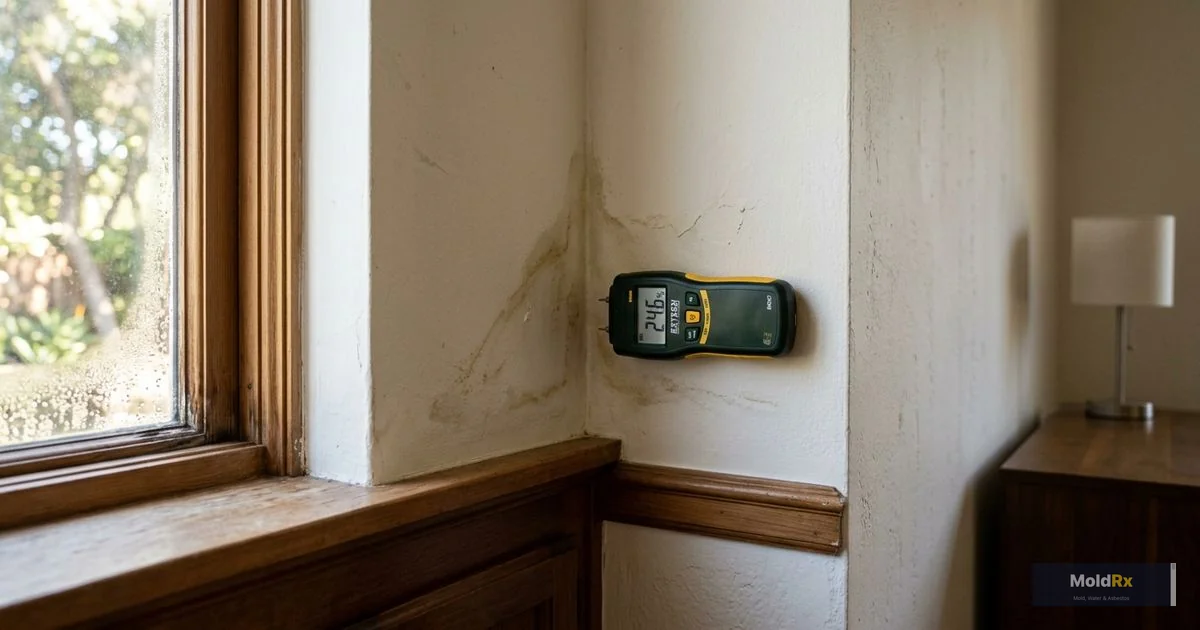
After water damage, the goal of mold testing is specific: determine whether the water event created conditions that allowed mold to colonize building materials. That question has a timing problem on both ends.
Testing Too Early: Unreliable and Misleading
During the first few days after water damage -- while extraction and drying are still underway -- mold testing produces results that are easy to misread in both directions.
Elevated spore counts during active drying don't necessarily mean you have a mold problem. Drying equipment creates aggressive air movement that stirs up spores already present in dust and on surfaces. The disruption of wet materials -- pulling carpet, removing baseboards, opening cavities -- releases trapped particles. All of this inflates airborne counts without indicating active colonization.
Conversely, normal counts during active drying don't mean you're in the clear. Mold that just began germinating hasn't had time to produce airborne spores in quantities an air sample would capture. A clean test at this stage creates false confidence.
Testing during the drying phase tells you almost nothing useful. It's money spent on a snapshot of chaos.
Testing Too Late: Damage Already Done
If mold colonized hidden materials and you don't test for weeks or months, the colony spreads -- from a single wall cavity to adjacent bays, into insulation, into HVAC ductwork that distributes spores building-wide. A problem discovered two weeks out is typically contained. The same problem at six months may be a multi-room remediation project. Testing exists to catch problems early, when intervention is less invasive and less expensive.
The Sweet Spot: 7 to 14 Days After Drying Is Complete
The most informative time to test is one to two weeks after professional drying has been completed and equipment has been removed. At this point:
- Air conditions have stabilized -- no equipment turbulence inflating counts
- Any mold that established itself has had time to produce detectable airborne spores
- Materials that were properly dried show stable, low moisture readings
- Materials that weren't properly dried show persistent moisture -- a red flag even before test results come back
If drying was completed months ago, testing is still valuable -- it just may reveal a more advanced problem than it would have caught at two weeks.
When You Should Test -- and When You Can Skip It
Not every water damage event requires mold testing.
You Should Test If:
Materials weren't dried within 48 hours. The 24-to-48-hour window for mold germination is real. If water sat for more than two days before drying began -- a weekend leak, a slow discovery, a delayed insurance response -- the probability of colonization justifies testing.
Water reached hidden cavities. If water entered wall interiors, migrated under flooring, or saturated insulation, testing is the most practical way to determine whether those hidden areas developed mold without tearing things apart first.
You smell something musty. A persistent earthy or musty odor after water damage is one of the most reliable indicators of active mold -- microbial volatile organic compounds (MVOCs) produced by growing colonies. Trust your nose and get testing to confirm the source.
You had contaminated water. Sewage backups, exterior flooding, and gray water events carry microorganisms that accelerate mold growth. If your water damage involved anything other than clean water from a supply line, testing verifies whether cleanup addressed the full scope.
Drying was handled without professional equipment. If you mopped up, ran household fans, and called it done, the chances of incomplete drying in wall cavities and subfloor spaces are significant. Testing after a self-managed cleanup answers the question dry surfaces can't: is something growing behind them?
You Can Probably Skip Testing If:
Professional drying was initiated within 24 hours, monitoring confirmed all materials reached target moisture levels, and you have no symptoms or odors. If the drying company provided a completion report with measurements showing acceptable moisture levels, and nothing seems off in the weeks after, the risk is low.
The water event was minor and fully contained. A small sink overflow on tile cleaned up within an hour, with no water reaching walls or porous materials, doesn't require testing. If water only contacted non-porous surfaces and was removed quickly, mold has nothing to grow on.
Scenarios by Water Event Type
Different water events carry different mold risks and testing timelines.
Burst Pipe
A burst pipe releases clean water under pressure -- high volume, short time. Water saturates ceilings, wall cavities, and flooring, making incomplete drying common.
Testing recommendation: If professional drying started within 24 hours and documented moisture readings at completion, testing may not be necessary unless symptoms develop. If there was any delay, or if the pipe was inside a wall or ceiling with direct access to enclosed spaces, test two weeks after drying is complete.
Slow Leak Discovered After Weeks or Months
This is the highest-risk scenario. A supply line dripping behind a wall, a drain leak under a cabinet, or a failing toilet wax ring delivers moisture continuously until someone notices. By the time you find it, mold has had sustained moisture, organic material, and an enclosed space with no airflow.
Testing recommendation: Test immediately after repair. Don't wait for a drying period -- materials wet for weeks almost certainly have active mold. The question is how far it has spread. Air sampling in surrounding rooms determines scope.
Flood From Exterior Water
Exterior flooding introduces Category 3 water -- contaminated with soil, sewage, and microorganisms -- which accelerates mold growth and creates additional health concerns. Flood water affects the lowest level of a structure and wicks several feet up walls.
Testing recommendation: Flood damage almost always requires professional remediation. Test during clearance to confirm the work addressed the full affected area. If you handled cleanup yourself, test two weeks after drying to verify mold didn't establish in materials you couldn't fully dry.
Appliance Failure
Washing machine supply lines, dishwashers, refrigerator water lines, and water heaters are among the most common causes of residential water damage, ranging from slow drips to catastrophic floods.
Testing recommendation: A failure discovered immediately and cleaned up the same day is low-risk if water stayed on hard flooring. A failure that ran while you were away -- saturating subfloor, migrating into adjacent rooms -- warrants testing if any delay occurred in professional drying.
Roof Leak
Roof leaks introduce water at the top of the structure, where it travels downward through attic insulation, ceiling joists, and drywall. The path is often invisible -- water enters the attic, runs along a rafter, and emerges on a ceiling far from the actual leak point.
Testing recommendation: Test if the leak persisted through multiple rain events before repair, or if you notice musty odor or discoloration afterward. Attic spaces are particularly vulnerable -- wet insulation dries slowly and is an excellent mold substrate, and access limitations make air sampling from the living space below especially valuable for detecting whether attic mold is producing spores reaching occupied areas.
What Testing Reveals That Visual Inspection Cannot
Mold after water damage grows where moisture is -- and moisture is almost always in places you can't see. Testing bridges that gap.
Hidden Colonization Behind Intact Surfaces
The most common post-water-damage scenario is mold on the back side of drywall, on insulation paper facing, or on framing inside wall cavities. The painted surface looks fine. Behind it, mold is growing on materials that stayed wet too long. Air sampling detects these hidden colonies because spores escape through electrical outlets, baseboard gaps, HVAC returns, and micro-cracks in drywall. A visual inspection gives you a clean bill of health. An air test catches the problem.
Mold Species Identification
Visual inspection confirms mold exists but can't tell you what species. After water damage, species identification matters. Water-damage indicators like Stachybotrys, Chaetomium, or Ulocladium in air samples confirm that growth is linked to water intrusion -- not normal background mold -- even when the colony is hidden. This affects remediation scope, urgency, and health risk assessment.
Quantifying Contamination Scope
Visual inspection finds mold in one location. Testing reveals whether that location is the full extent or the tip of a larger problem. By sampling multiple rooms, an inspector determines whether elevated levels are localized or building-wide -- indicating spread through HVAC systems or interconnected cavities. This scoping is critical: tearing out one wall when contamination has spread to three rooms means doing the job twice.
Baseline for Future Comparison
Air samples collected after water damage create a documented record of indoor air quality at a specific point in time. If symptoms develop later or a subsequent water event occurs, that baseline makes it possible to determine whether conditions changed. Without it, you're always starting from zero.
Mold Testing as Insurance Documentation
If your water damage is part of an insurance claim, mold testing serves a documentation function that goes beyond finding mold.
Establishing causation. Policies that cover mold typically require it to result from a covered water event -- not long-term neglect. Lab results showing water-damage indicator species establish a direct link between the covered event and the mold. Without testing, an adjuster can argue the mold was pre-existing.
Documenting scope. Mold coverage often has dollar limits. A lab report documenting affected areas, species, and spore concentrations supports your claim for appropriate coverage.
Creating a response timeline. Testing dates, locations, and results demonstrate diligence -- a factor insurers weigh. A property owner who documented every step faces a very different claims process than one who ignored the problem for months.
Testing During vs. After Restoration
During Drying: Moisture Monitoring, Not Mold Testing
During active drying, the relevant testing is moisture monitoring -- daily readings with meters and thermal imaging. This isn't mold testing. The question at this stage is "why isn't this drying?" not "does this have mold?"
After Drying, Before Reconstruction: The Decision Point
Once drying is complete, you decide: reconstruct immediately or test first? Where drying was thorough and well-documented, reconstruction can proceed with confidence. Where question marks exist -- areas that dried slowly, cavities that couldn't be fully accessed, delays in initial response -- testing before reconstruction prevents sealing a mold problem inside a freshly rebuilt wall.
After Remediation: Clearance Testing
Clearance testing is the most important application of mold testing in the entire water-damage-to-remediation timeline. After remediation is complete -- containment set, affected materials removed, surfaces treated, HEPA air scrubbing finished -- clearance testing determines whether the work was successful. An independent inspector collects air samples inside the containment area, in unaffected areas, and outside. Successful remediation produces indoor spore counts comparable to or lower than outdoor levels, with no elevated water-damage indicator species.
Clearance testing should be performed by someone independent of the remediation company. The company that did the work has an inherent interest in positive results. An independent inspector has no stake either way. Reputable remediation companies welcome this -- it validates their work and protects both parties.
What to Expect From the Testing Process
If you've decided testing makes sense, here's how it works in the context of a post-water-damage assessment. For a complete breakdown of testing methods, see our guide on types of mold testing.
A qualified inspector walks your property, discusses the water event -- when it happened, what was affected, how drying was handled -- and identifies sampling locations based on where water traveled. An inspector who doesn't ask about the water history is missing context that determines where to sample.
The standard approach combines air and surface sampling. Air samples come from water-damaged rooms, unaffected comparison rooms, and outside for baseline. Surface samples target any visible discoloration or suspect areas. Results from the AIHA-accredited laboratory typically arrive in two to five business days.
Interpretation requires context: which species were found, whether indoor levels exceed outdoor baseline, and whether elevated rooms correlate with the water damage footprint. A good inspector explains what results mean for your situation -- what they imply about hidden growth and what should happen next.
Frequently Asked Questions
How soon after water damage should I test for mold?
Don't test during active drying -- results are unreliable. The best window is 7 to 14 days after drying is complete. For slow leaks discovered after weeks of running, test as soon as the moisture source is addressed. See how fast mold grows after water damage for more on the colonization timeline.
Is mold testing after water damage covered by insurance?
Testing costs are sometimes included in water damage or mold claims, particularly when testing documents contamination scope for remediation planning. Coverage varies by policy. Document testing as part of your overall response and submit it with your claim -- your restoration company or public adjuster can advise on your specific coverage.
Can I use a home mold test kit instead of professional testing?
Home test kits -- the settle-plate type sold at hardware stores -- confirm that mold spores exist in the air, which is true in every building. They don't compare indoor levels to outdoor baselines, don't identify water-damage indicator species, and don't provide quantitative data. For post-water-damage assessment, professional testing with calibrated equipment and accredited laboratory analysis is the standard.
What if my mold test results are normal after water damage?
Normal results mean airborne spore levels were not elevated at the time of testing. If drying was thorough and timely, this likely confirms mold did not establish. If you still have concerns -- a persistent odor, unexplained symptoms, areas that were wet for a long time -- discuss further investigation with the inspector. Air sampling has limitations, and testing can sometimes miss hidden problems that require different detection methods.
What if results show elevated mold after my property was professionally dried?
This happens, and it doesn't necessarily mean the drying company failed. Some areas are extremely difficult to dry completely -- wall cavities with multiple layers, slab-on-grade construction, areas where water traveled far from visible damage. Elevated results indicate specific areas need targeted remediation, and the testing helps focus the response rather than guessing.
Should the same company that does water damage restoration also do mold testing?
The restoration company should handle moisture monitoring during drying -- they're on site with the right equipment. But when the question shifts from "is drying progressing?" to "did mold develop?", independent testing provides objectivity. MoldRx handles both water damage restoration and mold remediation as integrated services, and we coordinate with independent inspectors for clearance testing because verified results protect everyone.
Do I need mold testing if I can already see mold after water damage?
Testing to confirm visible mold isn't the best use of money. But testing still has value for identifying species (relevant for health risk and remediation protocol) and determining whether visible growth is the full extent or whether hidden contamination exists beyond it. See our guide on when testing is worth the investment.
How much does mold testing cost after water damage?
Scope varies based on the size of the affected area, sample count, and testing methods needed, so we don't publish flat pricing. What we can say is that testing is one of the least expensive steps in the water-damage-to-remediation process, and skipping it to save a few hundred dollars can result in thousands in additional remediation if a problem goes undetected.
What happens if mold is found during clearance testing after remediation?
The remediation company returns to address areas that didn't pass. This is exactly why clearance testing exists -- to catch incomplete work before containment comes down. Failing clearance isn't unusual on complex jobs. The company performs additional work, the independent inspector retests, and the area isn't cleared for reconstruction until it passes.
Can mold come back after water damage even if initial testing was clean?
Yes, if the moisture source wasn't fully resolved. A repaired pipe that leaks again, a roof repair that doesn't hold, or residual moisture in materials that seemed dry -- any of these can create mold conditions weeks or months later. If you notice musty odors, discoloration, or returning symptoms after clean initial testing, retest. The original results serve as a documented baseline for comparison.
When in Doubt, Test
Water damage creates uncertainty. You can see what the water did on the surface, but you can't see what it did inside wall cavities, under flooring, or behind cabinetry. That uncertainty is what mold testing resolves.
The cost of testing is minimal compared to guessing wrong -- spending thousands on unnecessary remediation, or ignoring a problem that's spreading behind the walls. Testing gives you data, and data lets you make decisions based on what's actually happening rather than what might be.
If you've had water damage and you're not sure whether mold developed, call (888) 609-8907 or request a free estimate. MoldRx provides coordinated water damage restoration, mold testing, and mold remediation across Orange County, Riverside County, and San Bernardino County -- because the answer to "do I have mold after water damage?" shouldn't require guessing.
Latest Mold Articles
View all articles
Mold Testing for Landlords: California Requirements and Best Practices
California doesn't mandate routine mold testing for landlords — but testing after tenant complaints, water events, or between tenancies protects you legally and financially. Here's when testing is required versus recommended, how to respond to tenant complaints with professional testing, what to do with results, and how proper documentation shields you from liability.
Mold Testing for Commercial Buildings: Requirements and Process
Commercial mold testing follows the same science as residential but adds complexity — larger HVAC systems, multiple zones, tenant notification, regulatory compliance, and liability documentation. Here's what building owners, facility managers, and commercial tenants need to know about when testing is required, how the process works in multi-zone commercial environments, Cal/OSHA workplace requirements, and how to maintain business continuity throughout the process.
Mold Testing After Water Damage: When to Test and What to Expect
Test for mold after water damage if materials weren't dried within 48 hours, if hidden cavities were wet, or if you smell something musty -- but testing during active drying is unreliable. Timing matters: too early gives you meaningless results, too late means damage spreads. Here's when to test, what each type of water event calls for, and what the results actually tell you.