An employee submits a complaint about a persistent musty smell near the break room. A tenant in a multi-suite office building reports visible discoloration along a wall shared with the mechanical room. A property manager notices staining on ceiling tiles after a rooftop HVAC unit leaked over the weekend.
Commercial mold testing follows the same fundamental science as residential testing — air sampling, surface sampling, laboratory analysis, indoor-versus-outdoor comparison — but everything else is more complex. The HVAC systems are larger and serve multiple zones. The buildings have dozens or hundreds of occupants with different exposure profiles. Tenant notification and communication involve legal obligations that don't exist in single-family homes. Regulatory frameworks like Cal/OSHA apply to workplaces but not residences. And the documentation requirements serve not just the building owner but tenants, employees, insurers, and potentially regulatory agencies.
This guide covers how commercial mold testing differs from residential, when testing is needed, what the process looks like in a commercial environment, workplace regulatory requirements, and how to manage tenant communication and business continuity while testing is underway.
How Commercial Mold Testing Differs from Residential
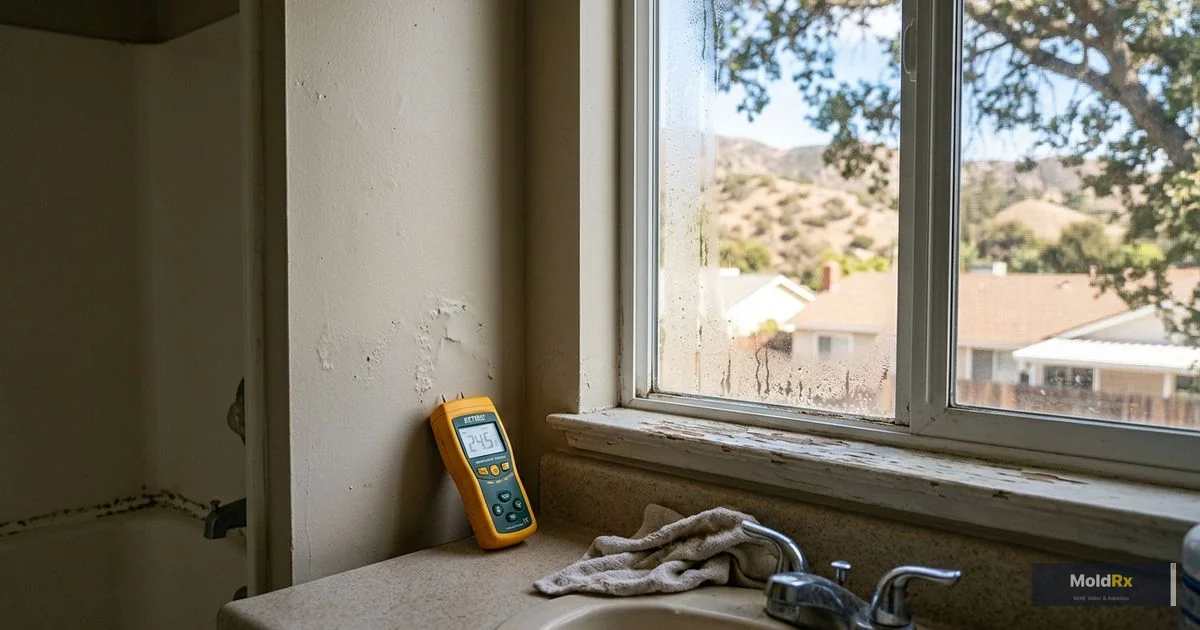
A residential mold assessment involves walking through a house, collecting a handful of air and surface samples, and delivering a report to the homeowner. The same inspector approaching a 50,000-square-foot office building faces a fundamentally different scope of work.
Scale and Zoning
A typical residential inspection involves 3 to 6 air samples. A commercial building may require 15, 30, or more sampling points to characterize air quality across different floors, wings, and mechanical spaces. Each area served by a separate HVAC zone needs independent sampling because air quality can vary dramatically between zones within the same building. Sampling only the complaint area while ignoring interconnected zones can miss contamination that has already spread through shared air pathways.
HVAC Complexity
Residential HVAC is simple — one or two units, one duct network. Commercial buildings use rooftop units, air handling units, variable air volume systems, and dedicated outdoor air systems, sometimes in combination. A single building might have a dozen independent air handling units, each serving different zones.
This matters because HVAC systems are one of the primary pathways for mold distribution. An inspector must evaluate each air handling unit independently — contamination in one unit affects only the zones it serves, while the rest of the building may be clean. Missing a contaminated unit means missing an active source.
Occupancy Considerations
A residential test is scheduled around one family's calendar. Commercial testing must account for building operating hours, tenant lease terms, employee schedules, and the sensitivity of operations in the space. A medical office, a food service operation, and a data center each present different constraints on when and how testing can occur. High-occupancy spaces also generate different baseline conditions — more foot traffic disturbing settled particles, more door openings affecting air pressure, and more HVAC load affecting condensation patterns.
Documentation Requirements
Residential reports serve the homeowner. Commercial reports may need to satisfy building owners, property managers, tenants, Cal/OSHA investigators, insurance carriers, and attorneys — sometimes simultaneously. This means more detail: sampling locations mapped to floor plans, chain-of-custody documentation, equipment calibration records, building condition descriptions, and interpretation in the context of workplace standards.
When Commercial Mold Testing Is Needed
Not every musty smell requires a full testing protocol, and not every building needs routine sampling. But several common scenarios make professional testing the only defensible response.
Tenant or Employee Complaints
When an occupant reports visible growth, musty odors, or health symptoms they attribute to indoor air quality, professional testing is the appropriate response — the same principle that applies to landlord mold testing obligations in residential settings. A visual inspection alone cannot determine whether airborne mold levels are elevated, and dismissing complaints without objective investigation creates liability exposure. Multiple complaints from different occupants in the same zone, or complaints that correlate with HVAC operation, are particularly strong indicators.
After Water Events
Any water intrusion — roof leaks, plumbing failures, sprinkler activations, HVAC condensate overflows, or flooding — creates conditions for mold growth within 24 to 48 hours. Testing establishes whether mold has developed and provides baseline documentation for insurance claims and remediation planning. Follow-up testing at 7 to 14 days post-event confirms that drying was adequate and that no hidden moisture remains — particularly important in commercial buildings where water can travel long distances through wall cavities, above suspended ceilings, and along utility chases.
Indoor Air Quality Investigations
Occupant complaints about headaches, respiratory irritation, fatigue, or "sick building syndrome" symptoms may or may not involve mold, but mold is one of the most common contributors to poor indoor air quality and testing is a standard component of any IAQ investigation. A comprehensive IAQ assessment typically includes mold sampling alongside measurements of temperature, humidity, carbon dioxide, and ventilation rates.
Pre-Lease and Pre-Purchase Due Diligence
Commercial tenants signing long-term leases and investors purchasing commercial properties increasingly include mold testing in their due diligence. A clean result provides documented assurance at the time of occupancy. An elevated result identifies a condition that should be addressed before the transaction closes. For tenants, baseline testing protects against future disputes over whether a condition predated their occupancy.
Regulatory Triggers
Cal/OSHA complaints about workplace air quality may trigger an investigation that includes mold sampling. Local health departments may require testing in buildings used for healthcare, food service, or childcare. Some lease agreements include testing triggers tied to water events or occupant complaints.
The Commercial Mold Testing Process
Professional mold testing in a commercial building follows a structured process that begins well before any samples are collected. A qualified mold inspector approaching a commercial project will work through these phases.
Phase 1: Building Assessment and History Review
Before designing a sampling strategy, the inspector reviews building plans, mechanical system layouts, and maintenance records. They identify HVAC zones, note the age and condition of building systems, and gather history on water events, previous mold findings, and the current complaint.
A physical walkthrough follows — checking ceiling tiles, wall surfaces, window frames, mechanical rooms, restrooms, and anywhere plumbing or HVAC equipment is accessible for visible moisture damage, staining, condensation, and musty odors. This assessment determines what needs to be sampled, where, and how many data points are required.
Phase 2: Zone-Based Sampling Strategy
Commercial testing requires a documented sampling plan that maps each location to the building floor plan. The strategy is organized by HVAC zone because each zone represents an independent air quality environment. Within each zone of concern, the inspector identifies:
- Complaint areas — the specific spaces where occupants reported problems
- Adjacent areas — nearby spaces within the same zone to assess the extent of any contamination
- Comparison areas — spaces within the building that are not subject to complaints, serving as internal controls
- Outdoor baseline locations — at least one, and sometimes two or three positions depending on building size and orientation, to establish ambient conditions
A targeted investigation of one complaint area in a small office might require 8 to 12 samples. A building-wide assessment of a large commercial property can require 30 or more.
Phase 3: HVAC System Evaluation
The HVAC evaluation is a critical component with no real parallel in residential work. The inspector examines each air handling unit serving the zones of concern, checking:
- Evaporator coils for visible contamination or biofilm
- Drain pans for standing water, biological growth, or evidence of overflow
- Filters for condition, proper fit, and evidence of moisture or microbial growth
- Supply and return plenums for contamination, moisture, or debris
- Ductwork at accessible points for interior contamination, moisture, or insulation degradation
- Condensate drain lines for proper drainage and blockages
Surface samples may be collected from HVAC components to identify what's growing on specific surfaces. Air samples collected at supply registers and return grilles help determine whether the HVAC system is distributing spores throughout the zone.
Phase 4: Multi-Point Air Sampling
Air sampling in a commercial building uses the same spore trap technology used in residential testing — calibrated pumps drawing a measured volume of air through collection cassettes — but at a much larger scale.
Each sample location is documented with its exact position, time of collection, pump calibration data, and environmental conditions. All samples are submitted to an AIHA-accredited laboratory under chain-of-custody protocols. Results are reported as spore concentrations per cubic meter of air, identified by genus.
Phase 5: Results Interpretation and Reporting
The inspector analyzes results in context, comparing indoor concentrations to outdoor baselines. Key indicators in commercial settings include:
- Indoor-to-outdoor ratios — healthy commercial buildings typically show indoor spore counts lower than outdoor counts, since the HVAC filtration should reduce particulate levels
- Water-damage indicator species — the presence of Stachybotrys, Chaetomium, or Ulocladium indoors suggests active or recent water damage, regardless of concentration
- Zone-to-zone variation — significantly elevated counts in one zone compared to others point to a localized source, often related to that zone's HVAC unit or a specific water intrusion point
- HVAC supply versus return — higher concentrations at supply registers than at returns suggests the HVAC system itself is a contamination source
The final report includes sampling data, floor plan maps, laboratory certificates of analysis, interpretation of findings, probable moisture sources, and recommendations for remediation or further investigation.
Cal/OSHA Workplace Requirements
California's occupational safety regulations create obligations for employers that don't apply to residential property owners.
General Duty Clause
Cal/OSHA's IIPP standard (Title 8, Section 3203) requires employers to maintain a safe and healthful workplace. No Cal/OSHA regulation establishes specific mold exposure limits, but the General Duty Clause (Labor Code Section 6400) requires employers to provide a place of employment that is safe and healthful. If mold contamination creates conditions that cause or are likely to cause illness, the employer must address it. When employees report respiratory irritation, allergic reactions, or headaches potentially related to mold, a professional IAQ investigation that includes mold testing is the standard of care.
Employer Response Obligations
When an employee files a Cal/OSHA complaint regarding indoor air quality or suspected mold, investigators evaluate whether the employer:
- Investigated the complaint promptly
- Used qualified professionals to assess conditions
- Communicated findings to affected employees
- Took corrective action when warranted
- Documented the entire process
Professional mold testing with a comprehensive report satisfies the investigation component. Failing to test — or relying on a visual inspection alone — can be cited as an inadequate response.
Documentation for Compliance
Structure commercial mold test reports for regulatory review: include inspector qualifications, sampling methodology, equipment calibration records, laboratory accreditation, and a narrative connecting findings to recommendations. Retain all testing records for a minimum of five years — Cal/OSHA can request documentation related to employee health complaints for extended periods.
Tenant Notification and Communication
Commercial buildings with multiple tenants create communication obligations that building owners and property managers must handle carefully.
When to Notify
Notify tenants in the affected zone as soon as testing is confirmed — don't wait for results. Delaying notification until after results arrive, especially if results are elevated, creates the appearance that you were managing information rather than managing the situation. If results reveal elevated mold levels, notify all tenants in the affected zone and any zones sharing air handling equipment. Provide the actual findings, not just a summary.
What to Communicate
Effective tenant communication during a mold investigation covers:
- What triggered the investigation — a complaint, a water event, a routine assessment
- What testing was performed — sampling dates, locations, methodology
- What the results showed — actual findings, translated into plain language without minimizing or exaggerating
- What happens next — whether conditions are normal, whether further investigation is needed, or whether remediation is planned
- Who tenants can contact — a specific person for questions, not a generic email address
Lease Considerations
Review lease agreements before communicating. Some commercial leases include provisions about environmental testing, notification requirements, and tenant remedies. Others establish rent abatement triggers tied to documented environmental conditions. Understanding your lease obligations before the first communication prevents inadvertent problems.
Business Continuity During Testing
Testing itself is minimally invasive. The challenge comes when results require follow-up action.
During Testing
Air sampling is quiet, fast, and non-destructive — each sample takes 5 to 10 minutes to collect. The inspector moves through the building with a portable pump and collection cassettes. In most cases, testing is performed during normal business hours without disrupting operations. HVAC inspection may require brief access to mechanical spaces, but testing does not require evacuation, HVAC shutdown, or closure of occupied spaces.
If Results Require Remediation
When testing reveals conditions that require professional remediation, business continuity planning becomes essential. Remediation involves containment barriers, negative air pressure, HEPA filtration, and material removal — all of which affect the immediate work area. Work with your remediation contractor to phase the project so only portions of the building are under containment at any time. After-hours and weekend scheduling can further reduce impact.
The testing report itself becomes a planning tool. Because it maps contamination to specific zones and identifies probable sources, it allows remediation to be targeted rather than building-wide — reducing both cost and disruption.
Frequently Asked Questions
How often should commercial buildings be tested for mold?
There is no universal schedule. Test when there's a reason — after water events, in response to occupant complaints, during IAQ investigations, and as part of pre-lease or pre-purchase due diligence. Some facility managers include mold sampling in annual IAQ assessments for buildings with a history of moisture problems, but routine testing in a building with no complaints and no water history is not typically necessary.
Is commercial mold testing required by law in California?
California does not mandate routine mold testing for commercial buildings. However, Cal/OSHA's General Duty Clause and IIPP requirements create an obligation to investigate workplace health complaints, and professional mold testing is the standard method. Failing to test after employee complaints leaves the employer vulnerable to Cal/OSHA citations.
How long does commercial mold testing take?
The on-site work depends on building size and the number of sampling points. A targeted investigation in a single zone of a small office building might take 2 to 4 hours. A comprehensive building-wide assessment of a large commercial property can take a full day or require multiple site visits. Laboratory analysis typically takes 3 to 5 business days, with rush processing available for urgent situations.
Can we continue operating the building during testing?
Yes. Air and surface sampling is non-invasive and does not require building closure, HVAC shutdown, or employee evacuation. Testing is routinely performed during normal business hours. The only accommodation needed is brief access to the spaces being sampled and to mechanical rooms for HVAC evaluation.
Who pays for mold testing in a commercial lease?
This depends on the lease terms. In gross leases, the landlord typically bears the cost. In triple-net leases, maintenance obligations may fall to the tenant. When testing is triggered by a tenant complaint about a building system failure, the cost typically falls on the party responsible for maintaining that system. Review your lease language and consult legal counsel if the obligation is unclear.
What happens if mold is found in a multi-tenant building?
The building owner or property manager is responsible for addressing the condition. Results should be shared with affected tenants, and a remediation plan should address both the moisture source and the contamination. This often means coordinating across lease boundaries and managing communication with multiple parties simultaneously — similar to the multi-unit considerations property managers face in residential portfolios.
Should the testing company and remediation company be different?
Yes. The same principle of separation that applies in residential testing applies in commercial work — and is arguably more important given the higher stakes. The company that identifies the problem should not be the company that profits from fixing it. Independent testing ensures objective findings, and independent post-remediation clearance testing ensures the work was done correctly.
What mold levels are considered unsafe in a commercial building?
There are no federally or state-established numeric thresholds for mold in commercial buildings. Assessment is based on comparison — indoor levels versus outdoor baselines, complaint zones versus non-complaint zones, and the presence of water-damage indicator species. A qualified inspector interprets results in context rather than against a fixed number.
Do commercial mold test results need to be disclosed to employees?
Cal/OSHA requires employers to communicate with employees about workplace hazards. If testing reveals conditions that pose a health risk, employees in the affected area should be informed of findings and corrective actions. Even when results are normal, sharing that information with employees who raised concerns demonstrates good faith and resolves complaints more effectively than silence.
How is commercial mold testing different from a Phase I environmental site assessment?
A Phase I ESA evaluates soil, groundwater, and hazardous materials as part of real estate due diligence — it does not assess indoor air quality or mold. Mold testing evaluates current biological conditions inside the building. The two are complementary but address different questions. A property with a clean Phase I can still have significant mold contamination.
Get Objective Answers for Your Commercial Property
Mold in a commercial building affects more people, involves more regulatory complexity, and carries higher liability than residential mold — but the path to resolution starts the same way: objective, professional testing that tells you exactly what you're dealing with.
MoldRx provides commercial mold testing and mold remediation for office buildings, retail centers, industrial facilities, and multi-tenant properties throughout Southern California. We understand the documentation standards commercial clients need, the regulatory frameworks that apply to workplace environments, and the coordination required to test and remediate without shutting down your operations.
If you're managing a commercial property with a mold concern, an employee complaint, or a water event that needs investigation — request an estimate or call (888) 609-8907 to discuss your situation with someone who understands commercial building challenges.
Latest Mold Articles
View all articles
Mold Testing for Landlords: California Requirements and Best Practices
California doesn't mandate routine mold testing for landlords — but testing after tenant complaints, water events, or between tenancies protects you legally and financially. Here's when testing is required versus recommended, how to respond to tenant complaints with professional testing, what to do with results, and how proper documentation shields you from liability.
Mold Testing for Commercial Buildings: Requirements and Process
Commercial mold testing follows the same science as residential but adds complexity — larger HVAC systems, multiple zones, tenant notification, regulatory compliance, and liability documentation. Here's what building owners, facility managers, and commercial tenants need to know about when testing is required, how the process works in multi-zone commercial environments, Cal/OSHA workplace requirements, and how to maintain business continuity throughout the process.
Mold Testing After Water Damage: When to Test and What to Expect
Test for mold after water damage if materials weren't dried within 48 hours, if hidden cavities were wet, or if you smell something musty -- but testing during active drying is unreliable. Timing matters: too early gives you meaningless results, too late means damage spreads. Here's when to test, what each type of water event calls for, and what the results actually tell you.