Water trapped inside a wall cavity almost always causes more damage than the same amount of water on a visible floor. The reason is time. A puddle on tile gets noticed, mopped up, and dried within hours. Water behind drywall can saturate framing, insulation, and sheathing for weeks or months before anything on the surface tells you it's there. By the time the wall shows signs -- a stain, a soft spot, a smell -- the damage behind it is already advanced.
If you suspect water behind your walls right now, the single most important thing to understand is that what you can see is almost never the full picture. A small discoloration on drywall may represent a much larger area of saturation on the other side. A faint musty smell may mean mold has already colonized the paper facing of the drywall and the wood framing behind it. The wall is hiding the real situation from you, and that's what makes this kind of water damage so destructive.
This guide covers how to recognize water damage inside walls, what causes it, how professionals find and measure it, what happens when wall cavities stay wet, and what the restoration process looks like from controlled demolition through rebuild.
Why Water Damage Behind Walls Is Worse Than Visible Water Damage
A burst supply line that floods a kitchen is an emergency, but it's also obvious. You see it, you stop it, you start cleanup. Hidden water damage works on a completely different timeline.
Water inside wall cavities has nowhere to go. Unlike water on a hard floor that can be extracted and dried relatively quickly, water that enters a wall cavity gets absorbed into porous materials -- drywall, wood studs, insulation, OSB or plywood sheathing -- and stays there. The enclosed space has minimal airflow. Evaporation is extremely slow. The moisture just sits, doing damage continuously.
The damage compounds over time. Wood framing begins to swell and soften. Drywall paper deteriorates. Metal fasteners and straps corrode. Insulation loses its R-value and becomes a moisture reservoir. And within 24 to 48 hours of sustained moisture, mold begins colonizing -- feeding on the organic materials that make up the wall assembly.
Detection is delayed. Most homeowners don't discover water behind walls until the damage has been active for days, weeks, or even months. By then, what might have been a simple plumbing repair and localized drying has become a project involving demolition, mold remediation, structural repair, and rebuild.
The hidden nature of this damage is precisely what makes it so expensive. Water damage you can see gets addressed. Water damage you can't see gets worse.
Signs of Water Damage Behind Walls
Water behind drywall can't be seen directly, but it produces a set of recognizable symptoms on the visible side. Learning to read these signs early can save thousands in restoration costs.
Discoloration and Staining
Water migrating through drywall leaves yellowish or brownish stains on the painted surface. These stains may appear suddenly after a plumbing event or develop gradually from a slow leak. They often have irregular borders and may grow over time. Pay attention to stains that reappear after you paint over them -- that means the moisture source is still active.
Paint Bubbling, Peeling, or Flaking
Moisture behind a painted wall disrupts the bond between paint and drywall surface. The result is bubbling, blistering, or peeling that has no explanation from surface contact. If paint is failing in an area that doesn't get splashed, touched, or exposed to high humidity from the room side, the moisture is coming from behind.
Wallpaper Lifting or Wrinkling
Similar to paint failure, moisture from within a wall loosens wallpaper adhesive. Wallpaper that is pulling away from the wall, developing wrinkles, or showing damp spots is signaling moisture behind the surface.
Soft or Spongy Drywall
Press your hand against the wall in the suspect area. Healthy drywall feels solid and firm. Drywall that has absorbed water feels soft, gives slightly under pressure, and may feel cool or damp to the touch. In advanced cases, you can push a finger into the surface. This level of saturation means the drywall is structurally compromised and will need to be replaced.
Warped or Bowed Walls
When drywall absorbs water unevenly, it swells in the saturated area. This creates visible warping or bowing -- the wall surface is no longer flat. You may notice this from certain angles or when light hits the wall from the side. Baseboards pulling away from the wall can also indicate that the lower portion of the wall has swollen.
Musty or Earthy Odors
A persistent musty smell near a wall -- especially one that gets stronger in enclosed spaces or when the HVAC system runs -- is one of the most reliable indicators of hidden moisture. That smell is the byproduct of microbial activity: mold and bacteria breaking down wet organic materials. Don't dismiss it. A musty smell near a wall means moisture and biological growth are present, even if you see nothing. For more on recognizing hidden mold, see our guide on signs of mold behind walls.
Unexplained Increase in Water Bills
If you're seeing wall symptoms alongside a water bill that has crept up without a corresponding change in usage, the two are almost certainly related. A supply line leak behind a wall is pressurized and continuous -- it runs 24 hours a day. Even a small leak wastes significant water over time and saturates wall materials relentlessly.
Sounds of Running or Dripping Water
Hearing water running through pipes when no fixture is in use, or a faint dripping sound inside a wall -- particularly after using a bathroom or kitchen fixture -- suggests a leak within the wall cavity. Supply line leaks may produce a hissing sound from pressurized water escaping through a small opening.
Common Causes of Water in Walls in Southern California Homes
Southern California's building practices, climate patterns, and plumbing infrastructure create specific risk factors for water intrusion into wall cavities.
Supply Line Leaks
Pressurized water supply lines run through wall cavities to reach bathrooms, kitchens, and laundry rooms. These copper, CPVC, or PEX lines can fail at joints, fittings, or along their length due to corrosion, manufacturing defects, or installation issues. In older SoCal homes with original copper plumbing, pinhole leaks from internal corrosion are especially common -- a consequence of the region's hard, mineral-rich water. Supply line leaks are pressurized and continuous, making them the most damaging type of in-wall leak.
Drain Line Failures
Drain lines carry wastewater from fixtures through wall cavities to the main sewer line. Unlike supply lines, drain leaks aren't pressurized -- they only leak when water is flowing through them. This makes them intermittent and harder to detect. Drain leaks often manifest as staining or odors that appear only after using specific fixtures.
Slab Leak Migration
Slab leaks -- leaks in plumbing running beneath or within the concrete foundation -- can force water upward through the slab and into the base of wall framing. The water wicks up through the bottom plate and into the wall cavity from below. This is one of the most insidious paths because the leak source is underground while the damage appears in walls, sometimes far from where the actual leak is located.
Shower and Tub Surround Failures
Failed grout, deteriorated caulk, or cracked tile in shower and tub surrounds allow water to penetrate behind the waterproofing layer and into the wall cavity. In homes where the waterproofing was insufficient or improperly installed -- common in SoCal tract homes from the 1960s through 1990s -- this is one of the most frequent causes of in-wall water damage. The leak is active every time someone showers, depositing water into the wall a little at a time.
Window and Door Flashing Failures
Southern California's stucco-clad homes rely on proper flashing around windows and doors to direct rainwater away from wall cavities. When flashing is missing, improperly installed, or deteriorated, rain that hits the wall can follow the window or door frame directly into the wall assembly. These leaks activate during rain events and may go unnoticed in dry periods, creating a cycle of wetting and partial drying that promotes mold growth.
Condensation from HVAC Systems
Air conditioning supply lines running through wall cavities or attic spaces can develop condensation on their exterior surfaces when insulation fails or is insufficient. In SoCal's hot summers, the temperature differential between cold refrigerant lines and warm ambient air can produce steady condensation that drips into wall cavities. Similarly, improperly sealed HVAC ducts in walls can introduce condensation where conditioned air meets unconditioned space.
Roof Leak Pathways
Water from a roof leak doesn't always drip straight down. It can travel along rafters, top plates, and sheathing before entering a wall cavity far from the original point of entry. A roof leak above the second floor can cause water damage in a first-floor wall if the water follows a framing member downward through the wall assembly.
How Professionals Detect Water Behind Walls
When visual signs suggest water behind a wall but the source and extent aren't clear, professional detection tools provide answers without unnecessary demolition.
Moisture Meters
Professional-grade moisture meters are the primary tool for assessing wall moisture. Pin-type meters use two probes inserted into the wall material to measure electrical resistance, which correlates with moisture content. Pinless meters use electromagnetic signals to scan for moisture without penetrating the surface, allowing rapid screening of large wall areas.
A trained technician uses pinless meters to map the boundaries of moisture -- determining exactly how far the wet area extends in all directions. Pin meters then provide precise moisture content readings at specific points. This mapping tells the restoration team exactly which sections of wall are affected and which are dry, preventing both unnecessary demolition and missed pockets of moisture.
Thermal Imaging Cameras
Infrared thermal imaging cameras detect temperature differences on wall surfaces. Wet areas behind drywall are typically cooler than surrounding dry areas because of evaporative cooling. On a thermal image, these show up as distinct color patterns that outline the moisture zone.
Thermal imaging is especially useful for identifying moisture patterns that aren't visible to the eye -- areas where water has wicked through framing or traveled along unexpected pathways. It also helps locate the origin point of a leak by following the thermal signature to its source.
Borescopes and Inspection Cameras
When moisture readings confirm water in a wall but the source or extent of damage is unclear, a small inspection camera can be inserted through a minimal opening -- often a drilled hole smaller than a dime. This provides a direct visual of conditions inside the wall cavity: standing water, wet insulation, mold growth on framing, corroded pipes, or deteriorated materials. One small hole can provide the information that prevents unnecessary large-scale demolition.
Acoustic Leak Detection
For active pressurized leaks, acoustic detection equipment amplifies the sound of water escaping from a pipe. A technician places sensors along the wall and listens for the characteristic sound of a supply line leak. This method is particularly useful for pinpointing the exact location of a leak within a long run of pipe.
What Happens When Wall Cavities Stay Wet
Understanding the consequences of unaddressed moisture inside walls explains why timely detection and response matter so much.
24 to 48 Hours: Mold Colonization Begins
Mold spores are always present in indoor air. When they land on wet organic material -- drywall paper, wood framing, dust on surfaces -- they begin germinating within 24 to 48 hours. Inside a wall cavity, conditions are ideal: sustained moisture, darkness, moderate temperatures, still air, and abundant food sources. Mold growth after water damage follows a predictable biological timeline, and enclosed wall cavities accelerate that timeline by trapping moisture.
Days to Weeks: Structural Degradation
Wood framing that stays wet begins to swell, warp, and lose structural integrity. The bottom plate -- the horizontal framing member that sits on the subfloor or slab -- is usually the first to deteriorate because gravity concentrates water at the lowest point. Drywall paper dissolves. Metal fasteners and hardware corrode. Insulation becomes waterlogged and compresses, permanently losing its thermal performance even after drying.
Weeks to Months: Systemic Damage
Over extended periods, water damage behind walls can spread far beyond the original leak area. Water follows gravity and capillary action, wicking through connected materials and finding pathways to adjacent wall bays, floor cavities, and ceiling spaces. Mold colonies mature and spread, producing increasing quantities of spores that can enter living spaces through electrical outlets, gaps at baseboards, and HVAC returns. What started as a single wet wall bay can eventually affect an entire room or floor.
The Cascading Cost Problem
Every stage of damage increases the scope and cost of restoration. A wall with a leak caught in the first few days may need only a plumbing repair, limited demolition, cavity drying, and patch work. That same wall after three months of undetected moisture may need full demolition, mold remediation, framing replacement, insulation replacement, new drywall, and finish work. The plumbing repair cost stays the same either way -- the difference is everything that happens after the water gets in.
The Restoration Process: What Happens After Water Is Found in Walls
Professional water damage restoration for in-wall moisture follows a structured sequence designed to remove all moisture, address any biological growth, repair structural damage, and return the wall to its pre-loss condition.
Step 1: Source Identification and Repair
Nothing else matters until the water source is stopped. The restoration team identifies the leak -- working with plumbers for supply or drain line issues, roofers for roof leak pathways, or addressing the specific failure point. The source must be fully repaired before drying begins, or moisture will continue entering the wall during the drying process.
Step 2: Moisture Mapping
Using the detection tools described above, technicians map the full extent of moisture penetration. This map determines the scope of work -- exactly which sections of wall need to be opened, whether adjacent walls, floors, or ceilings are also affected, and where the boundaries of the dry-to-wet transition zones are. Accurate mapping prevents two common problems: opening too little (leaving hidden moisture behind) and opening too much (unnecessary demolition that increases cost and disruption).
Step 3: Controlled Demolition
Affected drywall is removed to expose the wall cavity. This is done strategically -- cutting along the mapped moisture boundaries plus a margin to ensure all wet material is accessible. The term "controlled demolition" is deliberate: this isn't tearing out entire rooms. It's precise removal of material that can't be salvaged, guided by moisture data.
Wet insulation is removed entirely. Unlike drywall and framing, fiberglass and cellulose insulation cannot be effectively dried in place and must be replaced. The exposed wall cavity allows direct assessment of framing condition and provides the airflow access needed for effective drying.
Step 4: Cavity Drying
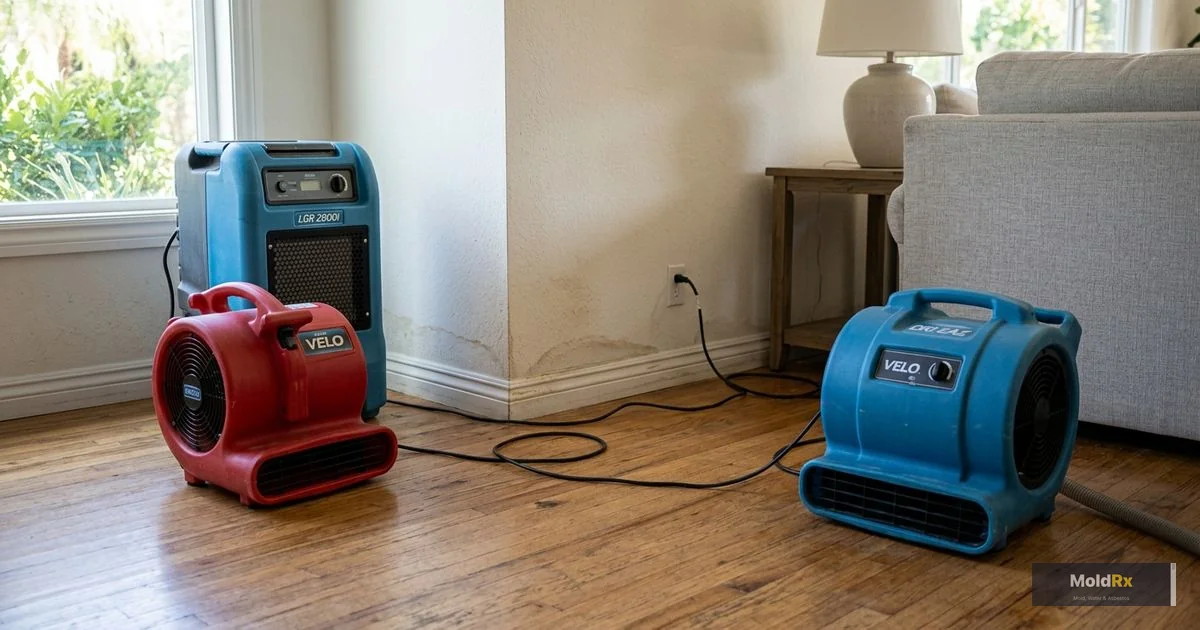
With the wall cavity open, professional drying equipment -- commercial dehumidifiers and high-volume air movers -- is positioned to move air across wet framing and sheathing surfaces. The goal is to reduce moisture content in all wood framing to below 15% and to bring the wall cavity to equilibrium with the ambient environment.
Drying is monitored daily with moisture meters. Technicians track progress, adjust equipment placement, and document readings until target moisture levels are achieved throughout the affected area. Depending on the extent of saturation and the materials involved, cavity drying typically takes three to five days. Rushing this step -- or declaring it complete based on surface readings rather than deep material readings -- creates the conditions for mold growth after the wall is closed back up.
Step 5: Mold Assessment
Once the cavity is open and drying is underway, a visual and sometimes laboratory assessment for mold is performed. If the wall was wet for more than 48 hours before discovery, some degree of mold growth is expected. If mold is present, mold remediation is performed before the wall is closed. This may involve HEPA vacuuming of surfaces, antimicrobial treatment of framing, removal of materials with embedded growth, and in some cases air quality testing to confirm the space is clear before rebuild.
The relationship between water damage and mold is not speculative -- it's biological. How water damage leads to mold follows a predictable pathway, and addressing it during the open-wall phase is far simpler and less expensive than discovering mold after the wall has been rebuilt.
Step 6: Structural Repair
Framing members that have been weakened by prolonged moisture exposure are evaluated for structural integrity. Softened or rotted studs, bottom plates, or headers are sistered (reinforced with new lumber alongside the damaged piece) or replaced entirely. This is a critical step that ensures the rebuilt wall is structurally sound, not just cosmetically repaired.
Step 7: Rebuild
With the cavity dry, mold addressed, and structural integrity confirmed, the wall is rebuilt. New insulation is installed, followed by new drywall, taping, texturing, and painting. The goal is to return the wall to its pre-damage condition -- or better, if the original construction had deficiencies that contributed to the problem (such as missing vapor barriers or inadequate insulation).
10 Frequently Asked Questions
How do I know if there is water damage behind my walls?
The most common indicators are discoloration or staining on the wall surface, paint bubbling or peeling without an obvious cause, soft or spongy drywall when pressed, a persistent musty smell near the wall, baseboards pulling away from the wall, and an unexplained increase in your water bill. Any combination of these signs warrants further investigation with professional moisture detection equipment.
Can water damage inside walls dry on its own?
In most cases, no. Wall cavities have very limited airflow, which means moisture trapped inside dries extremely slowly -- if at all. Even if the leak source is stopped, materials inside the cavity can remain wet for weeks or months. During that time, mold growth is virtually guaranteed. Professional cavity drying with commercial equipment is almost always necessary to dry wall assemblies to safe moisture levels within a timeframe that prevents mold.
How long does it take for water damage behind walls to cause mold?
Mold can begin growing on wet building materials within 24 to 48 hours under normal indoor conditions. Inside a wall cavity -- where it's dark, still, and humid -- conditions are ideal for rapid mold colonization. If a wall has been wet for more than two days, there is a high probability that mold is present, even if you can't see it from outside the wall.
What does water damage behind drywall smell like?
The most common smell associated with water damage behind walls is a musty, earthy odor -- similar to a damp basement. This smell is produced by mold and bacteria metabolizing wet organic materials. The odor may be faint initially and grow stronger over time. It often intensifies in enclosed areas or when air circulation increases (such as when HVAC systems cycle on).
How much does it cost to repair water damage behind walls?
Cost varies significantly based on the extent of damage, how long the moisture was present, whether mold is involved, and the materials affected. A small area caught early might require only a plumbing repair and localized drying. Extensive damage discovered after weeks or months of moisture can involve demolition, mold remediation, framing repair, and full wall rebuild. Contact us for a free estimate -- we assess the actual scope before discussing costs.
Does homeowner's insurance cover water damage behind walls?
Most homeowner's insurance policies cover sudden and accidental water damage -- such as a supply line that bursts unexpectedly. However, damage from gradual leaks, deferred maintenance, or long-term seepage is often excluded. The distinction usually comes down to whether the damage was sudden or developed over time. Filing promptly and documenting the damage thoroughly improves your chances of coverage. A professional moisture assessment provides the documentation insurers typically require.
Can I just paint over water stains on walls?
Painting over a water stain without addressing the underlying moisture is one of the most common and costly mistakes homeowners make. If the moisture source is still active, the stain will return. Even if the leak has stopped, the materials behind the stain may still be wet and supporting mold growth. The stain is a symptom. It needs to be investigated, not concealed.
How do professionals find water behind walls without tearing them open?
Professional water damage technicians use non-invasive detection tools including pinless moisture meters (which scan through surfaces using electromagnetic signals), thermal imaging cameras (which reveal temperature differences caused by moisture), and in some cases borescope cameras inserted through small holes. These tools map the extent of moisture damage and identify the leak source before any significant demolition occurs.
Is water damage behind walls dangerous?
Yes. The primary health concern is mold growth, which produces airborne spores and mycotoxins that can cause respiratory symptoms, allergic reactions, and other health effects -- particularly in children, elderly individuals, and those with compromised immune systems. Prolonged moisture can also compromise structural integrity of wall framing, creating safety concerns. Electrical wiring inside wet walls presents an additional hazard.
Should I call a plumber or a restoration company for water in my walls?
Both may be needed, but start with a restoration company that handles water damage assessment. A restoration team can locate the moisture, determine the extent of damage, and coordinate with a plumber for the source repair. Starting with a plumber alone often addresses only the pipe while leaving the moisture damage in the wall unassessed. Professional water damage restoration addresses the full picture -- source, moisture, mold risk, and structural condition.
When You Suspect Water Damage Behind Your Walls
The worst thing you can do with suspected water behind walls is wait. Every day that moisture sits inside a wall cavity, the scope of damage expands and the cost of restoration increases. What could have been a contained repair becomes a room-wide project.
MoldRx provides professional water damage assessment and coordinates restoration and mold remediation services throughout Southern California. If you're seeing signs of a hidden leak, noticing symptoms of moisture in your walls, or dealing with the aftermath of a known water event, we can assess the situation accurately and explain your options honestly.
Call (888) 609-8907 or request a free estimate to have a specialist evaluate your property. The sooner moisture behind walls is found and addressed, the simpler and less expensive the solution.