Mold under flooring is one of the most common hidden mold problems we encounter. The reason is straightforward: moisture gets trapped between the subfloor and the floor covering, where there's no airflow, no light, and no way to dry out. That enclosed, damp space — sitting on top of organic material like plywood sheathing, OSB, or carpet padding — is exactly what mold needs to establish a colony and spread.
Unlike mold on a bathroom ceiling or around a window, mold under flooring is completely concealed. It grows on the underside of the floor covering, on the adhesive, and on the subfloor itself. By the time it produces visible signs on the surface — warping, discoloration, soft spots — the colony underneath is often well established. In many cases, the only sign is a musty smell at floor level that you can't quite explain.
This guide covers the warning signs by flooring type, the causes most relevant to Southern California homes, when flooring can be saved versus replaced, and the professional process for detection and remediation.
Signs of Mold Under Flooring
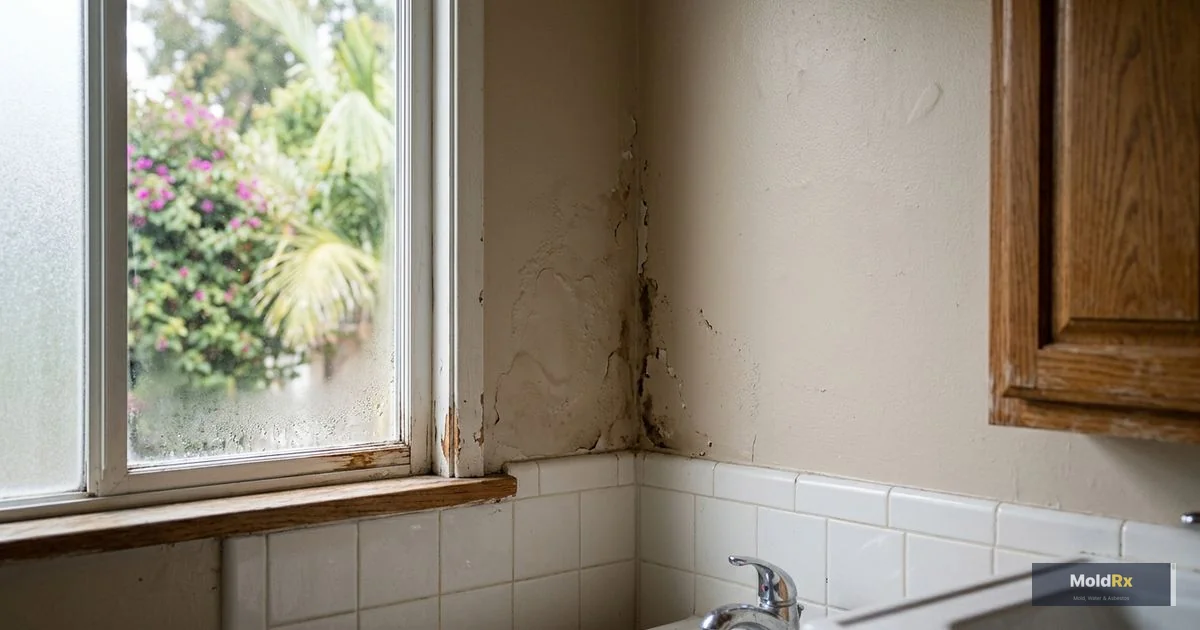
Mold growing beneath your floor can't be seen directly, but it produces consistent warning signs. Some are universal across flooring types; others are specific to the material.
Musty Odor at Floor Level
A persistent musty, earthy, or damp smell concentrated low — not near a wall or ceiling, but at the floor — is one of the earliest and most reliable signs. The odor comes from microbial volatile organic compounds (MVOCs) produced by actively growing mold. It may be strongest in rooms with the door closed, intensify on warm days, or seem to come from the floor itself rather than any fixture.
If you notice a musty smell but can't find a visible source, get down close to the floor in the room where it's strongest. If the odor intensifies at floor level, mold beneath the flooring is a strong possibility.
Discoloration
Dark spots, staining, or discoloration on or around the edges of flooring — particularly along baseboards, at seams, or in areas that have been wet before — can indicate mold activity underneath. On lighter flooring materials, you may see shadowy areas where mold is growing on the subfloor and the stain is telegraphing through. On carpet, look for dark patches that don't respond to cleaning.
Warping, Buckling, or Cupping
When moisture accumulates beneath flooring, the material responds. Laminate buckles at seams. Vinyl plank develops raised edges. Hardwood cups (edges rise higher than the center of each board). Tile can tent or crack. Any unexplained change in floor flatness suggests moisture underneath — and where there's sustained moisture beneath flooring, mold growth is likely.
Soft or Spongy Spots
When the subfloor has been compromised by moisture and mold, it deteriorates. You may feel areas that give more than they should — soft, spongy, or bouncy compared to surrounding floor. This means moisture has been present long enough to degrade the structural sheathing, and mold is almost certainly involved.
Allergy Symptoms That Concentrate in Certain Rooms
Mold spores from under-floor colonies migrate into living spaces through seams, edges, gaps at baseboards, and floor penetrations like vents and plumbing. If you or your family experience respiratory symptoms, allergic reactions, or headaches that are worse in a particular room — especially a room with carpet or a room that's had water issues — mold under the flooring should be considered.
Mold Under Carpet and Carpet Padding
Carpet is the most vulnerable flooring type for hidden mold because of the padding underneath. Carpet padding — foam, rubber, or fiber — is thick, absorbent, and porous. It soaks up and holds moisture, sitting on the subfloor in a warm, dark space with no airflow, staying wet long after the carpet surface feels dry.
Warning signs include a musty smell that persists after cleaning, dark staining at carpet edges or when carpet is pulled back, carpet that feels damp in a localized area, and padding that crumbles when lifted.
Here's the critical point: even if the carpet itself can be cleaned and dried, contaminated padding almost always needs to be replaced. Padding absorbs moisture deep into its structure, and mold roots penetrate throughout. Mold can begin growing within 24 to 48 hours of a water event, and padding provides one of the most hospitable environments for that growth. During remediation, all three layers — carpet, padding, and subfloor — need to be assessed, because leaving contaminated material in place underneath new flooring means the problem returns.
Mold Under Vinyl Plank and LVP Flooring
Luxury vinyl plank (LVP) and sheet vinyl are waterproof on the surface, which is often marketed as a mold-resistant advantage. The flooring itself won't grow mold. But that waterproof surface creates a different problem: it traps moisture underneath with no way out.
Most vinyl plank is installed as a floating floor with click-lock joints over an underlayment pad. Moisture reaches the space beneath through slab moisture migrating upward, slab leaks or plumbing failures, spills seeping through click-lock seams (water-resistant, not waterproof), and condensation on the cool slab surface. Once moisture is under the vinyl, the waterproof surface prevents evaporation — it's trapped.
Signs include planks lifting or developing raised edges, discoloration through lighter-colored planks, a musty odor at floor level, and moisture at plank edges. Many LVP installations include foam or cork underlayment that absorbs moisture like carpet padding — when mold is found, this underlayment typically needs full replacement along with subfloor treatment.
Mold Under Laminate Flooring
Laminate flooring is particularly susceptible to moisture damage because its core is made of high-density fiberboard (HDF) — essentially compressed wood fibers. When moisture reaches the HDF core, it swells irreversibly. Unlike hardwood, which can sometimes be dried and refinished, laminate that has absorbed moisture is permanently damaged.
Like vinyl plank, laminate is installed as a floating floor, and moisture reaches the core through the same paths. But the damage is more visible because the HDF core changes shape: edges swell, joints push apart, and planks buckle upward. Look for swollen edges, buckling, gaps developing between planks, a soft feel underfoot, and discoloration at plank edges.
In most cases, laminate that has absorbed moisture cannot be saved. The HDF core swells permanently and won't return to its original dimensions. The focus during remediation shifts to treating and preserving the subfloor.
Mold Under Hardwood Flooring
Hardwood is a natural, porous material that responds to moisture with visible changes. In some ways, this makes it easier to detect problems early — hardwood tells you something is wrong. But it also means the floor itself is at risk of permanent damage.
The most characteristic sign is cupping — board edges rise higher than the center, creating a washboard pattern. This means the bottom of each board is absorbing more moisture than the top. Also watch for dark discoloration between boards where moisture has wicked up through joints, boards separating wider than seasonal changes would explain, and finish failure like cloudiness or white spots in the polyurethane.
Hardwood that has cupped from a recent moisture event can sometimes recover if the source is eliminated and the floor is dried slowly and evenly. However, if mold has colonized the underside of the boards and the subfloor beneath them, affected sections often need removal for proper subfloor remediation.
Mold Under Tile Flooring
Tile itself is non-porous and won't support mold growth. But the grout between tiles is porous, and the mortar bed (thinset) and subfloor beneath the tile can absorb and hold moisture for extended periods.
Moisture gets under tile through cracked or deteriorated grout, moisture migrating up through a concrete slab, failed waterproof membranes in showers, and plumbing leaks beneath the slab. Signs include grout that stays dark despite cleaning, tiles that sound hollow when tapped (indicating the mortar bond has failed), loose or tenting tiles, a musty odor in tiled rooms, and efflorescence (white mineral deposits) at grout lines indicating moisture migration.
Tile remediation is more invasive than other flooring types because tile is bonded with mortar and destroyed during removal. The affected section must come up, the mortar bed scraped off, and the subfloor treated or replaced before new tile goes down. Early detection is particularly important here — the further mold spreads, the more tile has to come up.
Common Causes in Southern California
Southern California's climate and construction patterns create specific conditions that lead to under-floor mold.
Slab Leaks
A slab leak — a leak in the water supply or drain lines running through or beneath the concrete slab foundation — is one of the most common causes of mold under flooring in Southern California. The leak saturates the concrete from within, and moisture migrates upward to the flooring above. Because the leak is beneath the foundation, it can run for months before anyone notices. Signs include unexplained increases in your water bill, the sound of water running when fixtures are off, warm spots on the floor, and mold signs concentrated in a specific area.
Flooding or Water Damage Not Fully Dried
When a water event occurs, the visible water gets cleaned up, but moisture beneath flooring and behind walls persists long after surfaces feel dry. Without professional extraction and monitoring with moisture meters, trapped water can remain for weeks, quietly supporting mold growth. This is especially common when homeowners handle cleanup themselves without moisture-verification equipment.
Condensation on Concrete Slabs
In Southern California, slab-on-grade construction is standard. When warm, humid air contacts the cooler concrete surface beneath flooring, condensation forms — a subtle, persistent moisture source that doesn't come from a leak or water event. It's most common in homes with poor ventilation, during seasonal transitions, and where flooring was installed directly on the slab without a proper moisture barrier.
Irrigation and Landscape Drainage Near the Foundation
Sprinkler systems aimed at the foundation, planter beds without drainage against the house, and grading that directs water toward the slab all introduce moisture along the foundation perimeter. This moisture migrates under the slab edge and up through the concrete, particularly in homes without a vapor barrier beneath the slab.
Crawl Space Moisture
For homes with raised foundations, crawl space moisture is a direct pathway to mold under flooring. High humidity or standing water in the crawl space creates a damp environment directly beneath the subfloor. Without a proper vapor barrier and adequate ventilation, moisture condenses on floor joists and subfloor sheathing.
When Can Flooring Be Saved vs. When Must It Be Replaced?
The answer depends on the material, moisture duration, and mold extent.
Often salvageable: Hardwood (if cupping is moderate and the event was recent), tile (the tile itself isn't affected — only the mortar and subfloor beneath), and carpet fibers (if contamination is limited and drying was prompt).
Usually requires replacement: Carpet padding (absorbs deep, mold penetrates throughout), laminate (HDF core swells permanently), vinyl plank underlayment (behaves like carpet padding), and any material where mold has penetrated into the structure rather than sitting on the surface.
Subfloor replacement is needed when plywood or OSB sheathing has been compromised — soft, delaminated, discolored through its thickness, or reading above acceptable moisture levels after drying. This is why early detection matters: catching the problem before it degrades the subfloor means a simpler remediation.
Professional Detection Methods
Under-floor mold can be difficult to confirm without the right tools. Professional assessors use several methods to evaluate suspected mold without unnecessary demolition.
Moisture meters — pinless (radio frequency) meters can scan large areas of flooring quickly, measuring moisture content in the subfloor without penetrating the surface. Elevated readings beneath an area with other mold indicators provide strong evidence of conditions supporting growth.
Thermal imaging — infrared cameras detect temperature differentials caused by moisture. Wet materials are cooler than dry ones due to evaporative cooling. A thermal scan can reveal the location and boundaries of moisture beneath flooring that's invisible to the eye.
Air and surface sampling — mold testing through air sampling can detect elevated spore levels even when the source is hidden under flooring. If indoor counts are significantly higher than outdoor baselines, mold is actively growing somewhere in the space.
Exploratory openings — when non-invasive methods strongly indicate mold, a small, targeted opening — lifting a few vinyl planks, pulling back carpet, or removing a floor register — allows direct visual confirmation based on moisture readings and thermal data.
The Remediation Process for Mold Under Flooring
Professional remediation for under-floor mold follows the same principles as any mold remediation — containment, removal, treatment, and verification — with specifics dictated by the flooring situation.
Containment — the affected area is isolated with polyethylene sheeting and HEPA-filtered negative air machines, preventing spores from dispersing during flooring removal.
Flooring and subfloor removal — contaminated materials are removed within containment. For carpet, this means carpet, padding, and tack strips. For hard flooring, it includes the floor covering, adhesive or underlayment, and any compromised subfloor sections.
Subfloor treatment or replacement — if the subfloor is structurally sound but surface-contaminated, it's HEPA-vacuumed, sanded, and treated with antimicrobial solutions. If it's structurally compromised — soft, delaminated, or mold has penetrated through its thickness — affected sections are cut out and replaced.
Moisture source correction — remediation without addressing the moisture source guarantees recurrence. Whether that means repairing a slab leak, installing a vapor barrier, or correcting drainage, this step is as important as the mold removal itself.
Drying and verification — the area is dried to target moisture levels using commercial dehumidifiers and air movers, with readings documented before new flooring is installed. Clearance air sampling confirms airborne spore levels have returned to normal. New flooring goes down only after the area has been fully cleared, and a proper vapor barrier should be part of any reinstallation over a concrete slab.
Mold Under Flooring: 10 FAQs
Can mold grow under waterproof flooring?
Yes. Waterproof flooring prevents moisture from reaching the surface, but it also prevents moisture beneath the floor from escaping. Trapped moisture creates ideal conditions for mold — dark, damp, no airflow, sitting on organic subfloor material. The waterproof quality actually makes hidden mold worse by removing the only drying pathway.
What does mold under flooring smell like?
A musty, earthy, damp odor — often described as old basement, wet cardboard, or damp soil. The distinguishing feature is that the smell concentrates at floor level, strongest when you first enter a closed room, in corners, or near baseboards. It typically intensifies in warmer or more humid conditions.
Can I just put new flooring over mold?
No. Installing new flooring over mold does not kill or contain it. The colony will continue growing on the subfloor and producing spores that enter your living space. The mold must be properly remediated and the subfloor treated or replaced before new flooring goes down.
How long does it take for mold to grow under wet flooring?
Mold can begin growing within 24 to 48 hours when conditions are right — and the enclosed space under flooring provides near-ideal conditions once moisture is introduced. This is why professional water damage response emphasizes extracting water from beneath flooring within the first day.
Is mold under carpet dangerous?
Yes. Spores become airborne through foot traffic, vacuuming, and HVAC airflow. Carpet actually distributes more spores than hard flooring because walking on it compresses and releases air through the fibers. People with asthma, allergies, or immune system vulnerabilities are at greatest risk.
How do I know if my subfloor has mold?
You typically can't confirm it without professional assessment. Warning signs include a musty odor at floor level, soft or spongy spots, visible mold at floor edges or under pulled-back carpet, a history of water damage, and elevated spore counts from air testing. A professional assessment using moisture meters and thermal imaging can determine whether conditions beneath your floor support mold growth.
Does insurance cover mold under flooring?
Coverage depends on the cause. Mold from a sudden, accidental event — burst pipe, appliance failure, storm damage — is typically covered. Mold from gradual conditions like chronic condensation or deferred maintenance is usually excluded. Document everything before disturbing the flooring: photos, dates, any connection to a covered event.
Can I test for mold under my floor myself?
You can pull back accessible edges of carpet or vinyl plank to check visually, but disturbing mold without containment can release spores into your living space. For anything beyond a quick visual check, professional testing is recommended — air sampling can detect elevated spore levels without demolition.
How much flooring needs to be removed for mold remediation?
The scope depends on how far mold has spread, determined by moisture mapping and visual assessment. Remediation targets the affected area plus a safety margin — not the entire house. A problem affecting 50 square feet is a very different project than one that's spread to 500.
How can I prevent mold from growing under my flooring?
Address moisture sources promptly — repair leaks, dry water events within 24 hours, and monitor your water bill for unexplained increases. Ensure proper vapor barriers between concrete slabs and flooring. Maintain crawl space ventilation. Direct irrigation and landscape drainage away from your foundation. And if you've had water damage, verify dryness beneath the flooring with a moisture meter — not just by feel.
Next Steps
Mold under flooring won't resolve on its own. Moisture trapped beneath your floor covering continues feeding mold growth until the source is addressed and contaminated materials are properly remediated. The longer it goes, the more involved the project becomes.
If you're seeing the signs described in this article — musty odors at floor level, warping, discoloration, soft spots, or unexplained allergy symptoms — the most important step is finding out what's beneath the surface before it spreads further.
MoldRx coordinates professional mold testing and remediation for homes throughout Southern California. We'll help you determine whether professional assessment is warranted, and walk you through every step.
Call (888) 609-8907 to describe what you're seeing, or request a free estimate online.