Mold Removal in Moreno Valley, CA — MoldRx
IICRC-Certified Mold Removal Professionals Serving Moreno Valley and the Eastern Inland Empire
Moreno Valley is a city of approximately 216,000 residents in central Riverside County — ZIP codes 92551, 92553, 92555, and 92557 — sitting at roughly 1,630 feet elevation between the Box Springs Mountains and the Badlands. Incorporated in 1984 when Edgemont, Sunnymead, and Moreno unified, the city exploded from 49,000 residents to nearly 119,000 by 1990 — one of the fastest-growing cities in the country. That growth produced over 56,000 housing units, roughly 78 percent single-family detached, built between the early 1980s and early 2000s with slab-on-grade foundations, stucco exteriors, and builder-grade materials now 25 to 45 years old. Summer highs push into the mid-90s to low 100s, annual rainfall averages 12 inches concentrated between November and March, Santa Ana winds sweep the valley floor, and humidity swings between summer lows around 42 percent and winter peaks near 56 percent feed the condensation cycling that drives mold colonization. MoldRx only sends vetted, IICRC-certified mold removal professionals who follow IICRC S520/R520 standards and EPA guidance (publication 402-K-01-001).
Request your free estimate — we'll assess your property and give you straight answers.
Why Mold Grows in Moreno Valley Properties
Four persistent moisture vectors explain why this rapidly built valley city produces recurring mold problems across every ZIP code.
Inland Heat, Temperature Swings, and Condensation Cycling
Moreno Valley's inland position produces temperature extremes coastal cities never experience. Summer highs regularly reach 95 to 102 degrees while winter nights drop into the low 40s — creating condensation on any surface below the dew point. Interior walls, HVAC ductwork running through superheated attics, and cold-water pipes inside wall cavities all collect moisture. The IICRC S520 Standard and EPA publication 402-K-01-001 document that mold colonizes damp materials within 24 to 48 hours. In Moreno Valley, condensation events repeat hundreds of times between October and April, and the 1,630-foot elevation amplifies nighttime cooling — driving larger differentials than lower-elevation Inland Empire communities.
Rapid-Build Housing Stock Now Reaching Failure Age
Moreno Valley's population tripled in roughly a decade. That speed produced tens of thousands of tract homes built to minimum code — slab-on-grade foundations, stucco cladding, builder-grade windows, polybutylene supply lines, and bathroom exhaust fans vented into attics. These homes are now 25 to 45 years old, in the window where original plumbing begins leaking, HVAC systems develop condensation problems, and first-generation roofing approaches end of life. The volume of homes built on similar timelines means entire neighborhoods hit failure thresholds simultaneously. A slow slab leak or failed supply line behind drywall can feed mold growth for months before visible signs appear.
Santa Ana Winds and Stucco Degradation
Santa Ana winds sweep across the valley floor, driving humidity below 10 percent within hours. When the winds die, moisture rebounds to 55 percent in a single day. These rapid swings stress stucco aggressively — expansion and contraction produce hairline cracks that widen with each event. Once the November-through-March rain window arrives, those cracks become moisture pathways into wall cavities. The flat topography offers no windbreak, meaning properties across all ZIP codes experience the same degradation. Caulk around windows and doors fails faster here than in coastal or mountain communities.
Slab Leaks and Foundation Moisture Migration
Moreno Valley's slab-on-grade construction — standard during the boom — creates a direct pathway for moisture to reach interior finishes. Copper supply lines embedded in concrete corrode over decades, producing pinhole leaks that pressurize water into the slab. Moisture wicks upward, saturating carpet pad, vinyl flooring adhesive, and the bottom edge of drywall. Post-tension slab systems develop stress fractures as soil settles. Homeowners often first notice the problem when carpet feels damp, baseboards warp, or a musty smell appears — by that point, mold has typically been colonizing for weeks.
Signs You Need Professional Mold Removal
These indicators warrant professional assessment in an inland valley where temperature extremes and uniform-age construction create hidden moisture conditions.
Visible Growth Beyond a Small Area
EPA publication 402-K-01-001 sets ten square feet as the threshold for professional remediation. In Moreno Valley, colonies commonly appear along slab-to-drywall transitions, inside bathroom cavities where exhaust fans vent to attics, behind kitchen cabinetry on exterior walls, and at window frames where condensation collects. If growth exceeds a three-by-three-foot patch or appears in multiple rooms, professional containment is appropriate.
Persistent Musty Odor Without Visible Mold
A persistent musty smell without an obvious source typically means concealed growth — inside wall cavities, behind shower surrounds, beneath flooring where slab moisture migrates, or within HVAC ductwork. If the odor intensifies when the AC cycles on or during the first fall rains, concealed mold is likely.
Recurring Mold After Previous Cleanup
If mold returns after cleaning, the moisture source persists — condensation, a slow slab leak, compromised stucco, or humidity cycling through degraded weatherstripping. Recurring mold requires professional moisture mapping and source correction, not repeated surface cleaning.
Water Damage History
Per IICRC S520 and EPA guidance, mold colonization begins within 24 to 48 hours. Properties that have experienced plumbing failures, slab leaks, roof leaks, or any water event should be evaluated even if surfaces appear dry — slab assemblies and wall cavities retain moisture far longer than surfaces suggest.
Health Symptoms That Worsen Indoors
The CDC notes that mold exposure can cause nasal stuffiness, throat irritation, coughing, and wheezing. If symptoms improve when you leave and return when you come home — particularly during heating season when HVAC recirculates indoor air — indoor mold is a reasonable possibility.
Health Risks of Mold Exposure
Mold produces allergens, irritants, and in some species mycotoxins. The EPA, CDC, and WHO Guidelines for Indoor Air Quality: Dampness and Mould document that prolonged exposure is associated with respiratory symptoms, allergic reactions, and asthma aggravation — particularly when indoor colonies exceed normal outdoor baselines behind walls, inside ductwork, or beneath flooring.
Populations at Higher Risk
Moreno Valley's median age of 32.5 years and large family-oriented population shape which groups face the greatest risk:
- Children and infants — The WHO identifies children as a priority population. Developing respiratory systems are more sensitive to airborne spores, with documented risk for asthma development. Nearly a third of Moreno Valley residents are under 18.
- Adults with asthma or respiratory conditions — The CDC reports that mold triggers asthma attacks and exacerbates chronic respiratory conditions. Inland Empire air quality already stresses respiratory health; indoor mold compounds that burden.
- Older adults — Age-related immune changes increase vulnerability, particularly with sustained exposure in established neighborhoods like Edgemont and Sunnymead.
- Immunocompromised individuals — Chemotherapy patients, transplant recipients, and those with chronic immune conditions face elevated risk from species like Aspergillus.
The goal of professional remediation is to return indoor fungal ecology to normal background levels — what the IICRC S520 standard defines as Condition 1.
When DIY Mold Removal Isn't Enough
The EPA allows homeowners to address small mold areas. These situations exceed DIY methods:
- The affected area exceeds ten square feet — EPA publication 402-K-01-001 identifies this as the threshold for professional remediation.
- Mold is inside HVAC ductwork or the air handler — The National Air Duct Cleaners Association (NADCA) recommends professional cleaning when mold is confirmed inside duct systems. In Moreno Valley, attic temperatures exceeding 150 degrees create condensation on cold coils when the system cycles — feeding mold inside the air handler.
- Growth has penetrated structural materials — Mold in wall framing, subfloor sheathing, or floor joists requires selective demolition and professional drying.
- The mold appears to be Stachybotrys (black mold) — IICRC S520 requires careful containment due to mycotoxin production. Species identification requires laboratory analysis.
- The water source is Category 2 or Category 3 — IICRC S500 classifies water from sewage backups or flooding as gray or black water, requiring biohazard protocols. Storm-drain backups and flash flooding in low-lying Moreno Valley areas are documented Category 2 and 3 scenarios.
- Documentation is needed for insurance or real estate — DIY cleanup does not produce the reports and clearance testing carriers and buyers require.
If any of these apply, professional assessment is the next step. Request a free estimate — we will tell you what you actually need.
How We Remove Mold in Moreno Valley Properties
Every project follows IICRC S520/R520 and Cal/OSHA Title 8 regulations — methodical, documented, designed to eliminate mold at the source.
1. Inspection and Moisture Mapping
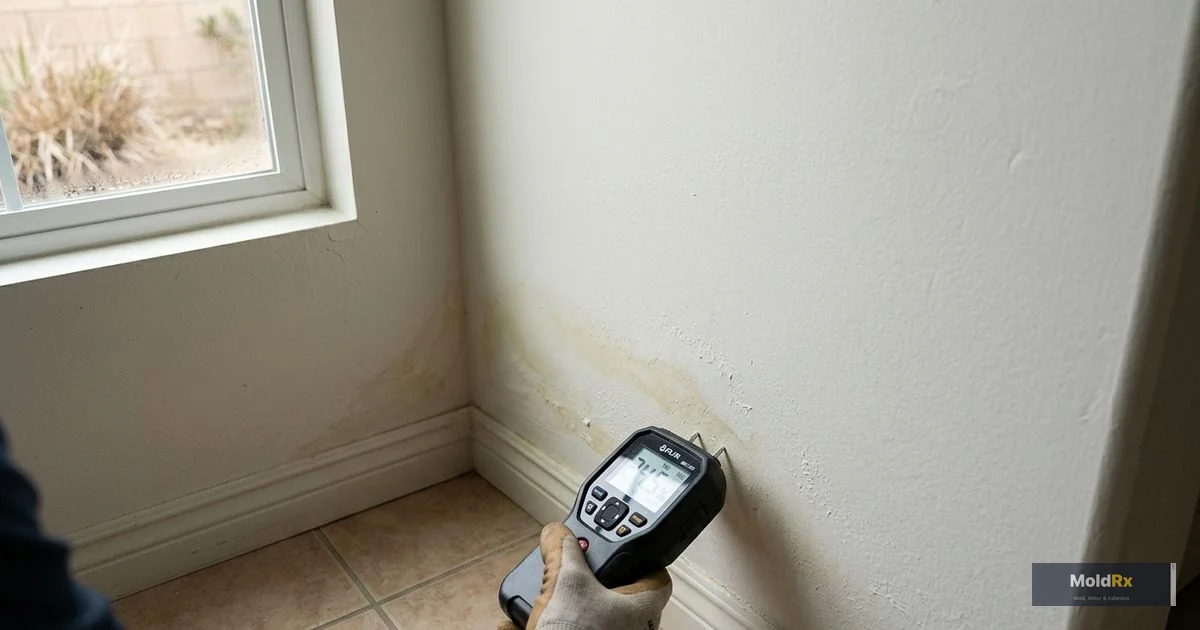
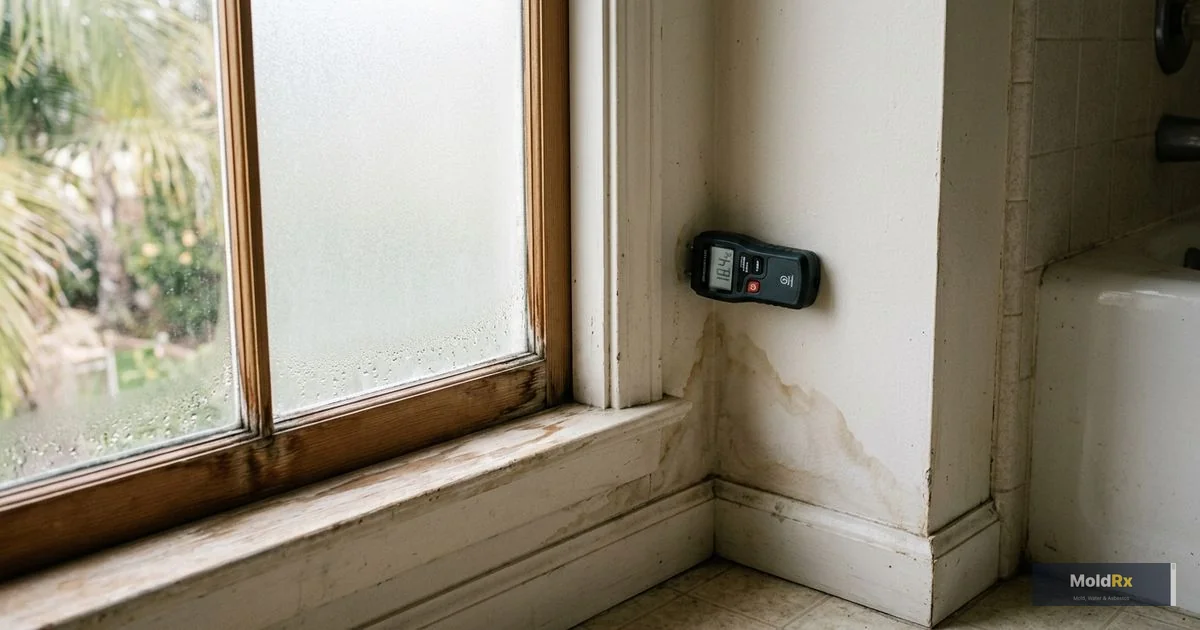
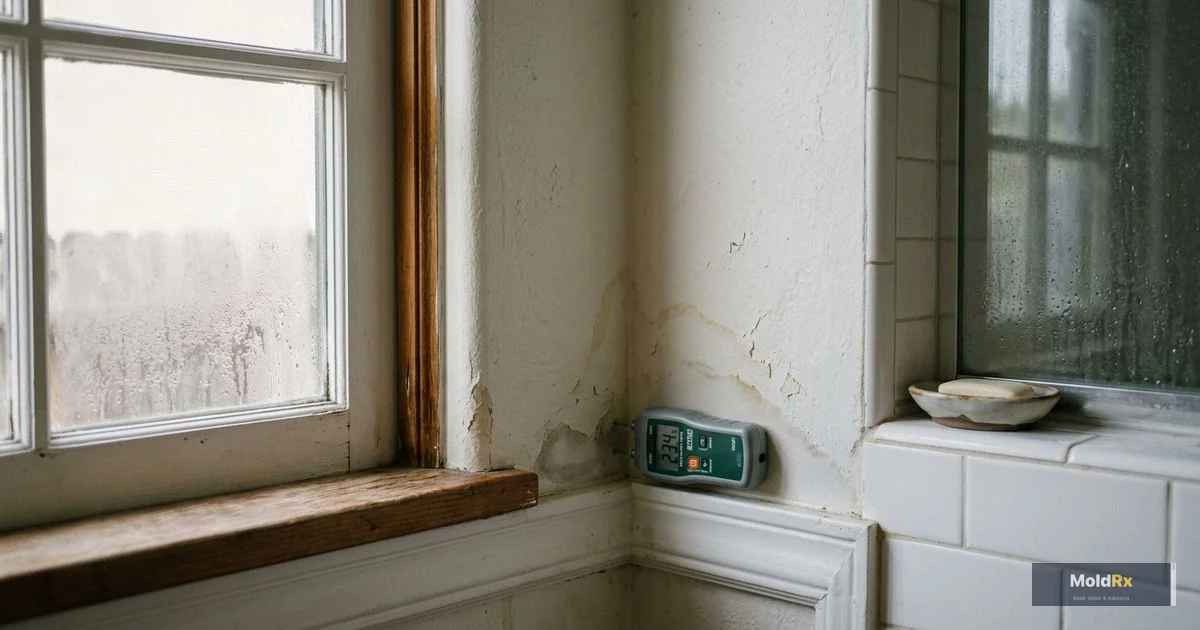
Infrared thermal imaging and calibrated moisture meters locate all affected areas — slab edges, wall cavities in 1980s tract homes, attic ductwork, and bathroom assemblies where exhaust vents terminate in attic spaces. The assessment follows EPA 402-K-01-001 protocols, producing a moisture map and scope of work before any material is disturbed.
2. Containment
Affected areas are isolated using polyethylene sheeting and negative air pressure with HEPA filtration per IICRC S520. The CDC and EPA advise keeping vulnerable occupants away from active remediation. In Moreno Valley's open floor plans — common in 1990s and 2000s tract homes — containment requires precise barrier placement to isolate the affected zone without disrupting the entire home.
3. Removal and Treatment
Colonized porous materials are removed, double-bagged, and disposed of per IICRC S520 and Cal/OSHA Title 8 section 5155 standards. Salvageable surfaces are HEPA-vacuumed and treated with EPA-registered antimicrobials. Common locations: behind drywall at slab-to-framing transitions, inside wall cavities where exhaust fans vent to attics, around aging copper plumbing joints, beneath vinyl flooring where slab moisture migrates, and inside HVAC plenums where attic heat drives condensation.
4. Moisture Correction
Mold removal without moisture correction is temporary. Correction targets the specific pathway: repairing slab leaks, rerouting exhaust from attics to exterior, sealing stucco cracks, improving attic ventilation, replacing degraded caulk and weatherstripping, and addressing foundation moisture migration.
5. Post-Remediation Verification
Verification confirms IICRC S520 Condition 1 — normal fungal ecology, no visible mold, no elevated spore counts. You receive complete documentation: photographs, moisture readings, clearance results, and correction summary.
Mold Removal vs. Mold Remediation: What's the Difference?
Mold removal is the physical elimination of colonized materials. Mold remediation is the full IICRC S520 process: assessment, containment, removal, moisture correction, drying, and verification to confirm Condition 1.
Removal without remediation is incomplete. In Moreno Valley, where inland temperature extremes, Santa Ana wind cycling, concentrated winter rainfall, and uniformly aging slab-on-grade construction create persistent recolonization risk, moisture correction is the difference between a lasting fix and a recurring problem. MoldRx coordinates the complete IICRC S520 protocol from assessment through Condition 1 clearance.
Preventing Mold After Remediation
Prevention tailored to Moreno Valley's inland climate, uniform-age housing, and slab-on-grade construction.
Control Indoor Humidity Against Seasonal Extremes
Moreno Valley's outdoor humidity swings from below 15 percent during Santa Ana events to 56 percent during winter months. The EPA recommends keeping indoor humidity between 30 and 50 percent. Run bathroom exhaust fans during showers and for 20 minutes afterward. Use kitchen range hoods. During humid winter weeks, a portable dehumidifier prevents moisture accumulation. Monitor with a hygrometer and respond when readings exceed 55 percent.
Maintain Your Building Envelope Against Wind and Heat Cycling
Santa Ana winds and daily temperature swings of 30 to 40 degrees stress stucco, caulk, and weatherstripping aggressively. Inspect exterior caulk around windows and doors twice per year — before the rainy season in October and again in spring. Re-seal with elastomeric caulk rated for UV and temperature cycling. Pay particular attention to north-facing walls where condensation accumulates most during winter nights.
Upgrade Ventilation in 1980s-1990s Homes
Most Moreno Valley homes from the building boom have bathroom exhaust fans that vent into the attic rather than outdoors — a code violation by current standards that pumps warm, moist air into a superheated space. Rerouting exhaust to the exterior is one of the highest-return improvements a Moreno Valley homeowner can make. Check that attic vents are unobstructed and soffit vents have not been blocked by insulation.
Address Water Intrusion and Slab Leaks Immediately
Mold colonization begins within 24 to 48 hours, and Moreno Valley's warm climate accelerates the process. Whatever the source — slab leak, plumbing failure, roof leak, or storm flooding — dry affected materials immediately. Watch for unexplained water-bill increases, warm spots on the floor, or damp carpet without a visible source — hallmarks of slab leaks in post-tension foundations common across the city. Active extraction and dehumidification are essential; do not wait for materials to "air dry."
Schedule Periodic Inspections for High-Risk Properties
For pre-1990 homes with original copper plumbing, properties with prior water damage, homes where bathroom exhaust vents into the attic, and properties in low-lying areas prone to storm drainage, an annual professional moisture inspection is practical preventive care. Ideal timing is late September — before winter storms test every seal.
What Sets MoldRx Apart
- Straight talk, not sales talk. We report what the inspection finds — including when the problem is smaller than you feared. No inflated scopes.
- Licensed, insured, IICRC-certified. Every professional holds credentials verified through the CSLB with full liability and workers' compensation insurance for Riverside County work.
- Full documentation on every job. Inspection reports, moisture readings, clearance testing, photo documentation — a complete record for insurance and real estate.
- Family-owned accountability. We only send vetted remediation professionals we stand behind. If something is not right, you call us directly.
Get your free estimate — no obligations, no pressure.
Moreno Valley Neighborhoods We Serve
MoldRx provides mold removal across every Moreno Valley neighborhood — ZIP codes 92551, 92553, 92555, 92557 — including the original communities, 1980s-era tract housing, and newer developments throughout this eastern Inland Empire city of 216,000.
-
Sunnymead — One of the three original communities that incorporated to form Moreno Valley in 1984. Commerce lines Sunnymead Boulevard while surrounding blocks hold modest homes built in the 1970s through early 1990s. Original plumbing in the oldest homes is reaching 45 to 50 years, and many properties retain builder-grade windows and bathroom fans venting into attics — one of the highest mold-risk areas in the city.
-
Edgemont — A suburb along the I-215 corridor with ranch-style homes from the pre-incorporation era and newer infill. Mixed construction eras mean varying plumbing materials and weatherproofing quality on the same street.
-
Moreno — The central community around which the city was named, with the earliest residential development in the valley. Older lots with mature landscaping and irrigation keep soil moisture elevated against foundations — a persistent mold pathway in slab-on-grade construction.
-
TownGate — Subdivisions, schools, and retail near Box Springs Mountain. Homes from the late 1980s and 1990s share similar construction timelines, meaning HVAC systems, water heaters, and roofing are reaching replacement age simultaneously. Proximity to Box Springs channels storm runoff toward lower-elevation properties.
-
Hidden Springs — A suburban setting near Box Springs Mountain Reserve with homes from the late 1980s. Elevation changes create grading-dependent drainage — winter storms push water toward downhill foundations, and cut-and-fill grading settles unevenly over decades.
-
Rancho Belago — The newest major community in eastern Moreno Valley, with homes from the 2000s onward near Lake Perris State Recreation Area. The lake raises localized humidity above the valley baseline, and builder-grade materials in the earliest phases are now 20-plus years old — entering the failure window for original roofing and water heaters.
Nearby Communities We Also Serve
Related Services in Moreno Valley
→ All remediation services in Moreno Valley
Frequently Asked Questions
How quickly does mold grow in Moreno Valley's inland climate?
Mold colonizes damp materials within 24 to 48 hours. Moreno Valley's warm temperatures accelerate the process — during summer, colonization can establish even faster. After any water event, drying must begin immediately. The concentrated November-through-March rain window means multiple storms can hit before a previous intrusion has been properly addressed.
Is mold more common in older Moreno Valley homes or newer ones?
Both produce mold through different mechanisms. The 1980s homes in Sunnymead and Edgemont face aging plumbing, exhaust fans venting into attics, and original weatherproofing at end of life. The 1990s tract homes have polybutylene or early-copper plumbing approaching failure. Even Rancho Belago's newer homes are entering the window where original water heaters, builder-grade caulk, and first-generation roofing reach replacement age. No era is immune — the moisture sources differ.
Do Santa Ana winds affect mold growth in Moreno Valley?
Indirectly but significantly. Santa Ana events drive humidity below 10 percent, causing stucco, caulk, and weatherstripping to contract and crack. When the winds die and moisture returns — sometimes within 24 hours — humidity spikes to 55 percent and moisture enters through every crack the winds created. The valley floor offers no windbreak, meaning this cycling degrades building envelopes faster than in coastal or mountain communities.
Are slab leaks common in Moreno Valley, and do they cause mold?
Yes — slab leaks are one of the most common mold pathways in the city. Most Moreno Valley homes sit on slab-on-grade foundations with copper supply lines in concrete. After 25 to 40 years, corrosion produces pinhole leaks that pressurize water into the slab. Moisture wicks upward into carpet pad, vinyl flooring, and drywall — creating concealed colonies that grow for weeks before visible signs appear. An unexplained spike in your water bill is often the first indicator.
Can I stay in my home during mold removal?
For most projects with proper containment, occupants can stay in unaffected areas. If contamination involves the HVAC system, spans multiple rooms, or household members include vulnerable populations, we may recommend temporary relocation during intensive phases. Containment per IICRC S520 prevents spore migration to occupied areas.
My bathroom exhaust fan vents into the attic — is that causing mold?
Very likely contributing. This was standard in Moreno Valley's 1980s-1990s building boom but violates current code. Every shower pumps warm, humid air into an attic that already reaches 140 to 150 degrees in summer — creating condensation on roof sheathing that feeds mold colonies homeowners never see until a roof replacement or attic inspection reveals extensive growth. Rerouting exhaust to the exterior is one of the most effective mold prevention steps you can take.
Should I test for mold before selling my Moreno Valley home?
Not legally required in California, but increasingly common in Inland Empire transactions. A pre-listing clearance report demonstrating IICRC S520 Condition 1 eliminates a negotiation point. Addressing mold before listing is less disruptive than negotiating remediation mid-escrow — median home values in Moreno Valley exceed $500,000.
How do I know if my home has hidden mold?
Warning signs include a persistent musty odor that worsens when the HVAC cycles on, respiratory symptoms that improve when you leave, water staining without active leaking, warm spots on the floor suggesting a slab leak, and warped or buckled flooring. Professional inspection with infrared thermal imaging and calibrated moisture meters locates concealed colonies that visual inspection misses.
Does Moreno Valley's air quality affect mold-related health symptoms?
The Inland Empire's air quality — consistently among the most challenged in California — already stresses respiratory systems. Indoor mold compounds that burden by adding spores and allergens to air residents breathe most of the day. The CDC and WHO document that combined stressors increase respiratory symptom risk, particularly in children and adults with pre-existing conditions. With nearly a third of Moreno Valley under 18, indoor air quality is especially consequential.
Does MoldRx provide emergency mold removal in Moreno Valley?
Yes. Mold colonization begins within 24 to 48 hours and Moreno Valley's warm climate accelerates the process. Call (888) 609-8907 — we coordinate prompt assessment and containment to limit spread.
Get Mold Removal in Moreno Valley
MoldRx only sends vetted, IICRC-certified remediation professionals who know eastern Inland Empire construction — from Sunnymead and Edgemont's original neighborhoods to TownGate tract homes, Hidden Springs hillside properties, and Rancho Belago's newer communities. We understand what Moreno Valley's inland temperature extremes, Santa Ana wind cycling, and aging slab-on-grade construction do to properties — and we fix it at the source.
Call (888) 609-8907 or request your free estimate online — clear answers, honest guidance, work done right.