Emergency Water Damage Restoration in Newport Beach, CA — MoldRx
Vetted Water Damage Restoration Specialists Serving Newport Beach and Coastal Orange County — 24/7 Emergency Response
Water does not wait. It does not pause while you search for a contractor, and it does not slow down while you weigh your options. Right now, every minute that water sits in your Newport Beach property, it is actively destroying flooring, saturating drywall, warping structural framing, and creating the exact conditions mold needs to colonize. If you are reading this because water has invaded your home or commercial property, stop reading and call (888) 609-8907 immediately. We will have a vetted, IICRC S500-certified restoration team mobilized to your property within the hour.
Still here? Then let us walk you through exactly what Newport Beach property owners face when water damage strikes, why coastal restoration demands specialized expertise most companies lack, and how MoldRx connects you with the only professionals we trust to handle the job right.
Request Your Free Emergency Estimate Now
Why Newport Beach Properties Face Elevated Water Damage Risk
Newport Beach is not a typical Southern California city. With a population of approximately 85,000, it sits directly on the Pacific Coast where the marine layer rolls in most mornings, keeping relative humidity between 59% and 74% year-round. That persistent coastal moisture creates a fundamentally different restoration environment than anywhere inland. A water event that might take weeks to cause secondary damage in Riverside can trigger active mold colonization in a Newport Beach property within 24 to 48 hours.
The Housing Stock Problem
The housing stock in Newport Beach spans over a century of construction. Balboa Island and the Balboa Peninsula contain original 1920s and 1930s beach cottages — many under historic preservation overlays — alongside mid-century builds and modern luxury reconstructions. Corona del Mar features predominantly 1950s to 1970s construction mixed with multimillion-dollar renovations. Newport Coast skews newer, with most homes built from the 1990s forward, but even those properties are now 25 to 35 years old with aging plumbing systems approaching failure points.
What this means for water damage is straightforward: older galvanized and copper plumbing corroded by decades of salt air exposure, original drain lines that have shifted or deteriorated beneath foundations, and water heaters that fail years before their rated lifespan because salt particles settle on components and accelerate corrosion from the inside out. Average luxury home water damage claims in Newport Beach range from $25,000 to $75,000 — and those numbers climb fast when restoration is delayed.
Coastal-Specific Threats
Newport Beach faces water damage threats that most inland cities never encounter:
-
King Tide Flooding: Balboa Island and the Balboa Peninsula experience recurring tidal flooding during king tide events, with seawater reaching up to a foot higher than tide table predictions. These events have intensified in frequency in recent years, pushing saltwater into low-lying residential areas, parking structures, and ground-floor living spaces along the harbor and bay channels.
-
Salt Air Corrosion: Ocean air carries salt particles that silently destroy plumbing infrastructure. Pipe joints corrode, copper develops pinhole leaks, outdoor plumbing fixtures deteriorate, and HVAC condensate lines degrade at accelerated rates. Salt corrosion is the leading cause of unexpected pipe failures in Newport Beach properties.
-
Marine Layer Humidity: The persistent marine layer keeps building materials from drying naturally after any moisture intrusion. You cannot simply open windows and run fans in a Newport Beach home the way you might in Temecula or Redlands. The ambient humidity fights you.
-
Storm Surge and Runoff: While Newport Beach averages only about 12 inches of annual rainfall, those storms arrive in intense winter bursts that overwhelm aging drainage infrastructure. Low-lying areas near Newport Harbor, along Lido Isle, and throughout Balboa Island are particularly vulnerable. Properties on the bluffs in Corona del Mar and Newport Coast face runoff intrusion into foundations and crawl spaces.
-
Groundwater Intrusion: Properties near the bay, channels, and harbor sit on a water table that rises with tides and storms, pushing moisture through foundation slabs and into structures from below — a source that many homeowners never see until the damage is advanced.
Water Damage Categories and Classes: What You Are Actually Dealing With
Not all water damage is the same, and understanding the classification system directly impacts what your restoration requires and how urgently you need to act. Our vetted professionals classify every Newport Beach water event according to IICRC S500 standards — the ANSI-accredited benchmark for professional water damage restoration.
Water Damage Categories (Contamination Level)
Category 1 — Clean Water: Originates from a sanitary source with no substantial health risk. Broken supply lines, sink or tub overflows with no contaminants, melting ice, appliance malfunctions involving supply lines. This is the most manageable category, but in Newport Beach's humid coastal environment, Category 1 water can degrade to Category 2 within 48 hours if not extracted and dried promptly.
Category 2 — Gray Water: Contains significant contamination that can cause illness upon exposure. Dishwasher or washing machine overflows, toilet overflows with urine (no feces), sump pump failures, HVAC condensate overflow. Requires heightened precautions, personal protective equipment, and antimicrobial treatment of affected materials.
Category 3 — Black Water: Grossly contaminated water that poses serious health risks. Sewage backups, rising floodwater (including king tide flooding in Newport Beach), water from beyond any trap regardless of appearance, and any Category 1 or 2 water that has remained stagnant long enough to support bacterial growth. This is a health emergency. Porous materials that contact Category 3 water — carpet, padding, upholstered furniture, mattresses, and unsealed drywall — must be removed and disposed of. There is no drying them out and hoping for the best. Category 3 events require immediate professional intervention aligned with both IICRC S500 and IICRC S520 mold remediation protocols.
Water Damage Classes (Extent and Drying Difficulty)
Class 1 — Slow Evaporation Rate: The least amount of water absorption and evaporation. Affects only part of a room with minimal moisture in materials. Typically a single room with low-porosity materials.
Class 2 — Fast Evaporation Rate: Water has wicked into walls, carpeting, and cushion. The entire room or a significant section is affected, with moisture reaching 12 to 24 inches up walls. Common in Newport Beach slab leak scenarios where water migrates laterally through flooring.
Class 3 — Fastest Evaporation Rate: Water has come from overhead or saturated the entire area — walls, ceilings, insulation, carpet, subfloor, and structural elements. Often seen in Newport Beach during second-story plumbing failures or roof leaks during heavy winter storms.
Class 4 — Specialty Drying: Deep pockets of saturation exist in materials with very low permeance — hardwood flooring, plaster walls, concrete, and stone. This class is extremely common in Newport Beach properties, where original 1920s-era plaster walls on Balboa Island, hardwood floors in Corona del Mar estates, and concrete slab foundations throughout the city all require extended, technically precise drying with specialized equipment. Standard dehumidifiers and air movers are insufficient.
This is why you need professionals who understand Newport Beach construction, not a franchise that sends the same crew and the same equipment to every zip code in Southern California.
The MoldRx Emergency Restoration Process for Newport Beach
We are not a restoration company. We are the filter between you and the restoration companies that actually deserve to touch your property. MoldRx only sends vetted, IICRC S500 and IICRC S520-certified professionals who carry proper CSLB licensing, maintain Cal/OSHA compliance, and have documented experience restoring coastal properties. Here is exactly what happens when you call.
Phase 1: Immediate Emergency Response
When you call (888) 609-8907, we do not put you on hold, we do not schedule you for next Tuesday, and we do not send a sales representative to upsell you. We dispatch a vetted restoration team to your Newport Beach property for emergency assessment. This is a 24/7 operation — water damage at 2 AM on a Saturday gets the same response as a Tuesday afternoon call.
The team arrives with thermal imaging cameras, professional-grade moisture meters, and the training to identify what you are dealing with before a single piece of equipment gets plugged in. They will identify the water source, classify the category (Categories 1 through 3) and class (Classes 1 through 4), map the full extent of moisture migration through your structure, and give you an honest assessment of what your property needs.
Phase 2: Water Extraction and Containment
Standing water comes out immediately using commercial-grade truck-mounted and portable extraction units. In Newport Beach homes with hardwood floors, custom tile, imported stone, or other high-value finishes, extraction techniques are adapted to minimize material damage. For Category 3 events — including king tide flooding with bay or harbor water — contaminated materials are isolated, removed, and properly disposed of per EPA guidelines and IICRC S500 protocols.
Salt water events require specialized treatment. Saltwater is significantly more corrosive than freshwater, and if residual salt is not removed from structural materials, it will continue drawing moisture from the air and accelerating deterioration for months after the visible water is gone.
Phase 3: Structural Drying and Dehumidification
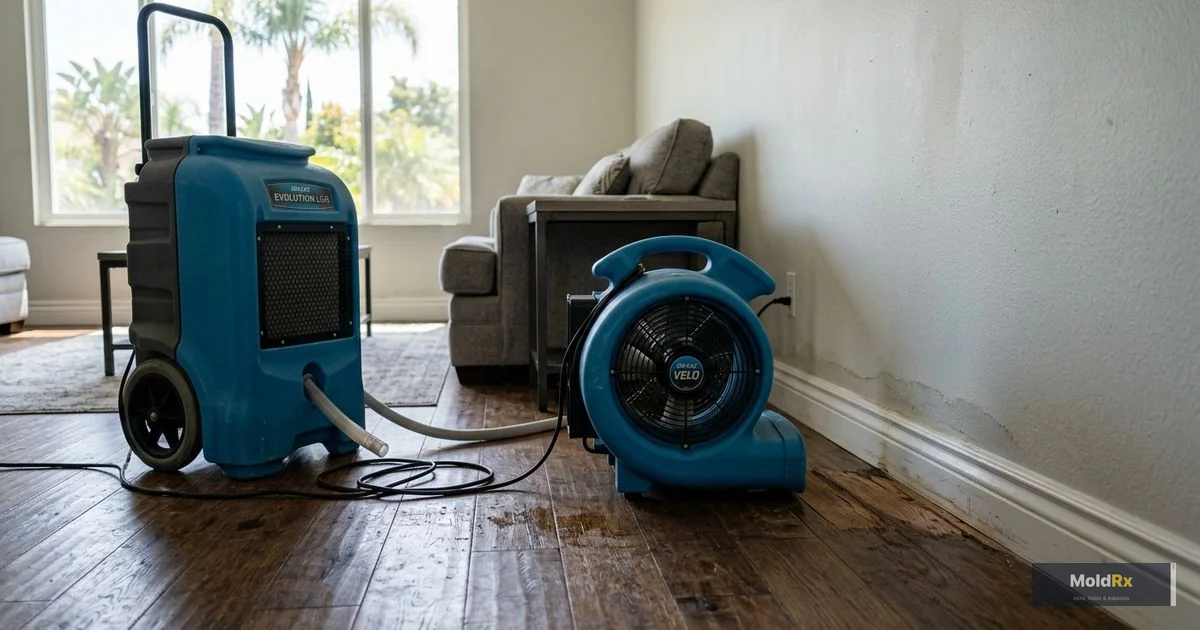
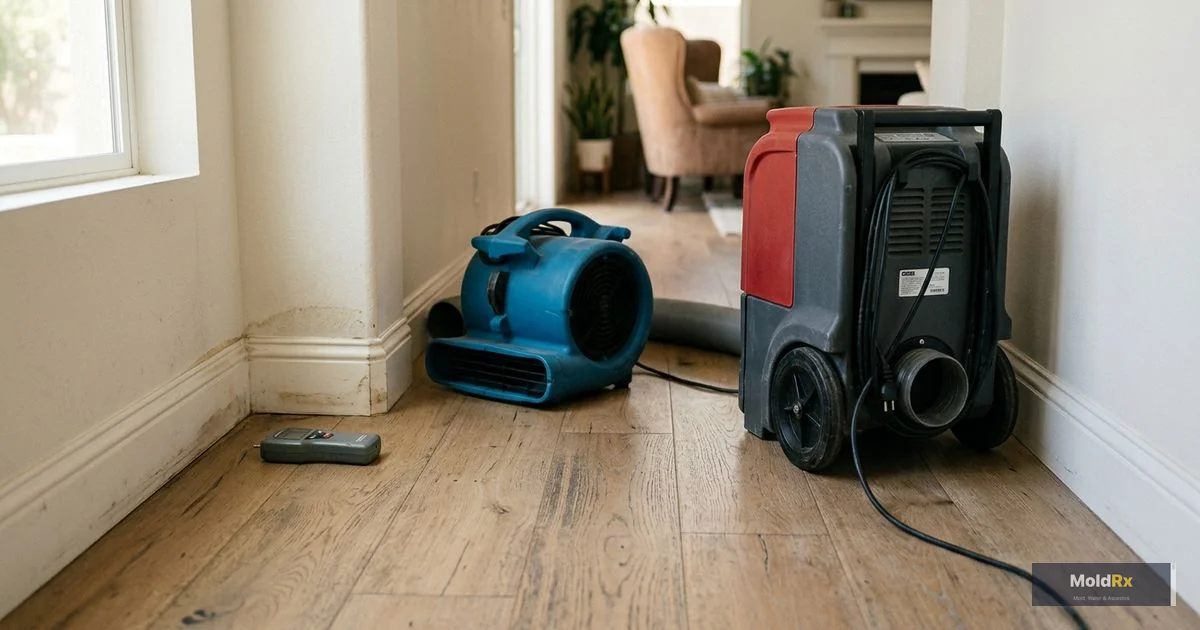
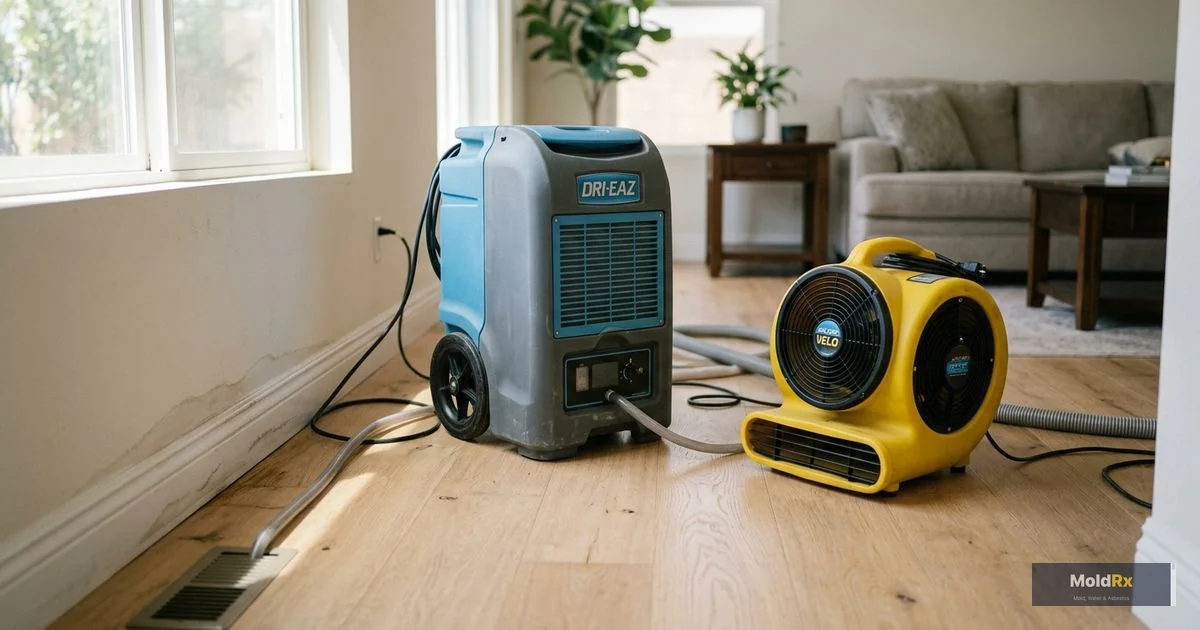
This is where coastal restoration separates from inland work. Newport Beach's ambient humidity means the structure will not dry on its own — ever. Our vetted professionals deploy commercial dehumidifiers calibrated for the local marine climate alongside strategically positioned air movers that create optimal evaporation patterns.
For Class 4 specialty drying situations — and these are extremely common in Newport Beach given the prevalence of hardwood, plaster, concrete, and stone in local construction — heat drying systems, desiccant dehumidifiers, and in-wall drying systems are deployed. Standard LGR dehumidifiers alone cannot penetrate the deep moisture pockets in these materials.
Moisture monitoring is continuous throughout this phase. Professionals take daily readings using penetrating and non-penetrating meters, documenting the drying curve for every affected area. Equipment does not come out until readings confirm the structure has returned to acceptable dry standard — not "close enough," not "it feels dry," but verified against IICRC S500 drying goals with documented data.
Phase 4: Antimicrobial Treatment and Mold Prevention
In Newport Beach's humid coastal environment, mold prevention is not optional — it is a critical component of every water damage restoration. Once structural drying is confirmed, affected areas are treated with professional antimicrobial solutions that inhibit mold and bacterial growth. If any mold growth has already begun — and in Newport Beach, 48 hours of unaddressed moisture is often enough — full IICRC S520 mold remediation protocols are initiated with proper containment, HEPA filtration, and post-remediation verification.
Phase 5: Restoration and Reconstruction
Damaged materials that could not be saved are replaced. Drywall, insulation, flooring, cabinetry, trim — whatever was removed during the restoration process is rebuilt to pre-loss condition or better. For Newport Beach properties with custom finishes, historical architectural elements, or luxury materials, our vetted professionals coordinate with specialty subcontractors to ensure the restoration matches the original quality of your home.
Insurance Documentation and Claims Support
Water damage insurance claims are paperwork-intensive nightmares, and Newport Beach claims tend to be higher-value and more complex than average. Our vetted professionals document everything from the moment they arrive: timestamped photographs of all damage, moisture readings with mapped locations, equipment placement logs, daily drying progress reports, itemized materials lists, and detailed scope-of-work documentation.
This level of documentation is not optional when you are filing a claim on a Newport Beach property. It is the difference between a claim that gets processed and a claim that gets disputed. We have seen too many property owners lose tens of thousands of dollars because a restoration company failed to document properly, leaving the insurance adjuster with no choice but to deny or reduce the claim.
Get Your Free Estimate — Call (888) 609-8907 or Request Online
Newport Beach Neighborhoods We Serve
Our vetted water damage restoration professionals serve every neighborhood and community in Newport Beach, each with its own construction characteristics and water damage risk profile:
- Balboa Island (Main and Little Balboa): 1920s cottages through modern rebuilds, low elevation, high king tide flooding risk, original plumbing in older homes
- Balboa Peninsula: Dense residential mix from 1930s bungalows to contemporary beachfront, slab-on-grade construction, storm surge vulnerability
- Corona del Mar: 1950s-1970s homes with extensive renovations, hillside properties with runoff risk, high-value finishes requiring specialty drying
- Newport Coast: 1990s-2000s luxury construction, complex plumbing systems, tiered hillside lots with drainage challenges
- Lido Isle: Waterfront properties surrounded by the harbor, tidal flooding exposure, salt air corrosion on all exterior systems
- Newport Heights: Mid-century homes with aging plumbing, mature tree roots threatening drain lines
- Eastbluff: 1960s-1970s construction near Upper Newport Bay, groundwater concerns
- Harbor View: Older housing stock with original copper plumbing, proximity to bay channels
- Cameo Shores: Exclusive coastal properties with bluff exposure, storm runoff vulnerability
- Dover Shores: Bayfront and bay-adjacent homes with tidal influence, older construction
We also cover the primary Newport Beach ZIP codes: 92660, 92661, 92662, 92663, and 92657.
Neighboring communities within our service area include Huntington Beach to the northwest, Costa Mesa to the north, Irvine to the northeast, and Laguna Beach to the south.
Why MoldRx Only Sends Vetted Professionals
Here is the problem with water damage restoration in Newport Beach: there is too much money on the table, and too many companies that see a coastal zip code as a blank check. We have seen it repeatedly — companies that dispatch the cheapest available crew, set up equipment with no moisture mapping, leave it running for days longer than necessary, and submit inflated invoices to insurance carriers. The homeowner ends up with a "restored" property that develops mold three months later because the drying was never actually verified.
MoldRx exists because that model is broken. We do not employ restoration crews. We vet them. Every professional we send to your Newport Beach property has been verified for:
- IICRC S500 certification for water damage restoration
- IICRC S520 certification for mold remediation (because in Newport Beach, the two are inseparable)
- Active CSLB contractor licensing appropriate to the scope of work
- Full Cal/OSHA compliance including injury and illness prevention programs
- Documented experience with coastal property restoration — not just a checkbox, but verified project history in salt-air environments
- Proper insurance and bonding
- Equipment inventory sufficient for Class 4 specialty drying scenarios
We do not send whoever is available. We send whoever is qualified. That distinction matters when your Newport Beach property is on the line.
Related Services in Newport Beach
Water damage rarely exists in isolation. In Newport Beach's coastal environment, water events frequently lead to secondary mold growth, and older properties may contain asbestos-containing materials that become disturbed during restoration. We also connect Newport Beach property owners with vetted professionals for:
Learn more about remediation services in Newport Beach
Frequently Asked Questions
How quickly do I need to act on water damage in Newport Beach?
Immediately. This is not an exaggeration. Newport Beach's coastal humidity creates a 24-to-48-hour window before mold colonization begins on wet building materials. Category 2 and Category 3 water events carry even tighter timelines due to bacterial and pathogen risks. Structural damage compounds with every hour water remains in contact with framing, subfloor, and drywall. If you have active water in your property right now, call (888) 609-8907 before reading another word on this page.
What makes coastal water damage restoration different from inland restoration?
Three factors fundamentally change the restoration equation in Newport Beach. First, ambient humidity between 59% and 74% prevents natural drying and requires more aggressive mechanical dehumidification. Second, salt air corrosion means the source of the water damage — corroded pipes, degraded fittings, failed water heaters — is often linked to the coastal environment itself, and if the salt exposure is not addressed during restoration, the problem will recur. Third, the prevalence of Class 4 materials in Newport Beach homes — hardwood, plaster, concrete, stone — demands specialty drying equipment and techniques that many restoration companies do not carry. A crew trained on tract homes in the Inland Empire is not equipped to restore a Balboa Island cottage or a Corona del Mar estate.
Will my homeowner's insurance cover water damage restoration?
Most standard homeowner's policies cover sudden and accidental water damage — burst pipes, appliance failures, supply line breaks. What they typically do not cover is gradual damage from deferred maintenance, water that has been leaking for weeks or months before discovery, and flooding from external sources (which requires separate flood insurance). King tide flooding in Newport Beach is a particularly important coverage gap — many property owners on Balboa Island and the Peninsula assume their standard policy covers tidal flooding, and it does not. Review your policy now, before you need it. Our vetted professionals document every aspect of the restoration to give your claim the strongest possible support.
How long does water damage restoration take in Newport Beach?
Timeline depends on the category, class, and extent of damage. Minor Class 1 or Class 2 events with Category 1 water may be fully restored in 3 to 5 days. Major events — a Class 3 or Class 4 situation with Category 2 or 3 water, which are common in Newport Beach — can require 7 to 14 days of active drying before reconstruction can begin. Reconstruction adds additional time depending on scope. Our vetted professionals will give you a realistic, honest timeline after the initial assessment. We do not rush the drying process to save on equipment rental, and we do not extend it unnecessarily to inflate the invoice.
Can water-damaged hardwood floors and custom finishes be saved?
Often, yes — if addressed within the first 24 to 48 hours. Hardwood floors that are extracted and placed under controlled drying within that window frequently survive without replacement. Once cupping, crowning, or buckling has set in, the calculus changes. Plaster walls, natural stone, and concrete require Class 4 specialty drying but are generally salvageable. Porous materials that have contacted Category 3 water — carpet, padding, upholstery, unsealed drywall — almost always require removal regardless of timing. Our vetted professionals will give you a straight answer about what can be saved and what cannot, with no financial incentive to push replacement when restoration is viable.
What certifications should a Newport Beach water damage restoration company have?
At minimum: IICRC S500 for water damage restoration, IICRC S520 for mold remediation, proper CSLB licensing, and full Cal/OSHA compliance. For Newport Beach properties specifically, you want documented experience with coastal restoration, Class 4 specialty drying equipment, and the ability to handle Category 3 contaminated water events including saltwater intrusion. Every professional MoldRx sends to your property meets all of these requirements. We verify before we dispatch.
Do Not Wait. Water Damage Gets Worse Every Hour.
If water has entered your Newport Beach property — whether it is a burst pipe flooding your Balboa Peninsula home at 3 AM, a king tide pushing harbor water into your Lido Isle garage, a slab leak silently saturating your Corona del Mar foundation, or a water heater failure in your Newport Coast kitchen — the clock is running against you.
Every hour of delay means more saturated material, more structural compromise, and a higher probability of secondary mold growth that transforms a restoration project into a remediation project. The cost goes up. The timeline extends. The health risk increases.
MoldRx only sends vetted, certified professionals who understand Newport Beach properties, coastal construction, and the urgency that water damage demands. No upselling. No inflated invoices. No crews that disappear mid-project. Just qualified professionals, honest assessments, and work done to IICRC S500 standards with full documentation.
Call (888) 609-8907 now for emergency water damage restoration in Newport Beach. Or request your free estimate online — we respond 24/7.