Water Damage Restoration in Norco, CA — MoldRx
24/7 Emergency Water Damage Restoration Professionals Serving Norco and Southwest Riverside County
Water does not wait. Not for morning. Not for a callback. Not for you to find the shutoff valve in a house you have lived in for twenty years but never needed to find it until now. Every hour water sits inside your walls, pooled beneath your flooring, saturating insulation in your crawl space, or wicking upward through your slab, the damage compounds — subfloor assemblies warping beyond salvage, drywall disintegrating from the inside out, structural framing absorbing moisture that will not release without professional extraction, and mold colonies germinating within 24 to 48 hours. In Norco — "Horsetown USA" — where 1960s and 1970s ranch homes on oversized equestrian lots sit on plumbing systems that are 45 to 60 years old, where irrigation lines running to barns, arenas, and pastures crack and leak for days before anyone notices, where the Santa Ana River has carved away bluffs and flooded low-lying properties along River Drive in documented storm after storm, and where summer heat exceeding 100 degrees turns hidden moisture into mold in half the time it would take in a cooler climate — the difference between a manageable restoration and a catastrophic structural rebuild comes down to one thing: how fast professional extraction begins.
This is not a situation that improves with time. It is actively getting worse right now.
MoldRx only sends vetted water damage restoration professionals who follow IICRC S500 standards — the national benchmark for water damage inspection, extraction, drying, and restoration. Our teams arrive with commercial-grade equipment, document everything for your insurance claim from the first minute on-site, and do not leave until moisture readings confirm your property is dry and safe.
Call now for emergency service — (888) 609-8907. Fast response. Professional extraction and drying.
Why Water Damage Is an Emergency in Norco
Norco is not like other Riverside County cities. This community of roughly 27,000 residents occupies approximately 14 square miles along the Santa Ana River, maintaining a distinctly rural, equestrian character despite being surrounded by the urban sprawl of Corona, Eastvale, and Riverside. Properties here are different — large lots, horse facilities, detached barns and tack rooms, arenas, wash racks, irrigation systems feeding pastures, and infrastructure that creates water damage vulnerabilities most suburban homes never face.
The climate drives the urgency. Summer temperatures regularly climb into the mid-90s to low 100s, putting enormous stress on aging plumbing, water heaters, and irrigation systems. Winter brings a concentrated rainy season from November through March that delivers most of the area's 12 to 14 inches of annual rainfall — often in violent, concentrated bursts. When atmospheric river storms hit, as they did in February 2024 and during the devastating December 2025 events that triggered a gubernatorial state of emergency across Riverside County, water overwhelms drainage infrastructure designed for a drier landscape and enters homes, barns, and outbuildings.
Aging Ranch Homes and the Plumbing Time Bomb
Norco was incorporated in 1964, and a significant portion of its housing stock dates from the 1960s through the early 1980s — making these homes 45 to 65 years old. These are not tract homes built on quarter-acre lots. Many are ranch properties on half-acre to multi-acre parcels with unique plumbing configurations: long supply line runs from the street to set-back structures, separate lines to barns and wash racks, irrigation systems with dozens of connection points, and well water systems on some of the more rural properties.
The plumbing materials in these homes tell the story. Galvanized steel supply and drain pipes — standard in 1960s and early 1970s construction — corrode from the inside out over decades, building up mineral scale that restricts flow until the pipe wall thins to the point of failure. Copper supply lines from this era have endured 50-plus years of thermal cycling and mineral exposure. Cast iron waste lines develop internal corrosion and root intrusion at joints. Many properties still have original sewer laterals running from the house to the street — clay pipes that crack, separate, and allow both infiltration and exfiltration.
These systems do not fail gradually. A corroded galvanized fitting lets go at 2 AM and releases 50 gallons per hour into a wall cavity. A copper supply line develops a pinhole behind a bathroom wall and runs undetected for a week. A sewer lateral collapses and backs Category 3 water — raw sewage — into your home through the lowest drain. By the time you see visible evidence, the damage has spread far beyond what is visible.
Properties with detached structures face compounded risk. A burst irrigation line near a barn can saturate soil around foundations for days before anyone notices the pressure drop. A water heater failure in a tack room or workshop may go undetected because no one enters the building daily. In Norco's equestrian community, water damage often begins in places people do not check routinely.
Santa Ana River Flooding and Bluff Erosion
The Santa Ana River defines Norco's northern boundary — and its most serious flood risk. The river has a documented history of catastrophic flooding. The March 1938 flood swept away nearly all bridges across the Santa Ana River, including the Norco Bridge, and forced mass evacuations. Modern flood control infrastructure has reduced but not eliminated the risk.
The Norco Bluffs — the steep embankments along the river above River Drive — have been an ongoing erosion crisis. The original Lower Norco Bluffs Toe Protection project was constructed in 2003 by the U.S. Army Corps of Engineers to protect homes along River Drive from erosional undercutting caused by the river's lateral migration during storm events. At least 80 residences were identified as at risk from this erosion. Then, following a significant storm in early 2024, the bluff behind the stabilization project began eroding from the top — threatening both the Corps project and River Drive itself. A groundbreaking ceremony for the Upper Norco Bluffs Emergency Repair Project was held on October 3, 2024, with the Riverside County Flood Control and Water Conservation District and the City of Norco partnering on an emergency response.
Properties in lower-lying areas near the Santa Ana River and Prado Basin face elevated flood risk during every major storm event. When the river rises, flood water carries Category 3 contamination — sewage, agricultural runoff, sediment, and debris. The city has closed horse trails along River Drive near Hillside Avenue due to slope instability and soil erosion. When the Seven Oaks Dam releases excess water, the City of Norco and CAL FIRE/Riverside County Fire Department have issued advisories warning walkers, hikers, and equestrians to avoid Santa Ana River trails due to swift-moving water and debris fields.
This is not a hypothetical risk. It is an active, documented, and recurring threat to Norco properties.
The 24-48 Hour Mold Window
Mold colonization begins within 24 to 48 hours of moisture exposure. The EPA and IICRC S520 both confirm this timeline. In Norco, where summer interior wall cavities reach 90 degrees or higher, germination can begin in as little as 12 to 18 hours. Stachybotrys chartarum (black mold) can colonize within 48 to 72 hours on saturated drywall and cellulose insulation.
Norco's older ranch homes present particular mold risks. Plaster walls in 1960s homes trap moisture differently than modern drywall. Original hardwood flooring absorbs water and swells, creating pockets of trapped moisture beneath the surface. Crawl spaces under older homes — common in pre-slab-era construction — can harbor standing water and elevated humidity for weeks without visible evidence inside the living space. Detached structures with intermittent ventilation provide exactly the warm, dark, still conditions where mold thrives.
Professional drying within the first 24 hours is the single most effective mold prevention measure. Box fans and open windows cannot produce the airflow volume or dehumidification capacity needed to dry wall cavities, subfloor assemblies, crawl spaces, and structural framing to safe moisture levels. In properties with equestrian outbuildings, hay storage, and organic material in proximity to water-damaged structures, the mold risk multiplies.
Insurance Documentation Starts Immediately
Insurance policies require prompt notification and mitigation. Delayed response can result in denied claims — insurers may argue that secondary damage resulted from failure to mitigate rather than the original event. Professional documentation beginning the moment technicians arrive establishes the timeline insurers need to process your claim.
Most homeowner's policies cover sudden and accidental water damage — burst pipes, failed water heaters, appliance line ruptures. Flood damage from external sources like Santa Ana River overflow typically requires separate flood insurance. Properties near the river and Prado Basin should verify their flood insurance status. Our documentation includes initial loss assessment with timestamped photographs, water category and damage class classification, daily moisture readings, equipment placement records, drying progress reports, and final verification readings. This package gives your adjuster the objective evidence needed to validate the claim.
Water Damage Categories and Classes
The IICRC S500 standard classifies water damage by contamination level and physical scope. Understanding the classification determines safety protocols, equipment requirements, and which materials can be salvaged.
Category 1 (Clean Water) — from a sanitary source like a broken supply line, water heater inlet, or wash rack supply failure. Not an immediate health threat, but degrades to Category 2 or 3 within 48 to 72 hours if not extracted. In Norco's summer heat, this degradation timeline accelerates.
Category 2 (Gray Water) — significant contamination from washing machine overflow, dishwasher discharge, toilet overflow with urine, or irrigation system backflow. Requires antimicrobial treatment. Contacted porous materials — carpet pad, particleboard, unsealed drywall — typically require removal.
Category 3 (Black Water) — the most hazardous. Sewage backups, Santa Ana River floodwater, storm runoff through equestrian areas carrying animal waste, and any standing water present long enough to support pathogens. Flood events in Norco almost always qualify as Category 3. Requires full PPE, removal of all contacted porous materials, and thorough sanitization. There is no drying Category 3 carpet or pad — it gets removed.
The IICRC S500 also classifies scope into four classes: Class 1 (minimal absorption, small area), Class 2 (significant absorption across a room with wall wicking — common in supply line failures), Class 3 (water from overhead saturating walls, ceilings, insulation, and floors), and Class 4 (specialty drying of low-permeability materials like concrete slabs, plaster walls, and hardwood flooring — frequent in Norco's older ranch homes where materials resist standard drying methods).
Our Water Damage Restoration Process
Every water damage event is different, but the IICRC S500 protocol provides the systematic framework our vetted professionals follow on every Norco job.
1. Emergency Response and Assessment — Technicians identify the water source, classify the water category (Category 1 through 3) and damage class (Class 1 through Class 4), and map the full extent of moisture intrusion using thermal imaging and penetrating moisture meters. In Norco, this assessment extends beyond the main residence — crawl spaces, detached structures, barn foundations, and irrigation infrastructure are evaluated for moisture migration.
2. Water Extraction — Standing water is removed immediately using truck-mounted and portable extraction units. Submersible pumps handle deep standing water from flood events. For crawl space scenarios common in older Norco homes, specialized extraction targets water pooled beneath the structure. Every gallon removed directly reduces drying time and limits secondary damage.
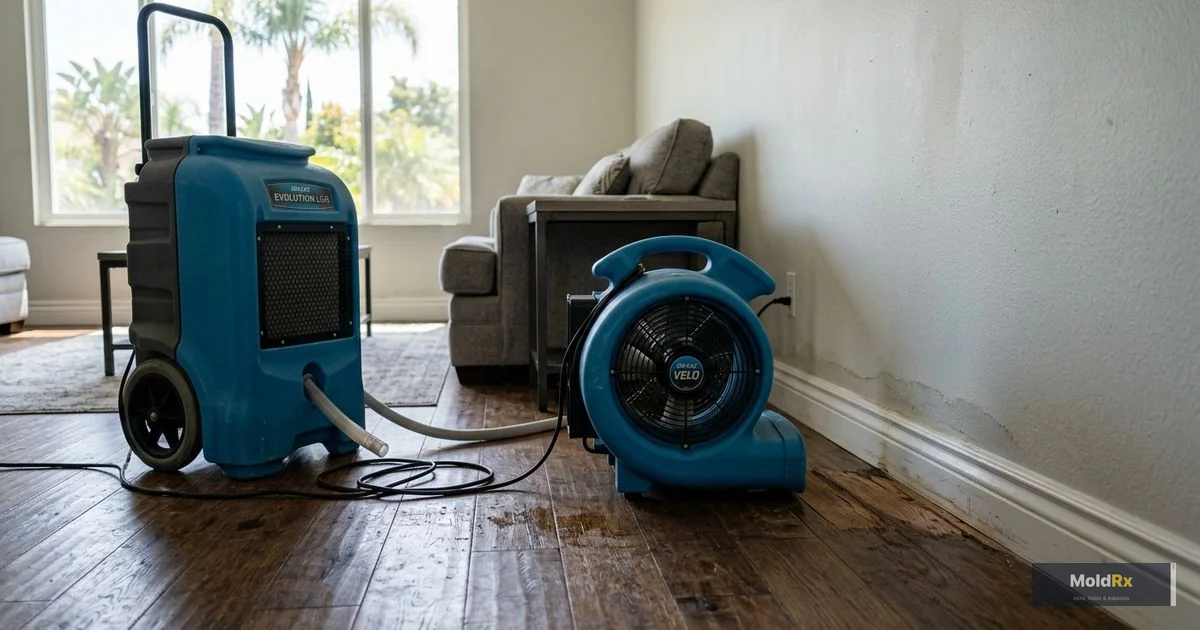
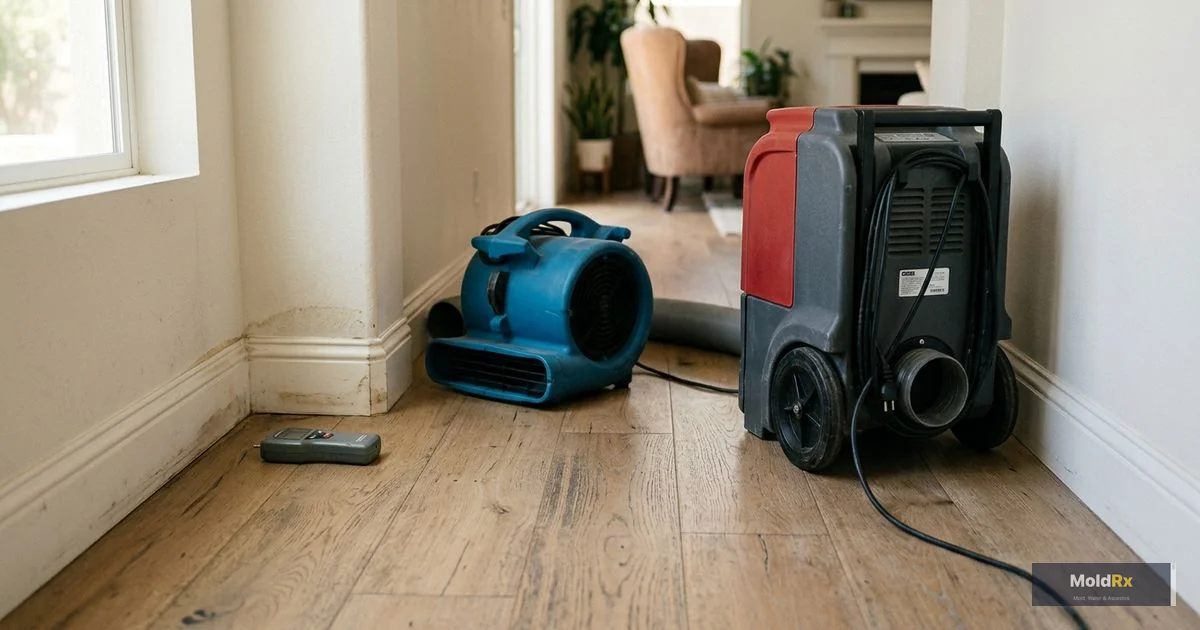
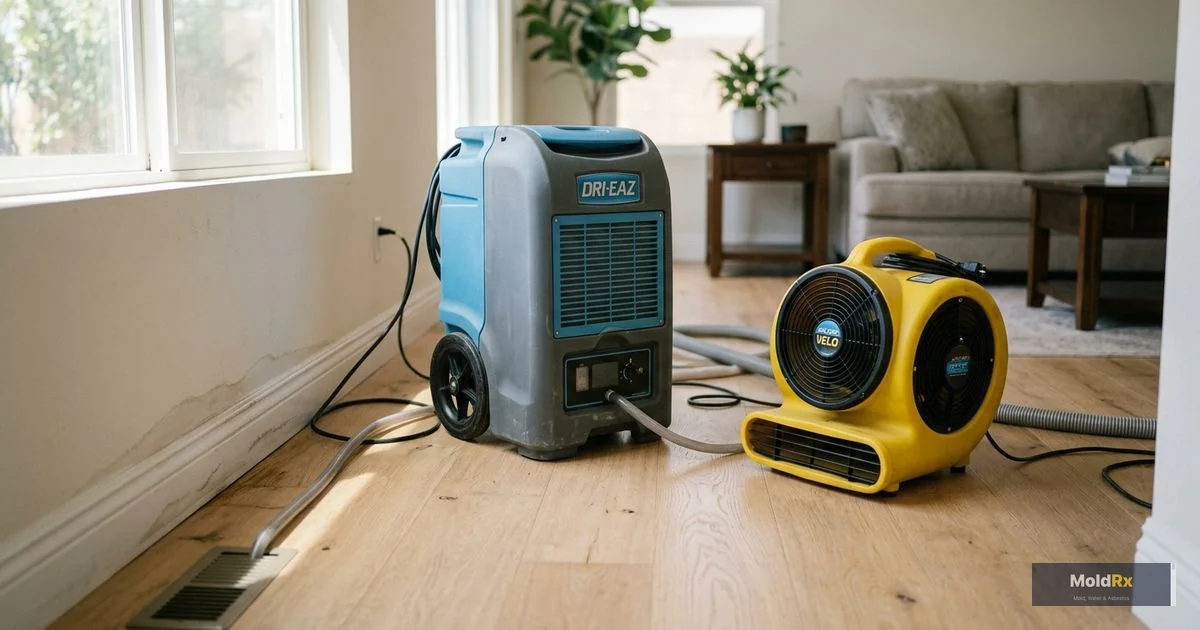
3. Structural Drying and Dehumidification — Commercial-grade dehumidifiers and high-velocity air movers are positioned according to psychrometric calculations calibrated for Inland Empire conditions. Wall cavities receive directed airflow through injection drying systems. Plaster walls in older Norco homes require different drying approaches than modern drywall — lower airflow rates, longer timelines, and careful monitoring to prevent cracking.
4. Moisture Monitoring and Documentation — Daily moisture readings using pin-type and pinless meters, thermo-hygrometers, and thermal imaging. Every reading is logged and provides your insurance adjuster with timestamped evidence that professional drying was performed per IICRC S500 standards.
5. Cleaning, Sanitizing, and Antimicrobial Treatment — Category 2 and Category 3 losses require antimicrobial application to all contacted structural materials. HEPA air scrubbers filter airborne contaminants. In flood events carrying agricultural or equestrian contamination, decontamination protocols follow both IICRC S500 and Cal/OSHA safety requirements.
6. Restoration and Rebuild — From reinstalling baseboards to replacing drywall, plaster, insulation, flooring, and cabinetry. All rebuild work is performed by CSLB-licensed professionals who understand the materials and construction methods used in Norco's diverse housing stock — from 1960s ranch construction to modern development.
Get emergency help now — (888) 609-8907.
What to Do Before We Arrive
- Shut off the water source if you can reach the shutoff safely. For slab leaks or supply line failures, turn off the main supply at the meter. For irrigation line breaks, shut off the irrigation controller and valve.
- Turn off electricity to affected areas at the breaker panel. Never step into standing water near active outlets, panels, or appliances.
- Move valuables to dry ground. Remove documents, photos, electronics, tack, and irreplaceable items from affected areas.
- Document everything with photos and video before moving anything. This evidence is critical for insurance claims.
- Check detached structures. If the water source is an irrigation line or shared supply, inspect barns, tack rooms, and outbuildings for water intrusion.
- Do not use a household vacuum on standing water — shock hazard.
- Do not run fans or your HVAC system. You risk spreading contaminated moisture through ductwork into unaffected areas.
- Do not open windows in summer — Norco's extreme heat accelerates mold germination in saturated materials.
What Sets MoldRx Apart
- Fast emergency response. Water damage is the most time-sensitive restoration service. The faster extraction begins, the more of your property we save.
- IICRC S500-certified professionals only. Every technician holds current IICRC certification and CSLB licensing. These are trained water damage restoration specialists who understand Norco's unique properties — the equestrian infrastructure, the older construction, the crawl spaces, the Santa Ana River flood risk.
- Complete documentation for insurance. From the first photo to the final moisture reading, every step is documented to the standard adjusters require.
- Psychrometric drying science calibrated for Norco's Inland Empire climate — not guesswork. Faster drying times, fewer complications, verifiable results.
- We only send vetted professionals. When we put a team in your home, our reputation goes with them. If something is not right, you call us directly.
Norco Neighborhoods We Serve
MoldRx provides emergency water damage restoration throughout Norco and surrounding southwest Riverside County:
- Horsetown / Central Norco — The heart of Norco's equestrian community. Large-lot ranch properties from the 1960s-1970s with aging plumbing, detached structures, and irrigation systems creating multiple water damage entry points.
- River Drive / Santa Ana River Corridor — Elevated flood risk from river erosion and storm events. The Norco Bluffs erosion directly threatens properties in this area. Flood water here is Category 3.
- Hidden Valley — Established residential area with 1970s-1980s homes. Galvanized and copper plumbing systems reaching end-of-life.
- Norco Hills — Higher-elevation properties with varied construction dates. Drainage challenges during heavy rain as runoff concentrates downslope.
- Lake Norconian — Historic area near the former Lake Norconian resort. Older infrastructure and proximity to water features increase water damage vulnerability.
- Corona Ranchos — Mixed-age equestrian properties near the Corona border with irrigation-intensive lot configurations.
- Hamner Avenue / Sixth Street Corridors — Commercial and residential mixed-use areas with varied construction ages and plumbing conditions.
- Norco College Area — Newer development with modern construction, but still subject to storm flooding and appliance-related water damage.
Coverage extends to all Norco ZIP codes: 92859 and 92860, plus neighboring Corona to the south, Eastvale to the north, Jurupa Valley to the east, and Riverside to the northeast.
Related Services
- Mold Removal in Norco — If the 24-to-48-hour mold window has passed, IICRC S520 remediation is the next step.
- Asbestos Removal in Norco — Licensed abatement required under Cal/OSHA and EPA regulations when asbestos-containing materials are disturbed.
-> Learn more about remediation services in Norco
Frequently Asked Questions
How quickly do you respond to water damage emergencies in Norco?
We treat every call as an emergency because it is one. Norco and southwest Riverside County are in our primary service area. Extraction that starts within the first few hours saves exponentially more material than extraction that starts the next day. The 24-to-48-hour mold window does not pause.
What should I do first when I discover water damage?
Stop the water source if you safely can. Turn off electricity to affected areas at the breaker panel. Do not walk through standing water near active electrical connections. Then call (888) 609-8907 immediately. Every hour matters.
My Norco home was built in the 1960s or 1970s. Am I at higher risk?
Yes. Homes from this era typically have galvanized steel, copper, or cast iron plumbing that is now 50 to 65 years old — far beyond the expected lifespan of these materials. Sewer laterals may be original clay pipe. If you have not repiped, your plumbing system is a known risk. Additionally, pre-1980 construction may contain asbestos in flooring, insulation, or joint compound — materials that require licensed testing and abatement if disturbed during water damage restoration.
Does homeowner's insurance cover water damage restoration?
Most policies cover sudden and accidental water damage — burst pipes, failed water heaters, appliance line ruptures. Flood damage from external sources like the Santa Ana River typically requires separate flood insurance. Properties near the river and Prado Basin should confirm their coverage. We document every aspect of the restoration to support your claim.
My barn or detached structure has water damage. Do you handle that?
Yes. Our vetted professionals restore residential structures, detached living quarters, barns, tack rooms, workshops, and other outbuildings. Norco's equestrian properties often require assessment of multiple structures, irrigation systems, and supply lines beyond the main residence.
How long does water damage restoration take?
A contained Category 1 event in one room may reach dry standard in three to five days. A major event involving multiple rooms or structures, Category 3 water, crawl space saturation, or flood damage can require one to three weeks. Older plaster walls and hardwood floors require longer drying timelines than modern materials. We do not rush drying — incomplete drying leads to mold.
What is the difference between water damage categories?
Category 1 is clean water from a sanitary source. Category 2 is gray water with contaminants that can cause illness. Category 3 is black water — sewage, floodwater, or grossly contaminated water. All categories are defined by the IICRC S500 standard. Santa Ana River flood water and storm runoff through equestrian areas is Category 3.
Why can't I dry water damage myself with fans?
Household fans cannot generate the airflow volume or dehumidification needed to dry wall cavities, crawl spaces, subfloor assemblies, and structural framing to safe moisture levels. In Norco's summer heat, opening windows raises interior temperatures and accelerates mold growth inside saturated materials. Professional equipment is calibrated through psychrometric calculations to achieve evaporation rates that household equipment cannot approach.
Will you work with my insurance adjuster?
Yes. We provide complete technical documentation — photos, moisture readings, drying logs, equipment records, verification data — directly to your adjuster. Our documentation follows IICRC S500 standards, the framework most insurers use to evaluate water damage claims.
Get Water Damage Restoration in Norco Now
Water damage is an active emergency that gets worse every hour. The materials in your home are absorbing water right now. Mold spores are finding the moisture they need. Structural elements are weakening. Whether it is a corroded galvanized pipe rupturing in your 1970s ranch home on a two-acre lot, an irrigation line break saturating the soil around your barn foundation, Santa Ana River floodwater forcing through your property near River Drive, a sewer lateral collapse backing Category 3 water into your home, or a water heater failure flooding a detached structure that no one checks until the weekend — waiting makes everything worse.
MoldRx only sends vetted water damage restoration professionals who follow IICRC S500 standards, carry current CSLB licensing, and understand Norco's unique challenges — the aging equestrian-property infrastructure, the Santa Ana River flood risk, the older construction materials, and the heat-accelerated mold timelines. Every technician complies with Cal/OSHA safety standards and EPA guidelines for contaminated water handling.
Every hour matters. Do not wait.
Call MoldRx now — (888) 609-8907. Every hour matters.