Emergency Water Damage Restoration in Orange, CA — MoldRx
Vetted, IICRC-Certified Water Damage Restoration Specialists Serving Orange and Central Orange County — 24/7 Emergency Response
Water is inside your Orange home right now, and it is destroying your property with every passing minute. Drywall is absorbing moisture upward through capillary action. Hardwood floors in your 1920s Old Towne Craftsman are cupping and swelling beyond the point of no return. Plaster walls that survived a century of Southern California life are disintegrating from the inside. Mold spores — present in every home, every day — will begin colonizing saturated materials within 24 hours. You found this page because you are in crisis. Act now.
MoldRx only sends vetted, IICRC-certified water damage restoration professionals. We do not employ technicians directly. We are not a franchise pumping unqualified labor into your emergency. We are a coordination service built by people with decades of combined remediation experience who saw too many Orange homeowners — especially those with irreplaceable historic properties — get matched with contractors who did not understand the difference between drying a 2020 tract home and saving a 1925 Craftsman bungalow. Every specialist we dispatch holds active certifications, carries proper insurance, and follows IICRC S500 standards for water damage restoration and IICRC S520 protocols for mold remediation.
Do not wait another hour. Request your free estimate now or call (888) 609-8907 for immediate emergency guidance.
Why Orange Is One of the Most Complex Cities in Southern California for Water Damage Restoration
Orange is not a simple city to restore. It is one of the most architecturally diverse municipalities in all of Southern California, and that diversity creates water damage challenges that generic restoration companies routinely mishandle.
The city of approximately 141,000 residents was incorporated in 1888, making it one of the oldest cities in Orange County. At its center sits the Old Towne Orange Historic District — a full square mile listed on the National Register of Historic Places in 1997, the largest such district in the entire state of California. More than 50 architectural styles are represented within Old Towne alone, with construction spanning from the 1870s through the 1940s. Victorian homes, Craftsman bungalows, American Foursquares, Hip Roof Cottages, Spanish Colonial Revivals, Prairie-style residences, and Mediterranean villas stand shoulder to shoulder on streets that predate the automobile.
Then beyond Old Towne, the city fans outward through dramatically different construction eras. The neighborhoods surrounding Chapman University — which itself owns 87 homes in the historic district, 50 of which are officially designated historic structures — blend into postwar tract homes from the 1950s and 1960s in areas like Killefer and Olive. Further out, El Modena — originally settled in the late 19th century by Quakers — retains its own distinct character with homes ranging from early 1900s originals to mid-century construction. Orange Park Acres features rural equestrian properties on larger lots. Santiago Hills and the Orange Hills neighborhoods contain homes from the 1970s through the 1990s built into the elevated terrain east of the city core.
This is not a city where one restoration approach fits all. A water damage specialist who treats a 1920s plaster-and-lath Craftsman the same way they treat a 1985 stucco tract home will destroy the historic property while trying to save it.
The Historic Home Crisis: Pre-1950 Construction and Water
The most urgent and complex water damage emergencies in Orange occur in the city's pre-1950 housing stock — and there is an enormous amount of it. These homes present restoration challenges that most companies are simply not trained to handle:
- Galvanized steel supply lines installed in the 1920s-1940s have a functional lifespan of 40-70 years. Every single one of these pipes in Orange has exceeded its expected service life. They corrode from the inside, restricting flow, building up rust deposits, and eventually developing pinhole leaks or catastrophic failures that flood homes without warning
- Original cast iron drain lines from pre-1950 construction crack, corrode, and allow Category 3 (black water) sewage backups — the most dangerous contamination category under IICRC S500 standards
- Plaster-and-lath walls absorb water differently than modern drywall. Plaster wicks moisture aggressively and retains it deep within the substrate. Improper drying causes plaster to delaminate from lath, crack, and crumble — destroying original walls that are literally irreplaceable
- Pier-and-post foundations common in early Orange homes create air spaces beneath the structure where moisture accumulates, wood framing rots, and mold colonies establish themselves invisibly
- Original hardwood floors — oak, maple, and fir are common in Old Towne — will cup, crown, buckle, and permanently deform if extraction does not begin within hours. Once hardwood gaps or buckles, it must be torn out and replaced. In a home with original 1920s tongue-and-groove oak flooring, that loss is irreversible
- Knob-and-tube wiring present in many pre-1940 homes creates electrocution hazards during water events that modern homes do not present
Chapman University owns 87 properties in the historic district alone. The restoration stakes in Old Towne are not just financial — they are historical. Damage to these structures is damage to California's built heritage.
The Mid-Century and Modern Problem
Orange's postwar neighborhoods — Killefer, Olive, the Chapman University-adjacent areas, portions of El Modena — were built primarily in the 1950s through 1970s. These properties are now 50 to 75 years old, and their plumbing systems are at or past the end of their expected service life.
- Copper supply lines from the 1960s develop pitting corrosion, especially in soil conditions common to Central Orange County, leading to slab leaks that saturate foundations from below and surface as unexplained damp spots rooms away from the actual leak point
- Water heaters in garages and utility closets that have aged past 10-15 years rupture without warning, releasing 40-80 gallons of water in minutes
- Slab-on-grade foundations — the dominant mid-century construction type — trap water beneath flooring with no natural drainage path. Water migrates laterally through concrete, emerging in locations that make it nearly impossible for homeowners to identify the source
The newer construction in Santiago Hills, Orange Hills, and Orange Park Acres faces its own vulnerabilities. Homes built into hillside terrain are subject to storm runoff, soil saturation during heavy rains, and drainage failures that direct water against foundations and into below-grade spaces.
Climate and Geology: The Conditions Working Against Your Home
Orange's semi-arid Mediterranean climate delivers approximately 12.9 inches of annual rainfall, almost entirely concentrated between November and March. When winter storms hit — and recent atmospheric river events in late 2025 triggered state-of-emergency declarations across Orange County — hardened soil from months of dry weather rejects the water. Santiago Creek, which runs through the eastern portion of the city, can overwhelm during heavy rainfall events, and properties in low-lying areas near the creek corridor face direct flood exposure.
Average summer temperatures reach the mid-80s to low 90s. Humidity in Orange typically averages 60-65%, with higher spikes during marine layer incursions from the coast. In a home already compromised by a pipe failure or roof leak, this ambient moisture dramatically accelerates mold colonization. The IICRC S520 standard identifies 60%+ relative humidity as a condition that supports active mold growth on organic building materials — a threshold Orange regularly exceeds.
The combination of aging infrastructure across multiple construction eras, seasonal flood exposure, and humidity levels that favor mold means water damage in Orange is never a minor inconvenience. It is an emergency that demands professionals who understand both the urgency and the extraordinary nuance of this city's built environment.
Emergency Water Damage Categories: What You Are Facing Right Now
The IICRC S500 Standard classifies every water intrusion event by contamination level and drying complexity. Our vetted specialists assess both the moment they arrive at your Orange property.
Water Contamination Categories
Category 1 — Clean Water: Originates from a sanitary source — broken supply lines, sink overflows, toilet tank leaks, melting ice. This is the best-case scenario, but Category 1 water degrades to Category 2 or 3 within 24-48 hours as it contacts building materials, dust, and bacteria. In Orange's older homes with decades of accumulated dust in wall cavities, this degradation can happen even faster.
Category 2 — Gray Water: Contains significant contamination — dishwasher or washing machine discharge, toilet overflows with urine, sump pump failures, and aged Category 1 water. Requires enhanced PPE and containment per IICRC S500 protocols.
Category 3 — Black Water: Grossly contaminated water — sewage backups, rising floodwater from Santiago Creek or storm drains, and any standing water that has remained long enough to support microbial amplification. All affected porous materials must be removed and disposed of. In Orange's Old Towne homes with original cast iron sewer laterals, Category 3 backups are not rare — they are a predictable consequence of 80-to-100-year-old drain infrastructure that was never designed to last this long.
Water Damage Classes
Class 1: Least absorption. Small area affected, low-porosity materials. Simplest drying.
Class 2: Significant absorption. Entire room wet, moisture wicking up walls under 24 inches. Common in Orange slab-on-grade homes where water spreads laterally.
Class 3: Greatest absorption. Water from overhead or saturating walls, ceilings, insulation, and subfloor. Requires the most aggressive drying setup.
Class 4: Specialty drying — hardwood floors, plaster walls, concrete, stone. These materials trap moisture and require extended drying with specialized equipment. This is the dominant scenario in Old Towne Orange. Original plaster walls, hardwood floors, and dense old-growth framing demand technicians who understand historic materials. A generic technician using standard drying protocols on a 1925 Craftsman will destroy the plaster and warp the floors while believing they are doing the job correctly.
The MoldRx Emergency Response Process for Orange
Every water damage event in Orange follows a protocol adapted from IICRC S500 standards and refined for the specific conditions of this city — the historic construction, the aging mid-century plumbing, the Santiago Creek flood corridor, and the coastal-influenced humidity.
Step 1: Emergency Contact and Triage (Immediate)
When you call (888) 609-8907 or submit an emergency estimate request, we begin triage immediately. What is the water source? Is it still active? How long has water been present? What era is your home — pre-1950, mid-century, or modern construction? What type of flooring, walls, and foundation? Are there vulnerable occupants — elderly, children, immunocompromised? The answers determine which vetted specialist we dispatch and what equipment they bring. An Old Towne Victorian demands a different response than a 1975 ranch in Santiago Hills.
Step 2: Rapid Assessment and Documentation (Within Hours)
Our vetted professionals arrive with professional-grade moisture detection — infrared thermal cameras, penetrating and non-penetrating moisture meters, thermo-hygrometers. In Orange's older homes, water never stays where you can see it. It travels through plaster walls, migrates along original wood framing, follows pier-and-post foundation channels, and accumulates in spaces hidden behind a century of construction layers. The assessment maps the full extent of the damage — not just the visible wet spot.
Everything is photographed and documented from arrival. Moisture readings are logged. Water category and damage class are formally established. This documentation is built to insurance-adjuster specifications.
Step 3: Water Extraction (Same Day — No Exceptions)
Standing water is removed immediately using truck-mounted and portable extraction units. For Old Towne properties with original hardwood floors, specialized low-pressure extraction protects the wood while removing water. For mid-century slab-on-grade homes, extraction includes pulling water from beneath floating floors, saturated carpet padding, and delaminated vinyl.
In Category 3 events — sewage backups from deteriorated cast iron lines are the most common cause in Orange — all contaminated porous materials are removed and disposed of per Cal/OSHA and EPA hazardous material handling requirements.
Step 4: Structural Drying and Dehumidification (Multi-Day)
This is where Orange's complexity demands genuine expertise. Drying a plaster-and-lath wall is fundamentally different from drying modern drywall. Plaster requires slower, more controlled moisture removal to prevent cracking and delamination. Hardwood floors require carefully balanced temperature and humidity to prevent cupping on one side and crowning on the other. Dense old-growth framing takes longer to release moisture than modern engineered lumber.
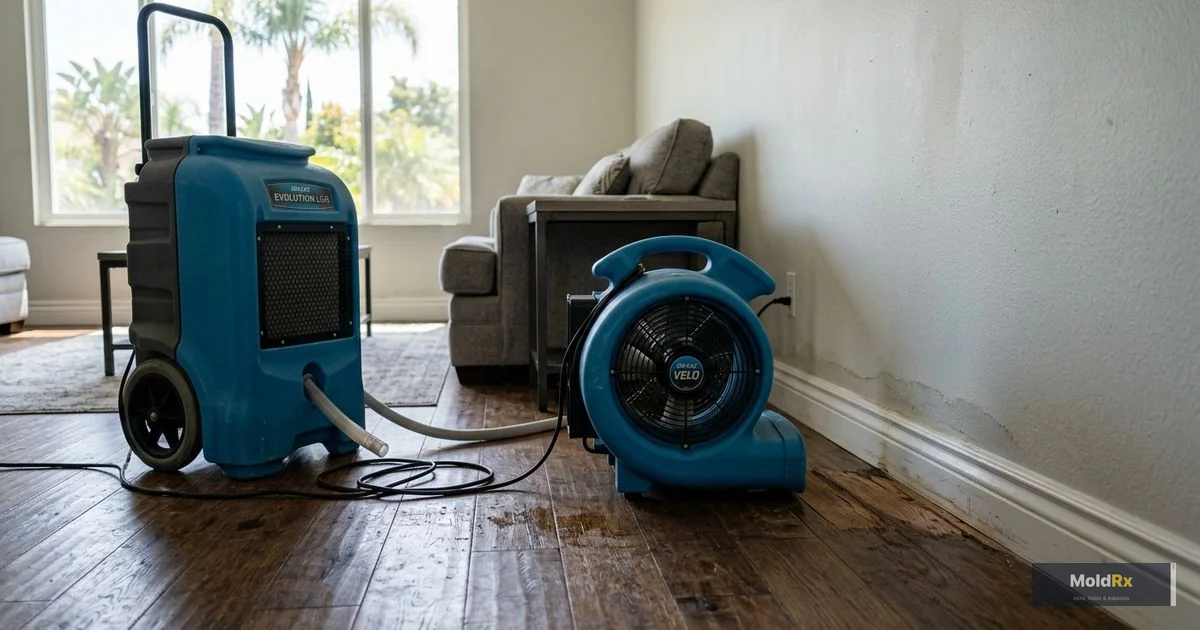
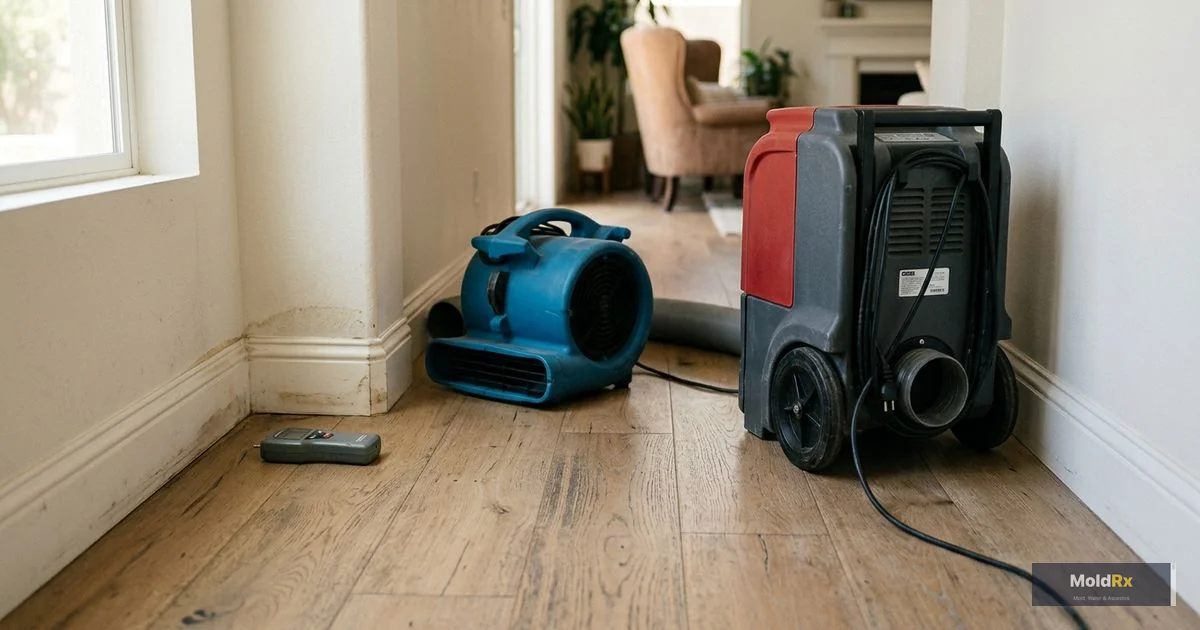
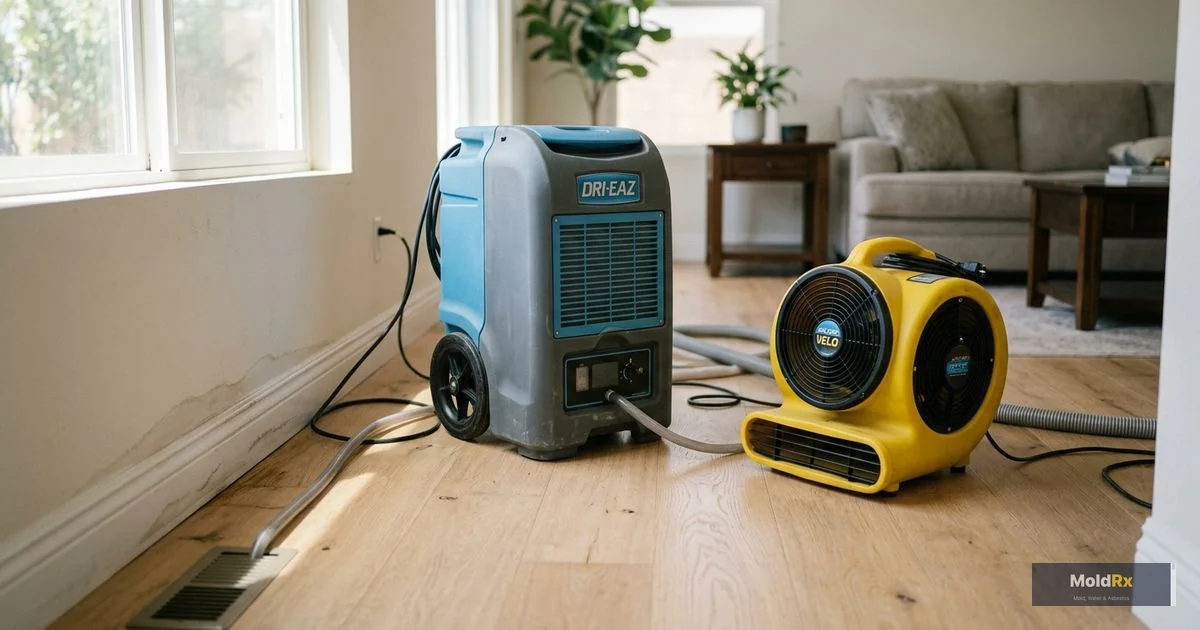
Our vetted specialists deploy commercial-grade low-grain refrigerant (LGR) dehumidifiers and high-velocity air movers in configurations calibrated for the specific construction era of your Orange home. For Class 4 situations — original hardwood, plaster, concrete — desiccant dehumidifiers, heat drying systems, or injectidry panels may be required. Moisture levels are monitored at least daily until all materials reach equilibrium moisture content for this climate zone per IICRC S500 standards.
Step 5: Antimicrobial Treatment and Mold Prevention
Given Orange's humidity profile and the IICRC S520 standard for mold remediation, antimicrobial treatment of all affected surfaces is a non-negotiable step. Mold begins colonizing within 24-48 hours. In older homes with decades of organic dust in wall cavities and beneath flooring, the food source for mold is abundant and the colonization window is even shorter. Our process treats affected areas proactively.
Step 6: Restoration and Rebuild
Damaged materials are repaired or replaced with attention to the construction era of your home. In Old Towne properties, this means matching original plaster, preserving trim profiles, and using historically appropriate materials where possible. In mid-century homes, it means modern materials installed to current code. The goal is returning your Orange home to its pre-damage condition while also identifying and flagging the infrastructure failure that caused the event.
Common Water Damage Emergencies in Orange
Our vetted specialists respond to these scenarios across Orange neighborhoods every week:
Galvanized Pipe Failures in Old Towne and Pre-1950 Homes Original galvanized supply lines — some approaching or exceeding 100 years of age in the oldest Old Towne properties — corrode, restrict, and eventually rupture. A single failed galvanized line can flood an entire floor of a historic home in under an hour. The water travels along original wood framing and lath channels, saturating walls and ceilings far from the failure point.
Slab Leaks in Mid-Century Neighborhoods Copper supply lines beneath 1950s-1970s slab foundations develop pitting corrosion from decades of soil contact and aggressive water chemistry. Water saturates the concrete slab and migrates laterally, emerging as mysterious damp spots in rooms nowhere near the actual leak. Thousands of gallons can pass through a slab leak before the homeowner notices.
Sewage Backups from Century-Old Cast Iron Drain Lines Original cast iron sewer laterals in pre-1950 Orange homes crack, corrode, collapse, and become root-invaded. Raw sewage backs up through floor drains, toilets, and tub drains. This is a Category 3 emergency under IICRC S500 requiring immediate professional response per EPA and Cal/OSHA protocols. No homeowner should attempt Category 3 cleanup.
Storm Flooding and Santiago Creek Overflow Properties in low-lying areas near Santiago Creek and in eastern Orange face direct flood exposure during heavy winter storms. The atmospheric river events of late 2025 demonstrated that Orange County's flood risk is not hypothetical — it triggered emergency declarations across the county. Flash flooding from hardened soil and overwhelmed drainage systems pushes contaminated stormwater into homes.
Water Heater Ruptures Tank water heaters in garages and utility closets that are 10-15+ years old rust through and release their full 40-80 gallon capacity in minutes. In mid-century Orange homes with slab-on-grade construction, this water spreads rapidly under flooring and into adjacent rooms.
Roof Failures on Aging Structures Old Towne homes with original or poorly maintained roofing systems — some dating to the 1930s and 1940s — allow water intrusion during winter storms. Water enters through compromised flashing, deteriorated underlayment, and cracked clay or composition tiles, saturating attic insulation, ceiling joists, and plaster ceilings.
What You Should Do RIGHT NOW
If you are reading this during an active water emergency in your Orange home, take these steps immediately:
- Shut off the water source if you can identify it and safely reach the valve. Most Orange homes have a main shutoff near the front of the property at the meter box. For older homes, the valve may be corroded or difficult to turn — if you cannot close it, call the City of Orange water department.
- Turn off electricity to affected areas at the breaker box — but only if you can reach it safely without standing in water. Homes with knob-and-tube wiring present elevated electrocution risk during water events.
- Do NOT use household fans or your HVAC system to try to dry the area. Residential fans cannot achieve structural drying, and your HVAC will spread moisture and contaminants throughout the entire home.
- Do NOT attempt to pull up original hardwood floors or tear into plaster walls yourself. You will cause more damage than the water did. Historic materials require specific drying protocols, not demolition.
- Do NOT attempt Category 3 cleanup if you suspect sewage or contaminated floodwater. This requires proper PPE, containment, and biohazard handling per EPA and IICRC standards.
- Document everything with photos and video before touching anything — your insurance adjuster needs to see original conditions.
- Call (888) 609-8907 or request an emergency estimate immediately so we can dispatch a vetted, IICRC-certified specialist to your Orange property.
The difference between saving and losing your Orange home's original materials — plaster, hardwood, framing — is measured in hours. Not days. Hours.
Orange Neighborhoods and Areas We Serve
MoldRx dispatches vetted water damage restoration specialists throughout all of Orange, including ZIP codes 92856, 92857, 92859, 92862, 92863, 92864, 92865, 92866, 92867, and 92868. We serve homeowners in Old Towne Orange, the Chapman University Historic District, El Modena, Olive, Killefer, Orange Park Acres, Santiago Hills, Orange Hills, and every neighborhood in between.
We also respond to water damage emergencies in neighboring Central Orange County communities including Tustin to the south, Santa Ana to the southwest, Anaheim to the north, Villa Park to the east, and Garden Grove to the west — all within our primary service area.
Local Compliance and Contractor Standards
All vetted specialists dispatched by MoldRx to Orange properties hold valid CSLB (Contractors State License Board) licenses as required by California law. Restoration work is performed in compliance with Cal/OSHA workplace safety standards, EPA environmental regulations for handling contaminated materials, and IICRC S500/S520 industry best practices. For work within the Old Towne Historic District, specialists understand the city's historic preservation guidelines and the Secretary of the Interior's Standards for the Treatment of Historic Properties.
Related Services in Orange
Water damage rarely exists in isolation — especially in Orange, where the age of the housing stock means asbestos-containing materials are frequently present in pre-1980 construction. When water damage requires demolition of flooring, wall materials, or pipe insulation, asbestos testing must be performed before any disturbance to comply with EPA NESHAP regulations and Cal/OSHA requirements.
MoldRx also coordinates vetted specialists for Mold Removal in Orange, Asbestos Removal in Orange.
Learn more about all remediation services in Orange
Frequently Asked Questions
How quickly can you get someone to my Orange home?
This is an emergency service. When you call (888) 609-8907 or submit an estimate request, we begin dispatching immediately. Our vetted specialists are positioned throughout Central Orange County and can typically reach Orange properties within hours of initial contact. For Old Towne historic homes, we prioritize dispatching specialists with demonstrated experience in historic material restoration — because sending the wrong person to a 1920s Craftsman is worse than sending no one at all.
My home is in the Old Towne Historic District. Will restoration damage the original materials?
This is exactly why we exist. Generic restoration companies use aggressive drying protocols designed for modern construction — protocols that crack plaster, warp original hardwood, and damage irreplaceable trim and millwork. Our vetted specialists understand Class 4 drying requirements for historic materials: slower controlled drying for plaster, carefully balanced humidity for hardwood, and preservation-conscious approaches that comply with historic district guidelines. Not every specialist we work with is qualified for Old Towne properties, and we will never send one who is not.
What should I tell my insurance company?
Document everything with photos and video before any cleanup begins. Note the time you discovered the water, the apparent source, and the extent of visible damage. File your claim immediately. Our vetted specialists generate comprehensive documentation — moisture mapping, photo evidence, category and class determinations, daily drying logs — specifically formatted for insurance adjuster review.
Will my homeowner's insurance cover this?
Most standard policies cover sudden and accidental water damage — burst pipes, appliance failures, water heater ruptures. Gradual damage from deferred maintenance, ground seepage, and external flooding typically require separate coverage. Sewage backups may require a separate rider. We provide the documentation your insurer needs to process your claim.
How long does water damage restoration take in Orange?
Timeline depends entirely on the category, class, and construction era of your home. Minor Category 1, Class 1-2 events in modern construction may be dried and restored in 3-5 days. Class 3 scenarios requiring extensive structural drying take 1-2 weeks. Class 4 situations in Old Towne historic homes — plaster walls, hardwood floors, dense framing — can require 2-3 weeks because these materials demand slower, more careful drying. Category 3 events with material removal and rebuild can extend further. We give you a realistic timeline after assessment, not an optimistic guess.
Can water-damaged materials in my historic home be saved?
It depends entirely on how fast you act. Original hardwood floors, plaster walls, and solid wood trim can often be saved if professional extraction and drying begin within 24-48 hours of a Category 1 event. Once hardwood buckles, plaster delaminates, or wood framing begins to rot, those materials must be replaced — and in a historic home, replacement is never as good as the original. Materials exposed to Category 2 or Category 3 water, or anything showing mold growth, generally must be removed. Speed is the only variable you still control.
Is mold guaranteed after water damage in Orange?
Not if you act fast enough. Mold requires moisture, organic material, and time — typically 24-48 hours under favorable conditions. Orange's 60-65% baseline humidity and warm temperatures create favorable conditions much of the year. In older homes with abundant organic material — original wood framing, plaster, paper-backed insulation — the colonization window is at its narrowest. Professional extraction and structural drying within the first day dramatically reduces mold risk. Every hour you wait increases the probability.
Stop the Damage Now — Call MoldRx
Every hour that water sits in your Orange home is an hour of compounding destruction. The plaster wall that could have been saved is now delaminating. The original hardwood floor that survived a century is now buckling beyond repair. The restoration that could have taken five days is becoming a three-week demolition and rebuild.
Orange is not a city where you can afford to wait — and it is not a city where you can afford to hire the wrong company. The difference between a contractor who understands how to dry a 1925 Craftsman bungalow and one who treats every home like a 2015 production build is the difference between preservation and destruction.
MoldRx only sends vetted, IICRC-certified professionals who follow IICRC S500 and S520 standards, carry proper CSLB licensing, and comply with EPA and Cal/OSHA regulations. We match your specific emergency — your specific home, your specific construction era, your specific damage category — with the specific specialist equipped to handle it.
Your Orange home cannot wait. Request your free emergency estimate now or call (888) 609-8907 for immediate 24/7 guidance. The best time to call was when the water first appeared. The second best time is right now.