Emergency Water Damage Restoration in Palm Desert, CA — MoldRx
MoldRx only sends vetted, IICRC S500-certified water damage restoration specialists to Palm Desert properties. Call (888) 609-8907 now — every minute counts.
Water is actively destroying your Palm Desert property. Not gradually. Not eventually. Right now. Behind the drywall, beneath the tile, inside the wall cavities of your home — moisture is wicking through every porous material it touches, warping substrates, saturating insulation, and generating the exact microbial conditions that turn a recoverable emergency into a full-scale catastrophe. In Palm Desert — where summer interior wall temperatures exceed 140 degrees, approximately 34% of homes sit vacant for months at a time, and the hard-packed desert floor rejects water instead of absorbing it — the destruction timeline is faster and more punishing than almost anywhere else in Southern California.
You found this page because something has gone wrong. Here is the reality: the difference between a contained restoration and a gut-and-rebuild measured in tens of thousands of dollars comes down to hours, not days. Stop reading and call (888) 609-8907 if water is actively spreading in your home.
If you need to understand what is happening inside your property and what the restoration process looks like, keep reading.
Why Water Damage in Palm Desert Is a Genuine Emergency
Palm Desert is the geographic and commercial center of the Coachella Valley — a city of approximately 54,000 permanent residents that swells dramatically during the winter season and empties out during the brutal summer months. It is surrounded by desert hardpan, bisected by monsoon-prone washes, and home to one of the highest concentrations of country clubs, pools, and water features in Riverside County. When water intrusion occurs inside a Palm Desert home, the physics of destruction do not follow the rules that apply in coastal or temperate climates.
The Desert Heat Paradox
Most people assume that Palm Desert's extreme aridity helps water damage resolve itself. The opposite is true. Extreme heat supercharges microbial colonization. According to IICRC S520 guidelines, mold colonization can initiate within 24 to 48 hours of water intrusion under favorable conditions. Inside a Palm Desert wall cavity during summer — where trapped air temperatures can reach 140 degrees with moisture present — "favorable conditions" is a drastic understatement. You are looking at potential mold colonization in as little as 12 to 18 hours.
The surface deception compounds the problem. Palm Desert's single-digit relative humidity pulls moisture from exposed surfaces rapidly, making countertops and flooring feel dry while the subfloor, wall cavities, insulation batting, and structural framing behind them remain fully saturated. Homeowners touch the tile, feel nothing, and assume the problem has resolved. Weeks later, the smell arrives. By then, the remediation scope has multiplied several times over.
The 34% Vacancy Factor
This is the statistic that makes Palm Desert one of the highest-risk cities for undetected water damage in all of Riverside County. Census housing data indicates that approximately 34% of Palm Desert homes are seasonally vacant — snowbird retreats, second homes, country club residences occupied from November through April and locked up for the remaining five to seven months. ZIP code 92260 carries a vacancy rate of nearly 33%. ZIP code 92211 sits at approximately 32%. Across both zones, roughly one in three homes is unmonitored during the most dangerous period of the year: summer monsoon season and the extreme heat that follows.
A supply line fails in June. A pool recirculation valve cracks in July. A monsoon wash pushes stormwater through a foundation gap in August. Nobody is there to see it. Nobody is there to hear it. Nobody is there to shut it off. The water sits. For days. For weeks. Sometimes for months.
When the homeowner returns in October or November, they walk into Category 3 contamination — what the IICRC S500 standard classifies as grossly contaminated water containing potentially harmful bacteria, fungi, and other pathogenic agents. What started as a clean Category 1 supply line break has degraded through Category 2 gray water into the worst-case scenario. The entire affected zone now requires full containment, demolition of all porous materials, antimicrobial treatment, and HEPA-filtered negative air throughout the restoration process.
This scenario plays out across Palm Desert every single year. It is preventable — but only if the initial water intrusion is caught and addressed immediately.
Do not let a manageable pipe break become a biohazard. Request your free emergency estimate now.
Water Damage Categories and Classes: What Is Happening Inside Your Palm Desert Home
Understanding the classification system used by IICRC S500-certified restoration professionals is not academic — it directly determines the scope, urgency, and method of restoration your property requires. Every water damage event in Palm Desert is classified along two axes.
Water Damage Categories (Contamination Level)
-
Category 1 — Clean Water. Originates from a sanitary source: broken supply lines, toilet tank failures (not bowl), appliance feed lines, melting ice, or rainwater through an intact roof. Poses no substantial health risk from contact. This is the best-case scenario — and it is temporary. In Palm Desert's heat, Category 1 water degrades to Category 2 within 24 to 48 hours if not extracted.
-
Category 2 — Gray Water. Contains significant contamination that may cause discomfort or illness if contacted or ingested. Sources include dishwasher discharge, washing machine overflow, toilet overflow with urine (no feces), and degraded Category 1 water. Requires additional PPE and antimicrobial protocols during restoration.
-
Category 3 — Black Water. Grossly contaminated. Sources include sewage backup, rising floodwater from monsoon wash overflow, groundwater intrusion, and any Category 1 or 2 water that has stagnated long enough to support pathogenic microbial growth. In Palm Desert — particularly in seasonally vacant homes where water sits undetected through the summer — Category 3 situations are alarmingly common. Requires full containment, removal and disposal of all affected porous materials, HEPA air filtration, and antimicrobial treatment per IICRC S500 and EPA indoor air quality guidelines.
Water Damage Classes (Evaporation and Drying Difficulty)
- Class 1 — Least amount of absorption. Affects only a small area with materials that have low porosity (concrete, stone). Minimal evaporation load.
- Class 2 — Significant absorption. Water has wicked into structural materials — carpet and cushion, drywall up to 24 inches, and similar porous materials. Moderate evaporation load.
- Class 3 — Greatest absorption. Water may have come from overhead or saturated walls floor-to-ceiling. Insulation, carpet, cushion, and substrates are fully saturated. High evaporation load.
- Class 4 — Specialty drying. Involves materials with very low permeance or porosity: hardwood flooring, plaster walls, concrete, natural stone, ceramic tile over concrete substrate — all of which are common across Palm Desert's wide range of residential construction. Requires specialized low-grain-refrigerant dehumidification and extended drying time.
Palm Desert's housing stock spans five decades — from mid-century ranch homes and 1970s country club condos through 1990s custom estates to newer construction in master-planned communities like Sun City Palm Desert. Whether your property features original terrazzo flooring, imported travertine, engineered hardwood, or standard builder-grade materials, the drying classification matters. Class 4 specialty drying is far more common in Palm Desert than many homeowners expect, and getting the protocol wrong means either destroying materials that could have been saved or sealing moisture inside materials that only appear dry on the surface.
What Causes Water Damage in Palm Desert
The sources of water intrusion in Palm Desert are specific to this community's geography, construction eras, climate, and lifestyle. Our vetted specialists see the same failure patterns repeatedly.
Aging Plumbing Systems and Slab Leaks
Palm Desert experienced its primary residential development in multiple waves: the original country club era of the 1960s and 1970s (Palm Desert Country Club, Monterey Country Club, Chaparral Country Club), the expansion of the 1980s and 1990s (Indian Ridge, Palm Valley Country Club, Ironwood Country Club), and the newer master-planned communities of the 2000s (Sun City Palm Desert, portions of the Highway 111 corridor). Properties from the earlier waves contain copper supply lines with 40 to 60 years of mineral deposit buildup from the Coachella Valley's notoriously hard water — among the hardest municipal water in Southern California.
Slab leaks are endemic throughout the Coachella Valley. The extreme thermal cycling — where temperatures can swing 40 degrees between day and night during the shoulder seasons — stresses pipe fittings, solder joints, and supply line connections embedded in concrete slab foundations. Repeated expansion and contraction of the soil and slab eventually fatigues the copper lines. When they fail, water flows under the slab, migrates through the foundation, and wicks up into wall assemblies and flooring from below. These failures are insidious because they often produce no visible water until the structural damage is already severe.
Pool, Spa, and Water Feature Failures
Palm Desert has one of the highest pool-per-capita ratios in Riverside County. Country club communities, gated enclaves, and standard residential neighborhoods alike feature pools, spas, fountains, misting systems, and decorative water elements. The equipment that drives these systems — pumps, heaters, filters, recirculation lines, automated chemical feeders — operates under extreme thermal stress year-round. Equipment failures and plumbing connection fractures can discharge thousands of gallons before anyone notices, especially in seasonally vacant properties where pool systems continue running on automation with no human oversight for months.
Monsoon Season and Desert Wash Flooding
July through September brings the North American Monsoon to the Coachella Valley. These are not gentle rain events. They are violent, fast-moving thunderstorms that can dump over an inch of rain in under an hour onto desert hardpan that absorbs almost nothing. Runoff concentrates instantly into desert washes and drainage channels.
In July 2024, a single storm dropped 1.34 inches on Palm Desert, eroding the wash near Haystack and Heliotrope and triggering emergency repairs costing approximately $200,000 for the Haystack Channel alone. Tropical Storm Hilary in August 2023 flooded Freedom Park — the baseball field and soccer park remained underwater for weeks. The February 2025 storm brought flooding into garages and around homes across the valley. The City of Palm Desert's Mountain View Retention Basin project exists specifically because the 77700 block of Mountain View accumulates up to four feet of standing water during heavy storms, overwhelming the existing underground retention chambers.
When floodwater enters a home, it is immediately classified as Category 3 — black water under IICRC S500 standards. It carries soil bacteria, petrochemicals from road surfaces, pesticide residue, and potentially sewage from overwhelmed municipal systems. There is no drying this out with fans. There is no waiting to see if it gets better. It requires immediate professional intervention.
HVAC Condensation and Mechanical Failures
Air conditioning systems in Palm Desert run 8 to 10 months per year, many continuously during summer. Condensate drain lines clog. Drain pans overflow. Evaporator coils develop leaks. Because HVAC systems are typically located in attics, closets, or mechanical rooms that homeowners rarely inspect, these failures can saturate surrounding materials for days or weeks before detection — creating Class 3 or Class 4 damage in concealed spaces that may not become visible until the problem is extensive.
Irrigation System Failures
The landscaping that distinguishes Palm Desert's country club communities from the surrounding desert requires extensive irrigation infrastructure. Buried supply lines, drip systems, sprinkler valves, and automatic controllers operate under pressure daily. When a line fractures underground or a valve fails to close, water can flow for hours — saturating foundation perimeters, migrating under slabs, and wicking into wall assemblies from below. In a city where water conservation is a constant concern and rates continue to rise, these failures are doubly destructive: property damage and significant water waste simultaneously.
Water Heater Failures
The Coachella Valley's hard water shortens water heater lifespan dramatically. Mineral scale accumulates inside tanks year after year, reducing efficiency, stressing components, and eventually causing catastrophic tank failure. A 50-gallon water heater that ruptures in a hallway closet or garage can saturate an entire floor zone within hours. In older Palm Desert homes where water heaters may be original or well past their expected service life, this is one of the most common single-source water damage events.
How MoldRx-Vetted Specialists Restore Palm Desert Properties
MoldRx only sends IICRC S500 and IICRC S520-certified restoration professionals to Palm Desert homes. Every specialist in our network carries active certifications, appropriate CSLB (California Contractors State License Board) licensing, and operates in full compliance with Cal/OSHA safety regulations and EPA indoor air quality standards. This is non-negotiable. Your property deserves professionals who hold the credentials this work demands — not a crew with a truck and a wet-vac.
Phase 1: Emergency Response and Containment (Hours 0-4)
The first four hours after water intrusion are the most critical. Our vetted specialists respond to Palm Desert emergencies with:
- Source identification and shutoff — stopping the water before anything else
- Contamination category assessment — determining whether you are dealing with Category 1, 2, or 3 water, because the answer changes everything about the restoration protocol
- Commercial-grade water extraction — truck-mounted and portable extraction units rated for high-volume removal, not residential-grade equipment
- Containment of affected areas — particularly critical in Category 2 and Category 3 events to prevent cross-contamination of unaffected spaces
- Emergency board-up and tarping if the intrusion source is structural (roof, window, or wall breach from storm damage)
Phase 2: Moisture Mapping and Damage Classification (Hours 4-12)
Once standing water is removed, the real assessment begins. Our specialists use:
- Thermal imaging cameras to identify moisture behind walls, under flooring, and in ceiling cavities without destructive investigation
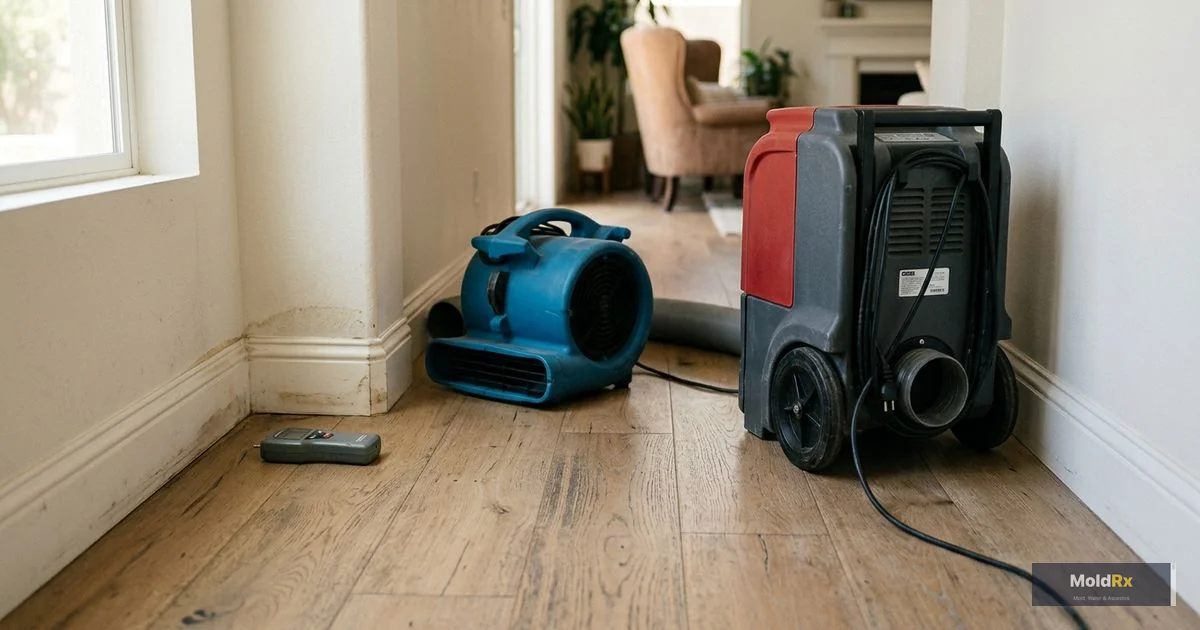
- Pin and pinless moisture meters to measure moisture content in structural materials and map the full extent of water migration
- Psychrometric calculations to establish baseline conditions specific to Palm Desert's desert environment — because drying targets and equipment placement depend on ambient temperature, relative humidity, and vapor pressure
Every affected zone is classified by IICRC S500 Class (1-4) to determine the correct drying protocol. Whether your Palm Desert home is a 1970s country club condo with original construction or a 2005 custom estate with specialty finishes, the classification drives the entire restoration strategy.
Phase 3: Structural Drying and Dehumidification (Days 1-5+)
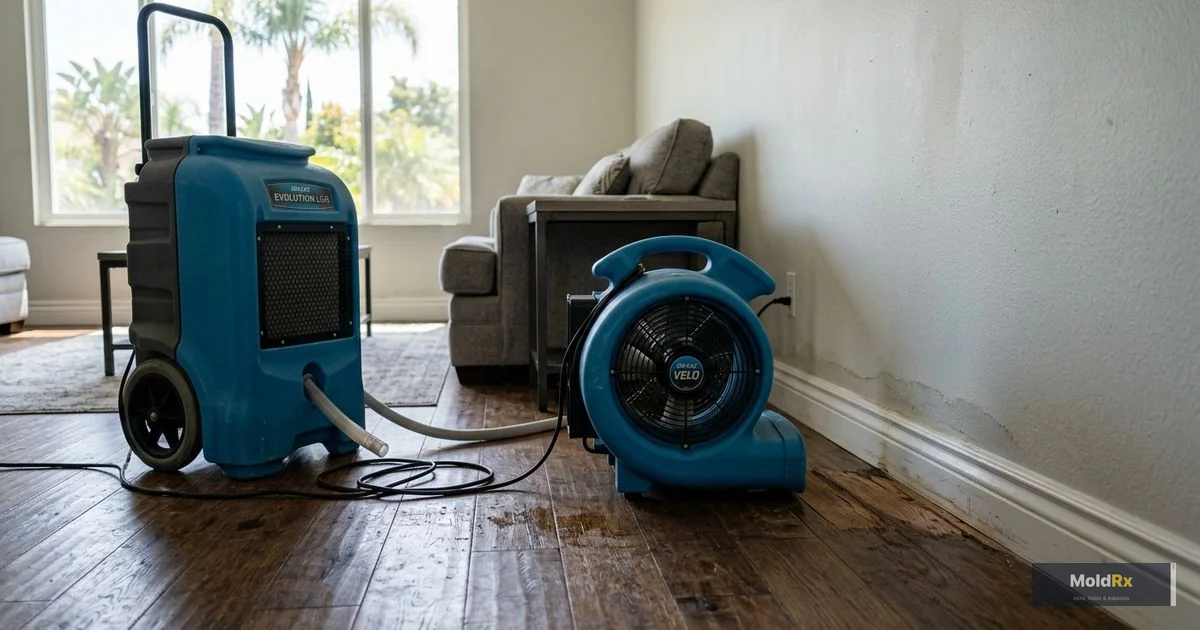
This is where Palm Desert restorations diverge significantly from standard approaches. Desert conditions create a counterintuitive drying environment:
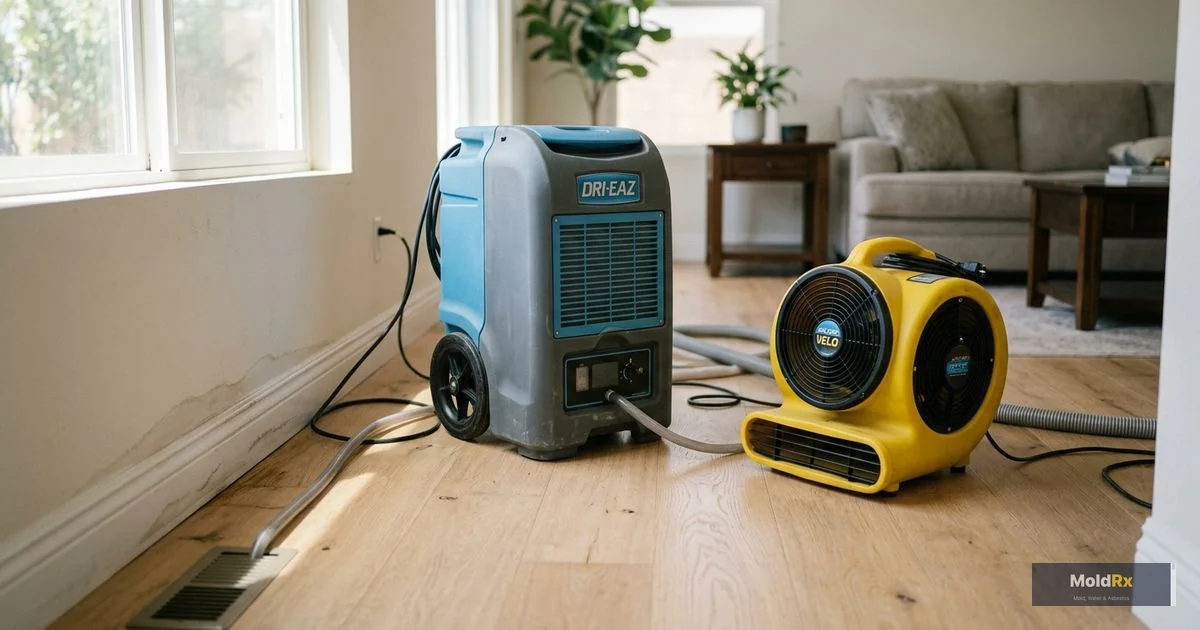
- Low-grain refrigerant (LGR) dehumidifiers are essential for Class 4 materials — standard refrigerant dehumidifiers cannot achieve the vapor pressure differential needed to extract moisture from dense substrates like travertine, concrete, hardwood, and natural stone
- Axial and centrifugal air movers positioned based on psychrometric data, not guesswork — incorrect placement in Palm Desert's low-humidity environment can cause surface materials to dry too rapidly while trapping moisture underneath
- Daily moisture monitoring with documented readings to verify progressive drying toward the target goals established during Phase 2
- Antimicrobial treatment applied to affected materials per IICRC S520 protocols — not optional in Palm Desert heat, where microbial colonization timelines are drastically compressed compared to temperate climates
Phase 4: Restoration and Verification (Days 5-14+)
Once all affected materials reach verified dry standard:
- Selective demolition only where necessary — our specialists do not tear out materials that can be saved. Palm Desert homes range from original mid-century construction with irreplaceable character to modern luxury finishes. If it can be dried and verified clean, it stays.
- Complete documentation of every phase — moisture readings, thermal images, equipment placement logs, material disposal records, and antimicrobial application reports. This documentation is critical for insurance claims, which frequently involve significant sums in Palm Desert's real estate market.
- Final clearance testing to verify moisture levels in all affected materials are at or below acceptable standards before reconstruction begins
- Air quality verification to confirm that microbial contamination has been eliminated per EPA indoor air quality guidelines
Request your free emergency estimate — our vetted specialists respond to Palm Desert 24/7.
The Seasonal Vacancy Crisis: Protecting Your Palm Desert Home While You Are Away
With roughly one in three Palm Desert homes sitting vacant during the hottest and most flood-prone months of the year, seasonal water damage is not a possibility — it is a statistical certainty for a significant number of properties every year. The combination of aging plumbing under thermal stress, pool equipment running without oversight, monsoon season flooding, and zero human monitoring creates a compounding risk that this community faces annually.
What Happens When No One Is Home
A Category 1 supply line failure in a vacant Palm Desert home follows a predictable and devastating timeline:
- Hours 1-6: Water spreads across flooring, begins wicking into baseboards and lower drywall. Damage is still highly recoverable with professional extraction.
- Hours 6-24: Water migrates into wall cavities, saturates insulation, reaches subfloor and slab. Interior temperatures in a Palm Desert home during summer accelerate moisture absorption into every porous material in the affected zone.
- Hours 24-72: Category 1 water begins degrading toward Category 2 as stagnant conditions promote microbial growth. Mold spores activate. Drywall loses structural integrity. Hardwood and laminate flooring begin cupping and buckling.
- Days 3-14: Full transition to Category 2 or Category 3 contamination. Mold colonies establish on organic materials. Structural framing begins absorbing moisture. The scope of required demolition expands significantly.
- Weeks 2-12+: Active mold colonization throughout the affected zone. Entire rooms may require gutting to framing. Structural members may require treatment or replacement. The restoration scope is now measured in tens of thousands of dollars and weeks of work.
This is not hypothetical. This is what our vetted specialists encounter in Palm Desert seasonally vacant homes every fall when snowbird owners return from summer elsewhere.
Protecting Your Vacant Property
While a comprehensive vacancy protection strategy is beyond the scope of this page, our vetted specialists consistently recommend:
- Automatic water shutoff systems with leak detection sensors at all supply points, water heaters, and appliance connections
- Smart water monitors that alert you to unusual flow patterns via smartphone — so a midnight pipe failure in July triggers your phone in Michigan or Montana immediately
- Regular property checks through a property management service or trusted local contact — at minimum weekly during monsoon season (July through September)
- Pool and water feature monitoring or professional winterization during vacancy periods
- Water heater inspection and replacement before the unit exceeds its expected lifespan — the hard water in Palm Desert shortens this timeline significantly compared to manufacturer estimates
Palm Desert Communities and Areas We Serve
Our vetted water damage restoration specialists respond to emergencies throughout all of Palm Desert, CA (ZIP codes 92260 and 92211), including:
- Palm Desert Country Club — One of the original country club communities, with homes dating to the 1960s and 1970s that carry elevated plumbing risk from decades of hard-water exposure
- Indian Ridge Country Club — Private gated community on 640 acres with over 1,000 homes, contemporary construction requiring specialized drying approaches
- Ironwood Country Club — Established community with mature homes and aging infrastructure
- Bighorn Golf Club — Custom luxury estates in the Bighorn Mountains and Canyons neighborhoods, requiring white-glove restoration that respects the caliber of these properties
- Palm Valley Country Club — Over 1,200 condo homes with complex shared plumbing infrastructure
- Chaparral Country Club — Guard-gated community of 625 condos with 21 heated pools and spas — significant water feature exposure
- Sun City Palm Desert — Del Webb's 55+ community spanning 1,600 acres with approximately 5,000 homes, representing the largest concentration of residential properties in Palm Desert
- Monterey Country Club and The Lakes Country Club
- Desert Falls Country Club, Portola Country Club, and Avondale Country Club
- Marrakesh Country Club, Stone Eagle, and Cahuilla Hills
- Hovley Lane area, Portola Avenue corridor, and the Highway 111 commercial corridor
We also serve neighboring Rancho Mirage to the west, Indian Wells and La Quinta to the east, and Cathedral City to the north — the entire central Coachella Valley corridor.
Whether your Palm Desert property is a full-time residence, a seasonal snowbird home, a vacation rental, or a commercial property on the Highway 111 corridor, our vetted specialists have the certification, equipment, and desert-specific expertise to handle your water damage emergency at the standard your property demands.
Get your free emergency estimate now or call (888) 609-8907 — 24/7 emergency response.
Related Services in Palm Desert
In addition to emergency water damage restoration, MoldRx connects Palm Desert property owners with vetted specialists for Mold Removal in Palm Desert, Asbestos Removal in Palm Desert, Water Damage Restoration in Palm Desert.
Water damage and mold are directly connected — especially in Palm Desert, where the heat-accelerated mold colonization timeline means that most water damage events left unaddressed for more than 48 hours also require mold remediation per IICRC S520 standards. If you suspect mold is already present, tell us when you call — it changes the restoration protocol and the certifications required.
Learn more about remediation services in Palm Desert
Frequently Asked Questions
How quickly do I need to act on water damage in Palm Desert?
Immediately. Not tomorrow. Not after you call your insurance company. Now. In Palm Desert's extreme heat, IICRC S520 mold colonization timelines are compressed well below the standard 24-to-48-hour window cited for temperate climates. Interior wall temperatures during summer can create incubation conditions that initiate mold growth in 12 to 18 hours. Every hour you wait expands the scope of damage, increases the contamination category, and adds to the restoration cost and timeline. Call (888) 609-8907 and get a certified crew on-site while you figure out the rest.
My Palm Desert home is a seasonal residence. I just returned and found water damage — what do I do?
This is one of the most common emergency calls our Palm Desert specialists receive — particularly in October and November when snowbird owners return. If the water source is still active, shut off your main water supply immediately — the shutoff valve is typically near the street or in the garage. Do not enter areas with standing water if there is any possibility the water has reached electrical outlets, panels, or appliances. Do not attempt to clean up Category 2 or Category 3 water yourself — it poses genuine health risks. Call (888) 609-8907 for emergency assessment. Our vetted specialists will determine the contamination category, the damage class, and the full restoration scope before any work begins.
What is the difference between Category 1, 2, and 3 water damage?
Category 1 is clean water from a sanitary source (supply lines, toilet tanks). Category 2 is gray water containing contaminants that can cause illness (dishwasher and washing machine discharge, degraded Category 1 water). Category 3 is black water — grossly contaminated with pathogenic agents (sewage, floodwater, long-standing stagnant water). The category determines the entire restoration protocol, required PPE, disposal requirements, and whether affected materials can be restored or must be removed. In Palm Desert, category escalation happens faster due to heat — what starts as Category 1 can become Category 3 within days in a vacant home during summer.
What is the difference between Class 1, 2, 3, and 4 water damage?
The class system measures drying difficulty, not contamination. Class 1 involves minimal absorption in a small area. Class 2 means significant absorption into carpet, cushion, and drywall. Class 3 indicates maximum absorption — saturated walls, insulation, and subfloor. Class 4 is specialty drying for low-permeance materials like hardwood, natural stone, plaster, and concrete. Many Palm Desert homes — particularly country club properties with tile-over-concrete construction, hardwood flooring, or natural stone — fall into Class 4, which requires low-grain refrigerant dehumidifiers and extended drying protocols that standard restoration equipment cannot deliver.
Will my homeowner's insurance cover water damage restoration in Palm Desert?
Most homeowner's policies cover sudden and accidental water damage — burst pipes, appliance failures, water heater ruptures. Gradual damage from deferred maintenance, foundation seepage, or external flooding typically requires separate coverage (flood insurance through FEMA's National Flood Insurance Program). The critical factor is documentation. Our IICRC S500-certified specialists document every phase of assessment and restoration with moisture readings, thermal imaging, photographs, equipment logs, and detailed written reports specifically formatted to support insurance claims. Proper documentation is the difference between a fully covered claim and a disputed one.
How long does water damage restoration take in Palm Desert?
Timeline depends on the damage category and class. A contained Category 1, Class 2 event (clean water, moderate absorption) may take 3 to 5 days for extraction and structural drying plus additional time for restoration. A Category 3, Class 4 event (contaminated water, specialty drying required) — which is common in Palm Desert seasonal vacancy situations — can take 2 to 4 weeks for the full scope of demolition, drying, antimicrobial treatment, clearance testing, and reconstruction. Our vetted specialists provide realistic timelines after the initial assessment, not guesses.
Can water-damaged materials in my Palm Desert home be saved?
Often yes — but only with the correct drying protocol applied promptly. Hardwood flooring, natural stone, ceramic tile, and concrete substrates require Class 4 specialty drying with low-grain refrigerant dehumidification and carefully controlled drying rates. Drying too fast causes cracking and delamination. Drying too slow allows mold colonization. This is precisely why you need IICRC S500-certified specialists — the margin for error is narrow. If extraction and specialty drying begin within the first 24 hours, the salvage rate for these materials increases significantly.
What should I do about water damage from monsoon flooding in Palm Desert?
Monsoon floodwater is automatically classified as Category 3 — black water under IICRC S500 standards. Do not attempt cleanup yourself. Do not wade through standing floodwater. Do not turn on HVAC systems, which can spread contamination throughout your home. Shut off electrical power to affected areas if you can do so safely. Call (888) 609-8907 for emergency response. Monsoon flood restoration requires full containment, HEPA air filtration, removal of all affected porous materials, antimicrobial treatment, and EPA-compliant disposal of contaminated debris. Our vetted specialists carry the certifications and equipment required for Category 3 flood restoration in Palm Desert.
Stop the Damage. Call Now.
Water damage does not wait for a convenient time. It does not pause while you research companies or compare quotes online. Every hour that passes in a Palm Desert home with active water intrusion — especially during summer — escalates the contamination category, expands the affected area, and increases the restoration scope. The math is simple and unforgiving.
MoldRx only sends vetted, IICRC S500-certified, CSLB-licensed, Cal/OSHA-compliant water damage restoration professionals to Palm Desert properties. We do not send the cheapest crew available. We send the right crew — specialists who understand desert construction across every era from mid-century country club homes to modern master-planned communities, who know Class 4 specialty drying protocols, and who have restored properties throughout the Coachella Valley in every damage category and class.
No runaround. No upselling. No guesswork. Honest assessment, qualified execution, complete documentation.
Get your free emergency estimate or call (888) 609-8907 — 24 hours a day, 7 days a week.