Ask these three questions before anything else: Are your technicians IICRC certified? Will you provide daily moisture readings and a written drying plan? Do you document the entire project for insurance purposes? If a company can't answer all three clearly and confidently, keep calling.
Water damage restoration is one of the few home services where the wrong hire doesn't just waste money — it creates a second, more expensive problem. Inadequate drying leads to mold growth within 24 to 48 hours. Poor documentation undermines your insurance claim. The company you choose determines whether this ends with a dry, documented property — or a mold remediation project six months from now that costs three times what proper drying would have.
This guide gives you the exact questions to ask, organized by category, along with what good answers sound like and what red flags to watch for.
The Three Questions That Matter Most
Before you compare quotes, read reviews, or schedule assessments, verify these three things about every company you're considering. These are non-negotiable.
1. Are your technicians IICRC certified?
The Institute of Inspection, Cleaning and Restoration Certification (IICRC) publishes the S500 Standard for water damage restoration — the industry-recognized protocol for assessment, drying, monitoring, and verification. IICRC WRT (Water Damage Restoration Technician) certification means technicians have been trained in drying science, moisture detection, equipment deployment, and health and safety protocols specific to water damage.
What a good answer sounds like: "Yes. Our technicians hold IICRC WRT certification, and we follow S500 protocols on every project. We can provide our certification numbers."
Red flag: They don't know what IICRC is, say they've "been doing this for years" instead, or claim their own internal training is equivalent.
2. Will you provide a written drying plan with daily moisture readings?
Professional restoration is not "set up fans and hope for the best." It requires a documented drying plan based on the materials affected, the category of water, the class of water loss, and the psychrometric conditions of the space. Progress should be tracked with daily moisture readings that prove materials are drying on schedule.
What a good answer sounds like: "We create a drying plan based on our initial moisture mapping, and we take moisture readings at least once a day — sometimes twice — to verify progress. You'll receive all of that documentation."
Red flag: They can't explain their drying methodology, don't mention moisture meters, or say they "check on things every few days."
3. Do you document the entire project for insurance purposes?
Water damage restoration documentation isn't a nice-to-have — it's the foundation of your insurance claim. Moisture readings, equipment placement logs, daily progress photos, scope of work, materials removed, and a final dry-down verification report should all be standard. Without this, your adjuster has nothing objective to work with.
What a good answer sounds like: "We provide a complete project file: initial moisture mapping, daily readings, equipment logs, photos from every stage, and a final verification report. We work with insurance adjusters regularly and know what they need."
Red flag: They mention photos but nothing about moisture data. They say they'll "write something up" after the fact. They seem unfamiliar with what adjusters require.
Questions About Credentials and Licensing
These questions establish whether a company has the training, legal standing, and financial protections to work on your property.
4. What specific certifications do your technicians hold?
Beyond IICRC WRT, look for IICRC ASD (Applied Structural Drying) for complex projects, and IICRC AMRT (Applied Microbial Remediation Technician) if mold is a concern — which it almost always is after significant water damage. A company that handles both water damage and mold should hold certifications in both disciplines.
5. Are you licensed as a contractor in this state?
In California, restoration work that involves structural repair requires a contractor's license. Verify the license number through the Contractors State License Board. An active, valid license means the company has met bonding and insurance requirements and is subject to regulatory oversight.
6. Do you carry general liability insurance and workers' compensation?
General liability protects your property if the restoration work causes damage. Workers' compensation protects you from liability if a technician is injured on your premises. Ask to see current certificates of insurance — not just a verbal confirmation. If a company doesn't carry workers' comp and a crew member is hurt in your home, you could face a claim.
7. How long have you been performing water damage restoration specifically?
General contracting experience is not the same as restoration experience. Drying science and restoration-specific protocols are specialized knowledge. A company that's been framing houses for 20 years but started offering restoration last year doesn't have the same depth.
Questions About Process and Equipment
These questions reveal whether a company follows professional protocols or cuts corners.
8. How do you determine the full scope of the damage?
A qualified company uses moisture meters, thermal imaging, and hygrometers to map moisture levels across the affected area — including behind walls and under flooring. The visible wet area is almost always smaller than the actual affected area. A company that assesses scope based only on what's visible is missing the damage that matters most.
9. What equipment do you use for drying?
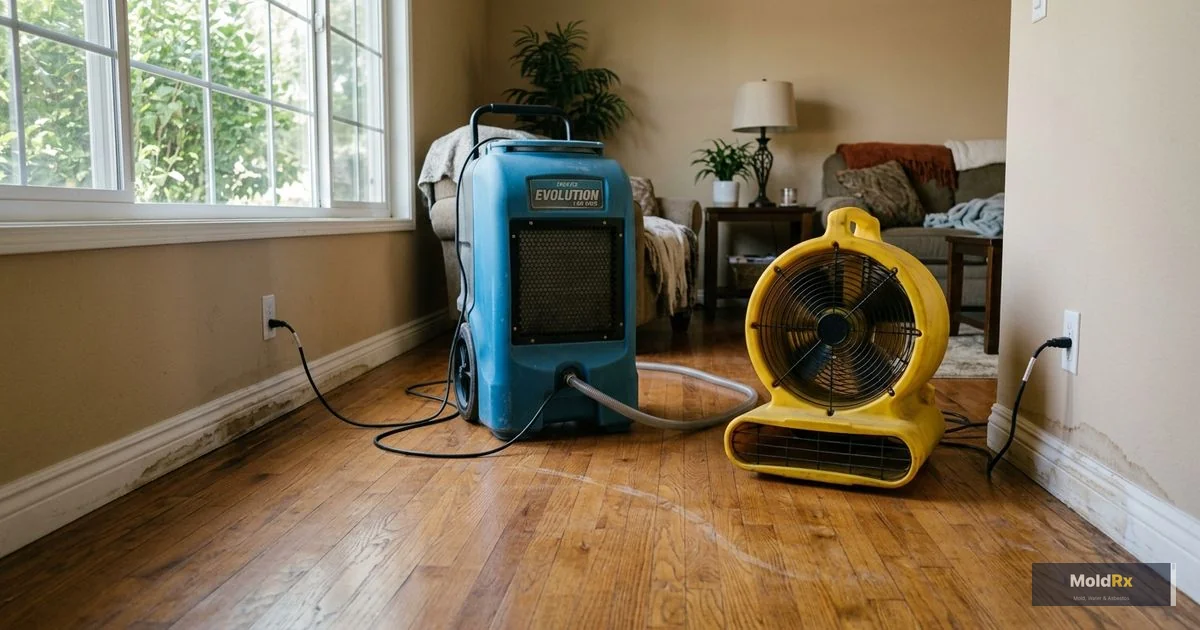
Professional structural drying requires commercial-grade LGR or desiccant dehumidifiers, high-velocity air movers, and HEPA air scrubbers when warranted. The number and type should be calculated based on the volume of the affected space, the materials involved, and the class of water loss. A company that mentions "fans and a dehumidifier" without specifics, or can't explain how they size equipment to your job, is not following professional standards.
10. How do you handle different categories of water damage?
Water damage categories determine the restoration approach — what materials can be saved, what must be removed, and what safety protocols are required. A company should explain how the category of your loss affects the scope and timeline without you having to ask.
11. Will you address the source of the water, or just the damage it caused?
Drying out a space without fixing what caused the water intrusion is like bailing out a boat without plugging the hole. A professional company either corrects the source themselves or coordinates with the appropriate specialist (plumber, roofer, HVAC technician) to make sure it's resolved before or during the drying process.
12. Do you perform antimicrobial treatment?
Antimicrobial application on wet structural materials slows microbial colonization during the drying process. This is standard protocol — not an upsell. A company that doesn't include it is leaving your structure vulnerable to mold growth even if the drying itself is adequate.
Questions About Timeline and Monitoring
These questions help you understand what to expect and whether the company takes drying science seriously.
13. How long will the drying process take?
A straightforward answer is a sign of experience. Most contained water damage events (single room, Category 1 water, standard building materials) require 3 to 5 days of active drying. Multi-room events, Category 2 or 3 water, concrete slab losses, or hardwood flooring take longer — sometimes 7 to 10 days or more. A company that promises same-day completion for a significant loss is not performing structural drying.
14. How often will you monitor drying progress?
Daily monitoring with calibrated instruments is the standard. Moisture readings should be taken at the same locations each day so progress can be tracked against the drying plan. A company that sets up equipment and doesn't return for several days is not managing the drying process.
15. What happens if materials aren't drying on schedule?
The answer to this question tells you whether the company actively manages drying or passively waits. The right response includes adjusting equipment placement, adding dehumidification capacity, opening wall cavities for better airflow, or investigating a secondary moisture source.
16. When do you determine that drying is complete?
Drying is complete when moisture readings in affected materials reach the dry standard — determined by comparison to unaffected materials of the same type in the same structure, not by arbitrary numbers. "It looks dry" is not a professional verification method.
Questions About Documentation and Insurance
These questions protect your financial interests and your insurance claim.
17. What documentation will I receive at the end of the project?
A professional company provides: initial assessment and moisture map, scope of work, daily moisture readings with locations noted, equipment logs, progress photos, materials removed, antimicrobial treatment records, and a final dry-down verification report. This documentation is your evidence — for the insurance claim, for future real estate transactions, and for your own records.
18. Do you work directly with insurance adjusters?
A company experienced in insurance restoration should be comfortable communicating with your adjuster and providing documentation that meets adjuster expectations. They should know the process and speak the language — but they shouldn't "handle everything" in a way that removes your oversight.
19. Will your documentation support my insurance claim?
Professional moisture readings, equipment logs, and progress documentation give your adjuster objective data that supports claim approval. Companies that provide a single invoice and nothing else leave gaps that adjusters can use to reduce your payout. Ask this question directly.
Questions About Communication and Accountability
These questions reveal how the company operates when things don't go perfectly — because something always comes up.
20. Who is my point of contact throughout the project?
You should have a single, named person responsible for your project — someone who knows the status, can answer questions, and is accessible by phone. If the answer is "whoever is on site that day" or "our office," communication will be fragmented. Water damage restoration involves daily decisions, and you need someone who knows your specific project.
21. How will you communicate progress to me?
Daily updates — even brief ones — should be standard. Whether it's a phone call, text, email, or app notification, you should know what happened each day: what the moisture readings showed, what equipment was adjusted, and what to expect tomorrow. A company that goes silent after setup and reappears to pick up equipment isn't managing the project or your expectations.
22. What happens if additional damage is discovered during the project?
Water damage scope frequently expands once walls are opened or floors are pulled back. A professional company contacts you immediately, documents the additional damage, communicates with your adjuster, and provides a revised scope before proceeding. They don't just do additional work and add it to the invoice.
23. What is your warranty or guarantee on the drying work?
If mold develops in an area they dried and documented as dry, what is their responsibility? Get the answer in writing. A company confident in its process will have a clear answer. A company that hesitates is telling you something.
Red Flags in the Answers
The questions above are only useful if you know how to evaluate the responses. Here are the warning signs that should make you keep looking.
They quote a price without seeing the property. Water damage scope cannot be determined by phone or from photos. The affected area behind walls and under floors is almost always larger than what's visible. A company quoting sight-unseen is either lowballing or padding — neither serves you.
They minimize the importance of moisture readings. If a company treats moisture monitoring as optional or says they can "tell by feel," they are not following professional standards. Drying decisions without instrument data are guesses.
They can't explain their equipment selection. Asking "how many dehumidifiers and air movers will you use?" should produce a specific answer tied to your space and loss conditions — not "we'll figure it out when we get there."
They push to start immediately without a plan. There's a difference between responding quickly and starting work without a documented scope. A company that deploys equipment before explaining what they're going to do is prioritizing revenue over results.
They discourage you from contacting your insurance company first. A company that wants to start work before you've filed a claim may be trying to position themselves before an adjuster can evaluate the scope independently.
They do their own "clearance" without independent testing. If mold remediation becomes necessary, post-remediation verification should be performed by an independent party. This is the same conflict-of-interest principle that applies to mold remediation.
They want full payment upfront. A deposit is reasonable. Full payment before the work is complete and documented is not.
They lack online reviews or verifiable references. If you can't find reviews, references, or evidence of past work, proceed with extreme caution. The restoration industry has a low barrier to entry.
What Good Answers Sound Like
When you're comparing companies, the best ones share common characteristics in how they communicate.
They explain without selling. A confident company describes their process, answers your questions thoroughly, and lets you make your own decision. They don't pressure, create artificial urgency, or make guarantees they can't back up.
They use specific, technical language naturally. Terms like "psychrometric conditions," "grain depression," and "dry standard" come up in conversation because that's how professionals talk about what they do.
They bring up things you didn't ask about. They mention insurance documentation, antimicrobial treatment, and moisture source correction before you ask — because those are standard parts of their process, not extras.
They acknowledge what they don't know yet. "I can't give you a firm scope until we map the moisture, but here's what the process looks like." A company that has all the answers before seeing your property doesn't actually have any answers.
Frequently Asked Questions
How do I find water damage restoration companies to evaluate?
Start with your insurance company's recommended list, then research independently: check IICRC's directory for certified firms in your area, read reviews across multiple platforms, and ask for referrals. Evaluate at least two to three companies using the questions in this guide.
Should I get multiple estimates for water damage restoration?
Two or three assessments from qualified companies is reasonable. When comparing, don't just compare price — compare the proposed scope. A lower estimate may reflect a smaller scope, which means they're planning to dry less of your property.
Is it better to hire a company my insurance recommends?
Insurance-recommended companies know the claims process and documentation requirements, which is a genuine advantage. However, you are not required to use your insurer's recommendation. Evaluate recommended companies the same way you'd evaluate any other — using the questions in this guide.
What if I need both water damage restoration and mold remediation?
Water damage and mold frequently overlap. If water has been present for more than 24 to 48 hours, mold growth is likely. A company that holds both IICRC WRT (water) and AMRT/S520 (mold) certifications can address the full scope. If mold is present, make sure the company uses independent third-party testing for post-remediation verification — the same company should not test and remediate.
How quickly should a restoration company respond?
For active water emergencies, same-day response is the standard — many companies offer response within one to four hours. Every hour water sits in contact with materials, the damage deepens and the category can escalate. Ask about response time during your initial call.
Can I do water damage restoration myself?
For very small, Category 1 events on hard surfaces caught within hours, DIY cleanup may be sufficient. For anything involving wall cavities, subfloors, multiple rooms, or Category 2 or 3 water, professional equipment is necessary. Consumer-grade fans and dehumidifiers cannot produce the conditions required for structural drying.
What should I do in the first 24 hours before the restoration company arrives?
Stop the water source, turn off electricity to affected areas, remove standing water with a wet/dry vacuum, move belongings off wet surfaces, and start documenting everything with photos and video. Our first 24 hours guide walks through this step by step.
Will my homeowner's insurance cover the restoration?
Most policies cover sudden, accidental water events — burst pipes, appliance failures, storm damage. Gradual leaks, deferred maintenance, and external flooding (which requires separate flood insurance) are typically excluded. The quality of your documentation directly affects the outcome. Read our complete guide to water damage insurance claims in California for details.
How do I know if a company is cutting corners?
If you're not receiving daily moisture readings, progress photos, and clear communication — corners are being cut. Other signs: equipment removed before drying is verified with instruments, no antimicrobial treatment, no discussion of the moisture source, and reluctance to share documentation with your insurance adjuster.
What's the difference between water mitigation and water restoration?
Water mitigation is the emergency phase — stopping the water, extracting standing water, deploying drying equipment. Water restoration encompasses the full process through complete recovery: drying, antimicrobial treatment, monitoring, verification, documentation, and repairs. Both are typically covered under homeowner's insurance.
Hire the Company That Answers These Questions Best
Water damage restoration is not a commodity. The company that shows up with equipment and a plan backed by certifications, documented protocols, daily monitoring, and thorough communication will deliver a fundamentally different outcome than the company that shows up with fans and a handshake.
Ask the questions in this guide. Listen to how companies answer — not just what they say, but whether they're specific, transparent, and comfortable being evaluated. The right company welcomes scrutiny because their process holds up to it.
If you're dealing with water damage in Southern California and want to talk to a company that will answer every question on this list, call (888) 609-8907 or request a free estimate. We'll walk through your situation and give you the information you need to make a confident decision — whether you hire us or not.
Water Damage Restoration --> | Emergency Services --> | Mold Removal --> | Mold Testing --> | Free Estimate -->