Emergency Water Damage Restoration in Redlands, CA — MoldRx
24/7 Vetted Water Damage Restoration Specialists Serving Redlands and the Inland Empire — Call Now
Water is inside your Redlands home right now, and every single minute matters. Whether a pipe burst behind the wall of your 1905 Craftsman bungalow at 3 AM, mountain runoff from the San Bernardino foothills is pooling against your foundation, or a failed water heater just dumped 50 gallons across your kitchen floor — the damage is accelerating as you read this. Mold colonization begins within 24 to 48 hours. Structural wood starts warping within hours. Subfloor materials begin delaminating the moment they saturate. This is not a situation that can wait until morning, wait until Monday, or wait until you "figure out" insurance. This requires immediate professional intervention.
MoldRx deploys vetted emergency water damage restoration specialists who know Redlands — the aging plumbing behind historic Victorian plaster walls, the mountain runoff patterns that send water cascading down from the San Bernardino National Forest, the clay-heavy soil that traps moisture against slab foundations for weeks. We respond when you call, not when it's convenient.
Why Redlands Faces Extreme Water Damage Risk
Redlands is not an ordinary Inland Empire suburb. With a population of approximately 73,000 to 74,000 residents spread across a landscape that stretches from the San Timoteo Canyon lowlands to the steep foothills of the San Bernardino Mountains, this city sits at the collision point of multiple water damage threats that most homeowners never see coming — until it is too late.
The Historic Housing Stock Problem
Redlands was founded in 1888 and quickly earned the title "The City of Millionaires" and later "The City of Beautiful Homes." Wealthy Easterners and Midwesterners built elaborate Victorian mansions, Queen Anne estates, and Craftsman bungalows throughout eight locally designated historic districts. The Morey Mansion — "America's Favorite Victorian" — still stands on the bluffs overlooking San Timoteo Canyon. The Kimberly Crest House, built in 1897 for the Kimberly-Clark fortune, anchors another historic corridor.
This architectural heritage is stunning. It is also a water damage catastrophe waiting to happen.
Homes built between 1888 and 1940 contain original cast iron drain lines, galvanized steel supply pipes, and lead joints that have been corroding for over a century. Many have been retrofitted piecemeal over the decades — copper soldered to galvanized, PEX spliced into cast iron — creating weak points where dissimilar metals meet and corrosion accelerates. When these connections fail, they do not trickle. They rupture. A burst galvanized supply line in a Victorian-era wall cavity can release hundreds of gallons per hour into plaster, lath, original hardwood flooring, and irreplaceable millwork before the homeowner even realizes what is happening.
Homes in the Smiley Heights, Terracina, and Redlands Heights neighborhoods — many of which are 80 to 130+ years old — are especially vulnerable. Their balloon-frame construction allows water to travel vertically through wall cavities from foundation to attic, meaning a first-floor pipe failure can saturate second-story walls and ceilings within hours.
Mountain Runoff and Flash Flooding
Redlands sits at the base of the San Bernardino Mountains, where Mill Creek and other mountain drainages funnel stormwater directly toward the city. During atmospheric river events — like the devastating February 2024 storms that triggered a state of emergency across San Bernardino County — mountain runoff overwhelms culverts, floods streets, and sends water surging against foundations throughout Lugonia, South Redlands, and low-lying areas near San Timoteo Canyon.
The hard, sun-baked alluvial soil that underlies much of Redlands absorbs almost nothing during these intense precipitation events. Water sheets across the surface, pools in low spots, and forces its way through foundation cracks, window wells, and garage door seals. Properties in the Ford Park and University District areas near the University of Redlands campus sit in natural drainage paths that become active waterways during heavy storms.
The December 2024 atmospheric river that prompted Governor Newsom to declare a state of emergency across Riverside, San Bernardino, and four other counties brought another round of flash flooding and debris flows to the Inland Empire. Roads turned into rivers. Motorists became trapped in rapidly moving water. Storm drains built for moderate rainfall were overwhelmed in minutes.
This is not theoretical risk. This is the documented reality of living at the base of a major mountain range in a climate that alternates between extreme drought and extreme deluge.
Slab Leaks — The Silent Destroyer
Many Redlands homes built from the 1950s through the 1980s sit on concrete slab foundations with copper supply lines running beneath them. The region's expansive clay soil shifts constantly with moisture changes, grinding against those copper pipes year after year. Pinhole leaks develop silently, releasing water beneath the slab where it migrates outward — saturating the perimeter soil, wicking upward through the slab, destroying flooring, and creating perfect conditions for hidden mold colonies that can grow for months before detection.
By the time a Redlands homeowner notices a warm spot on the floor, an unexplained spike in the water bill, or a musty smell in a bedroom — the damage has been spreading for weeks. The slab leak itself may involve a tiny perforation in a copper line. The resulting water damage can affect an entire wing of the house.
The Inland Empire Heat-Mold Acceleration Cycle
Redlands summer temperatures regularly reach the mid-90s to low 100s. When water intrusion occurs during warm months, the combination of moisture and heat creates an incubator for mold growth that operates at terrifying speed. Aspergillus, Penicillium, and Stachybotrys (black mold) can establish visible colonies within 24 to 48 hours under these conditions. Behind walls, inside HVAC ducts, and beneath flooring — where temperatures are elevated and air circulation is minimal — mold can spread through entire wall cavities before any visible sign appears in the living space.
What begins as a water damage emergency becomes a mold remediation crisis. What might have cost a few thousand dollars to dry properly on day one becomes a $15,000 to $30,000+ remediation project by week two. Do not let this happen to your home.
Emergency Water Damage Restoration Process in Redlands
When you call MoldRx, vetted specialists deploy to your Redlands property and execute a systematic, IICRC S500-compliant restoration protocol designed for one purpose: stop the damage from getting worse and restore your home as fast as humanly possible.
Step 1: Immediate Emergency Response and Damage Assessment
The first specialist through your door is focused on triage. Where is the water coming from? Is the source still active? What category of water are we dealing with — Category 1 (clean water from a supply line or faucet), Category 2 (gray water from appliances, dishwashers, or washing machines), or Category 3 (black water from sewage backups, storm flooding, or toilet overflow with fecal contamination)?
The category determines everything. Category 3 contamination in a historic Redlands home requires immediate removal of all porous materials that contacted the water — carpet, pad, lower drywall, insulation. There is no drying your way out of sewage contamination. The assessment also maps the full extent of water migration using thermal imaging cameras and penetrating moisture meters, because water travels — and in a Victorian balloon-frame home, it can travel far.
Step 2: Rapid Water Extraction
Commercial-grade truck-mounted extractors and submersible pumps remove standing water at rates of hundreds of gallons per hour. Weighted extraction tools pull water from carpet fibers and pad. Hard-surface extractors recover water from hardwood, tile, and concrete. In Redlands homes with finished basements or below-grade rooms — common in hillside properties along Sunset Hills and Smiley Heights — portable pumps deploy to remove water that gravity won't drain.
Speed is everything during extraction. Every hour that standing water remains in contact with building materials, the scope of damage expands. Drywall wicks moisture upward at approximately one inch per hour. Hardwood flooring begins cupping and buckling within hours of saturation. Carpet pad — essentially a sponge — holds contaminated water against the subfloor where it drives mold growth and structural deterioration.
Step 3: Structural Drying and Dehumidification
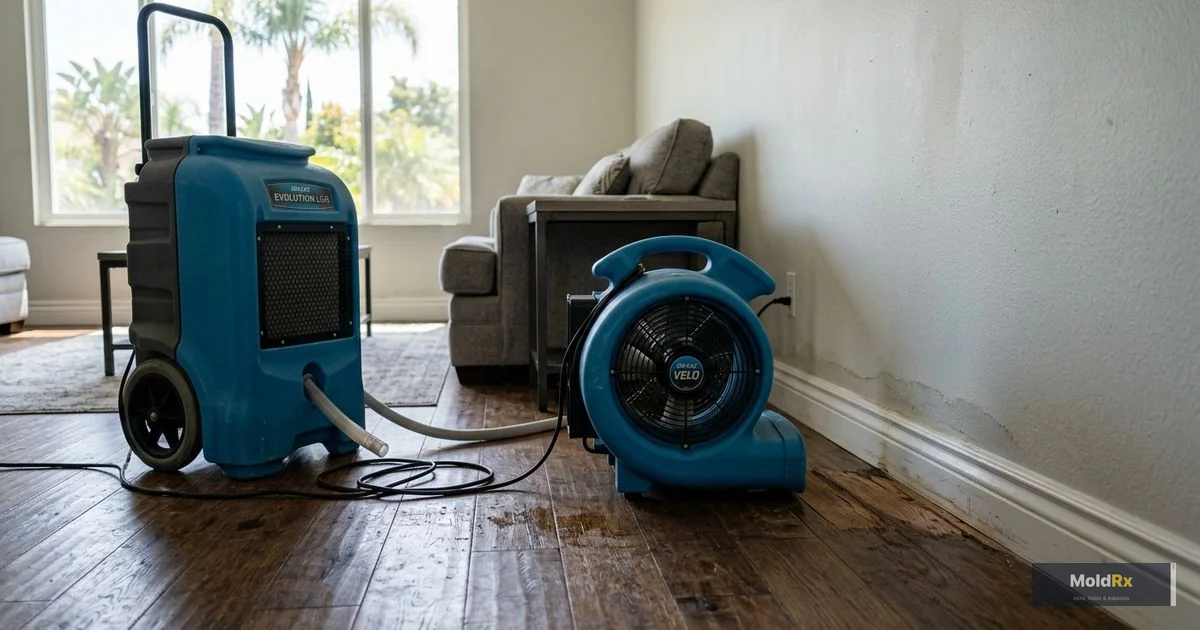
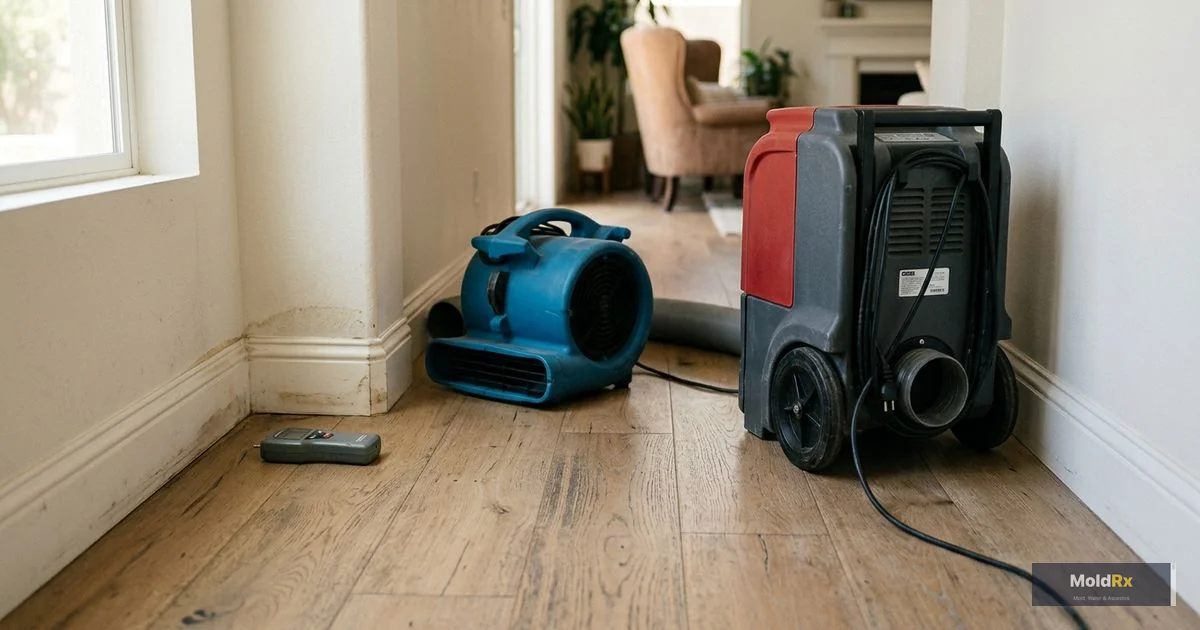
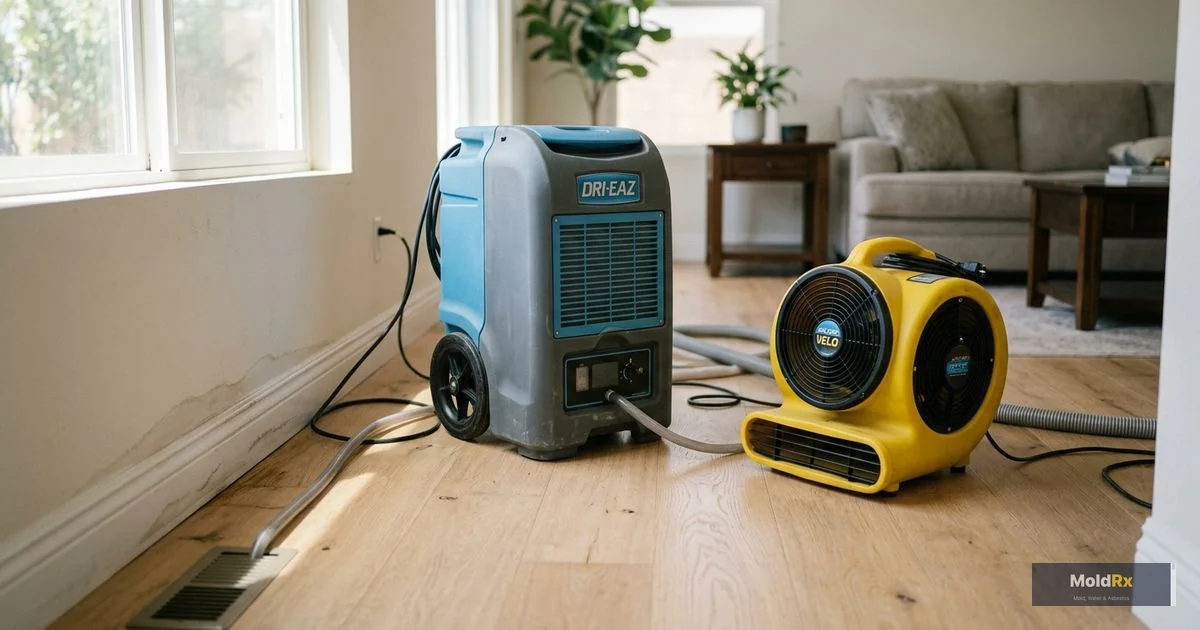
This is the phase that separates professional restoration from "we put some fans down and hoped for the best." Industrial air movers create high-velocity airflow across wet surfaces, accelerating evaporation. Commercial dehumidifiers — pulling 70 to 130 pints of moisture per day per unit — capture that evaporated water from the air before it can recondense on cooler surfaces.
In Redlands homes, structural drying presents unique challenges. Victorian-era plaster-and-lath walls hold moisture tenaciously and dry far more slowly than modern drywall. Original hardwood floors in Craftsman bungalows require careful, controlled drying to prevent irreversible crowning or gapping. Pier-and-beam foundations in older homes create crawl spaces where moisture lingers for weeks without active intervention.
Our vetted specialists monitor moisture levels daily using pin-type and pinless moisture meters, documenting readings at multiple points throughout the affected area. Drying is not complete when surfaces feel dry to the touch. Drying is complete when moisture meter readings confirm that materials have returned to their dry standard — the baseline moisture content for that material in that climate. In Redlands, structural drying typically takes 3 to 7 days depending on the extent of saturation and the materials involved.
Step 4: Cleaning, Antimicrobial Treatment, and Restoration
Once structural drying is verified, affected areas receive antimicrobial treatment to eliminate bacteria and prevent mold colonization. Salvageable contents are cleaned and restored. Materials too damaged to save — typically including carpet pad, lower sections of drywall, wet insulation, and any materials that contacted Category 2 or Category 3 water — are removed, bagged, and disposed of properly.
In Redlands historic homes, restoration often involves specialized considerations: matching original trim profiles, preserving salvageable hardwood, protecting decorative plasterwork during controlled demolition. Our vetted specialists understand that in a Terracina Boulevard Victorian or a Cajon Street Craftsman, the goal is not just structural restoration — it is preserving the character and value of an irreplaceable home.
What to Expect When You Call MoldRx
-
Immediate Response: Water damage is an emergency. You will reach a live person, and vetted specialists will be dispatched to your Redlands property without delay. Not tomorrow. Not "first thing in the morning." Now.
-
Brutal Honesty: You will know exactly what you are dealing with — the full extent of damage, the realistic scope of work, and a truthful timeline. If the situation is less severe than you feared, you will hear that. If it is worse than it looks, you will hear that too. We do not inflate estimates, and we do not minimize problems.
-
Full Documentation: Every phase of the restoration is documented with photographs, moisture readings, and detailed notes. This documentation is critical for insurance claims — and it protects you from future disputes about scope of work or completeness of drying.
-
Verified Completion: We do not guess when drying is complete. We do not pull equipment based on a calendar. Moisture meters confirm that every affected material has returned to acceptable levels before a single piece of equipment leaves your home. This verification step is what prevents the mold problems that plague homeowners who hired companies that cut corners.
Redlands Neighborhoods and Areas We Serve
MoldRx deploys vetted water damage restoration specialists to every neighborhood in Redlands and surrounding areas, including Downtown Redlands, Smiley Heights, Terracina, Redlands Heights, Lugonia, South Redlands, Sunset Hills, Ford Park, University District near the University of Redlands, the Kimberly Crest area, Prospect Park, and newer developments east of the I-10/210 interchange. We cover ZIP codes 92373, 92374, and 92375.
We also respond to water damage emergencies in neighboring communities including Loma Linda to the west, Highland to the north, Yucaipa to the east, Mentone to the northeast, and San Timoteo Canyon to the south. Whether you are in a 130-year-old Queen Anne Victorian on the historic bluffs, a mid-century ranch in South Redlands, or a newer development near Live Oak Canyon — we are equipped, we are vetted, and we respond immediately.
Related Services in Redlands
In addition to emergency water damage restoration, we also offer Mold Removal in Redlands, Asbestos Removal in Redlands, Water Damage Restoration in Redlands services to Redlands property owners.
→ Learn more about remediation services in Redlands
Frequently Asked Questions
I just discovered water damage in my Redlands home. What do I do RIGHT NOW?
Stop the water source immediately if you can safely do so — shut off the main water valve, turn off the appliance, or close the supply valve. Then call MoldRx. Do not attempt to dry the area yourself with household fans. Do not rip out wet carpet without understanding what is underneath. Do not wait to see if it "dries on its own" — it will not. Every hour of delay increases damage exponentially. Our vetted specialists will guide you through immediate steps over the phone while they are en route to your property.
My Redlands home is historic — will restoration damage the original features?
Our vetted restoration specialists understand the irreplaceable value of Redlands' historic homes. Victorian plasterwork, original hardwood, Craftsman millwork, and period fixtures require specialized handling during water damage restoration. Controlled drying protocols prevent the cracking, warping, and delamination that destroy historic materials. Where demolition is necessary, it is performed surgically — removing only what cannot be saved and preserving everything that can.
How much does emergency water damage restoration cost in Redlands?
Costs depend entirely on the scope: the water category, affected square footage, materials involved, duration of exposure, and whether secondary damage (mold, structural compromise) has already developed. A contained Category 1 pipe burst caught within hours is fundamentally different from a Category 3 sewage backup that saturated 800 square feet for two days. We provide detailed, documented estimates after assessing your specific situation. Contact us immediately — the longer you wait, the more expensive restoration becomes.
Will my homeowner's insurance cover this?
Most policies cover sudden and accidental water damage — burst pipes, appliance failures, storm damage to the structure. Gradual damage from deferred maintenance, slab leaks that went unaddressed, or flood damage typically requires separate coverage. Our thorough documentation of the damage, the restoration process, and verified completion supports your insurance claim and protects you throughout the process.
How long does water damage restoration take in Redlands?
Minor incidents with fast response — a contained pipe burst caught within hours — may complete in 3 to 5 days. Major water intrusion involving multiple rooms, Category 2 or 3 water, or historic materials requiring specialized drying can take 1 to 3 weeks. We will give you an honest, realistic timeline after assessment. We do not rush the process at the expense of thoroughness, and we do not drag it out unnecessarily.
I see mold growing already. Is it too late?
It is not too late, but the scope of work has expanded. Visible mold growth means colonization has progressed beyond the initial water damage — and it means there is almost certainly more mold behind walls and beneath flooring than what you can see. The water damage restoration must now be coordinated with professional mold remediation. Call MoldRx immediately so we can assess both the water damage and the mold situation simultaneously and develop an integrated response plan.
Your Redlands Home Is Taking Damage Right Now — Act Immediately
This is not a decision you can put off. Water does not pause. Mold does not wait. Every hour that passes allows moisture to penetrate deeper into your home's structure, saturate materials that could have been saved, and create conditions for biological growth that will dramatically increase the cost and complexity of restoration.
MoldRx exists because Redlands property owners deserve better than 1-800 call centers, inflated estimates, and technicians who have never set foot in a Victorian-era wall cavity. Every water damage emergency in Redlands is handled by vetted restoration specialists who know this city — the historic housing stock, the mountain runoff patterns, the soil conditions, the aging infrastructure — and who follow IICRC S500 standards without exception.
If water has invaded your Redlands home, call MoldRx now. Not in an hour. Not after you finish reading reviews. Now. The damage is accelerating, and the only thing that stops it is professional intervention. We will give you an honest assessment, deploy qualified specialists, and restore your home properly — because that is the only way it should be done.