Water Damage Restoration in San Bernardino, CA — MoldRx
Vetted Water Damage Restoration Specialists Serving San Bernardino and the Inland Empire
Water is inside your San Bernardino home right now. Maybe a pipe split behind a wall at 3 AM and you woke up to a soaked carpet. Maybe storm runoff poured through a foundation crack during the last winter downpour. Maybe the water heater in the garage finally gave out after decades of service and now the slab is saturated. Whatever brought you here, one fact overrides everything else: the damage is getting worse every single minute you wait.
Within 24 hours, water that seems manageable starts wicking up drywall, saturating subfloor materials, and creating the exact humid, dark conditions where mold colonizes. Within 48 hours, that mold is actively growing. Within 72 hours, what started as a water extraction job becomes a full-scale mold remediation project that can cost five to ten times more. That timeline is not a scare tactic. It is the documented reality of water damage in the Inland Empire's climate, and San Bernardino sits at the epicenter of every risk factor that accelerates it.
Why San Bernardino Faces Extreme Water Damage Risk
San Bernardino is not just another Southern California city with aging homes. It is the county seat of the largest county in the contiguous United States, with approximately 222,000 residents spread across a geography that funnels water damage threats from every direction. The city sits at the base of the San Bernardino Mountains, directly below the Cajon Pass — the narrow corridor where the San Gabriel and San Bernardino mountain ranges meet. That pass is not just a freeway bottleneck. It is a funnel for storm energy, wind, and runoff that pours directly into the flatlands where San Bernardino's neighborhoods sit.
The Climate Problem
San Bernardino's semi-arid Mediterranean climate creates a dangerous cycle. Long, brutally hot summers with temperatures regularly exceeding 100 degrees bake the ground into hardpan. Clay-heavy soils contract and crack during months of zero rainfall. Then, between November and March, concentrated winter storms dump the city's entire annual rainfall — roughly 16 inches — in a matter of weeks. When that rain hits bone-dry, cracked soil, the ground cannot absorb it. Water sheets across surfaces, pools against foundations, and forces its way into every gap, crack, and weak point in a structure.
December 2025 proved exactly how dangerous this cycle is. An atmospheric river slammed San Bernardino County, triggering flash flood warnings across the region. Interstate 15 through the Cajon Pass was temporarily shut down when clogged drains caused flooding across the freeway. Rescue teams pulled three people from an SUV trapped in raging floodwaters in the pass. Mudslides and debris flows hit communities across the county. This was not a once-in-a-generation event. This is the new pattern, and San Bernardino homeowners are on the front line.
The Housing Stock Problem
San Bernardino's housing tells the story of Southern California's twentieth-century expansion, and every chapter of that story comes with its own plumbing vulnerabilities.
Pre-war and early post-war homes (1900s-1940s): Neighborhoods in the downtown core, Muscoy, and parts of Del Rosa contain homes built with cast iron drain lines and galvanized steel supply pipes. These materials have lifespans of 50 to 70 years. They are now 80 to 120 years old. Cast iron develops internal scale that restricts flow and eventually cracks. Galvanized steel corrodes from the inside out, developing pinhole leaks that can run for months inside walls before anyone notices the damage.
Mid-century expansion homes (1950s-1970s): The massive post-war housing boom — fueled by railroad jobs, Norton Air Force Base employment, and Kaiser Steel in nearby Fontana — produced vast tracts of homes across Verdemont, Kendall, Pacific, Shandin Hills, and the north-central neighborhoods. These homes were built fast to meet demand. Many used polybutylene pipes (common from the 1970s through the early 1990s) which are now known to become brittle and fail catastrophically without warning. Copper supply lines in these homes have been exposed to San Bernardino's hard water for 50 to 70 years, creating the perfect conditions for slab leaks.
The slab leak crisis: San Bernardino homes built on concrete slab foundations are especially vulnerable. The city's soil contains a mix of clay and sandy layers that expand when wet and contract when dry. This constant movement puts mechanical stress on pipes running through or beneath the slab. Combined with incoming water pressure that frequently exceeds 100 PSI in neighborhoods closer to the mountains, these pipes fatigue and crack. Slab leaks are silent destroyers — they can run undetected for weeks or months, saturating the foundation, warping flooring, and creating hidden mold environments that only become apparent when the damage is severe.
The Wildfire-Flooding Connection
San Bernardino's proximity to wildfire zones adds a layer of risk that many homeowners never consider until it is too late. When fires burn through the mountain watersheds above the city, they destroy vegetation and bake the soil into a water-repellent layer called hydrophobic soil. When rain falls on these burn scars, water does not absorb — it runs off in torrents, carrying mud, ash, and debris directly toward downstream communities. San Bernardino County experienced exactly this scenario during the December 2025 storms, when mudslides and flooding hit burn-scar communities across the region. Recovery operations had to be expanded as the damage spread.
Emergency Water Damage Restoration: What Happens When You Call
Every water damage event is different. A toilet supply line that cracked overnight is a fundamentally different problem than three inches of storm flooding across a ground floor. But the physics of water damage follow the same trajectory in every case, and our restoration process is built to interrupt that trajectory at the earliest possible point.
Phase 1: Rapid Assessment and Source Control
Before a single piece of equipment gets deployed, we need to understand exactly what we are dealing with. This means identifying and stopping the water source (if it is still active), determining the category of water contamination, and mapping the full extent of moisture penetration.
Water categories matter enormously:
- Category 1 (clean water): From supply lines, faucets, or appliance supply connections. Least hazardous, but still causes structural damage if not extracted quickly.
- Category 2 (gray water): From washing machines, dishwashers, or toilet overflows without solid waste. Contains chemical or biological contaminants that require specific handling protocols.
- Category 3 (black water): From sewage backups, storm flooding, or any standing water that has been present long enough to support bacterial growth. This is a health hazard. Contaminated materials often cannot be saved and require removal under controlled conditions.
In San Bernardino homes with older construction, this initial assessment frequently reveals that water has traveled far beyond the visible damage. Water wicks up drywall at a rate of roughly one inch per hour. It migrates along floor joists. It pools in wall cavities and beneath flooring where you cannot see it. Thermal imaging and moisture meters map these hidden pockets so nothing gets missed.
Phase 2: Emergency Water Extraction
Standing water gets removed immediately using professional-grade truck-mounted extraction units and portable pumps capable of removing hundreds of gallons per hour. Speed is everything during this phase. Every hour that standing water remains in contact with building materials increases the depth of penetration and the scope of eventual restoration.
For San Bernardino properties with slab foundations — which is the majority of homes here — extraction is especially critical. Water left sitting on concrete wicks into the porous surface and can migrate laterally beneath flooring, creating moisture pockets that standard drying equipment may not reach without directed intervention.
Phase 3: Structural Drying and Dehumidification
This is where the difference between amateur and professional restoration becomes most apparent. Removing visible water is only the beginning. Moisture trapped inside walls, subfloors, insulation, and structural framing must be systematically extracted through controlled drying.
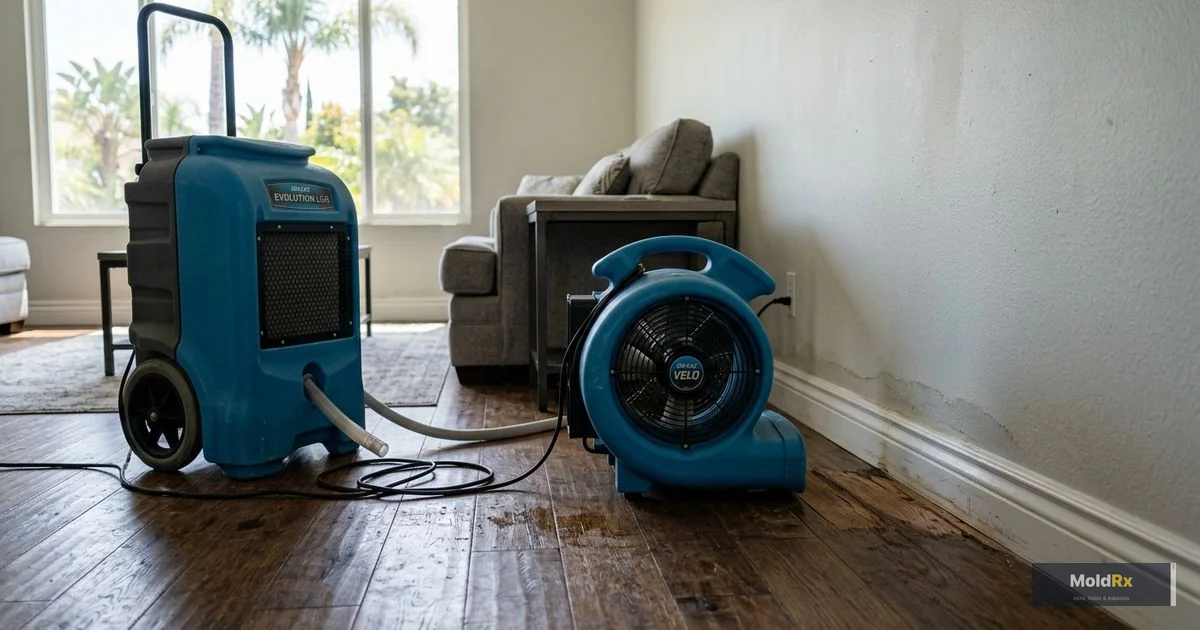
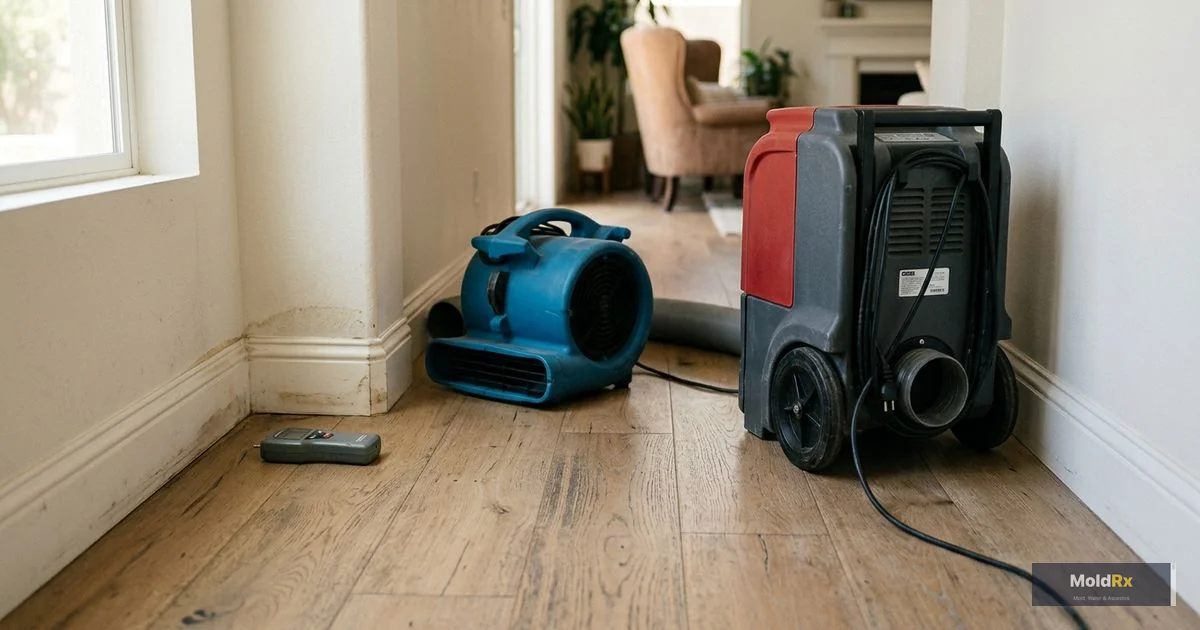
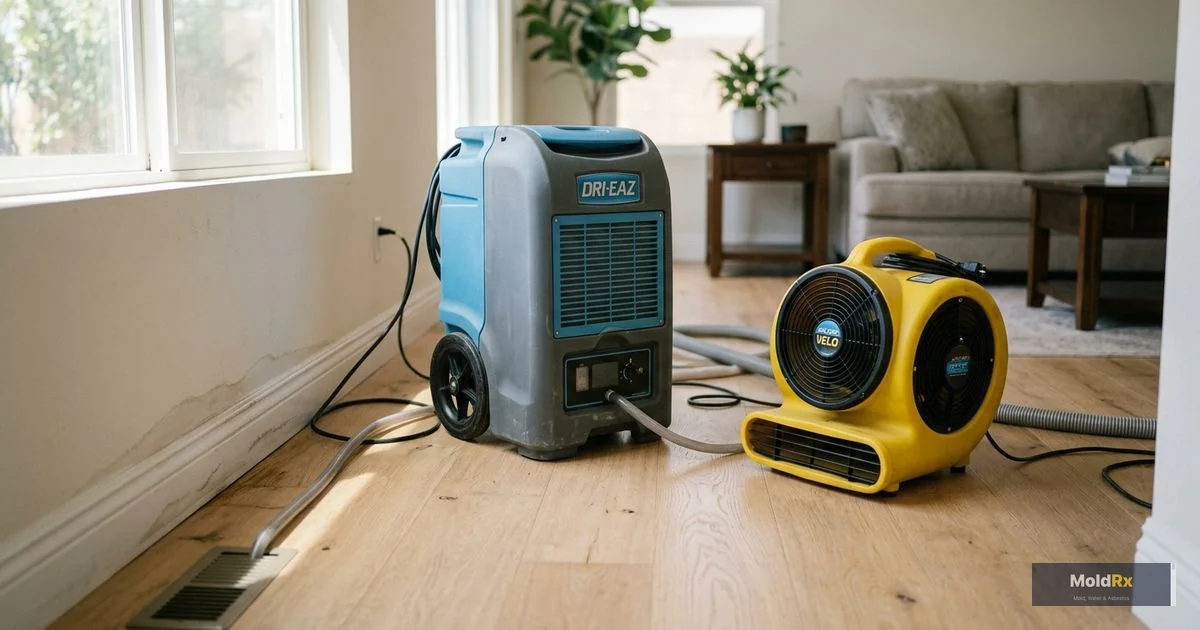
Industrial air movers and commercial dehumidifiers create precise airflow patterns that pull moisture from materials and capture it from the air. San Bernardino's average humidity — typically around 35 to 50 percent for most of the year — actually aids this process compared to coastal cities, but we never rely on ambient conditions alone. Moisture meters take daily readings at multiple points throughout the affected area, tracking the drying curve until every material returns to its normal moisture content.
Drying typically takes 3 to 5 days for moderate damage. Severe cases involving saturated subfloors or extensive wall cavity moisture can take a week or longer. We do not stop until the numbers confirm the structure is dry — not when it looks dry, not when it feels dry, but when objective measurements verify it.
Phase 4: Cleaning, Sanitization, and Antimicrobial Treatment
Once drying is complete and verified, every affected surface is cleaned and treated with antimicrobial solutions designed to eliminate existing microbial activity and inhibit future mold growth. For Category 2 or Category 3 water events, this phase may include removal and disposal of contaminated materials — saturated carpet padding, lower sections of drywall, insulation that absorbed contaminated water, and any porous materials that cannot be adequately decontaminated.
Phase 5: Restoration and Reconstruction
The final phase returns your property to pre-loss condition. Depending on the extent of damage, this may involve replacing drywall sections, installing new flooring, repainting, replacing baseboards and trim, or more extensive structural repairs. The goal is not just making things look normal — it is ensuring that the structure is sound, dry, and free of any conditions that could lead to secondary damage.
The Hidden Danger: When Water Damage Becomes Mold Damage
This is the part that keeps restoration professionals up at night in the Inland Empire. San Bernardino's climate creates a narrow window between water intrusion and active mold colonization. Mold spores are everywhere — they are a normal part of the environment. What they need to transition from dormant spores to active, growing colonies is moisture, warmth, and an organic food source. Water-damaged drywall, wood framing, carpet backing, and insulation provide all three.
In San Bernardino's warm climate, mold can begin colonizing within 24 to 48 hours of sustained moisture exposure. Once established, mold does not stop when the visible water is gone. It continues growing on residual moisture trapped in materials, spreading through wall cavities and HVAC ductwork where it is invisible but actively degrading air quality and structural materials.
This is precisely why every phase of our restoration process is designed with mold prevention as a primary objective — not an afterthought. Rapid extraction reduces moisture exposure time. Thorough structural drying eliminates the residual moisture that mold needs to establish. Antimicrobial treatment provides a chemical barrier against colonization even if microscopic moisture remains.
If your water damage occurred more than 48 hours ago, or if you notice musty odors, visible discoloration, or respiratory symptoms after a water event, mold testing should be conducted before or during restoration to determine whether remediation protocols are needed alongside the water damage work.
What to Expect When You Work With Us
-
Immediate, Honest Assessment: We will tell you exactly what is happening in your home and what needs to be done about it. If the situation is less severe than you feared, you will hear that clearly. If it is worse than it looks — and in San Bernardino's older homes, it often is — we will explain precisely why and what the implications are. No inflated scope. No unnecessary services.
-
Clear, Ongoing Communication: Water damage restoration is disruptive. Equipment runs for days. Parts of your home may be inaccessible. That uncertainty is stressful, and we address it by keeping you fully informed at every stage — what is happening, why, how long it will take, and what decisions you need to make.
-
Thorough Insurance Documentation: Most homeowner's policies cover sudden and accidental water damage, and proper documentation is critical to getting your claim processed without delays. Our restoration professionals photograph every stage, log moisture readings, document affected materials, and provide detailed reports of all work performed.
-
Aggressive Mold Prevention: In San Bernardino's climate, you do not get second chances with mold prevention. Every decision — from extraction speed to equipment placement to drying duration — is made with the understanding that mold colonization is a real and imminent threat if any step falls short.
San Bernardino Areas We Serve
Our vetted water damage restoration professionals serve every neighborhood in San Bernardino, including Arrowhead Springs, Shandin Hills, Kendall, Pacific, Muscoy, Verdemont, Del Rosa, the downtown core, the Cajon neighborhood, University District, Belvedere, and Terrace. We respond to emergencies throughout the city's major ZIP codes: 92401, 92404, 92405, 92407, 92408, 92410, 92411, and surrounding areas.
We also provide rapid emergency response to neighboring communities including Rialto to the west, Highland to the east, Colton to the south, Fontana to the southwest, and Loma Linda to the southeast. Whether your property sits in the hillside neighborhoods near the mountains, along the historic Route 66 corridor, or in the flatlands near the 215 freeway, we understand the specific water damage risks your location faces.
Related Services in San Bernardino
In addition to water damage restoration, we also offer Mold Removal in San Bernardino, Asbestos Removal in San Bernardino, Water Damage Restoration in San Bernardino services to San Bernardino property owners.
→ Learn more about remediation services in San Bernardino
Frequently Asked Questions
How quickly should I address water damage in San Bernardino?
Immediately. Not tomorrow. Not this weekend. Right now. In San Bernardino's warm climate, mold can begin growing within 24 to 48 hours of water intrusion. Every hour of delay allows water to penetrate deeper into structural materials, increases the scope of required restoration, and raises the risk of secondary mold damage that can multiply your total costs by a factor of five or more. If you are reading this because you have active water damage, call now.
What are the most common causes of water damage in San Bernardino?
Slab leaks are the single most common cause we encounter in San Bernardino, driven by the city's hard water, expansive clay soils, and high incoming water pressure in foothill neighborhoods. After slab leaks, the most frequent causes are aging galvanized or polybutylene pipe failures, water heater failures (especially in homes with original units from the 1960s-1980s), appliance supply line bursts from washing machines and dishwashers, and storm-related intrusion during the November-through-March rainy season. Flash flooding from mountain runoff is an increasing risk, particularly after wildfire seasons that damage upstream watersheds.
Will my insurance cover water damage restoration in San Bernardino?
Most homeowner's policies cover sudden and accidental water damage — a pipe burst, an appliance failure, or a water heater rupture. What is typically not covered without additional riders is gradual damage from ongoing leaks that were not addressed, flood damage from rising water or storm surge (which requires separate FEMA flood insurance), and damage resulting from deferred maintenance. We document everything thoroughly — photos, moisture readings, detailed work reports — specifically to support your insurance claim and reduce friction during the approval process.
How much does water damage restoration cost in San Bernardino?
Every situation is different, and costs vary significantly based on the category of water (clean, gray, or black), the square footage affected, the materials involved, and whether mold has already begun to develop. What we can tell you is that the cost always goes up with time. A water event addressed within the first 12 to 24 hours is almost always less expensive than the same event addressed after 72 hours, and dramatically less expensive than one that has progressed to active mold growth. Contact us to discuss your specific situation.
How long does water damage restoration take in San Bernardino?
Minor water damage — a contained appliance overflow or small supply line break — typically takes 3 to 5 days from extraction through drying verification. Moderate damage involving multiple rooms or significant subfloor saturation may take 7 to 10 days. Major events involving structural damage, Category 3 water contamination, or concurrent mold remediation can extend to 2 weeks or longer. We provide a realistic timeline after our initial assessment and update you as work progresses.
Can water-damaged materials in my San Bernardino home be saved?
It depends entirely on the material, the category of water, and how quickly restoration begins. Hardwood floors, drywall, and carpet can often be saved if professional drying begins within 24 to 48 hours of a clean water event. However, materials exposed to Category 2 or Category 3 water — or any porous materials that have been wet for more than 48 hours in San Bernardino's warm climate — frequently cannot be salvaged and must be removed to prevent mold colonization. Our assessment identifies exactly which materials can be saved and which need replacement, so you are never paying for unnecessary demolition or keeping materials that should be removed.
Your San Bernardino Home Cannot Wait
If water is in your home right now, here is what you need to understand: the damage you can see is not the full picture. Water travels through wall cavities, beneath flooring, and along structural members in ways that are invisible from the surface. The warm, enclosed spaces inside your walls are incubators for mold growth. The longer water remains, the deeper it penetrates, the more materials are compromised, and the more expensive and disruptive the restoration becomes.
MoldRx coordinates with vetted water damage restoration professionals who know San Bernardino — the aging plumbing in its mid-century neighborhoods, the slab leak epidemic driven by hard water and expansive soils, the flash flood risks from mountain runoff, and the accelerated mold timeline that the Inland Empire's warm climate creates.
We are not here to give you a sales pitch. We are here because you have a problem that is getting worse by the hour, and you need professionals who will tell you the truth about what is happening and what needs to happen next.
If you have water damage in your San Bernardino home, call MoldRx now. Every hour matters.