Emergency Water Damage Restoration in San Clemente, CA — MoldRx
MoldRx only sends vetted, IICRC-certified water damage restoration specialists to San Clemente properties. If water is in your home right now, do not wait.
Water does not pause. It does not slow down while you research contractors, compare reviews, or wait until morning. Right now, if water is standing in your San Clemente home — from a burst pipe, a failed water heater, storm intrusion, or a sewage backup — it is actively migrating through drywall, saturating subfloor materials, wicking into wall cavities, and creating the conditions for structural rot and mold colonization. According to IICRC S500 standards, mold can begin germinating on wet building materials in as few as 24 to 48 hours. In San Clemente's coastal humidity, that window shrinks.
You need professionals on-site — not tomorrow, not next week. Now.
Request your free emergency estimate or call (888) 609-8907 for immediate 24/7 response.
Why Water Damage in San Clemente Is a Genuine Emergency
San Clemente sits at the southernmost edge of Orange County, a 19-mile stretch of coastline where Pacific salt air meets hillside terrain and a housing stock that spans nearly a century. That combination does not forgive slow responses to water intrusion.
Coastal Humidity Accelerates Every Stage of Damage
Average relative humidity in San Clemente hovers between 65% and 75% year-round, with June regularly pushing above 75% as marine layer fog rolls in from the Pacific. That persistent ambient moisture means water-damaged materials in a San Clemente home cannot dry on their own. Unlike inland cities where lower humidity provides a natural assist, San Clemente's climate actively works against you. Open a window and you are introducing more moisture, not less. Every hour you wait, water migrates deeper into structural assemblies — behind baseboards, under engineered hardwood, into wall cavities behind tile surrounds — and the high humidity ensures that mold spores already present in the environment find ideal germination conditions.
The EPA identifies indoor relative humidity above 60% as the threshold where mold growth becomes likely. San Clemente's baseline outdoor humidity often exceeds that number. When you add standing water or saturated building materials to the equation, you are not on a 48-hour clock. You may be on a 24-hour clock or less.
Aging Housing Stock and Hillside Terrain Compound the Risk
San Clemente was founded in 1925 and incorporated in 1928. The city's oldest neighborhoods — the streets surrounding Avenida Del Mar, the Pier Bowl district, the Spanish Village area, and the coastal corridors along El Camino Real — contain homes dating from the 1920s through the 1960s. These properties carry original galvanized and copper plumbing that has endured decades of salt-air corrosion, drainage systems not designed for modern water loads, and construction methods that predate modern moisture barriers and vapor retarders.
Meanwhile, the hillside topography that gives San Clemente its dramatic ocean views creates serious water management challenges. The city's Sea Level Rise Vulnerability Assessment documents ongoing risks from coastal erosion and storm-driven flooding, and the hillside neighborhoods that climb inland from Pacific Coast Highway are susceptible to stormwater runoff channeling directly toward foundations and crawl spaces. Heavy rainfall events — particularly during El Nino winters when storm tracks shift south and precipitation intensifies across Southern California — can saturate hillside soils to the point of failure. San Clemente has documented mudslide events where sections of saturated earth gave way, sending water and debris into surrounding structures and creating catastrophic water intrusion scenarios.
Newer master-planned communities like Talega (built from the late 1990s onward), Forster Ranch, Sea Summit, and Marblehead Coastal feature contemporary construction with more complex plumbing layouts — multi-story supply lines, manifold systems, tankless water heaters, and extensive irrigation networks. These systems fail in different ways than older plumbing, but they fail just the same. A pinhole leak in a second-story supply line in a Talega home can release hundreds of gallons before anyone notices, saturating multiple floors and creating a Class 3 or Class 4 water loss that demands immediate professional intervention.
What Actually Causes Water Damage in San Clemente
Based on the restoration calls we see across San Clemente's ZIP codes — 92672 and 92673 — the most common and most urgent sources include:
- Plumbing failures in pre-1980 homes — corroded supply lines, deteriorated angle stops, failed shut-off valves, and slab leaks caused by decades of soil shifting beneath post-tension and conventional slab foundations
- Water heater failures — tank ruptures and slow leaks from units that have exceeded their 10-15 year service life, accelerated by salt-air corrosion on fittings and connections
- Appliance malfunctions — washing machine supply hose blowouts, dishwasher drain failures, and refrigerator water line leaks that go undetected behind cabinetry
- Storm-driven intrusion — Pacific storms pushing rain horizontally into improperly sealed windows, deteriorated roof flashing, and failed weatherstripping, particularly in older beachside and hillside properties
- Sewer backups — aging municipal laterals and tree root intrusion creating Category 3 (black water) contamination scenarios that require the most aggressive restoration protocols under IICRC S500
- Coastal and stormwater flooding — low-lying properties near San Clemente Creek and the coastal plain experiencing surface flooding during heavy rain events, with hillside runoff overwhelming existing drainage infrastructure
Every one of these scenarios creates an emergency. Some — particularly Category 2 (gray water) and Category 3 (black water) losses — present immediate health hazards that demand same-day response.
How Our Vetted Specialists Restore San Clemente Properties
MoldRx does not employ restoration crews directly. We vet, verify, and deploy IICRC S500-certified water damage restoration specialists who carry the training, equipment, and insurance to handle every category and class of water loss. Every specialist we send to a San Clemente property has been screened for CSLB (California State License Board) credentials, current liability coverage, and demonstrated competency in the IICRC S500 standard for professional water damage restoration.
This is not a referral list. We do not hand you three names and wish you luck. We match your specific situation — the category of water, the class of damage, the age and construction type of your property, and the urgency of the loss — with the right specialist for the job.
Phase 1: Emergency Response and Containment
When you call (888) 609-8907 or submit an emergency estimate request, the clock starts immediately. Our vetted specialists prioritize:
- Identifying and stopping the water source — shutting off supply valves, coordinating with San Clemente municipal water if needed, or implementing temporary containment for ongoing storm intrusion
- Assessing the water category — determining whether the loss involves Category 1 (clean water from supply lines), Category 2 (gray water from appliance discharge, washing machines, or sump failures), or Category 3 (black water from sewer backups, toilet overflows with fecal matter, or floodwater). Category classification dictates every downstream decision per IICRC S500 protocol
- Documenting the loss — photographic and written documentation begins immediately to support your insurance claim
In San Clemente's older coastal neighborhoods, emergency assessment often reveals damage that extends well beyond the visible water line. Salt-air-corroded plumbing may have been leaking slowly for weeks before a catastrophic failure, meaning moisture may have already migrated into structural framing and subfloor assemblies that appear dry on the surface.
Phase 2: Water Extraction and Category-Specific Protocols
Standing water is removed using truck-mounted and portable extraction units capable of pulling hundreds of gallons per hour from carpeting, pad, hardwood, tile substrates, and concrete slab surfaces. The extraction approach is adapted to the specific flooring and construction materials common in San Clemente homes:
- Older Spanish-tile and hardwood floors in pre-1960s homes require careful extraction techniques that minimize secondary damage to irreplaceable original materials
- Engineered hardwood and luxury vinyl in newer Talega and Sea Summit properties demand rapid extraction before delamination begins
- Concrete slab-on-grade construction common throughout San Clemente requires subsurface extraction techniques to pull moisture from beneath flooring systems
For Category 2 and Category 3 losses, extraction is accompanied by removal of contaminated porous materials — carpet pad, affected drywall below the flood line, wet insulation — per IICRC S500 and IICRC S520 (the standard for professional mold remediation) requirements. Contaminated materials cannot simply be dried in place. They must be removed, properly contained, and disposed of in compliance with Cal/OSHA regulations governing biohazard materials.
Phase 3: Structural Drying and Dehumidification
This phase is where San Clemente's coastal environment demands the most specialized approach. Standard drying protocols designed for inland environments are insufficient here.
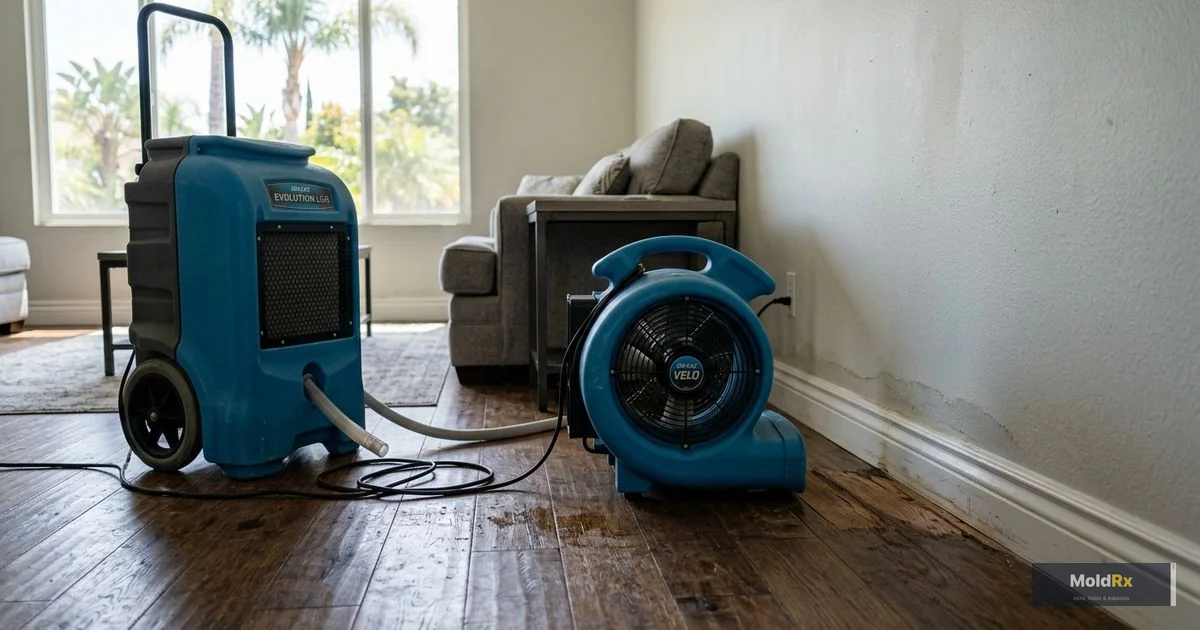
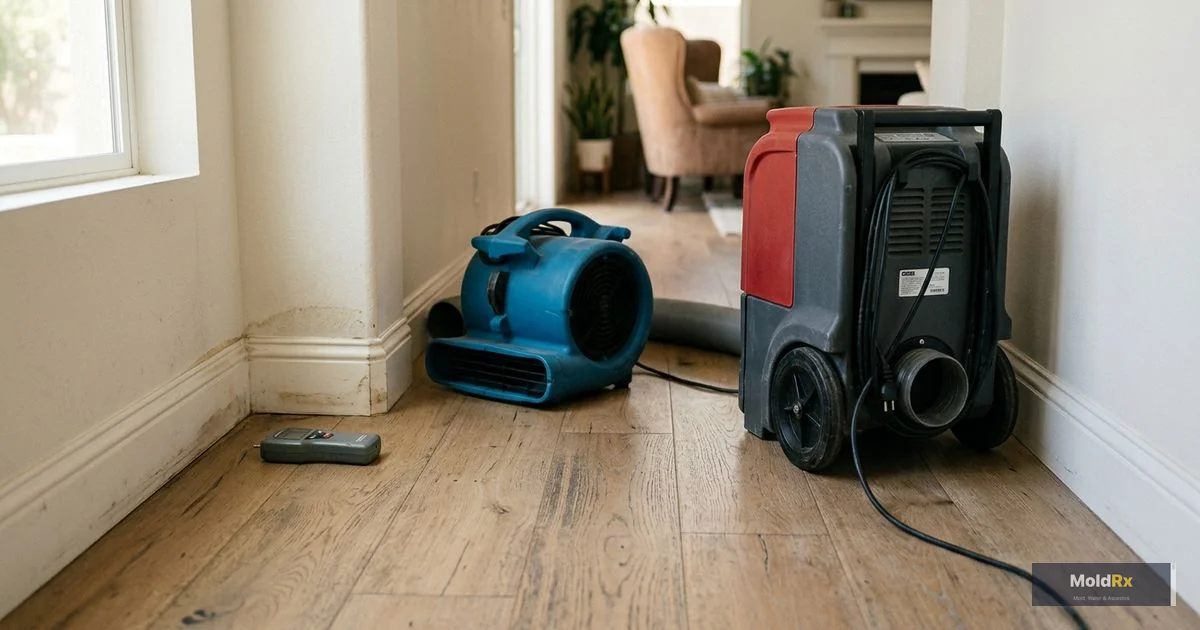
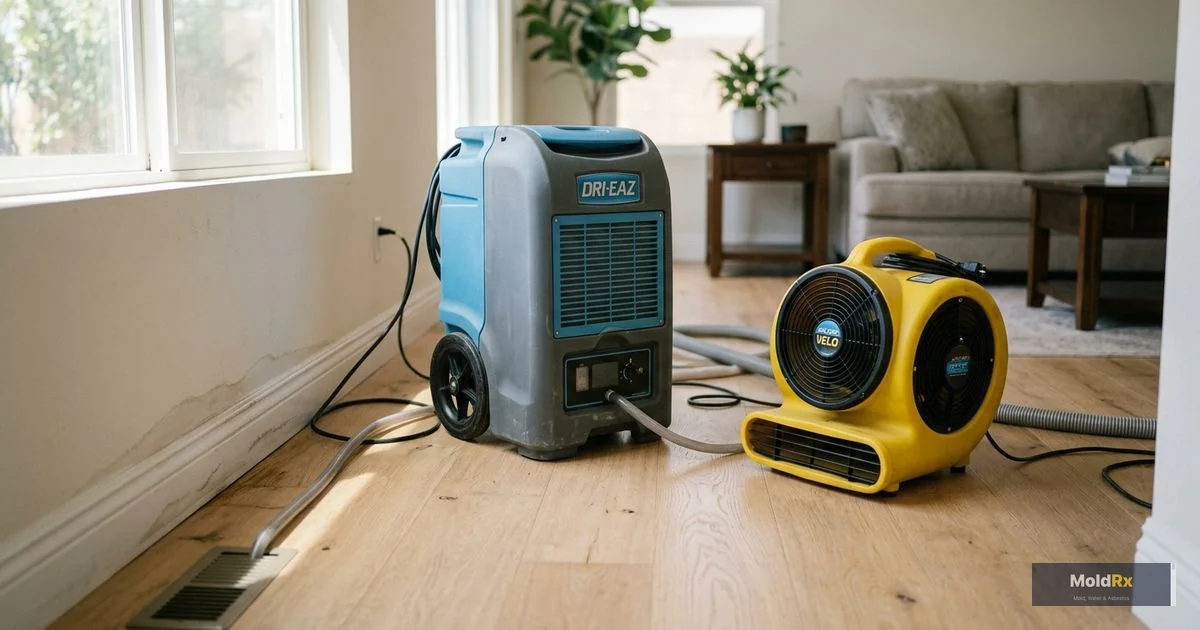
Our vetted specialists deploy Class-specific drying systems calibrated for the water loss classification:
- Class 1 (slow evaporation rate, minimal absorption): Targeted air movement and dehumidification for isolated areas
- Class 2 (fast evaporation rate, water affecting entire rooms with absorption into structural materials up to 24 inches high): Wall cavity drying systems, commercial air movers, and LGR (low-grain refrigerant) dehumidifiers rated for San Clemente's humidity levels
- Class 3 (fastest evaporation rate, water saturating from overhead — ceiling, walls, insulation, subfloor): Overhead drying systems, injectidry wall-cavity systems, and aggressive dehumidification capable of overcoming the ambient coastal moisture
- Class 4 (specialty drying for deep moisture in hardwood, plaster, concrete, stone): Extended drying with desiccant dehumidifiers and specialized heat-drying systems for materials with very low permeance ratings
Throughout the drying process, technicians monitor progress with daily moisture readings using pin-type and pinless moisture meters, thermo-hygrometers, and thermal imaging cameras. Drying is not considered complete when materials feel dry to the touch. It is complete when documented moisture content readings fall within the dry standard established at the start of the job — typically matching unaffected reference materials in the same structure.
In San Clemente homes, this phase frequently takes longer than in inland properties because the dehumidification equipment must overcome the constant moisture contribution from the coastal air. Our specialists account for this from day one, sizing equipment appropriately and setting realistic timelines.
Phase 4: Antimicrobial Treatment and Mold Prevention
Given the EPA-documented relationship between sustained moisture and mold colonization, every water damage restoration in San Clemente includes antimicrobial treatment of affected structural materials. This is not optional in a coastal environment — it is essential.
Antimicrobial agents are applied to exposed framing, subfloor materials, and any structural components that were wetted during the loss. For Category 2 and Category 3 losses, more aggressive biocide and sanitization protocols are followed per IICRC S520 standards.
If mold growth is discovered during the restoration process — which is common in San Clemente properties where slow leaks may have preceded the catastrophic failure — the scope expands to include professional mold remediation under full containment. Our vetted specialists carry dual IICRC S500 and IICRC S520 certifications for exactly this reason.
Phase 5: Reconstruction and Restoration
Once the structure is verified dry and treated, damaged materials are replaced and the property is restored to its pre-loss condition. This includes:
- Drywall replacement, tape, texture matching, and paint
- Flooring reinstallation or replacement
- Baseboard and trim replacement
- Cabinet repair or replacement where water intrusion occurred
- Insulation replacement in affected wall and ceiling cavities
Our specialists coordinate with your insurance adjuster throughout this phase, providing the documentation and scope detail needed to support your claim.
The Categories and Classes: Why Correct Classification Protects You
Not all water damage is the same, and the distinction is not academic — it determines the health risk, the required restoration protocol, and the scope of work needed to make your San Clemente home safe again.
Water Damage Categories (Contamination Level)
Category 1 — Clean Water: Originates from a sanitary source. Broken supply lines, appliance feed lines, rainwater intrusion. Poses no immediate health risk from contact, but must be extracted and dried rapidly to prevent degradation to Category 2 or 3 as bacterial growth begins.
Category 2 — Gray Water: Contains significant contamination that can cause illness if contacted or ingested. Sources include washing machine discharge, dishwasher overflow, sump pump failures, and aquarium leaks. Requires protective equipment for workers and removal of contaminated porous materials.
Category 3 — Black Water: Grossly contaminated water containing pathogenic organisms, toxins, or other harmful agents. Sewer backups, toilet overflows with fecal matter, rising floodwater, and wind-driven rain carrying surface contaminants. IICRC S500 mandates the most aggressive response protocols for Category 3, including full PPE for workers, removal of all affected porous materials, and sanitization of non-porous surfaces.
Critical fact: Category 1 water that is not extracted within 48 hours can degrade to Category 2. Category 2 can degrade to Category 3. In San Clemente's humidity, these transitions happen faster. This is why immediate response is not a sales pitch — it is a health and safety imperative.
Water Damage Classes (Evaporation Load)
Class 1: Least amount of absorption and evaporation. Small area affected, low-porosity materials.
Class 2: Significant absorption. Water has wicked up walls at least 12-24 inches. Entire rooms affected. Structural materials are holding moisture.
Class 3: Greatest amount of absorption. Water may have come from overhead, saturating walls, ceilings, insulation, and subfloor from above. Common in multi-story San Clemente homes where a second-floor plumbing failure sends water cascading through the structure.
Class 4: Specialty drying situations involving materials with very low permeance — hardwood flooring, plaster walls (common in San Clemente's 1920s-1940s homes), concrete, and natural stone. These materials trap moisture deep within their matrix and require extended drying time with specialized equipment.
San Clemente Neighborhoods and Areas We Serve
Our vetted water damage restoration specialists respond to emergencies across every neighborhood and community in San Clemente, including:
- Historic Downtown and Pier Bowl — 1920s-1960s construction, original plumbing, proximity to coastal flooding
- Spanish Village by the Sea — Character homes with aging infrastructure and salt-air exposure
- Southwest San Clemente and T-Street — Beach cottages and coastal properties with maximum marine-layer humidity exposure
- Avenida Del Mar corridor — Mixed residential and commercial with pre-war construction
- Talega — Master-planned community, late 1990s and newer, complex multi-story plumbing
- Forster Ranch — Spacious lots, ranch-style and modern homes, hillside runoff concerns
- Sea Summit and Marblehead Coastal — Newer luxury construction on the bluffs
- Rancho San Clemente — Diverse housing stock with both older and newer construction
- Vista Hermosa and Costanoa — Mixed-era homes along the inland ridgeline
- Shorecliffs and Riviera — Mid-century homes with direct coastal exposure
We cover ZIP codes 92672 and 92673, as well as neighboring communities including Dana Point to the north and areas adjacent to Camp Pendleton to the south.
What to Do Right Now If You Have Water Damage
If water is actively in your San Clemente home, take these steps immediately:
- Shut off the water supply if the source is a plumbing failure. The main shut-off valve is typically near the street-side property line or where the supply line enters the home.
- Turn off electricity to affected areas if water is near electrical outlets, appliances, or the breaker panel. If you cannot safely reach the panel, call your electrician or SCE.
- Do not walk through standing water if the source is unknown or potentially Category 3 (sewage, floodwater). Black water contains pathogens that pose genuine health risks.
- Do not attempt to dry the structure yourself with household fans. Improper air movement can push moisture deeper into wall cavities and spread contamination in Category 2 and 3 losses.
- Call (888) 609-8907 or request your free estimate immediately. The sooner a vetted, IICRC-certified specialist assesses the loss, the more of your home can be saved and the lower the total restoration scope will be.
Document what you can with photos and video for your insurance claim, but do not delay calling for help to take pictures. Your specialist will handle comprehensive documentation on arrival.
Insurance and Your Water Damage Claim
Most homeowner's insurance policies in San Clemente cover sudden and accidental water damage — burst pipes, appliance failures, water heater ruptures. Gradual damage from deferred maintenance, earth movement, and flooding from external sources typically require separate coverage or a Difference in Conditions (DIC) policy.
Our vetted specialists document every water damage restoration in San Clemente with the detail your insurance company requires: moisture readings, photographic evidence, affected materials inventory, category and class designation, scope of work, and drying logs. This documentation is provided to you and your adjuster to support your claim.
We do not inflate scope. We do not manufacture damage. Our specialists document what is there and what needs to happen to fix it. That honesty is what makes the documentation credible when your adjuster reviews the claim.
Frequently Asked Questions
How quickly should I address water damage in my San Clemente home?
Immediately. Not within a day or two — immediately. IICRC S500 standards establish that mold can begin growing on wet materials in 24 to 48 hours, and San Clemente's coastal humidity shortens that timeline. Category 1 water degrades to Category 2 as bacteria colonize stagnant water, and Category 2 degrades to Category 3. Every hour you wait expands the scope of damage, increases the restoration cost, and elevates the health risk. Call (888) 609-8907 or request your free estimate now.
Will my homeowner's insurance cover the restoration?
Most standard policies cover sudden and accidental water damage — supply line failures, appliance malfunctions, water heater ruptures. They typically exclude flood damage (which requires separate NFIP or private flood coverage), gradual leaks from deferred maintenance, and earth movement including mudslide-related water intrusion. Our vetted specialists produce the documentation your adjuster needs. We work with every major carrier.
How do you determine the category and class of my water damage?
Our vetted specialists assess the contamination source to determine the category (1, 2, or 3) per IICRC S500 protocol, then evaluate the evaporation load — how much water was absorbed, what materials are affected, and the extent of saturation — to assign the class (1 through 4). This classification drives every decision in the restoration, from PPE requirements to material removal protocols to drying equipment selection.
How long does water damage restoration take in San Clemente?
Timelines depend on the category, class, and scope of the loss. A contained Class 1 supply-line break in a single room may require 3-5 days of drying. A Class 3 multi-room loss with Category 2 or 3 water, common in older San Clemente homes with hidden plumbing failures, may require 7-14 days for extraction, drying, treatment, and reconstruction. San Clemente's humidity typically adds 1-2 days to drying timelines compared to inland properties. Our specialists provide realistic timelines after the initial assessment — no false promises.
Can water-damaged hardwood, plaster, and original materials be saved?
In many cases, yes — if response is fast enough. Original hardwood floors, plaster walls in San Clemente's historic homes, and quality construction materials can often be restored through proper extraction and controlled drying techniques, including Class 4 specialty drying protocols. However, porous materials exposed to Category 2 or Category 3 water — carpet pad, standard drywall below the flood line, insulation — must be removed per IICRC S500 and IICRC S520 standards regardless of how quickly you respond. The sooner you call, the more of your home's original character can be preserved.
What is the difference between water damage restoration and mold remediation?
Water damage restoration (IICRC S500) addresses the immediate crisis: extracting water, drying the structure, and restoring damaged materials. Mold remediation (IICRC S520) addresses fungal colonization that occurs when moisture persists. In San Clemente, these two services frequently overlap because the coastal humidity accelerates mold growth on water-damaged materials. Our vetted specialists hold certifications in both standards and can transition seamlessly from restoration to remediation if mold is discovered during the drying process.
Related Services in San Clemente
Water damage and mold go hand in hand in San Clemente's coastal environment. In addition to emergency water damage restoration, MoldRx connects San Clemente property owners with vetted specialists for Mold Removal in San Clemente, Asbestos Removal in San Clemente.
Important for older San Clemente homes: Properties built before 1980 may contain asbestos in flooring, insulation, pipe wrap, or textured ceilings. When water damage restoration requires removing these materials, asbestos testing should be performed first. Our vetted specialists coordinate both services to keep your family safe and your project compliant with Cal/OSHA and EPA regulations.
Learn more about all remediation services in San Clemente
Stop the Damage Now — Call MoldRx
Every minute that water sits in your San Clemente home, the damage deepens, the scope expands, and the risk of mold colonization increases. MoldRx only sends vetted, IICRC-certified specialists who follow IICRC S500, IICRC S520, and EPA protocols — because your home, your health, and your family deserve professionals who do this the right way.
No pricing games. No bait-and-switch. No sending whoever is available. We match your emergency with the right specialist for your specific situation, and we do it fast.
Request your free emergency estimate now | Call (888) 609-8907 — 24 hours, 7 days, every day.