Emergency Water Damage Restoration in San Juan Capistrano, CA -- MoldRx
Vetted, IICRC S500-Certified Specialists Serving San Juan Capistrano and South Orange County -- 24/7
Water is inside your San Juan Capistrano home right now, and it is destroying materials you cannot see. Behind the drywall. Under the Saltillo tile. Saturating the subfloor in that 1960s ranch house near the Mission. Wicking into the adobe-adjacent plaster in the Los Rios Historic District. Within 24 to 48 hours, mold colonization begins -- and at that point a water damage emergency becomes a mold remediation project that costs multiples more. If water has entered your property, stop reading and call.
Call (888) 609-8907 now for emergency water damage response in San Juan Capistrano.
MoldRx does not perform restoration work ourselves. We vet the specialists who do. Every water damage professional we send to your San Juan Capistrano property has been screened for IICRC S500 certification, proper CSLB licensing, verified insurance, and documented experience handling the exact building types, creek-flood scenarios, and aging-infrastructure failures that define water damage in this city. You get the right crew -- not whoever happens to answer the phone.
Why Water Damage in San Juan Capistrano Is Different
San Juan Capistrano is not a generic Orange County suburb. It is a city built at the confluence of two major creek systems, with a housing stock that spans nearly 250 years, an active equestrian community with unique property configurations, and a flood history that FEMA, the Army Corps of Engineers, and Orange County Public Works have studied for decades. Your water damage situation here carries risks that do not exist ten miles in any direction.
Two Creeks, One Valley, and a Documented Flood History
San Juan Capistrano sits in the valley where San Juan Creek and Trabuco Creek converge before draining to the Pacific at Doheny State Beach. This is not an academic detail -- it is the reason this city has flooded repeatedly for over 200 years, and it is the reason your property faces water intrusion risks that most South Orange County homeowners never consider.
The documented record is sobering:
- 1861-1862: Four continuous weeks of rain tore into adobe walls, carried away structures, and reshaped the creek channels
- 1916: Flooding destroyed multiple railroad bridges and 1,000 feet of rail track
- 1938: Nine inches of rain in six days -- both creeks crested their banks and inundated surrounding areas
- 1969: The USGS gauge at San Juan Creek measured 5.8 feet; 14.56 inches of rain fell in January and February alone
- 1996-1998: Severe flooding overflowed San Juan Creek, destroyed long sections of concrete channel lining, breached the embankment adjacent to City Hall, and severely damaged a pedestrian bridge on Trabuco Creek
- 2005: The highest flow ever recorded in the San Juan watershed -- 33,650 cubic feet per second on January 11 -- shattered all previous records
- 2010: San Juan Hills Golf Club flooded, horses were evacuated from equestrian properties, Mission San Juan Capistrano closed, and Amtrak suspended service
Properties in lower-lying areas near the historic downtown, along the creek corridors, and in the floodplain zones mapped by FEMA face genuine flash-flood exposure during heavy winter storms. When San Juan Creek or Trabuco Creek overtops, the water that enters your home is not Category 1 clean water from a supply line. It is Category 3 black water carrying sediment, sewage, agricultural runoff from upstream equestrian operations, and microbial contaminants that require full hazmat-level restoration protocols per IICRC S500 and Cal/OSHA standards.
A Housing Stock Spanning Three Centuries
Approximately 37,000 people live in San Juan Capistrano across ZIP codes 92675 and 92693. The building inventory here is unlike anything else in Orange County:
- Pre-1900 adobes and Victorian-era structures in the Los Rios Historic District -- the oldest residential neighborhood in California, containing forty historic homes including three original adobe structures (the Montanez, Rios, and Silvas adobes) dating to the late 1700s. These buildings use earthen construction materials that absorb and retain water in ways modern drywall never does. Adobe walls saturated by a plumbing failure or storm intrusion require Class 4 specialty drying protocols -- standard equipment and techniques will destroy them.
- 1960s and 1970s tract homes throughout established neighborhoods near Camino Capistrano and Del Obispo Street. These properties are now 50 to 65 years old and carry the predictable infrastructure failures of that era: corroding cast iron drain lines, galvanized steel supply pipes developing pinhole leaks, polybutylene piping (installed widely in the 1970s-1980s) becoming brittle and failing at joints, and original water heaters that have been replaced at least once and are often overdue again.
- Custom equestrian estates on larger parcels, many with barns, riding arenas, wash racks, and irrigation infrastructure that create water-damage vectors residential contractors rarely encounter. A failed well pump, a ruptured irrigation main, or a horse-wash drain backup can send thousands of gallons into adjacent living spaces before anyone notices.
- 1980s-2000s developments in communities like Rancho San Juan, Marbella Country Club, San Juan Hills, and Capistrano Villas -- slab-on-grade and raised-foundation construction with aging supply lines, water heaters at or past their service life, and appliance connections approaching failure.
Every one of these building types responds differently to water intrusion. The specialists MoldRx vets for San Juan Capistrano understand which materials can be dried, which must be removed, and which require the kind of specialty protocols that most restoration crews have never performed.
The Equestrian Factor
San Juan Capistrano's identity as an equestrian community -- home to the Rancho Mission Viejo Riding Park and dozens of private equestrian properties along the creek corridors -- creates water damage scenarios that are genuinely unusual. Horse properties have extensive plumbing networks for wash racks, paddock drainage, and irrigation systems. These systems run through outdoor environments exposed to soil movement, root intrusion, and corrosion. When they fail, they often fail big -- a ruptured irrigation main on a two-acre equestrian lot can saturate the soil beneath an adjacent home's foundation for days before the source is identified.
Additionally, floodwater that has contacted equestrian land carries biological contaminants -- animal waste, hay decomposition, parasites, and bacteria -- that automatically classify it as Category 3 per IICRC S500 standards. There is no drying-in-place option for porous materials contacted by this water. They come out.
Mediterranean Climate with a Flooding Problem
San Juan Capistrano's semi-arid Mediterranean climate delivers roughly 14 inches of annual rainfall, concentrated almost entirely between November and March. The city enjoys approximately 280 sunny days per year. But those winter storms arrive in intense bursts that overwhelm drainage infrastructure -- particularly in a valley flanked by the Santa Ana Mountains to the east, where runoff funnels directly into the San Juan Creek and Trabuco Creek watersheds.
The pattern is predictable: months of dry conditions followed by sudden, heavy rainfall on hardened, drought-compacted soil that cannot absorb it. Water sheets off hillsides, floods creek channels, backs up storm drains, and enters properties through every pathway available -- foundations, window wells, garage doors, slab cracks, and compromised exterior walls.
Coastal proximity (roughly six miles to the Pacific) adds marine-layer humidity that prevents natural drying of water-damaged materials. After a flood event or major plumbing failure, you cannot open windows and wait. The ambient moisture works against you.
The IICRC S500 Restoration Process Our Vetted Specialists Follow
The professionals MoldRx sends to your San Juan Capistrano property do not improvise. They follow the IICRC S500 Standard and Reference Guide for Professional Water Damage Restoration -- the ANSI-accredited, industry-recognized protocol that defines how this work must be done. Here is what that looks like in a city with three centuries of building types and two major creek systems running through it.
Step 1: Emergency Response and Loss Assessment
When you call (888) 609-8907, we deploy a vetted specialist to your San Juan Capistrano property for immediate assessment. They will:
- Identify and stop the water source -- whether it is a burst galvanized supply line in a 1960s ranch, a failed slab-mounted water heater, a backed-up sewer lateral, an irrigation system rupture on an equestrian lot, or floodwater intrusion from San Juan Creek
- Classify the water category per IICRC S500 standards:
- Category 1 (Clean Water): Originates from a sanitary source -- broken supply lines, sink overflows, toilet tank failures, melting ice. Lowest contamination risk but demands rapid extraction before degradation begins.
- Category 2 (Gray Water): Contains significant contamination causing potential illness on contact or ingestion -- dishwasher discharge, washing machine overflow, toilet overflows with urine, sump pump failures, HVAC condensate line backups. Requires enhanced PPE and antimicrobial protocols.
- Category 3 (Black Water): Grossly contaminated water containing pathogenic, toxigenic, or other harmful agents -- sewage backups, floodwater from San Juan Creek or Trabuco Creek, storm-drain intrusion, groundwater rise through slab cracks, or any Category 1 or 2 water that has remained stagnant for 48+ hours. Cal/OSHA hazmat protocols apply. All contacted porous materials must be removed. This is the most dangerous and most expensive scenario, and in a flood-prone city like San Juan Capistrano, it is more common than most homeowners expect.
- Determine the damage class per IICRC standards:
- Class 1: Least amount of water absorption -- small area, minimal material saturation
- Class 2: Significant absorption -- water saturating carpet, cushion, and wicking up walls to 24 inches
- Class 3: Greatest absorption -- water from overhead sources, saturating ceilings, walls, insulation, carpet, and subfloor simultaneously
- Class 4: Specialty drying situations involving hardwood, plaster, adobe, concrete, tile over mortar beds, or stone -- materials with very low permeance that trap moisture and require extended drying with specialized equipment. Common in San Juan Capistrano's historic structures and older slab-on-grade homes.
- Map the full moisture footprint using infrared thermal imaging and penetrating moisture meters -- essential in San Juan Capistrano's older homes where water travels through plaster, adobe, mortar joints, and beneath multi-layer flooring systems in ways that are completely invisible to the eye
- Document everything with timestamped photography and written reports for insurance claims, and in historic-district properties, for potential compliance with preservation requirements
Step 2: Water Extraction
Standing water is removed immediately using truck-mounted and portable extraction units. For San Juan Capistrano properties, extraction protocols vary dramatically by building type:
- Historic adobes and plaster-wall structures: Low-pressure extraction to prevent mechanical damage to irreplaceable materials
- 1960s-70s slab-on-grade homes: Targeted extraction at slab-foundation interfaces where water pools beneath baseboards and travels laterally through expansion joints
- Equestrian properties: Large-volume extraction for irrigation failures and flood events that can involve thousands of gallons across multiple structures
- Multi-story homes in hillside developments: Top-down extraction strategy to prevent cascading water damage to lower levels
Speed is everything in this phase. Every hour water remains in contact with building materials increases the damage class, elevates the contamination category (Category 1 water degrades to Category 2, then Category 3 over time), and expands the scope and cost of restoration. The specialists we vet understand that extraction is not a task you can approximate -- it must be thorough, documented, and complete.
Step 3: Structural Drying and Dehumidification
This is the phase that separates competent restoration from the kind that produces a mold problem eight weeks later.
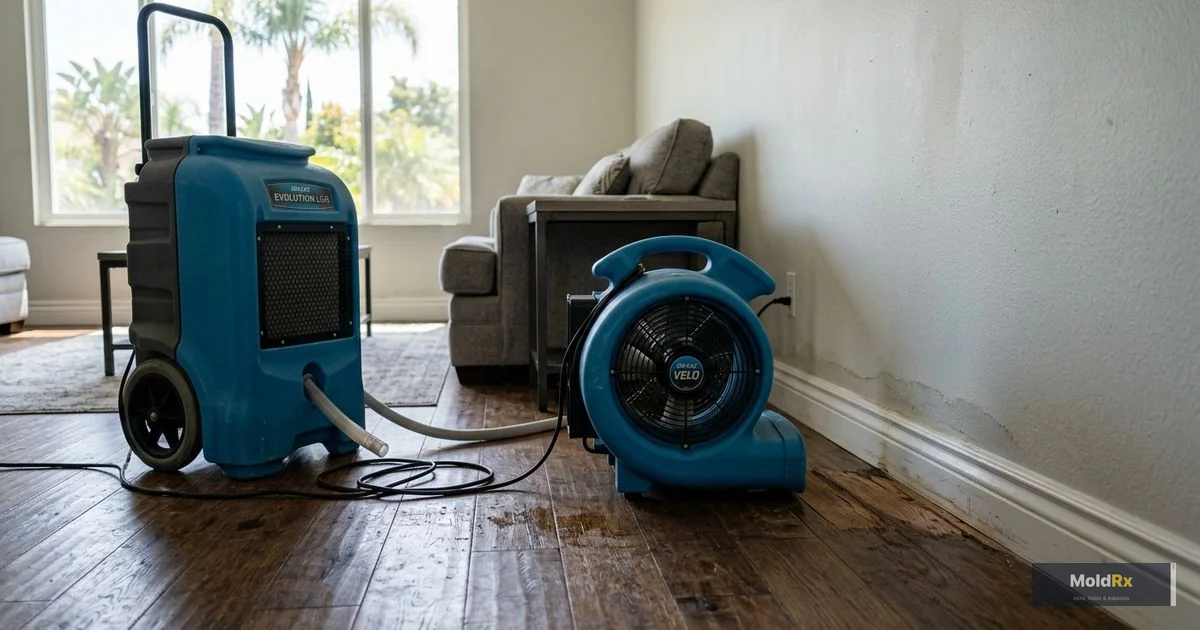
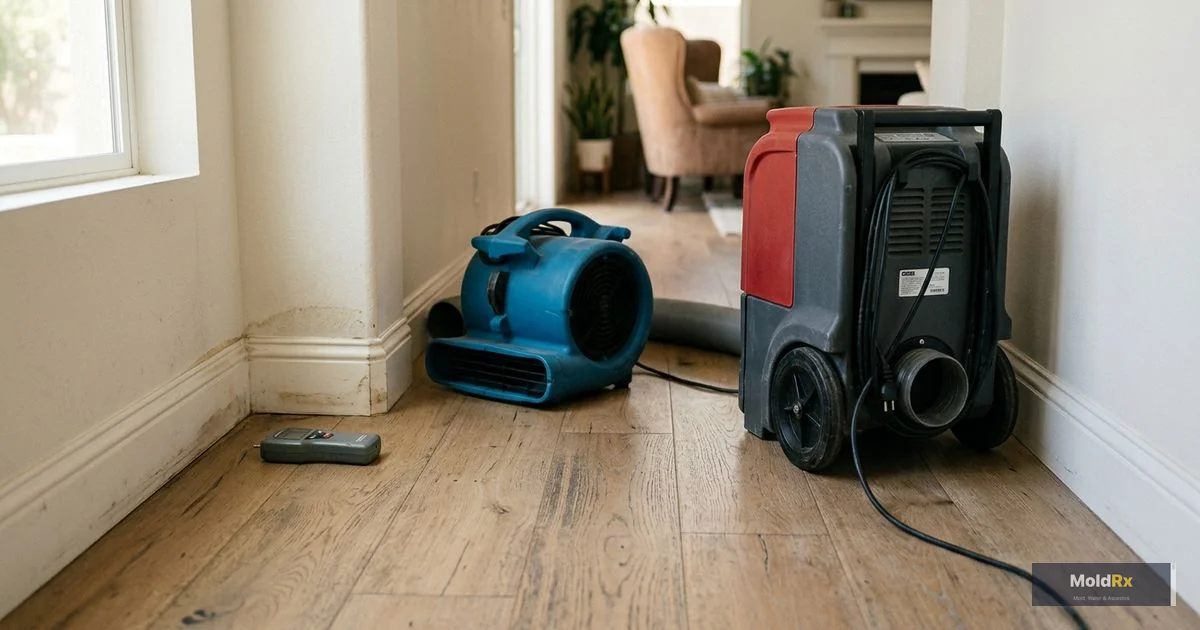
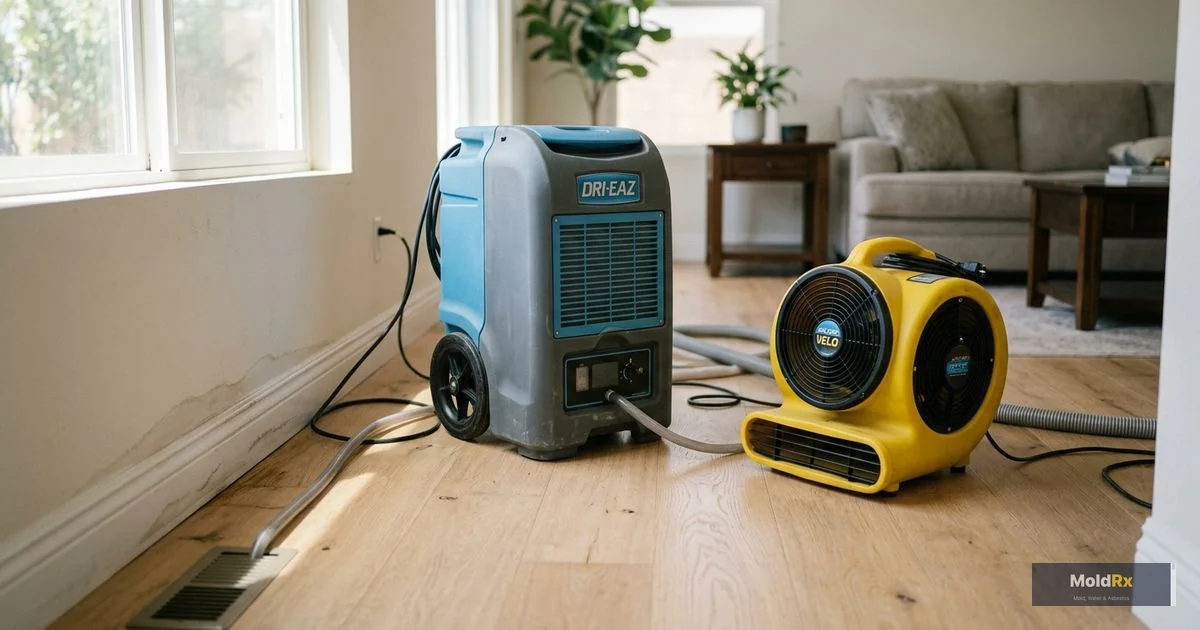
Our vetted specialists deploy commercial-grade LGR (low-grain refrigerant) dehumidifiers and high-velocity air movers in configurations calculated for each affected space. In San Juan Capistrano, where marine-layer humidity and valley-bottom air stagnation can keep ambient moisture elevated, the drying protocol must compensate for environmental conditions that actively work against you. Standard residential dehumidifiers cannot perform this work.
For Class 4 losses -- common in San Juan Capistrano's historic structures with plaster walls, adobe construction, hardwood flooring over mortar beds, and Saltillo tile installations -- specialty techniques are required. Desiccant dehumidification, heat drying systems, and controlled-environment chambers may be deployed to extract moisture from materials that have very low vapor permeance and will not release water under standard protocols.
Drying is monitored daily with calibrated moisture meters and hygrometers. The specialists document psychrometric readings -- temperature, relative humidity, grain depression -- to verify that conditions are progressing toward the IICRC S500 drying goals for each material type. Drying is not complete when the floor feels dry underfoot. It is complete when instrument readings confirm that all affected materials -- including those hidden inside wall cavities, beneath flooring layers, and within slab-to-framing interfaces -- have returned to their normal equilibrium moisture content.
Step 4: Cleaning, Sanitization, and Antimicrobial Treatment
Once the structure is verified dry, the contamination category dictates the protocol:
- Category 1 losses: Cleaning and thorough drying may be sufficient for salvageable materials. Hard surfaces are cleaned; porous materials that dried successfully are evaluated for retention.
- Category 2 losses: All affected porous materials that cannot be adequately cleaned must be removed. Semi-porous materials receive antimicrobial treatment using EPA-registered products applied per label instructions. PPE requirements are elevated.
- Category 3 losses: All affected porous materials are removed and discarded -- no exceptions. This includes drywall, insulation, carpet, pad, upholstered furnishings, and any organic material that contacted the contaminated water. Structural framing is cleaned, treated with EPA-registered antimicrobials, and verified before reconstruction begins. In sewage-backup and creek-flood scenarios -- both common in San Juan Capistrano -- IICRC S520 mold remediation protocols may run concurrently if microbial growth is identified during the process.
Step 5: Reconstruction and Restoration
The final phase returns your property to pre-loss condition: drywall replacement, flooring reinstallation, painting, trim work, cabinetry repair, and any structural repairs identified during the drying phase. For San Juan Capistrano's historic properties, reconstruction may require materials and techniques consistent with the original construction -- a level of craftsmanship that generic restoration crews cannot provide.
Our vetted specialists coordinate reconstruction to minimize displacement and disruption, whether you are in a family home near San Juan Hills, a condo in Capistrano Villas, or a historic property in the Los Rios District that may involve additional preservation considerations.
What Category and Class Mean for Your San Juan Capistrano Property
Understanding the IICRC S500 classification system protects you from being oversold on unnecessary work -- or undersold on work that is critical. Here is how the system applies to the water damage scenarios most common in San Juan Capistrano.
| Classification | What It Means | Common San Juan Capistrano Scenarios |
|---|---|---|
| Category 1 | Clean water from a sanitary source | Burst supply line, ice-maker line failure, toilet tank crack, water heater supply rupture |
| Category 2 | Contaminated water causing potential illness | Washing machine overflow, dishwasher backup, HVAC condensate failure, irrigation system cross-connection |
| Category 3 | Grossly contaminated / black water | Sewage backup, San Juan Creek floodwater, Trabuco Creek overflow, equestrian-land runoff, any stagnant water 48+ hours |
| Class 1 | Minimal absorption, small area | Leak caught early, limited to one room with hard-surface flooring |
| Class 2 | Significant absorption, water wicking up walls | Burst supply line saturating carpet and wicking into drywall to 24 inches |
| Class 3 | Greatest absorption, water from overhead | Second-floor plumbing failure saturating ceiling, walls, and flooring of level below |
| Class 4 | Specialty drying -- low-permeance materials | Water trapped in adobe walls, plaster, concrete slab, Saltillo tile, hardwood over mortar |
The higher the category and class, the more complex, time-intensive, and costly the restoration. But cutting corners on a Category 3 / Class 3 loss to reduce short-term costs virtually guarantees a mold remediation project within weeks -- a project that will cost significantly more than doing the water damage restoration correctly the first time.
Request your free estimate now -- or call (888) 609-8907 for immediate emergency response.
The Most Common Water Damage Scenarios in San Juan Capistrano
Based on the building stock, geography, and infrastructure age in this city, these are the water damage situations our vetted specialists encounter most frequently.
Aging Plumbing Failures in 1960s-1970s Homes
The wave of residential construction that swept through San Juan Capistrano in the 1960s and 1970s produced thousands of homes that are now 50 to 65 years old. The plumbing in these properties was state-of-the-art when installed -- galvanized steel supply lines, cast iron drain pipes, copper with lead-solder joints -- but every one of these materials has a finite service life, and most of these homes have reached or exceeded it.
Galvanized steel corrodes from the inside out, restricting flow before eventually developing pinhole leaks at joints and fittings. Cast iron drain lines develop internal scaling that leads to slow drains, then cracks, then failures that send gray or black water under the slab. Polybutylene supply piping -- installed widely in 1970s-1980s construction across San Juan Capistrano -- becomes brittle with age and chlorine exposure, failing suddenly and catastrophically at fittings and valves.
When a 55-year-old supply line bursts behind a wall at 3 AM, you can lose hundreds of gallons per hour into your wall cavities, subfloor, and foundation before anyone notices. By morning, you have a Class 2 or Class 3 loss that has already begun degrading toward Category 2 contamination.
San Juan Creek and Trabuco Creek Flooding
This is the water damage scenario unique to San Juan Capistrano. When winter storms dump heavy rainfall onto the Santa Ana Mountain watersheds, runoff funnels into San Juan Creek and Trabuco Creek with force that has overwhelmed engineered channel systems repeatedly -- in 1969, 1982, 1993, 1996, 1998, 2005, and 2010.
Properties along the creek corridors, in lower-elevation areas near the historic downtown, and in FEMA-mapped floodplain zones face genuine flash-flood risk. Creek floodwater is automatically Category 3 -- it carries sediment, sewage from overwhelmed municipal systems, agricultural and equestrian contaminants from upstream, and microbial loads that make it immediately dangerous to occupants and destructive to building materials.
Flood restoration in San Juan Capistrano is not a dry-it-out operation. It is a full IICRC S500 / IICRC S520 combined protocol: extract, remove all contacted porous materials, treat structural components with EPA-registered antimicrobials, verify microbial clearance, and reconstruct. The specialists we vet for flood response carry Cal/OSHA-compliant PPE and understand the hazmat-level protocols that creek floodwater demands.
Slab Leaks in Older Construction
Homes built on slab-on-grade foundations -- common throughout San Juan Capistrano's 1960s-1980s developments -- route supply and drain lines through or beneath the concrete slab. Over decades, soil movement, seismic activity, and pipe corrosion cause these lines to develop leaks that run undetected for weeks or months.
The symptoms are subtle at first: a warm spot on the floor, a faint musty smell, an unexplained increase in the water bill. By the time a slab leak is identified, water has often saturated the concrete, migrated laterally through the sand bed beneath the slab, and wicked into wall framing and flooring materials across an area far larger than the visible damage suggests.
Slab leaks in San Juan Capistrano typically present as Class 4 losses requiring specialty drying. The concrete itself must be dried -- a process that can take significantly longer than standard structural drying because concrete has extremely low vapor permeance and releases moisture slowly.
Roof Failures on Historic and Mid-Century Properties
San Juan Capistrano's architectural identity includes Spanish tile roofs, flat-roof sections on mid-century modern homes, and wood-shake roofing on older properties. All of these systems degrade: tile underlayment fails, flat-roof membranes crack, wood shakes split and curl. When a heavy winter storm hits -- and in San Juan Capistrano, those storms are intense -- a compromised roof system allows water into attic spaces, ceiling cavities, and wall interiors.
Roof-driven water damage is often a Class 3 scenario because the water enters from above, saturating everything as it moves downward through the structure. Ceiling drywall, insulation, wall cavities, and flooring can all be affected by a single roof failure in a single storm event.
Appliance and Water Heater Failures
This is the most common cause of residential water damage nationwide, and San Juan Capistrano is no exception. Water heaters in garages -- standard in Southern California home design -- fail and release 40 to 80 gallons onto the garage floor, which then flows into adjacent living spaces. Washing machine supply hoses burst. Dishwasher drain connections fail. Refrigerator ice-maker lines develop pinhole leaks behind the unit where no one sees them for weeks.
In older San Juan Capistrano homes, the appliance connections themselves are often original -- rubber supply hoses that should have been replaced with braided steel decades ago, compression fittings that have loosened with vibration over years of use, and drain hoses that have hardened and cracked. These failures are sudden, and they typically release water directly onto finished flooring.
Why MoldRx -- And Why "Vetted" Is Not a Marketing Word
There are dozens of restoration companies in Orange County that will answer the phone at 2 AM and promise to be at your San Juan Capistrano property within the hour. Some of them are excellent. Some of them are not licensed, not insured, not trained, and not accountable when they leave moisture behind your adobe walls and you discover mold ten weeks later in a structure that has stood since 1794.
MoldRx exists because Tyler and Adrian -- co-founders with over 40 years of combined remediation and business experience -- saw that problem firsthand and built a solution. We do not perform restoration ourselves. We vet the people who do, and we only send specialists who meet every one of these criteria:
- IICRC S500 certification for water damage restoration
- IICRC S520 certification for mold remediation -- because water damage and mold overlap in virtually every loss
- Active CSLB contractor's license in good standing with the California State License Board
- Verified general liability and workers' compensation insurance -- protecting you from liability if an accident occurs on your property
- Documented experience with the specific building types in San Juan Capistrano: historic adobes, 1960s-70s tract homes, equestrian properties, slab-on-grade construction, and hillside developments
- Cal/OSHA compliance for worker safety protocols, particularly critical in Category 3 / black-water and creek-flood scenarios
- Understanding of EPA guidelines for antimicrobial application, contaminated-material disposal, and occupant safety during restoration
When we say "vetted," we mean we have verified every credential, called references, confirmed insurance, and established that these specialists do the work per IICRC S500 and EPA standards -- with proper documentation, honest communication, and accountability. San Juan Capistrano properties are too valuable and too varied to trust to anyone who simply owns extraction equipment.
San Juan Capistrano Neighborhoods We Serve
Our vetted water damage restoration specialists respond to emergencies throughout San Juan Capistrano, including:
- Los Rios Historic District -- California's oldest residential neighborhood, requiring Class 4 specialty protocols for historic adobe and plaster construction
- San Juan Hills and the San Juan Hills Golf Club area
- Marbella Country Club and Rancho San Juan
- Meredith Canyon and Casitas de Capistrano
- Capistrano Villas and the Serra Plaza area
- Del Obispo corridor and Camino Capistrano corridor properties
- Ortega Highway corridor and hillside properties
- Equestrian estates throughout the creek corridors and rural residential zones
We cover ZIP codes 92675 and 92693, from the historic downtown core to the newest developments at the city's edges.
We also respond to water damage emergencies in neighboring South Orange County communities, including Dana Point, Laguna Niguel, Mission Viejo, Rancho Santa Margarita, Ladera Ranch, and San Clemente.
Insurance and Documentation
Most San Juan Capistrano homeowner policies cover sudden and accidental water damage -- a burst supply line, a failed water heater, an appliance malfunction. What they typically do not cover is gradual damage from deferred maintenance, and standard policies almost never cover flood damage (which requires a separate NFIP or private flood policy -- directly relevant for San Juan Capistrano properties in FEMA-mapped floodplain zones along San Juan Creek and Trabuco Creek).
Our vetted specialists understand what insurance adjusters require:
- Timestamped photo and video documentation of all affected areas before, during, and after restoration
- Moisture readings and psychrometric data supporting the drying protocol and confirming completion
- Itemized scope of work with IICRC-standard line items that adjusters can process without resistance
- Category and class determination documented per IICRC S500 standards -- this directly affects what your policy covers and the reimbursement amount
For San Juan Capistrano's historic properties, documentation may also need to address preservation considerations and compliance with any applicable historical-district regulations. Our vetted specialists have experience producing the records that both insurance carriers and municipal agencies require.
Frequently Asked Questions
How fast can a vetted specialist reach my San Juan Capistrano property?
For active water emergencies, our goal is same-day deployment -- often within hours. Call (888) 609-8907 any time, day or night. Water damage does not wait for business hours and neither do we. San Juan Capistrano is within rapid-response range of our vetted specialist network serving South Orange County.
What is the difference between Category 1, 2, and 3 water damage?
Category 1 is clean water from a sanitary source (supply line break, toilet tank failure). Category 2 is contaminated water that can cause illness (washing machine overflow, dishwasher backup). Category 3 is grossly contaminated black water (sewage backup, creek floodwater, any water stagnant for 48+ hours). The category determines safety protocols, PPE requirements, and whether porous materials can be saved or must be removed. Categories are defined by the IICRC S500 standard and directly affect restoration scope and cost.
My home near San Juan Creek flooded during a storm. Is this covered by my homeowner's insurance?
Typically, no. Standard homeowner policies cover sudden and accidental water damage from internal sources -- burst pipes, appliance failures -- but do not cover flood damage from external water sources like creek overflow or storm-drain backup. Flood coverage requires a separate NFIP (National Flood Insurance Program) or private flood policy. If your property is in a FEMA-mapped floodplain zone along San Juan Creek or Trabuco Creek, you may already be required to carry flood insurance. Either way, our vetted specialists document everything to support whichever policy applies.
I have a historic home in the Los Rios District. Can water-damaged adobe and plaster be saved?
Adobe and plaster construction can often be saved with proper Class 4 specialty drying protocols -- but the window is narrow and the technique is critical. Standard drying equipment and aggressive air movement can crack adobe and destroy historic plaster. Our vetted specialists use controlled drying environments, desiccant dehumidification, and careful moisture monitoring calibrated for low-permeance historic materials. The sooner professional intervention begins, the higher the probability of preserving irreplaceable construction.
How long does water damage restoration take in San Juan Capistrano?
Timeline depends entirely on the category, class, and building materials involved. A Category 1 / Class 1 loss in a modern home may take 3-5 days. A Category 3 / Class 4 loss in a historic structure or slab-on-grade home -- particularly one involving creek floodwater or adobe construction -- can require 2-4 weeks for complete drying, remediation, and reconstruction. We will give you an honest timeline after assessment, not a number designed to win the job.
What about mold -- is it already growing?
If you can see standing water or feel dampness and it has been more than 24-48 hours, microbial amplification has likely begun -- even if you cannot see it yet. Mold colonizes behind walls, under flooring, and inside wall cavities where you will not detect it without moisture meters and visual inspection. In San Juan Capistrano's valley-bottom humidity, this timeline can compress further. Our vetted specialists are dual-certified in IICRC S500 (water damage) and IICRC S520 (mold remediation) because these two problems are inseparable in practice.
My equestrian property has a broken irrigation main and the barn area is flooded. Is this the same as a house flood?
Not exactly, but it can be worse. Water from a failed irrigation system that has contacted soil, animal waste, hay, and organic debris is classified as Category 2 or Category 3 depending on contamination level. If that water has migrated into living spaces, all contacted porous materials must be removed per IICRC S500 protocols. Equestrian-property water damage also involves larger volumes and more complex extraction logistics. Our vetted specialists include crews experienced with agricultural and equestrian property restoration.
How do I know the drying is actually complete?
Legitimate restoration per IICRC S500 standards requires documented moisture readings confirming that all affected materials have returned to normal equilibrium moisture content. Our vetted specialists provide these readings to you. If a contractor tells you "it feels dry" or wants to pull equipment after two days without showing you calibrated meter readings, that is a red flag. Incomplete drying is the number-one cause of post-restoration mold growth -- and in San Juan Capistrano's humid valley climate, inadequate drying is even more dangerous.
Related Services in San Juan Capistrano
Water damage and mold are rarely isolated problems. When one appears, the other is usually close behind. MoldRx connects San Juan Capistrano property owners with vetted specialists for:
-> Learn more about remediation services in San Juan Capistrano
Water Is in Your San Juan Capistrano Home Right Now. Here Is What to Do.
Every hour you wait, the damage class escalates, the contamination category worsens, the restoration scope expands, the cost increases, and mold gets closer to establishing a foothold that turns a water damage project into a full remediation. This is not a scare tactic. It is building science -- and in a city with San Juan Capistrano's flood history, aging infrastructure, and irreplaceable historic structures, the stakes are higher than most homeowners realize.
You need a vetted, IICRC S500-certified specialist who knows San Juan Capistrano's building stock -- from 18th-century adobes to 1960s ranch houses to equestrian estates to modern hillside construction. MoldRx only sends professionals who meet that standard, because sending anything less is not something we are willing to do.
Get your free estimate now -- or pick up the phone.
Call (888) 609-8907 for emergency water damage restoration in San Juan Capistrano.
No runaround. No upselling. Just vetted professionals, honest answers, and the urgency this situation demands.