Water Damage Restoration in Santa Ana, CA — MoldRx
Vetted Water Damage Restoration Specialists Serving Santa Ana and Central Orange County
Your Santa Ana home is flooding. A pipe behind the wall gave out. The washing machine supply line burst. Storm water is seeping through the foundation. Maybe sewage is backing up through the floor drain. Whatever the cause, you are standing in a home with water where it should not be, and the clock is already running against you.
Santa Ana is not a city where you can afford to wait. With approximately 310,000 people packed into just 27.5 square miles, this is one of the most densely populated cities in California — over 11,000 people per square mile. That density means smaller lots, shared walls, multi-family buildings where one unit's water damage becomes the building's water damage, and a housing stock that is overwhelmingly old enough to fail. Within 24 to 48 hours of water intrusion, mold begins colonizing in Santa Ana's humidity. Within 72 hours, the scope of your problem — and its cost — can multiply exponentially. You need professionals on-site now, not tomorrow.
Why Santa Ana Is a Water Damage Emergency Zone
Santa Ana is not simply at risk for water damage. The city's age, density, geography, and climate combine to create conditions where water damage is more likely to occur, harder to detect, and faster to escalate than almost anywhere else in Orange County.
A City Built Before Modern Standards
Santa Ana was incorporated in 1886, making it one of the oldest cities in Orange County. The county seat grew rapidly through the early and mid-twentieth century, and that growth left behind a housing stock where the overwhelming majority of structures predate modern building codes, modern plumbing materials, and modern moisture barriers.
1920s through 1950s construction: Historic neighborhoods like Floral Park, French Park, Park Santiago, and Willard contain craftsman bungalows, Spanish Colonial Revival homes, and early ranch-style houses with plumbing systems that are now 70 to 100 years old. These homes were built with galvanized steel supply pipes and cast iron drain lines. Galvanized steel corrodes from the inside out — developing thick internal rust deposits that restrict flow, create pressure imbalances, and eventually perforate into pinhole leaks that can run inside walls for months before visible damage appears. Cast iron drain lines crack, develop root intrusion from mature landscaping, and separate at joints as the ground shifts beneath them.
1960s through 1970s expansion: The post-war boom pushed Santa Ana's development outward into neighborhoods like Riverview West, Delhi, Artesia Pilar, Logan, and areas south of the civic center. These homes used copper supply lines and early PVC or ABS drain lines. After 50 to 60 years, copper develops pinhole leaks from prolonged exposure to chemically treated municipal water. The early plastic drain lines become brittle and crack, especially beneath slab foundations where soil movement places constant stress on joints.
90 percent of Santa Ana's housing was built before 1980. That single statistic explains why water damage from plumbing failure is not a matter of if — it is a matter of when.
Density Multiplies the Damage
Santa Ana's extreme population density — among the highest in the state — means that water damage does not stay contained. In a detached single-family home on a large lot, a burst supply line floods one house. In Santa Ana's dense urban fabric of duplexes, triplexes, apartment complexes, and tightly packed single-family homes on narrow lots, the same failure can affect multiple living spaces, shared walls, and common infrastructure within hours.
Multi-family buildings present especially dangerous scenarios. Water from an upper-unit failure migrates downward through floors and ceilings, damaging units that had nothing to do with the original failure. Shared plumbing stacks in older apartment buildings mean that a single pipe failure can affect every unit on the line. And in Santa Ana's many older multi-family properties — where 78 percent of residents have reported some form of housing problem according to city assessments — deferred maintenance makes these cascading failures more common and more severe.
Santiago Creek and Flood Zone Exposure
Santa Ana sits in the path of Santiago Creek, which drains from the Santa Ana Mountains through the city before connecting to the Santa Ana River system. FEMA flood maps designate areas adjacent to Santiago Creek Channel as Zone A and Zone AE flood hazard areas, meaning these neighborhoods face significant inundation risk during major storm events. Approximately 18.4 percent of all properties in Santa Ana — nearly 7,800 properties — face meaningful flood risk over the next 30 years.
The January 1969 Santiago Creek floods were severe enough that the Marine Corps had to helicopter old car frames into the creek bend to prevent erosion from destroying adjacent homes. While flood control infrastructure has been significantly improved since then, the fundamental geography remains: Santa Ana is flat, sits in a drainage path, and its aging storm drain systems can be overwhelmed during the intense winter storms that have become more frequent.
The Humidity Factor
Unlike Inland Empire cities where dry heat offers some margin, Santa Ana's coastal-influenced climate pushes average humidity to around 65 percent year-round, peaking near 70 percent or higher during May and June. This elevated humidity has a direct and dangerous impact on water damage timelines.
In drier climates, you might have 48 hours before mold takes hold. In Santa Ana, that window can shrink to 24 hours or less during peak humidity months. Warm, humid air trapped inside water-damaged wall cavities creates an ideal incubation environment for mold colonies. This means extraction speed and thorough structural drying are not just important in Santa Ana — they are the entire difference between a manageable restoration and a full-scale mold crisis.
Emergency Water Damage Restoration: Our Process
When water damage strikes your Santa Ana property, our vetted restoration specialists follow a systematic, urgency-driven process designed to stop the damage trajectory before it reaches the mold threshold.
Phase 1: Rapid Response and Damage Assessment
The first priority is stopping the source of water if it is still active. The second is understanding exactly what you are dealing with.
Water category identification determines everything:
- Category 1 (clean water): From broken supply lines, faucet failures, or appliance connections. The least hazardous, but still destructive to building materials if not extracted immediately.
- Category 2 (gray water): From washing machine overflows, dishwasher discharges, or toilet overflows without solid waste. Contains microorganisms and chemical contaminants that require specific decontamination protocols.
- Category 3 (black water): From sewage backups, storm flooding, or any standing water that has been stagnant long enough to support dangerous bacterial growth. This is a health emergency. Contaminated materials must be removed and disposed of under controlled conditions.
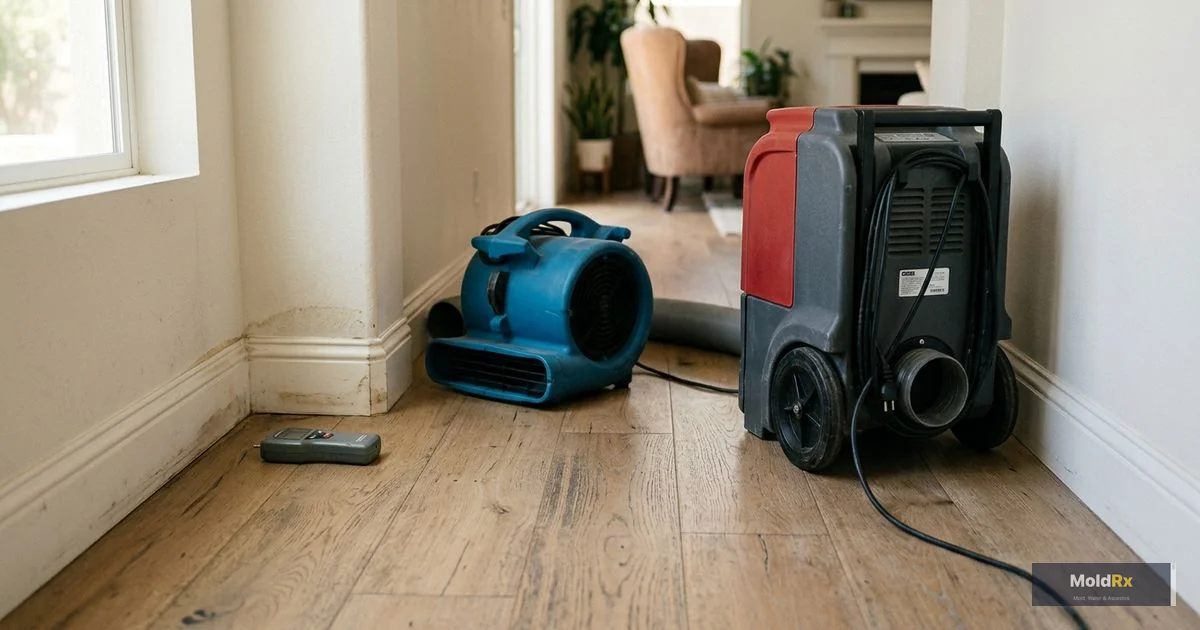
In Santa Ana's older construction, water almost always travels further than the visible damage suggests. Moisture wicks up plaster and drywall. It migrates along floor joists in raised-foundation homes. In slab-on-grade construction, it pools beneath flooring in hidden reservoirs. Thermal imaging cameras and professional moisture meters map the full extent of infiltration so that nothing is missed during restoration.
Phase 2: Aggressive Water Extraction
Standing water is removed immediately using truck-mounted extraction units and commercial-grade portable pumps. In Santa Ana's dense housing, this phase often involves coordinating access across multiple units or working in tight spaces between closely-packed structures where standard equipment positioning requires careful planning.
For multi-family properties, extraction must address both the source unit and any units affected by downward water migration — ceilings, shared walls, and floor assemblies between levels all require inspection and extraction where moisture is found.
Phase 3: Controlled Structural Drying
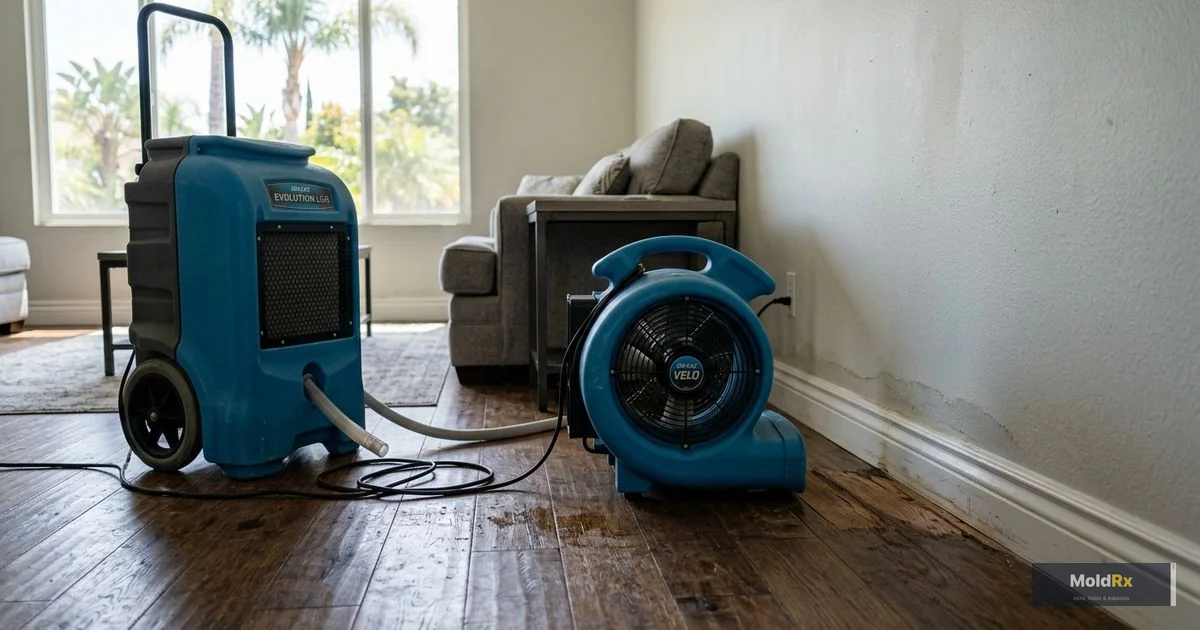
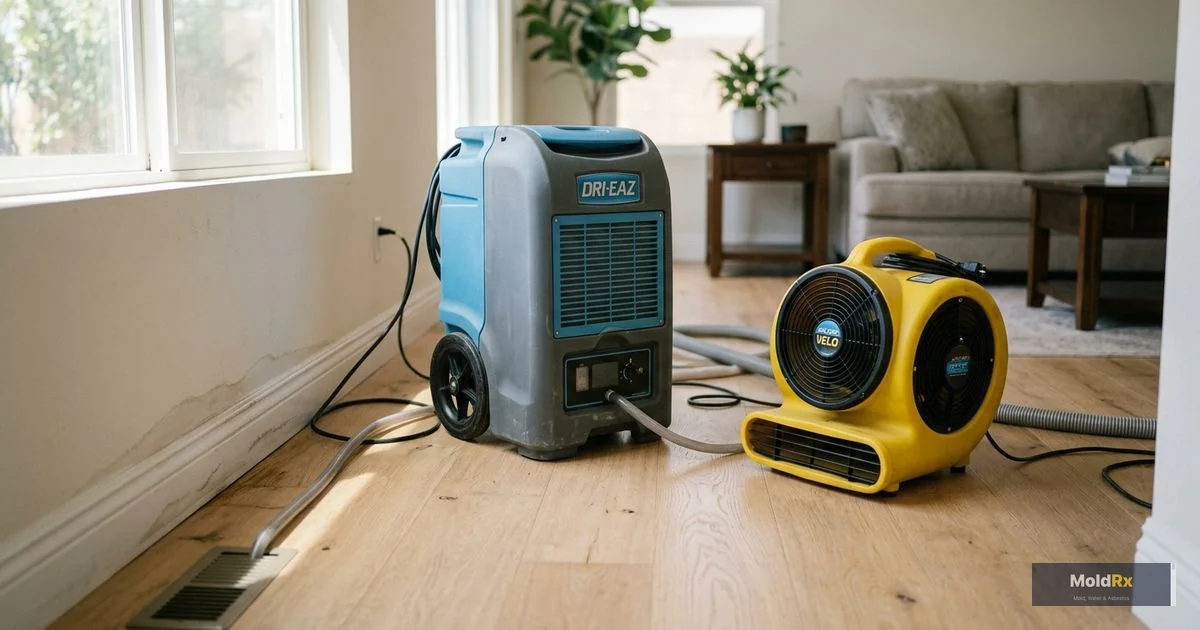
After extraction, the real battle begins. Moisture trapped inside building materials must be systematically removed through controlled drying before mold colonization begins. Industrial air movers and commercial dehumidifiers are placed strategically throughout the affected area, creating directed airflow patterns that pull moisture from walls, subfloors, cabinets, and structural framing.
Santa Ana's elevated ambient humidity makes this phase especially critical. In drier environments, ambient conditions assist the drying process. In Santa Ana, ambient humidity actively works against it. Dehumidification equipment must work harder and longer to create the moisture differential needed for effective drying. Daily moisture monitoring with calibrated meters tracks the drying curve at multiple measurement points, and equipment is adjusted as conditions evolve.
Structural drying in Santa Ana typically takes 3 to 5 days for moderate damage. More extensive events — particularly those involving slab moisture, multi-level water migration, or high-humidity seasonal conditions — can take 7 days or longer.
Phase 4: Decontamination and Antimicrobial Treatment
Once drying is verified by moisture readings (not visual inspection — actual instrument verification), affected surfaces are cleaned and treated with antimicrobial solutions. For Category 2 and Category 3 events, this phase includes removal and disposal of contaminated porous materials — saturated carpet and pad, lower drywall sections that absorbed contaminated water, insulation, and any materials that cannot be adequately decontaminated.
Phase 5: Restoration to Pre-Loss Condition
The final phase rebuilds what was removed. Drywall replacement, flooring installation, painting, trim work, and any structural repairs needed to return your Santa Ana property to its condition before the water damage occurred. For older homes, this phase may also identify pre-existing conditions — such as previous water damage that was cosmetically covered rather than properly remediated — that should be addressed while walls and floors are open.
Protecting Your Investment in Santa Ana's Tight Market
Santa Ana real estate has appreciated significantly over the past decade, and property values in established neighborhoods like Floral Park, French Park, and Park Santiago reflect the desirability of these historic communities. Unresolved water damage — and especially unaddressed mold growth — can devastate property values and create legal disclosure obligations that follow the property through every future transaction.
Proper water damage restoration is not just about fixing the immediate problem. It is about protecting the long-term value and habitability of your most significant financial asset. Complete documentation of professional restoration — moisture readings confirming complete drying, antimicrobial treatment records, and before-and-after photographic evidence — provides a permanent record that the damage was properly addressed.
What to Expect When You Work With Us
-
Immediate, Honest Assessment: We tell you what is actually happening — not what generates the biggest invoice. If your situation is less severe than you feared, you will hear that. If it is more extensive than the visible damage suggests (and in Santa Ana's older homes, it usually is), we will explain exactly what we found and why it matters.
-
Clear Communication Throughout: Restoration is disruptive. Equipment runs constantly. Rooms may be inaccessible. In Santa Ana's tight living spaces, this disruption is even more impactful. We keep you informed at every stage so you understand what is happening, what is coming next, and how long it will take.
-
Complete Insurance Documentation: Water damage insurance claims require meticulous documentation. Our professionals photograph every phase, record moisture readings with timestamps and locations, inventory affected materials, and produce detailed reports specifically structured to support your claim.
-
Relentless Mold Prevention: In Santa Ana's humidity, mold prevention is not an add-on — it is the core objective of the entire restoration process. Every decision about extraction speed, equipment placement, drying duration, and antimicrobial treatment is made with the understanding that mold colonization is the immediate and most expensive threat you face.
Santa Ana Areas We Serve
Our vetted water damage restoration specialists serve all Santa Ana neighborhoods and surrounding communities, including Floral Park, Willard, Downtown Santa Ana, South Coast Metro, French Park, Park Santiago, Riverview West, Delhi, Artesia Pilar, Logan, Saddleback View, Santa Anita, Washington Square, Heninger Park, and Bristol Memory Lane. We cover ZIP codes 92701, 92702, 92703, 92704, 92705, 92706, 92707, and all surrounding areas.
We also serve neighboring communities including Tustin to the east, Costa Mesa and Fountain Valley to the south, Garden Grove and Orange to the north, and Irvine to the southeast. Whether your property is a historic Floral Park bungalow, a mid-century apartment complex in South Santa Ana, a commercial building in the civic center, or a multi-family property anywhere in the city, we are equipped to respond.
Related Services in Santa Ana
In addition to water damage restoration, we also offer Mold Removal in Santa Ana, Asbestos Removal in Santa Ana services to Santa Ana property owners.
→ Learn more about remediation services in Santa Ana
Frequently Asked Questions
How quickly should I address water damage in Santa Ana?
Immediately. Not in a few hours. Not tomorrow morning. Right now. Santa Ana's elevated humidity — averaging 65 percent year-round and peaking above 70 percent in late spring and early summer — creates one of the shortest windows between water intrusion and mold colonization in all of Southern California. Within 24 hours, mold spores begin colonizing on damp surfaces in Santa Ana's warm, humid conditions. Within 48 hours, active growth is underway. Within 72 hours, what started as a water damage event has become a mold remediation project at several times the cost. If you have water in your home right now, call immediately.
What are the most common causes of water damage in Santa Ana?
In Santa Ana's aging housing stock, the most common cause is plumbing failure — corroded galvanized pipes in pre-1960s homes, copper pinhole leaks in mid-century homes, and deteriorating cast iron drain lines throughout the city. Slab leaks are extremely common in homes with slab-on-grade foundations. Appliance failures — water heater ruptures, washing machine supply line bursts, and dishwasher connection failures — are the second most common cause. Storm-related intrusion during the November-through-March rainy season, including Santiago Creek-area flooding and overwhelmed storm drains in low-lying neighborhoods, rounds out the major risk categories.
Will my insurance cover water damage restoration in Santa Ana?
Most homeowner's insurance policies cover sudden and accidental water damage: a pipe that bursts, an appliance that fails, a water heater that ruptures. What is typically excluded is gradual damage from slow leaks that were not addressed, flood damage from rising water (which requires separate FEMA flood insurance — particularly important for properties in Santiago Creek flood zones), and damage resulting from deferred maintenance. Our professionals document everything — photographs, moisture readings, material inventories, detailed work reports — specifically to support your claim and minimize delays.
How much does water damage restoration cost in Santa Ana?
Costs vary based on water category, affected area, materials involved, the number of units affected (critical in Santa Ana's many multi-family properties), and whether mold has developed. What we can tell you definitively is that cost increases with delay. A water event addressed within the first 12 hours costs a fraction of the same event addressed after 72 hours, and a tiny fraction of one that has progressed to active mold contamination. Contact us to discuss your specific situation.
How long does water damage restoration take in Santa Ana?
For contained incidents — a single appliance failure or small pipe break — expect 3 to 5 days from extraction through drying verification. Moderate damage involving multiple rooms or multi-level water migration may take 7 to 10 days. Severe events involving Category 3 water, extensive structural saturation, or concurrent mold remediation can extend to 2 weeks or longer. Santa Ana's higher humidity can add 1 to 2 days to drying timelines compared to inland locations. We provide a realistic timeline after our initial assessment.
Can water-damaged materials in my Santa Ana home be saved?
It depends on the material type, the water category, and — critically — how fast professional restoration begins. Hardwood floors, drywall, and carpet can often be saved if drying begins within 24 hours of a clean water event. However, Santa Ana's humidity narrows this salvage window compared to drier climates. Materials exposed to Category 2 or Category 3 water, any porous materials wet for more than 48 hours, or anything showing visible mold growth typically must be removed. Older building materials common in Santa Ana — plaster walls, original hardwood, and subfloor materials from the 1920s through 1960s — may have different salvage characteristics than modern materials. Our assessment determines exactly what can be saved.
Your Santa Ana Property Cannot Wait
Water is actively damaging your home right now. It is wicking up walls, saturating subfloors, migrating through shared structures, and creating the warm, humid conditions that mold needs to colonize. In Santa Ana's climate, every hour that passes shrinks the window for effective restoration and expands the scope of the damage.
MoldRx coordinates with vetted water damage restoration professionals who understand Santa Ana — the century-old plumbing in its historic neighborhoods, the multi-family complexity of its dense housing stock, the Santiago Creek flood exposure, and the accelerated mold timelines that the city's coastal humidity creates.
We are not the biggest name in restoration. We are the team that tells you the truth about what is happening in your home and gets the right professionals there to stop it before it gets worse. No sales pitch. No unnecessary services. Just honest, urgent help when your property is at stake.
If you have water damage in your Santa Ana home, call MoldRx now. The clock is already running.