Asbestos Removal in Seal Beach, CA — MoldRx
Licensed Asbestos Removal Professionals Serving Seal Beach and Northwest Orange County
Asbestos is not something you deal with later, and it is not something you handle yourself. Seal Beach — a coastal city of approximately 25,000 residents in northwest Orange County, incorporated in 1915, ZIPs 90740 and 90743, sitting just 10 to 15 feet above sea level — was built across every decade of the asbestos era. From the 1920s beach cottages of Old Town to the 6,600-plus retirement units of Leisure World built in the early 1960s at the absolute peak of asbestos use, from the late-1950s homes on The Hill to the 1960s-1970s tract homes of College Park East and West, this city's housing stock reads like a complete timeline of asbestos in American construction. When those materials are disturbed during renovation or natural deterioration, they release microscopic fibers that cause fatal diseases with no cure. California law is unambiguous: asbestos abatement must be performed by licensed, certified professionals. There is no legal shortcut and no safe DIY method. MoldRx only sends vetted, licensed abatement professionals who work in full compliance with EPA NESHAP, OSHA 1926.1101, Cal/OSHA Title 8 Section 1529, and SCAQMD Rule 1403.
Request your free estimate — we will assess your Seal Beach property and explain your options.
Why Seal Beach Properties May Contain Asbestos
Seal Beach sits at the far northwest corner of Orange County, bordered by Long Beach to the north, Huntington Beach to the south, Los Alamitos to the east, and the Pacific Ocean to the west. The San Gabriel River defines the western edge, Anaheim Bay and the coastline anchor the south and west, and the low-lying coastal plain keeps nearly every property at 10 to 15 feet elevation. Mild Mediterranean climate, 70 percent average humidity from ocean proximity, roughly 12 inches of annual rainfall, and periodic Santa Ana winds keep renovation activity going year-round — and that year-round renovation on housing stock ranging from 50 to over 100 years old is exactly why asbestos risk here demands immediate attention.
Construction Era and Asbestos Use
Asbestos was used extensively from the 1920s through the late 1970s. The EPA began restrictions in the late 1970s, but manufacturers exhausted inventory into the mid-1980s. Any property built before 1980 should be presumed to contain asbestos until testing proves otherwise.
Seal Beach's construction spans the entire asbestos era. Development began in 1903 when the Bayside Land Company marketed $50 lots after the Pacific Electric Red Car arrived. By 1906, wooden bungalows dotted the grid near Main Street. The 1920s brought Arts and Crafts bungalows and the Joy Zone carnival boom. In 1929, Surfside Colony was established as the West Coast's first beach resort community. The postwar 1940s-1950s introduced stucco bungalows for military families, and The Hill neighborhood took shape in the late 1950s. Then came the defining development: in 1962, Ross Cortese opened Leisure World — over 6,600 units for adults 55-plus, the nation's first mass-marketed senior housing project, built between 1962 and the early 1970s during the absolute peak of asbestos use when more than 3,000 commercial products incorporated asbestos fibers. College Park East and West followed in the 1960s-1970s.
The median construction year for Seal Beach housing is 1966. The overwhelming majority of properties were built between the 1920s and mid-1970s, encompassing the entire arc of asbestos use in American construction. The risk is not concentrated in one neighborhood — it spans the entire city.
Common Asbestos-Containing Materials in Seal Beach Properties
In properties built before 1980 — which describes the vast majority of Seal Beach — asbestos is commonly found in:
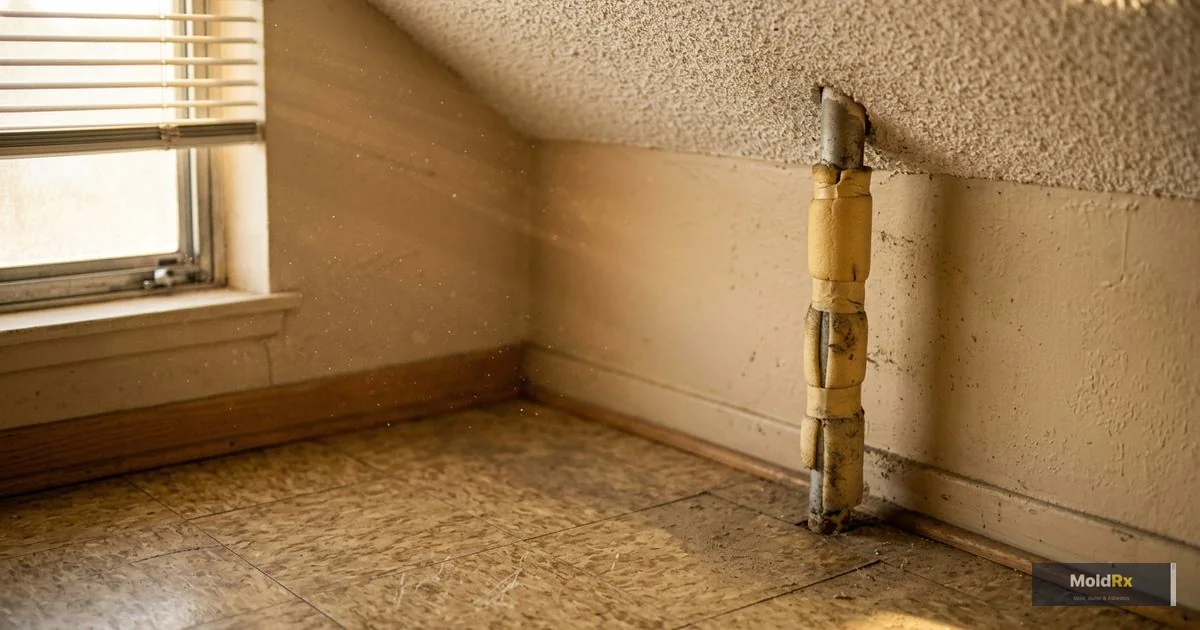
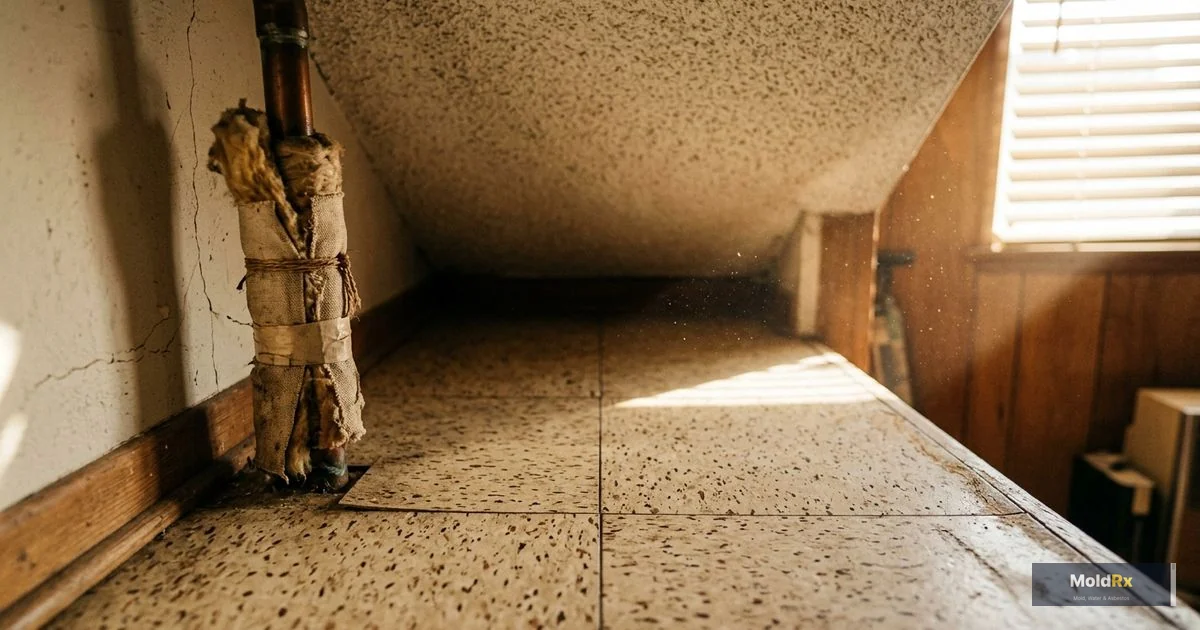
- 9x9-inch floor tiles and black mastic adhesive — found extensively in Leisure World units, Old Town homes, and College Park tract houses
- Popcorn (acoustic) ceiling texture — prevalent across the entire housing inventory, from Leisure World apartments to College Park family homes
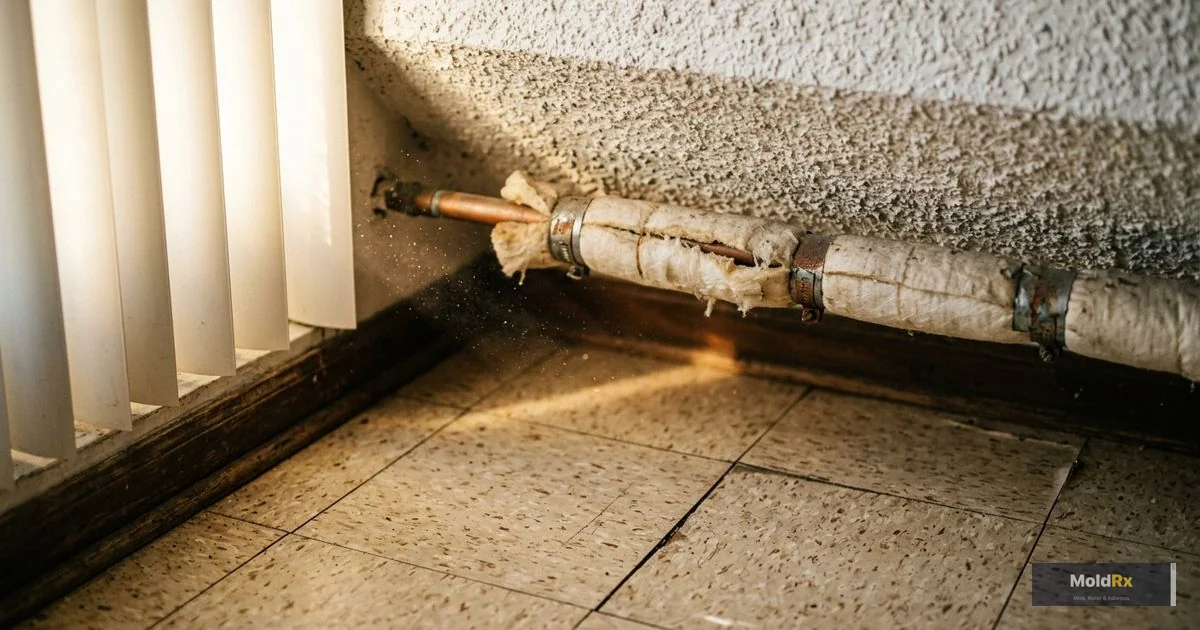
- Pipe insulation and duct wrap — in homes with original HVAC systems, particularly 1950s-1970s construction
- Roof materials and adhesives — shingles, felts, tar products on low-pitched composition roofs
- Textured wall coatings and joint compound — found across every neighborhood
- Vermiculite attic insulation — particularly Zonolite brand, contaminated with tremolite asbestos
- Exterior stucco — asbestos mixed in for strength and fire resistance
- Window glazing putty and caulking — in original single-pane aluminum-frame windows
- HVAC duct connectors and furnace components — gaskets, cement, insulation in aging systems
- Transite siding and cement-asbestos products — in older sections of Old Town and The Hill
When Asbestos Becomes Dangerous
Intact, undisturbed asbestos does not automatically release fibers. The danger begins when materials are disturbed. Friable materials — those that crumble under hand pressure, like pipe insulation or sprayed ceiling texture — release fibers easily. Non-friable materials — floor tiles, transite siding — become hazardous when cut, sanded, drilled, or broken. Renovation is the most common trigger. Tearing out old flooring, scraping popcorn ceilings, or demolishing walls in a pre-1980 Seal Beach property without testing can contaminate the entire structure in minutes.
Seal Beach-Specific Risk Factors
Leisure World — 6,600-plus units from the peak asbestos era. Built 1962-early 1970s, Leisure World is the single largest concentration of peak-era asbestos construction in Seal Beach. Floor tiles, ceiling textures, pipe insulation, and HVAC components commonly contain asbestos. Residents are 55-plus, many in their 70s-90s — age-related respiratory decline makes any fiber exposure more dangerous. When units change hands and buyers renovate, disturbance of original 1960s materials is unavoidable. Leisure World governance requires renovation approval, but SCAQMD Rule 1403 and Cal/OSHA obligations apply independently. Nearly a third of the city's population lives within its gates — the asbestos risk footprint is enormous.
Old Town — a century of layered construction. Homes span from 1906 bungalows through 1960s postwar builds, containing ACMs from every era of asbestos use. Many properties have been renovated multiple times, creating layers where ACMs from different decades coexist within the same walls. Narrow lot lines and dense fabric mean fiber release from one property immediately affects neighbors.
Naval Weapons Station Seal Beach. Over 5,000 acres with 230 buildings and 128 ammunition depots — military construction from the 1940s-1960s used asbestos extensively. The EPA has identified the station in connection with environmental contamination. Adjacent residential neighborhoods were built during the same asbestos-intensive era.
Coastal climate degradation. Constant marine moisture, salt air, and 70 percent humidity accelerate degradation of asbestos-containing materials. Binders corrode, substrates absorb moisture, and materials that were stable when installed become increasingly friable after decades of coastal exposure. Old Town, Surfside Colony, and beachfront properties face the most aggressive salt-air effects.
Low elevation and flood vulnerability. At 10-15 feet above sea level, heavy rainfall, king tides, and storm surge push water into crawl spaces and foundations. Moisture degrades ACMs in lower building components, making non-friable materials prone to fiber release. FEMA maps portions of Seal Beach in special flood hazard areas.
Aging population. Median age 60.8 years — over 43 percent of residents are 65 or older. Reduced lung capacity, pre-existing respiratory conditions, and diminished immune function mean even low-level fiber exposure carries greater consequences for Seal Beach's senior population.
When Asbestos Removal Is Required
Before renovation or demolition. SCAQMD Rule 1403 requires an asbestos survey before any renovation or demolition. Notification must be submitted for projects disturbing more than 100 square feet of ACM. If you are planning any work on a pre-1980 property — remodeling a kitchen, removing popcorn ceilings, updating HVAC, renovating a Leisure World unit — testing must come first. This is law, not recommendation.
When materials are damaged or deteriorating. Friable materials that are crumbling, water-damaged, or visibly deteriorating require immediate professional attention. In Seal Beach's aging housing stock, where decades of settling, seismic movement, coastal moisture, and salt-air corrosion have compromised materials, degradation is accelerating.
Real estate transactions. California Civil Code requires sellers to disclose known asbestos hazards. In Seal Beach's active market — where Leisure World units turn over regularly and Old Town properties command premium prices — a clean clearance report prevents costly renegotiations.
After professional testing confirms ACMs. No removal begins without laboratory-confirmed results from an NVLAP-accredited lab using PLM or TEM analysis.
Our Asbestos Removal Process
The professionals MoldRx sends to your Seal Beach property follow a six-phase process designed for complete compliance and maximum safety.
1. Pre-Abatement Survey and Testing. A certified inspector surveys your property, collects samples for NVLAP-accredited lab analysis following AHERA protocols. For Seal Beach, this commonly includes flooring, ceilings, pipe insulation, HVAC components, roof materials, stucco, window glazing, and attic insulation.
2. Regulatory Notification. SCAQMD Rule 1403 advance written notification for projects disturbing more than 100 square feet of ACM. Cal/OSHA DOSH notification and registration. All permits obtained — including City of Seal Beach building permits and, for Leisure World properties, community approval coordination.
3. Containment and Worker Protection. Complete isolation with polyethylene sheeting and HEPA-filtered negative-pressure air scrubbers. Decontamination unit. Full PPE with NIOSH-approved P100 HEPA respirators per OSHA 1926.1101. In Leisure World's shared-wall units, Old Town's tight lot lines, and College Park's suburban layouts, containment accounts for proximity of neighboring properties. Boundary air monitoring is standard.
4. Wet Removal and Abatement. All ACMs thoroughly wetted before removal per NESHAP and OSHA. Hand tools minimize breakage. Glovebag techniques for pipe insulation. Continuous air monitoring throughout.
5. Disposal. Double-bagged in labeled 6-mil poly bags, rigid containers, warning labels. Waste manifest documents chain of custody to approved disposal landfill.
6. Air Monitoring and Clearance Testing. Independent air monitoring — TEM or PCM analysis. Clearance requires fiber concentrations below 0.01 f/cc. Complete clearance report provided as your permanent record.
Asbestos Removal vs. Encapsulation
Encapsulation — applying a sealant that binds fibers — is sometimes acceptable for non-friable materials in good condition that will not be disturbed. However, encapsulation does not eliminate the asbestos. In Seal Beach's coastal environment — where salt air degrades sealants, moisture infiltrates low-lying structures, renovation pressure drives constant disturbance, and Leisure World units change hands regularly — encapsulant longevity requires careful evaluation. Removal is often the more definitive solution. The professionals MoldRx sends will give you an honest assessment.
Get your free estimate — no obligations.
Regulations That Govern Asbestos Removal in California
Federal: EPA NESHAP. National Emission Standards for Hazardous Air Pollutants establish baseline requirements — inspection before demolition or renovation, proper notification, wet methods, disposal at approved facilities.
Federal: OSHA 1926.1101. Construction Industry Standard — PEL of 0.1 f/cc over 8-hour TWA, medical surveillance, engineering controls, containment, ventilation, PPE.
California: Cal/OSHA Title 8 Section 1529. Meets or exceeds federal OSHA — contractor registration with DOSH, AHERA-approved training (4-day initial, annual refreshers), medical monitoring. DOSH inspects active projects throughout Orange County.
Regional: SCAQMD Rule 1403. Pre-project surveys, advance notification for projects disturbing 100+ square feet of ACM, adequate wetting, proper disposal. Failure to comply can result in fines upwards of $20,000 per day. SCAQMD Asbestos Hot Line: (909) 396-2336.
Licensing: CSLB C-22. California requires a C-22 Asbestos Abatement license. Workers must hold ASB certification and EPA-accredited training — 40 hours initial, 8-hour annual refreshers. Every professional MoldRx sends holds required licenses and current training.
Health Risks of Asbestos Exposure
There is no safe level of asbestos exposure according to OSHA.
Mesothelioma — aggressive cancer of the lung, abdominal, or heart lining, caused almost exclusively by asbestos. Incurable in most cases. Median survival 12-21 months. Even brief, one-time exposure can trigger this disease decades later.
Asbestosis — chronic lung disease from inhaled fibers that permanently scar tissue. Progressive difficulty breathing. No cure.
Lung Cancer — asbestos significantly increases risk, multiplying dramatically with smoking.
Latency period — symptoms typically appear 10 to 50 years after exposure. A Seal Beach homeowner who disturbs ACMs during renovation may not develop symptoms for decades. A Leisure World resident exposed during a unit update may never connect a future diagnosis to that event. The elderly in Leisure World, the families in College Park, the homeowners in Old Town — all face exposure risks whose consequences may not appear for years. By the time symptoms appear, the damage is irreversible. Do not wait.
For authoritative information, consult the EPA asbestos page and OSHA's asbestos safety topics.
What Sets MoldRx Apart
- Licensed, certified, compliant. Every professional holds a CSLB C-22 license, EPA-accredited training, full compliance with Cal/OSHA Title 8, OSHA 1926.1101, and SCAQMD Rule 1403.
- Full regulatory documentation. SCAQMD notifications, waste manifests, NVLAP lab results, clearance reports — everything for compliance, real estate transactions, insurance, and property sales.
- Honest assessment. If encapsulation is sufficient, we say so. If materials are asbestos-free, we say that too. No upselling. No minimizing genuine hazards.
- Family-owned accountability. Every contractor verified for licensing, insurance, training, and track record before we send them to your property.
Seal Beach Neighborhoods and Areas We Serve
Old Town Seal Beach — The historic core between the beach and PCH. Development began 1903. Homes from 1906 Arts and Crafts bungalows through 1960s postwar builds. The most architecturally diverse neighborhood and the most complex for asbestos assessment — layered construction from multiple eras, narrow lots, dense fabric. Every renovation here is an asbestos assessment event.
Leisure World — Over 6,600 units across a gated 55-plus campus. Built 1962-early 1970s during peak asbestos use. Units feature original floor tiles, ceiling textures, pipe insulation, and HVAC components. Active resale market means frequent renovation and disturbance of original materials. Cal/OSHA and SCAQMD requirements apply to every unit.
The Hill — Late-1950s single-family homes on sloping terrain south of PCH. Approaching 70 years old. Standard 1950s materials — popcorn ceilings, floor tiles, pipe insulation — commonly contain asbestos. Elevated terrain reduces flood exposure compared to low-lying Old Town.
College Park East — 1960s-1970s single-family tract homes in the northeast, near the Los Alamitos boundary. Classic midcentury ranch layout. Full complement of peak-era asbestos materials. Families renovating kitchens and bathrooms here encounter ACMs routinely.
College Park West — Same 1960s-1970s construction as College Park East. Quiet suburb east of Studebaker Road, accessed via bridge over the San Gabriel River.
Surfside Colony — Established 1929 on a narrow oceanfront strip. Original cottages extensively renovated or rebuilt, but layered construction often preserves ACMs from multiple eras. Extreme coastal exposure accelerates material degradation.
Nearby Communities We Also Serve
MoldRx also serves Long Beach, Huntington Beach, Los Alamitos, Sunset Beach, Cypress, Garden Grove, Westminster, Rossmoor, and properties throughout northwest and central Orange County.
Related Services in Seal Beach
-> All remediation services in Seal Beach
Frequently Asked Questions
I live in Leisure World and want to renovate my unit. Do I need asbestos testing?
Yes — mandatory, not optional. Leisure World units were built 1962-early 1970s during peak asbestos use. Floor tiles, ceiling textures, pipe insulation, duct wrap, and HVAC components commonly contain asbestos. SCAQMD Rule 1403 requires a survey before any renovation. Leisure World governance requires approval, but the legal testing obligation exists independently. Given shared-wall construction, improper disturbance in one unit can expose adjacent residents — many of whom are elderly and more vulnerable to respiratory harm. Testing must come before any work begins.
Does salt air affect asbestos materials in beachfront Seal Beach properties?
Yes. Persistent marine moisture, salt-laden air, and 70 percent humidity accelerate degradation of building materials. Non-friable asbestos materials that were stable when installed decades ago can lose binding integrity as salt corrodes the matrix holding fibers in place. Severely deteriorated materials can become spontaneously friable. Properties in Old Town, Surfside Colony, and along the beachfront face the most aggressive exposure. If you own a beachfront or near-beach property with original materials, professional assessment is advised even without planned renovation.
Are elderly residents at higher risk from asbestos exposure?
Yes. Reduced lung capacity, pre-existing respiratory conditions, and diminished immune function increase vulnerability to asbestos-related diseases. For Leisure World residents — where advanced age intersects directly with 1960s-era construction containing peak-era asbestos materials — ensuring renovation and maintenance work is preceded by professional testing is critically important.
How do I know if my Seal Beach home has asbestos?
Laboratory testing by an NVLAP-accredited lab is the only way — visual inspection cannot identify asbestos. With a median construction year of 1966, the overwhelming majority of Seal Beach properties fall within the peak asbestos window. A certified inspector collects samples for PLM or TEM analysis, with results typically in three to five business days.
Is it legal to remove asbestos myself in California?
California requires C-22 licensed contractors for asbestos abatement. A narrow exemption exists for homeowners removing small quantities of non-friable asbestos from their own single-family residence, but containment, wet methods, disposal, and notification requirements still apply. In Seal Beach — where Leisure World units have shared walls, Old Town has dense lot lines, and the range of ACMs spans every building system — professional abatement is the only responsible option.
How long does asbestos removal take?
Most residential projects take two to five days. Small projects like pipe insulation may finish in one to two days. Whole-unit Leisure World renovations or whole-house ceiling abatement take longer. SCAQMD Rule 1403 notification adds lead time — demolition projects require 14 days advance notice.
Can I stay in my home during asbestos removal?
For small, contained projects, you may remain in unaffected areas. Larger projects — multiple rooms, whole-unit renovation, materials connected to HVAC — typically require temporary relocation. Your abatement team will advise based on your property specifics.
What is the difference between friable and non-friable asbestos?
Friable asbestos crumbles under hand pressure (pipe insulation, sprayed fireproofing, ceiling textures) and releases fibers with minimal disturbance. Non-friable materials have fibers bound in a solid matrix (floor tiles, transite siding, shingles) and are hazardous when cut, broken, drilled, or sanded. Both require professional handling under California law.
Will my homeowner's insurance cover asbestos removal?
Standard policies typically exclude asbestos abatement. However, if ACMs are damaged by a covered peril — fire, earthquake, storm, water intrusion — your policy may cover abatement as part of the broader claim. Given Seal Beach's seismic zone, coastal flood exposure, and aging housing stock, this is worth reviewing with your insurer.
Is encapsulation as safe as removal?
Encapsulation can work for non-friable materials in good condition that will not be disturbed. However, the asbestos remains in place. In Seal Beach's coastal environment — where salt air degrades sealants, renovation is constant, and Leisure World units turn over regularly — removal is often the more permanent solution.
Get Asbestos Removal in Seal Beach
Asbestos in your Seal Beach property demands a professional response — not next month, not when the budget allows. The diseases are irreversible. The fibers are invisible. The latency period spans decades.
In a city built across every decade of the asbestos era — where Old Town bungalows from the 1920s contain early-generation asbestos in their plaster and pipe wrap, where over 6,600 Leisure World units from the 1960s house nearly 10,000 seniors behind walls containing peak-era floor tiles and ceiling textures, where The Hill homes from the late 1950s are approaching 70 years old, where College Park tract homes are being gutted by young families, where Surfside Colony cottages sit on foundations that may still contain original asbestos, and where the Naval Weapons Station's 5,000 acres added decades of military asbestos construction — the risk is not theoretical. It is present in the ceilings, floors, walls, pipes, and ductwork of thousands of properties across ZIP codes 90740 and 90743.
Whether you have confirmed ACMs, suspect asbestos, or need testing before renovating an older home or Leisure World unit anywhere in Seal Beach, MoldRx only sends licensed, insured, and fully compliant abatement professionals. Your family's safety is not something to gamble on.
Call MoldRx for your free estimate — (888) 609-8907. Licensed. Compliant. Done right.