Emergency Water Damage Restoration in Seal Beach, CA — MoldRx
Vetted Water Damage Restoration Specialists Serving Seal Beach and Northwestern Orange County — 24/7 Emergency Response
Water is in your home right now. Every minute it sits there, it is destroying your floors, saturating your walls, and creating conditions for dangerous mold growth. In a coastal city like Seal Beach — where humidity regularly exceeds 70%, elevations sit near sea level, and much of the housing stock dates back 50 to 100 years — the damage accelerates faster than most homeowners realize.
Do not wait. Call (888) 609-8907 or request your free estimate immediately. MoldRx only sends vetted, IICRC-certified water damage restoration professionals who follow IICRC S500 and IICRC S520 standards. We do not guess. We do not cut corners. We get the right crew to your Seal Beach property as fast as physically possible.
Why Water Damage in Seal Beach Is an Emergency — Not a Project
Seal Beach has a water damage crisis waiting to happen in nearly every neighborhood. The geography, climate, and building stock all work against you the moment a pipe bursts, a storm surge hits, or an appliance fails.
Low Elevation and Wetland Proximity
Seal Beach sits at the edge of the Pacific Ocean at an elevation barely above sea level. The Seal Beach National Wildlife Refuge — 965 acres of coastal salt marsh, tidal sloughs, and mudflats — borders the city. The San Gabriel River and Anaheim Bay flank its boundaries. This is not abstract environmental data. It means the water table is high, drainage is slow, and when water enters your home, it has nowhere to go.
During king tide events and winter storms, ocean water has flooded the parking lots and ground floors of businesses along the coast. In February 2024, sewage spills triggered by weather-impacted surges on sewer mains forced the OC Health Care Agency to close Seal Beach's coastal waters. When the infrastructure is already overwhelmed outside, the last thing your home can handle is standing water inside.
Coastal Humidity That Turns Hours Into a Mold Emergency
Seal Beach's marine layer keeps relative humidity hovering between 65% and 85% for much of the year, spiking above 80% during late spring and early summer. Compare that to Riverside or San Bernardino, where humidity regularly drops below 30%.
What does this mean for your water-damaged property? Mold can begin colonizing wet building materials within 24 to 48 hours. In Seal Beach's humidity, that timeline compresses. Materials that might air-dry in an inland home will stay saturated in a coastal home unless professional-grade dehumidification equipment is deployed immediately. Every hour you delay extraction and drying is an hour closer to a secondary mold remediation project that dwarfs the original water damage in scope and disruption.
Aging Housing Stock Across Every Neighborhood
Seal Beach was incorporated in 1915. The oldest homes in Old Town — the blocks between Pacific Coast Highway and the ocean, centered around Main Street and the pier — date to the 1920s. Arts and Crafts bungalows with original galvanized plumbing, cast iron drain lines, knob-and-tube wiring near water sources, and sandy-soil foundations that have shifted over a century of seismic activity and coastal erosion.
The Hill neighborhood and areas surrounding Seal Beach Boulevard saw development through the 1940s, 1950s, and 1960s. College Park East and College Park West were built primarily in the 1960s and 1970s. Even these "newer" homes are now 50 to 65 years old — meaning copper supply lines are developing pinhole leaks, original water heaters have long exceeded their lifespan, and polybutylene piping (common in that era) is failing throughout Orange County.
The bottom line: the plumbing in most Seal Beach homes is at or past its expected service life. Failures are not a question of if. They are a question of when — and whether you have a plan when it happens.
The Specific Threats Seal Beach Homeowners Face
Water damage is classified under IICRC S500 into Categories 1 through 3 (contamination level) and Classes 1 through 4 (evaporation rate and material saturation). Here is what that looks like in Seal Beach.
Category 1 — Clean Water (Act Fast Before It Escalates)
A burst supply line under your kitchen sink. A failed washing machine hose in the laundry room. A cracked water heater in the garage. This is Category 1 water — originating from a sanitary source with no immediate contamination risk.
But Category 1 does not stay Category 1. In Seal Beach's warm, humid coastal environment, clean water that sits on carpet, drywall, or hardwood for more than 48 hours begins picking up bacteria and contaminants from building materials. It degrades to Category 2 — and potentially Category 3 — if not extracted and dried under controlled conditions.
In Old Town homes with original plaster walls and hardwood subfloors, Category 1 water can cause catastrophic structural swelling within the first 12 hours.
Category 2 — Gray Water (Health Risk Present)
Dishwasher overflow. Washing machine discharge. A toilet overflow with urine but no fecal matter. Sump pump failure. This water contains significant contamination and can cause illness through skin contact or ingestion.
In Seal Beach's multi-unit environments — particularly Leisure World — Category 2 events often originate from shared plumbing systems. A discharge failure in one unit sends gray water through common walls into adjacent units, turning a single-unit problem into a multi-unit emergency within hours.
Category 3 — Black Water (Immediate Health Hazard)
Sewage backup. Storm surge carrying ocean contaminants. Floodwater from the San Gabriel River channel. Any standing water that has contacted soil or decaying organic matter. Category 3 water is grossly contaminated and poses serious health risks, particularly to children, elderly residents, and anyone with compromised immune systems.
Seal Beach's low elevation makes Category 3 events more common here than inland. When winter storms coincide with king tides, contaminated floodwater enters ground-level structures — especially in Old Town and near Anaheim Bay.
Category 3 requires specialized extraction, antimicrobial treatment, and removal of all porous materials that contacted the water. This is not a shop-vac-and-fans situation. It requires technicians trained to IICRC S500 and IICRC S520 standards under Cal/OSHA safety protocols.
Classes 1 Through 4 — The Drying Reality
- Class 1: Minimal water absorption. Only part of a room is affected. A small section of carpet, a single wall cavity. The fastest and least invasive to dry.
- Class 2: An entire room has water affecting carpet, cushion, and wicking up walls less than 24 inches. Common in slab leak scenarios in College Park homes where water migrates beneath flooring before being detected.
- Class 3: Water has come from overhead or has saturated walls, ceilings, insulation, carpet, and subfloor. Typical in Leisure World units where an upstairs water heater or supply line failure sends water cascading through ceilings into the unit below.
- Class 4: Deep saturation into hardwood, plaster, concrete, or stone. This is the class Old Town Seal Beach homeowners dread. Original 1920s-era plaster walls, hardwood floors, and pier-and-beam foundations absorb and trap water in ways that modern drywall does not. Class 4 situations require specialty drying techniques — low-grain refrigerant dehumidifiers, targeted heat drying, and extended monitoring over days or weeks.
Seal Beach's Elderly Population: Why Speed Is a Health Issue
This section matters. Seal Beach is not a typical Orange County city when it comes to demographics.
Leisure World Seal Beach is one of the largest 55+ communities in California — over 9,000 units housing approximately 9,500 residents across 16 mutuals. Many residents are in their 70s, 80s, and beyond. The units were built primarily in the 1960s and 1970s, with shared walls and common plumbing infrastructure that the city itself has acknowledged is reaching the end of its serviceable life. In March 2025, the Seal Beach City Council publicly discussed the deteriorating state of the city's water and sewer infrastructure, with staff citing systems that have surpassed their expected lifespans.
Why This Creates Urgent Risk
Elderly residents are among the most vulnerable populations when water damage leads to mold growth. According to public health research and the EPA, older adults face heightened risk from mold exposure because:
- Weakened immune systems make them more susceptible to respiratory infections triggered by mold spores — including Aspergillus, Penicillium, and Stachybotrys (black mold) species.
- Pre-existing respiratory conditions like COPD and asthma — common in older adults — are exacerbated by airborne mold spore exposure.
- Reduced mobility can delay detection of water intrusion. A slow leak behind a bathroom wall or under a kitchen sink may go unnoticed for days or weeks, allowing mold colonization to advance well beyond the initial water damage site.
- Cognitive decline may prevent some residents from recognizing warning signs like musty odors, discoloration on walls, or increased allergy symptoms.
- Extended indoor time — seniors spend significantly more hours inside their homes than younger, working-age adults, increasing total exposure duration if mold is present.
If you are a Leisure World resident — or the family member of one — and water has entered the unit, do not wait. Shared-wall construction means moisture migrates. Aging plumbing means failures cascade. And what would be an inconvenience for a younger homeowner can become a genuine medical risk for a senior.
Call (888) 609-8907 now or request your free estimate. Our vetted specialists understand Leisure World's mutual structure, coordinate with building management, and deploy drying equipment calibrated for multi-unit scenarios where containment is critical.
How MoldRx's Vetted Restoration Process Works in Seal Beach
MoldRx does not employ restoration crews directly. We vet them. Every specialist we send to your Seal Beach property holds current IICRC certification, carries CSLB-verified California contractor licensing, and follows the full IICRC S500 standard for water damage restoration and IICRC S520 standard for mold remediation. Here is the process.
Step 1: Emergency Contact and Rapid Dispatch
You call (888) 609-8907 or submit an estimate request. We assess the situation over the phone — water source, duration, affected areas, presence of vulnerable occupants — and dispatch the nearest vetted crew to your Seal Beach location. For active flooding or sewage backup, we prioritize immediate dispatch.
Step 2: On-Site Assessment and Damage Classification
The crew arrives and conducts a full assessment:
- Identifies the water source and stops it if still active.
- Classifies the water category (Category 1, 2, or 3) to determine contamination level and safety protocols.
- Determines the damage class (Class 1 through 4) to establish the scope of extraction and drying required.
- Documents everything — moisture readings with calibrated meters, thermal imaging of wall cavities, photographic evidence of all affected areas. This documentation is critical for insurance claims and for verifying that restoration meets IICRC S500 completion standards.
In Seal Beach, the assessment accounts for elevated coastal humidity baselines, the age and construction type of the structure, and whether adjacent units may be affected.
Step 3: Water Extraction
Standing water is removed using truck-mounted and portable extraction units. In Category 3 situations (sewage, floodwater), extraction includes contaminated material removal — saturated carpet, pad, baseboards, and drywall up to the flood line — performed under Cal/OSHA safety protocols with full PPE.
For Leisure World and multi-unit scenarios, containment barriers prevent moisture migration to adjacent units during extraction.
Step 4: Structural Drying and Dehumidification
This is where Seal Beach's coastal climate makes professional intervention non-negotiable.
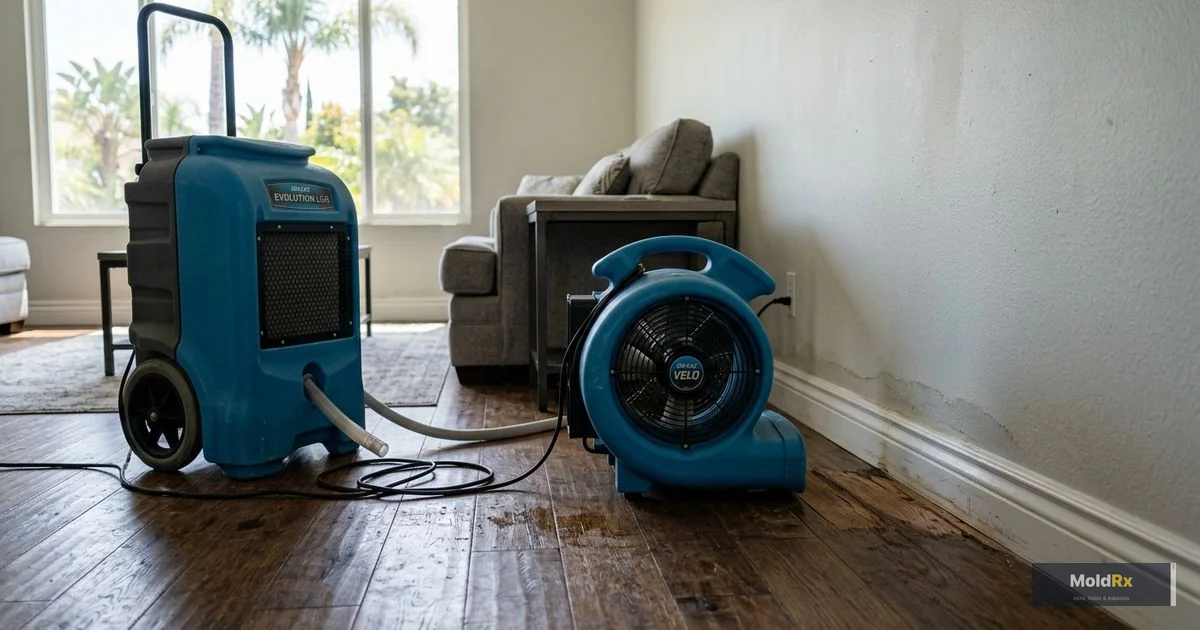
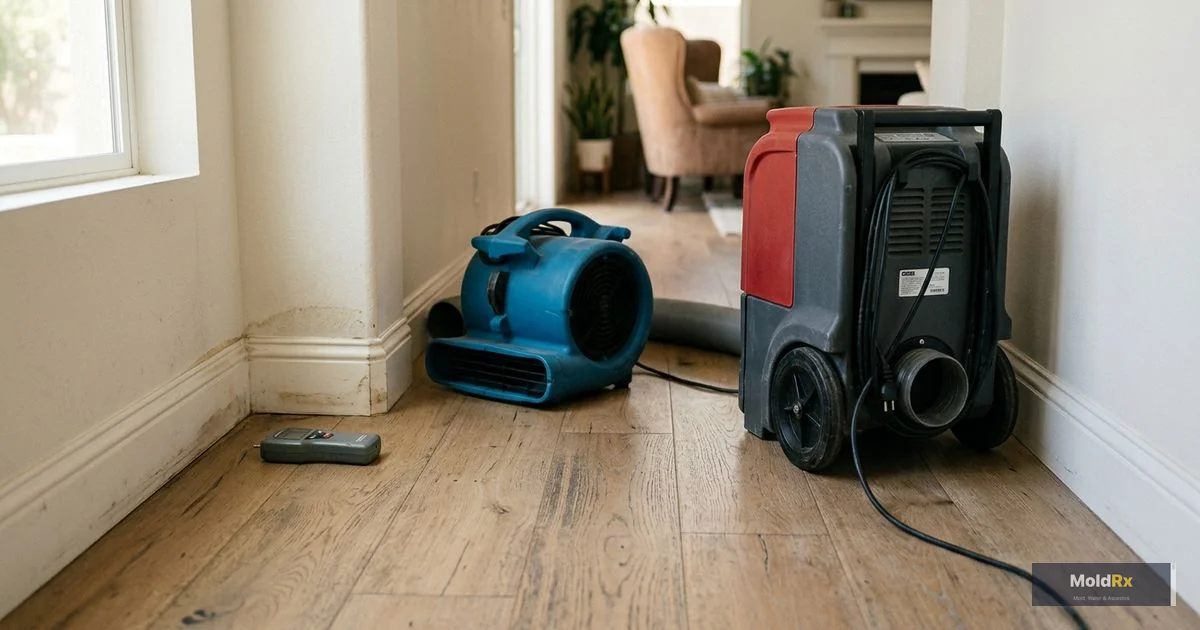
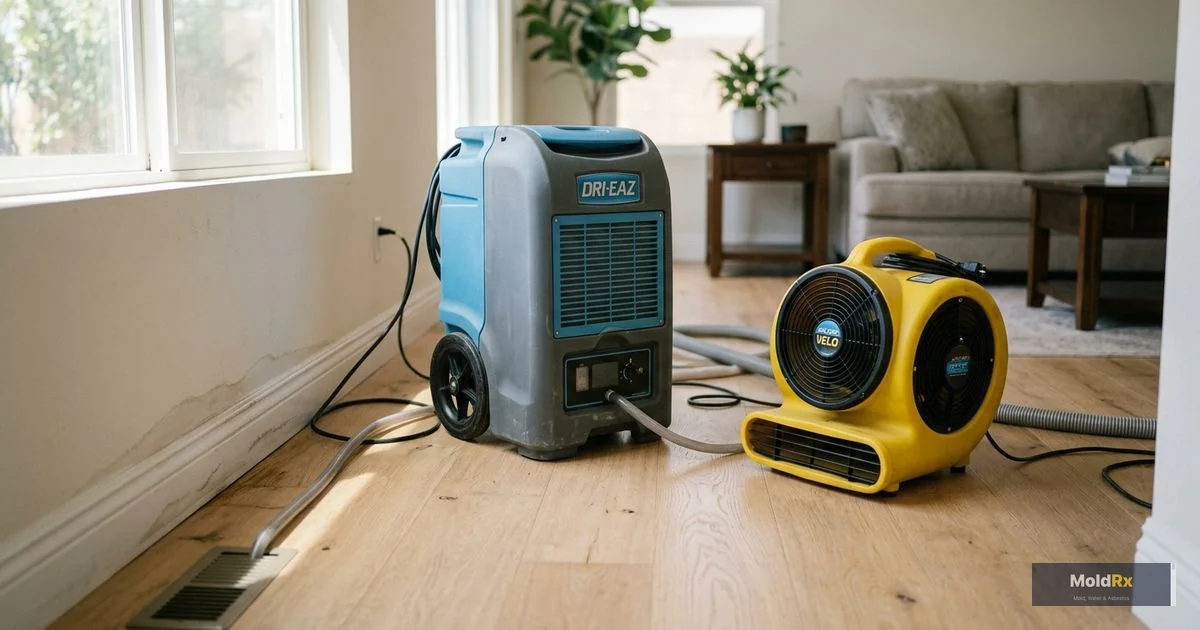
Commercial-grade low-grain refrigerant (LGR) dehumidifiers and high-velocity air movers are positioned throughout the affected area. In Seal Beach, the drying equipment must overcome ambient humidity 20% to 40% higher than inland conditions demand — requiring more equipment, more precise placement, and longer run times.
Moisture levels are monitored daily with calibrated meters and documented in a drying log. Equipment stays until readings confirm IICRC S500 drying goals are met — not until materials "feel dry," but until the data confirms it.
For Class 4 situations in Old Town homes — original plaster, hardwood, pier-and-beam construction — specialty techniques including desiccant dehumidification and targeted heat injection are required. These materials trap moisture in ways modern drywall does not, and improper drying leads to warping, cracking, and hidden mold inside wall cavities.
Step 5: Antimicrobial Treatment and Mold Prevention
All affected surfaces are treated with EPA-registered antimicrobial solutions to eliminate residual bacteria and prevent mold colonization. In Category 2 and Category 3 events, this step is mandatory under IICRC S500 protocol — not optional, mandatory.
In Seal Beach's humidity, antimicrobial treatment is applied more aggressively than in drier climates. A surface that might stay clean in Palm Springs can develop mold in Seal Beach within days if not properly treated.
Step 6: Restoration and Rebuild
Damaged materials are replaced — drywall, flooring, paint, trim — returning your Seal Beach home to pre-damage condition or better. For Old Town properties, restoration matches original architectural details. For Leisure World units, work coordinates with mutual-specific building standards.
Seal Beach Neighborhoods and Areas We Serve
Our vetted water damage restoration specialists respond to emergencies across all of Seal Beach, including:
- Old Town — Main Street corridor, the pier area, and residential blocks between PCH and the ocean. 1920s-1960s homes with the highest risk of Class 4 drying scenarios.
- The Hill — Elevated neighborhood above Old Town. Mid-century homes with aging copper and galvanized plumbing.
- Leisure World Seal Beach — All 16 mutuals. Multi-unit coordination, elderly occupant protocols, shared plumbing system expertise.
- College Park East and College Park West — 1960s-1970s tract homes. Slab leaks, polybutylene piping failures, and water heater ruptures are the primary threats.
- Surfside Colony — Beachfront properties with extreme salt air exposure accelerating pipe corrosion and fixture degradation.
- Areas along Seal Beach Boulevard and Pacific Coast Highway — Commercial and residential properties near major thoroughfares.
We cover ZIP codes 90740 and 90742 and respond to emergencies in neighboring communities including Long Beach, Huntington Beach, Los Alamitos, Sunset Beach, Rossmoor, and Cypress.
What to Do Right Now If You Have Water Damage
If water is actively in your Seal Beach home, take these steps immediately:
- Stop the water source if you can safely do so. Turn off the main water supply valve. If you cannot locate it or the source is sewage/floodwater, leave the area.
- Turn off electricity to affected areas if you can reach the breaker panel without standing in water. Water and electricity are lethal.
- Do not use a household vacuum to extract standing water. Standard vacuums are not designed for water and create electrocution risk.
- Move to dry ground if the water is dark, has an odor, or came from outside. This is likely Category 3 contaminated water and poses health risks — especially for elderly residents, children, and immunocompromised individuals.
- Call (888) 609-8907 immediately. Describe what you see: where the water is coming from, how much is present, what rooms are affected, and whether anyone in the home has health vulnerabilities.
Do not wait until morning. Do not wait until Monday. Do not assume it will dry on its own. In Seal Beach's coastal environment, water damage escalates faster than in any inland city in Southern California.
Request your free estimate now or call (888) 609-8907 — we answer 24 hours a day, 7 days a week, 365 days a year.
Related Services in Seal Beach
Water damage rarely exists in isolation. When water sits in a Seal Beach home, secondary damage follows. We also connect you with vetted specialists for:
- Mold Removal in Seal Beach — when water damage has already led to visible or suspected mold growth
- Asbestos Removal in Seal Beach — safe abatement when water-damaged materials test positive
-> Learn more about remediation services in Seal Beach
Frequently Asked Questions
How quickly does water damage become a mold problem in Seal Beach?
Faster than most homeowners expect. Under IICRC S520 guidelines, mold can begin colonizing damp building materials within 24 to 48 hours under favorable conditions. Seal Beach's coastal humidity — regularly exceeding 70% — creates those favorable conditions year-round. During late spring and summer, when marine layer humidity spikes above 80%, mold can establish in as little as 24 hours on wet drywall, carpet, and wood. Professional extraction and dehumidification within the first 12 to 24 hours dramatically reduces the probability of secondary mold damage.
My Leisure World unit has a slow leak — is that really an emergency?
Yes. Slow leaks in Leisure World are arguably more dangerous than sudden pipe bursts because they go undetected longer. The shared-wall construction means moisture migrates into adjacent units through common framing and insulation. By the time you notice discoloration on a wall or a musty smell, mold may already be established inside the wall cavity. For elderly residents, prolonged low-level mold exposure exacerbates respiratory conditions, triggers chronic inflammation, and can cause symptoms that mimic or worsen age-related cognitive decline. Have any suspected leak evaluated immediately — the earlier it is caught, the less invasive the remediation.
What is the difference between Category 1, 2, and 3 water damage?
Under IICRC S500: Category 1 is clean water from a sanitary source (broken supply line, ice maker). Category 2 is gray water causing potential illness (dishwasher overflow, washing machine discharge). Category 3 is black water — grossly contaminated (sewage backup, floodwater, storm surge). Each category requires progressively more aggressive protocols. In Seal Beach, Category 1 water degrades faster than in drier climates due to humidity accelerating bacterial growth.
Will my homeowner's insurance cover water damage restoration?
Most policies cover sudden and accidental water damage — burst pipes, water heater ruptures, appliance failures. Gradual damage and external flooding typically require separate coverage. The documentation our vetted specialists produce — moisture readings, classification data, photos, drying logs — is designed to support insurance claims. We work with your adjuster to ensure they have what they need.
Is it safe for my elderly parent to stay in the home during restoration?
For Category 1 events limited to one room, it may be possible to contain the work area while maintaining livable conditions elsewhere. For Category 2 or Category 3 events, or any situation where mold is suspected, elderly residents should relocate temporarily. Dehumidifier noise, antimicrobial application, and potential airborne contaminants create conditions that are particularly dangerous for seniors with respiratory conditions or cognitive vulnerabilities. Our specialists will give you an honest assessment.
What certifications should a water damage restoration company have?
At minimum: current IICRC certification, valid CSLB licensing for California, and Cal/OSHA compliance. Work should follow IICRC S500 for water damage and IICRC S520 for mold, with EPA guidance incorporated into protocols. MoldRx only sends specialists who meet all of these requirements — we verify before we vet, and we vet before we send.
How long does water damage restoration take in Seal Beach?
A Class 1/Category 1 event may resolve in 3 to 5 days. Class 3 or Class 4 events — common in Leisure World and Old Town — can require 7 to 14 days of active drying plus rebuild time. Seal Beach's humidity typically adds 1 to 3 days compared to identical damage inland. Our specialists give you an honest, data-based timeline after the initial assessment.
Every Hour Counts — Get Vetted Help Now
Water damage in Seal Beach is not a situation where you can shop around for three days, collect quotes, and make a leisurely decision. The physics do not care about your schedule. Water is wicking up your walls right now. Humidity is feeding bacterial growth right now. And if you are in Leisure World or Old Town, the age of your building is working against you right now.
MoldRx exists because property owners deserve better than pressure tactics, inflated scopes, and incomplete drying that leads to mold six weeks later. We only send vetted professionals — IICRC-certified, CSLB-licensed, following IICRC S500 and IICRC S520 standards from assessment through final restoration.
Call (888) 609-8907 now. Tell us what is happening. We will get the right crew to your Seal Beach property and give you an honest assessment of what needs to happen next.
No pressure. No runaround. No pricing games. Just vetted professionals who know how to handle water damage in one of the most challenging coastal environments in Southern California.
Request your free estimate | Call (888) 609-8907 — 24/7 Emergency Response