Water Damage Restoration in Twentynine Palms, CA — MoldRx
24/7 Emergency Water Damage Restoration Professionals Serving Twentynine Palms, MCAGCC, and the Morongo Basin
Water does not wait. Not for morning. Not for a callback. Not for the desert air to dry it out on its own. Every hour water sits inside your walls, pooled beneath your flooring, or wicking upward through your slab, the damage compounds — subfloor warping beyond salvage, drywall disintegrating from the inside out, insulation collapsing under its own saturated weight, and mold colonies germinating within 24 to 48 hours. In Twentynine Palms, where aging plumbing in 1950s-through-1970s housing stock fails without warning, where swamp cooler supply lines corrode on rooftops across the Morongo Basin, where monsoon thunderstorms dump an inch of rain in minutes onto hardpan desert soil that absorbs nothing, and where flash floods tore through Highway 62 in July 2024 stranding fifteen vehicles in two feet of rushing water — the difference between a manageable restoration and a catastrophic structural rebuild comes down to one thing: how fast professional extraction begins.
This is not a situation that improves with time. It gets worse with every passing hour. Materials that could have been saved at hour two are demolished at hour twelve. A manageable restoration at hour four becomes a full structural rebuild by the end of the week.
MoldRx only sends vetted water damage restoration professionals who follow IICRC S500 standards — the national benchmark for water damage inspection, extraction, drying, and restoration. Our teams arrive with commercial-grade equipment, document everything for your insurance claim from the first minute on-site, and do not leave until moisture readings confirm your property is dry and safe.
Call now for emergency service — (888) 609-8907. Fast response. Professional extraction and drying. Every hour matters.
Why Water Damage Is an Emergency in Twentynine Palms
Twentynine Palms sits at approximately 1,800 feet elevation in the Mojave Desert, spread across the Morongo Basin in San Bernardino County. The city's roughly 26,000 residents — a number that fluctuates significantly with Marine Corps rotations at MCAGCC (Marine Corps Air Ground Combat Center) — live in a climate defined by extremes. Summer highs routinely exceed 110 degrees Fahrenheit. Winter nights plunge below freezing. Temperature swings of 40 degrees or more in a single day are routine. Annual rainfall averages just 4 inches. Those numbers create a dangerous false sense of security. Homeowners and renters assume the dry desert air will handle moisture problems on its own. It will not. Water trapped behind drywall, beneath slab foundations, and inside wall cavities does not care how low the outdoor humidity is. Without professional extraction and controlled drying, you are looking at mold growth, structural damage, and restoration costs that multiply by the day.
Twentynine Palms' arid climate masks the reality that this community faces serious water damage risks from multiple vectors: catastrophic plumbing failures in aging civilian and military housing stock, monsoon flash flooding on impermeable desert soil, evaporative cooler malfunctions on thousands of rooftops, and increasingly severe storm events that overwhelm drainage infrastructure built decades ago for a fraction of the current population.
The Military Housing Boom and Its Plumbing Legacy
The story of Twentynine Palms is inseparable from the Marine Corps. What began as a glider training facility during World War II became the Marine Corps Training Center in 1953 when civilian construction firms began building the base — $15.9 million allocated for initial construction alone. The base grew steadily through the Cold War, and the surrounding civilian community grew with it. The most significant wave of off-base residential construction came during the 1950s through the 1970s, driven by military families who needed housing near the expanding installation.
That means thousands of Twentynine Palms homes are now sitting on 50-to-70-year-old plumbing systems. Galvanized steel supply lines corroded from the inside out by decades of mineral-heavy desert water. Cast iron waste lines with half a century of buildup. Original sewer laterals compromised by root intrusion and ground shifting from the dramatic thermal cycling that defines the Mojave Desert — 110-degree summer days followed by below-freezing winter nights, expanding and contracting soil and pipe material thousands of times over decades.
These plumbing systems do not fail gradually. They fail all at once — at 2 AM on a Tuesday, while you are deployed, while you are on leave, or six inches behind a wall where you cannot see it happening. By the time you notice a water bill spike, a warm spot on the slab, or a stain blooming across the ceiling, hundreds or thousands of gallons may have already saturated structural materials.
Pre-1980 construction in Twentynine Palms carries an additional risk layer: asbestos-containing materials in insulation, flooring, popcorn ceilings, and joint compound. When water damage requires material removal in these older homes, disturbing asbestos becomes a regulated hazard under Cal/OSHA and EPA guidelines. A burst pipe in a 1960s ranch home is not just a water problem — it is potentially an asbestos exposure event and an electrical hazard simultaneously.
Swamp Coolers: The Desert's Hidden Water Damage Source
Evaporative coolers — swamp coolers — are a defining feature of Morongo Basin life. Thousands of Twentynine Palms homes, particularly off-base civilian housing, rely on rooftop-mounted evaporative units instead of or in addition to central air conditioning. These systems work exceptionally well in the bone-dry desert climate, pulling outside air through water-saturated pads to cool it by up to 20 degrees. But they depend on continuous water supply through copper or plastic feed lines that run from interior plumbing up through the ceiling and roof to the cooler unit.
Those supply lines corrode. Connections loosen from thermal expansion. Float valves stick open. Overflow pans crack from relentless UV exposure and the temperature cycling that defines life at 1,800 feet in the Mojave. Swamp coolers last only 6 to 10 years before requiring professional repair or replacement — and many Twentynine Palms homeowners push them well past that window. The result is water dripping or flowing into your ceiling cavity, attic insulation, and interior walls — sometimes for days or weeks before visible signs appear. By the time you notice a brown stain spreading across the ceiling or drywall softening near the cooler duct, water has been saturating insulation, framing, and sheathing in an enclosed space where it cannot evaporate.
Swamp cooler failures are especially dangerous because they introduce water into the highest point of your structure. Gravity carries it downward through every material it contacts — ceiling drywall, top plates, wall insulation, electrical wiring channels, and into the living space below. Mold growth in these attic and ceiling-cavity scenarios is nearly inevitable without professional intervention.
Flash Flooding: Twentynine Palms' Most Violent Water Damage Vector
Twentynine Palms has a documented and deadly history with flash flooding. Originating in 49 Palms Canyon and the mountains above the city during desert thunderstorms, flash floods historically raced down the canyon, onto the highway, and through the downtown area, flooding businesses and residences. A Flood Control Channel completed in 1969 was designed to carry rainwater away from the city — but recent events have proven that this infrastructure cannot handle the intensity of modern storm events.
July 14, 2024 brought the worst flash flooding the community had seen in years. A sudden monsoonal storm overwhelmed drainage systems across the city. On Highway 62 at Encelia Avenue, fifteen vehicles were stranded in two feet of water flowing at 15 to 20 mph. Fire crews from Joshua Tree, Yucca Valley, and MCAGCC responded alongside a swiftwater rescue team from Fontana. Eleven people were assisted from vehicles. Six were rescued. Ten were medically evaluated by paramedics. One person was transported to Hi-Desert Medical Center. Eighty percent of the city's major arterials were damaged. Public works crews moved more than 1,000 cubic yards of sand — the equivalent of 100 dump trucks — just to clear streets and neighborhoods. Some homeowners found mud in their front yards, backyards, garages, and inside their homes. A local hotel owner reported millions of dollars in damage.
The storms did not stop there. The Twentynine Palms City Council convened emergency discussions on July 23, 2024 to address storm response as additional rain and flash floods continued hitting the area. Residents expressed frustration with the scope of damage and response timelines.
Then in December 2025, a massive atmospheric river system slammed all of Southern California. Governor Newsom proclaimed a state of emergency for San Bernardino County among others. San Bernardino County activated its Emergency Operations Center as flooding, mud flows, and road closures impacted mountain and desert communities — including the Morongo Basin. Additional rainfall in the desert region raised flooding concerns in Twentynine Palms, Landers, Barstow, and Trona.
Twentynine Palms' hard-packed desert soil has near-zero absorption capacity. When rain arrives — in violent, concentrated bursts during monsoon season (July through September) and in atmospheric river events during winter — water sheets across the landscape instead of soaking in. Runoff concentrates in washes, low-lying streets, and against foundations. It enters homes through garage door seals, foundation cracks, window wells, and saturated soil that forces moisture upward through slab floors. Flash flood water is almost always Category 2 or Category 3 under IICRC S500 — carrying road debris, sewage overflow, desert sediment, and bacterial contamination that requires hazardous-material-level restoration protocols.
The 24-48 Hour Mold Window
Mold colonization begins within 24 to 48 hours of moisture exposure. The EPA and IICRC S520 both confirm this timeline. In Twentynine Palms, where summer interior wall cavities can reach 90 degrees or higher even with cooling systems running, the clock runs faster — germination can begin in as little as 12 to 18 hours. Stachybotrys chartarum (black mold) can begin colonizing within 48 to 72 hours on saturated drywall and cellulose insulation. Swamp cooler failures are especially high-risk because they introduce moisture into enclosed attic and ceiling spaces with limited airflow — exactly the conditions mold needs to thrive.
Once mold takes hold, your restoration becomes a water damage plus mold remediation project — dramatically increasing scope, timeline, cost, and disruption. Professional drying within the first 24 hours is the single most effective mold prevention measure. Every hour you wait narrows that window.
Insurance Documentation Starts Immediately
Insurance policies require prompt notification and mitigation. Delayed response can result in denied claims — insurers may argue that secondary damage resulted from failure to mitigate rather than the original event. Professional documentation beginning the moment technicians arrive establishes the timeline insurers need to process your claim. Do not wait to call your insurer. Do not wait to call us.
Water Damage Categories and What They Mean for Your Twentynine Palms Property
The IICRC S500 standard classifies water damage into three categories based on contamination level. The category determines safety protocols, equipment requirements, and which materials can be salvaged versus which must be removed.
Category 1: Clean Water
Water from a sanitary source — a broken supply line, water heater inlet, refrigerator ice-maker line, or clean roof breach. Category 1 does not pose an immediate health threat. However, it degrades to Category 2 or Category 3 within 48 to 72 hours if not extracted, because standing water breeds bacteria regardless of its original source. In Twentynine Palms' summer heat, this degradation accelerates significantly — what starts as a clean supply line break can become a contaminated environment within a single day.
Category 2: Gray Water
Water with significant contamination that could cause illness. Sources include washing machine overflow, dishwasher discharge, swamp cooler overflow that has contacted insulation or attic debris, toilet overflow with urine (no feces), and sump pump failures. Any Category 1 water that remains standing long enough develops into Category 2. Restoration requires antimicrobial treatment, and contacted porous materials — carpet pad, particleboard, unsealed drywall — typically require removal.
Category 3: Black Water
The most hazardous classification. Category 3 includes sewage backups, toilet overflows containing feces, floodwater from desert washes and storm runoff, and any standing water present long enough to support pathogenic organisms. In Twentynine Palms, monsoon flash flooding and events like the July 2024 storm and December 2025 atmospheric river almost always qualify as Category 3 because the water carries surface contaminants, desert soil bacteria, and potentially sewage from overwhelmed municipal infrastructure. Category 3 restoration requires full personal protective equipment, removal of all contacted porous materials, thorough sanitization, and antimicrobial treatment of structural elements. There is no drying Category 3 carpet or pad — it gets removed.
Water Damage Classes: Understanding the Scope
Beyond contamination categories, the IICRC S500 classifies the physical scope of water intrusion into four classes based on the volume of water and the types of materials affected. These classes determine equipment requirements and drying timelines.
Class 1: Minimal Absorption
Only a small area is affected with materials that have absorbed minimal moisture. An example: a single room with water on a concrete or vinyl floor, limited wall wetting. This is the simplest restoration scenario.
Class 2: Significant Absorption
Water has affected an entire room or large area. Moisture has wicked up walls 12 to 24 inches, saturated carpet and pad throughout, and penetrated structural materials. Class 2 is common in Twentynine Palms supply line failures where water flows for several hours before discovery — particularly when residents are away on deployment or temporary duty.
Class 3: Greatest Absorption
Water has come from overhead — a roof breach, swamp cooler failure, or second-story plumbing rupture — saturating walls, insulation, carpet, subfloor, and structural elements. Ceilings, walls, and floors in the affected area are all wet. This is the most common class in Twentynine Palms swamp cooler failures, where water enters through the roof and ceiling cavity and migrates downward through every material it contacts.
Class 4: Specialty Drying
Water has penetrated low-permeability materials — hardwood floors, plaster, concrete, stone, or dense structural lumber — that require extended drying times with specialized techniques. Slab leak scenarios in Twentynine Palms, where water saturates concrete foundations and the dense desert soil beneath, frequently qualify as Class 4.
Our Water Damage Restoration Process
Every water damage event is different, but the IICRC S500 protocol provides a systematic framework that our vetted professionals follow on every Twentynine Palms job. This process is designed to stop damage progression, document everything for insurance, and return your property to pre-loss condition as quickly and safely as possible.
1. Emergency Response and Assessment
The clock is running. Our teams respond to Twentynine Palms emergencies with the understanding that every hour of delay means more damage, more cost, and greater risk of mold. Upon arrival, technicians perform a rapid initial assessment: identify the water source and stop it if still active, classify the water category (Category 1 through 3), assess the damage class (Class 1 through Class 4), and establish a containment perimeter to prevent further spread. Thermal imaging cameras and penetrating moisture meters map the full extent of moisture intrusion — including water you cannot see behind walls, beneath flooring, and inside ceiling cavities. This initial assessment determines the full scope of equipment, personnel, and timeline required.
2. Water Extraction
Standing water is removed immediately using truck-mounted and portable extraction units capable of removing thousands of gallons per hour. Submersible pumps handle deep standing water from flood events. Weighted extraction tools pull water from carpet and pad. In Twentynine Palms slab leak scenarios, extraction may include subsurface work — pulling water from beneath flooring systems that migrated through concrete from the leak source. For swamp cooler failures, extraction targets attic insulation, ceiling cavities, and interior wall assemblies where water has accumulated by gravity. Every gallon removed during extraction directly reduces drying time and limits secondary damage.
3. Structural Drying and Dehumidification
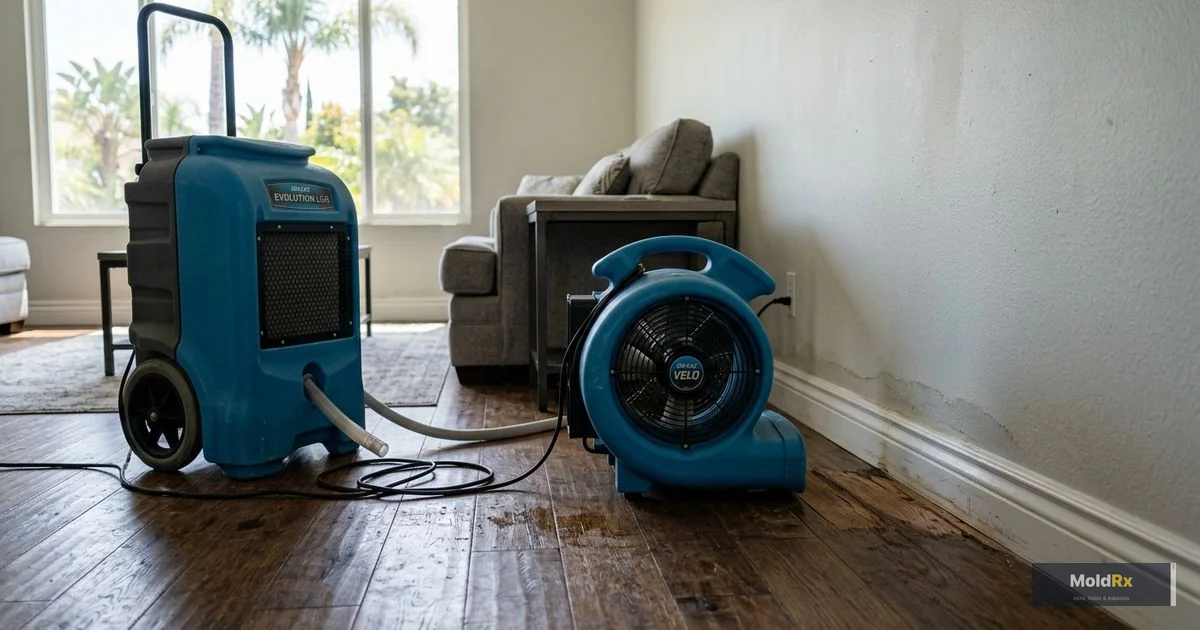
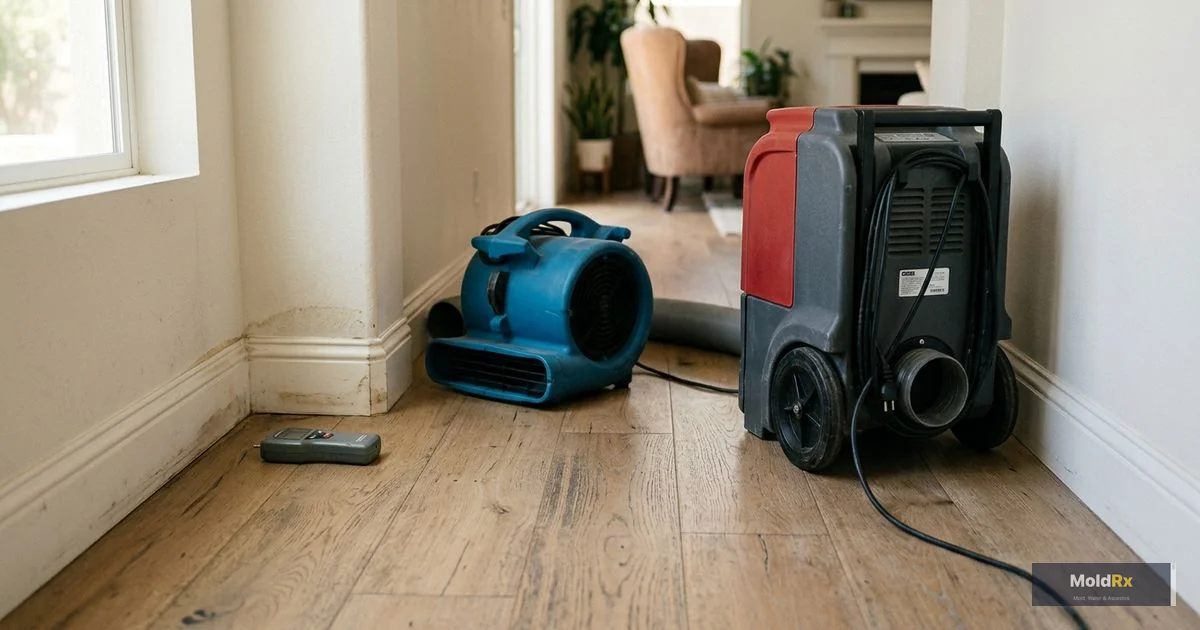
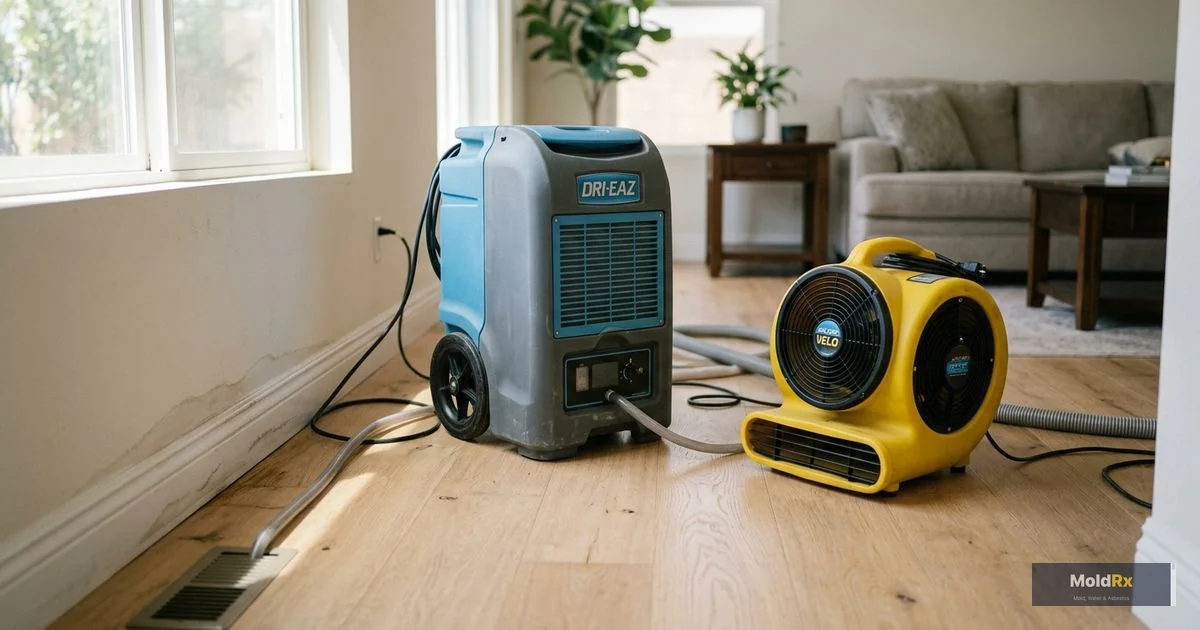
This phase separates professional restoration from inadequate DIY efforts. Our technicians deploy commercial-grade dehumidifiers (desiccant or LGR units) and high-velocity air movers positioned according to psychrometric calculations — the science of moisture behavior in air. In Twentynine Palms' extremely low-humidity desert environment, drying dynamics differ significantly from coastal or valley properties. Technicians calibrate equipment placement and dehumidifier capacity specifically for Morongo Basin conditions, targeting optimal grain depression to maximize evaporation rates from saturated materials.
Wall cavities receive directed airflow through injection drying systems. Hardwood floors may require vacuum mat systems that extract moisture without demolition. Attic and ceiling cavity drying — critical in swamp cooler failure scenarios — uses elevated-temperature drying techniques to address insulation and framing without requiring full attic demolition when materials are salvageable. The goal is to reach dry standard — the moisture content of unaffected materials in the same structure — throughout all affected areas.
4. Moisture Monitoring and Documentation
Technicians return daily to take moisture readings using pin-type and pinless moisture meters, thermo-hygrometers, and thermal imaging cameras. Every reading is logged in a drying record that tracks moisture content over time. These logs confirm drying is progressing correctly and provide your insurance adjuster with timestamped evidence that professional drying was performed per IICRC S500 standards.
If readings plateau or increase, technicians adjust equipment or investigate hidden moisture pockets — common in Twentynine Palms homes where slab leak water migrates laterally through subslab soil before wicking up in unexpected locations, or where swamp cooler overflow travels through ceiling framing and appears in rooms far from the original entry point.
5. Cleaning, Sanitizing, and Antimicrobial Treatment
Once materials reach dry standard, all affected surfaces are cleaned and treated. Category 1 losses may require only general cleaning. Category 2 and Category 3 losses require antimicrobial application to all contacted structural materials — framing, subfloor, concrete, sheathing. HEPA air scrubbers filter airborne contaminants during and after cleaning. Contents within the affected area are evaluated for cleaning or disposal. Soft goods, upholstered furniture, and porous items contacted by Category 3 water are non-restorable. All sanitization protocols comply with Cal/OSHA safety requirements and IICRC S500/IICRC S520 standards.
6. Restoration and Rebuild
The final phase returns your property to pre-loss condition. This may be as simple as reinstalling baseboards and repainting, or as extensive as replacing drywall, insulation, flooring, cabinetry, and roofing materials damaged by swamp cooler overflow. In pre-1980 Twentynine Palms homes, restoration must account for asbestos-containing materials that may have been disturbed during water damage work — all abatement is performed by licensed professionals in compliance with Cal/OSHA and EPA regulations. Our vetted professionals coordinate the full restoration — you do not need to hire a separate contractor to finish the job. All rebuild work is performed by CSLB-licensed professionals.
Get emergency help now — (888) 609-8907.
What to Do Before We Arrive
The actions you take in the first minutes directly affect how much of your property can be saved. While you wait for our team:
- Shut off the water source if you can reach the shutoff safely. For slab leaks, turn off the main supply at the meter. For swamp cooler failures, shut off the supply valve feeding the rooftop unit.
- Turn off electricity to affected areas at the breaker panel. Never step into standing water near active outlets or beneath a ceiling that is sagging with water weight.
- Move valuables to dry ground. Place foil or wood blocks under furniture legs on wet carpet. Remove documents, photos, and electronics from affected rooms.
- Document everything with photos and video. Photograph the source, standing water extent, ceiling damage, and any visible structural distress before moving anything. This evidence is critical for insurance.
- Do not use a household vacuum on standing water — shock hazard and equipment damage.
- Do not run fans or your HVAC system. Without category assessment, you risk spreading contaminated moisture through ductwork into unaffected areas.
- Do not open windows in summer — in Twentynine Palms' extreme desert heat, this raises interior temperatures and accelerates mold germination in saturated materials.
Signs You Need Professional Water Damage Restoration
Not every water event requires a full restoration response. A small drip caught and dried within minutes may not need professional intervention. But these situations demand immediate professional response:
- Standing water of any depth. Professional extraction equipment is required. Mops and towels cannot match the volume removal rate needed to prevent structural saturation.
- Any sewage involvement. Toilet overflows with feces, sewer line backups, and floodwater are all Category 3 hazards requiring professional-grade sanitization and PPE.
- Ceiling stains or bulging from swamp cooler failure. Water pooling above the ceiling plane can collapse drywall without warning. Do not puncture a bulging ceiling — weight and contamination make this dangerous without proper containment.
- Water that has been present for more than a few hours. If you return from deployment, TDY, or leave to find a burst pipe that has been running while you were away, the saturation has reached structural elements that require commercial drying equipment.
- Multiple rooms affected. When water has migrated through hallways, under walls, or into adjacent rooms, the scope exceeds what portable fans and a hardware store dehumidifier can address.
- Hidden moisture behind walls or under flooring. Musty odors, bubbling paint, warped baseboards, or soft spots in drywall mean moisture is trapped inside structural cavities and requires professional detection and drying.
- Slab leak indicators. Hot spots on the floor, spiking water bills, running water sounds when fixtures are off, damp flooring with no visible source, or new foundation cracks suggest a pressurized line failure beneath the slab — common in Twentynine Palms' aging housing stock where extreme desert thermal cycling has stressed pipe joints and fittings for decades.
- Mud or flood debris inside your property. Flash flood events like July 2024 push contaminated water, mud, and debris directly into structures. This is always Category 3 and requires professional hazmat-level restoration.
Military Housing and Water Damage in Twentynine Palms
Twentynine Palms exists because of the Marine Corps. MCAGCC — the largest Marine Corps base in the world by area — drives the local economy, and a significant portion of the city's housing stock serves active-duty Marines, their families, and civilian base employees. Water damage in this community has a military dimension that most restoration companies do not understand.
On-Base Privatized Housing
On-base family housing at MCAGCC is privatized and operated by Lincoln Military Housing across multiple neighborhoods — including Adobe Flats I through V, Ocotillo Heights, Joshua Heights, and other communities. These neighborhoods contain homes ranging from 1950s-era original construction through modern builds. Privatized military housing across the country has faced well-documented challenges with mold, water damage, and maintenance responsiveness. A Military Family Advisory Network study covering more than 15,000 families across 100-plus bases found that 55 percent rated their base housing negatively, with 3,342 individual claims of mold reported. The EPA and IICRC S520 standards apply regardless of whether the property owner is a private company managing military housing or an individual homeowner.
If you are living in on-base housing and experiencing water damage, you have the right to request professional restoration that meets IICRC S500 standards. Document everything. Photograph conditions. Log your maintenance requests and response timelines. If you are not getting adequate response through your housing management office, MoldRx can help you understand what professional restoration should look like and connect you with vetted professionals who can assess the situation independently.
Off-Base Rentals and Owned Homes
A large percentage of Marines and their families live off-base in Twentynine Palms, Joshua Tree, and Yucca Valley. Many of these rental properties are older homes — 1950s through 1970s construction with aging plumbing, swamp coolers instead of central air, and decades of deferred maintenance by absentee landlords who own rental inventory primarily to capture BAH (Basic Allowance for Housing) income. Water damage in these properties often reveals pre-existing conditions that have been ignored or inadequately patched: slow leaks behind walls, corroded supply lines, swamp cooler overflow damage that was painted over rather than properly dried and restored.
Whether you own or rent, water damage demands the same professional response. Tenants should notify their landlord immediately but should not wait for landlord approval to call for emergency extraction — delayed response creates exponentially worse damage that ultimately harms everyone.
Deployment and Extended Absence
Military life means extended absences. Training rotations, deployments, and temporary duty assignments leave Twentynine Palms homes unoccupied for weeks or months at a time. A plumbing failure or swamp cooler malfunction in an empty house can run for days or weeks before anyone notices. When these situations are discovered — by a neighbor, a property manager, or upon return — the damage is typically severe: Class 3 or Class 4 saturation, mold colonization well past the 48-hour window, and structural damage that may require extensive rebuild. If you are leaving for an extended period, shut off your main water supply and have someone check the property regularly. If you return to a flooded home, call us immediately.
Mold Prevention After Water Damage
The 24-to-48-hour mold window is not a rough estimate. It is a well-documented biological reality confirmed by the EPA, the IICRC S520 standard, and decades of restoration industry data. Mold spores are omnipresent — they exist in every indoor environment. What they need to colonize is moisture and time. Professional water damage restoration eliminates the moisture before the time runs out.
In Twentynine Palms, the mold risk window is particularly dangerous during summer months when interior wall cavities can reach 90 degrees or higher — conditions that accelerate mold germination to as little as 12 to 18 hours. Swamp cooler failures are especially high-risk because they introduce moisture into enclosed attic and ceiling spaces with limited airflow — exactly the conditions mold needs to thrive.
Professional drying to IICRC S500 dry standard is the only reliable prevention method. Box fans and open windows cannot produce the airflow volume or dehumidification needed to dry wall cavities, subfloor assemblies, attic insulation, and structural framing to safe moisture levels. In Twentynine Palms' summer heat, opening windows actually makes the problem worse — it raises interior temperatures and accelerates microbial growth in saturated materials.
If mold has already begun growing, the project expands to include IICRC S520 remediation — containment, HEPA filtration, removal of colonized materials, and post-remediation verification. Preventing that escalation is why every hour matters.
Insurance and Water Damage Claims
Most homeowner's insurance policies cover sudden and accidental water damage — a burst pipe, a failed water heater, an appliance line rupture, a swamp cooler supply line failure. What is typically not covered without separate flood insurance is rising water from external sources (flash flooding, storm runoff) or gradual damage from long-term neglected maintenance. For renters, your landlord's property insurance covers structural restoration, but your renter's insurance covers your personal property — make sure you have it.
Here is what our documentation provides for your claim:
- Initial loss assessment with timestamped photographs and conditions upon arrival
- Water category and damage class classification per IICRC S500 standards
- Daily moisture readings logged with dates and calibration data
- Equipment inventory and placement records showing dehumidifier, air mover, and air scrubber deployment
- Drying progress reports showing moisture trending toward dry standard
- Final verification readings confirming acceptable moisture levels throughout the structure
- Complete photo documentation from initial conditions through final restoration
This package gives your adjuster the objective evidence needed to validate the claim. Our teams work directly with adjusters and provide supplemental documentation when requested.
What Sets MoldRx Apart
- Fast emergency response. When you call, we dispatch. Water damage is the most time-sensitive restoration service, and our Twentynine Palms teams treat it accordingly. The faster extraction begins, the more of your property we save.
- IICRC S500-certified professionals only. Every technician we send holds current IICRC certification and is licensed through the California Contractors State License Board (CSLB). These are not general handymen — they are trained water damage restoration specialists who understand Morongo Basin desert conditions.
- Complete documentation for insurance. From the first photo to the final moisture reading, every step is documented. You will not need to reconstruct a timeline or explain what was done. The record speaks for itself.
- Psychrometric drying science. Our technicians do not guess at equipment placement. They calculate drying requirements based on temperature, humidity, material permeability, and airflow dynamics — calibrated for Twentynine Palms' unique extreme desert climate. That precision means faster drying times and fewer secondary complications.
- We only send vetted professionals. MoldRx coordinates every job through vetted restoration specialists we stand behind. When we put a team in your home, our reputation goes with them. If something is not right, you call us directly — not a corporate call center.
Get emergency help now — (888) 609-8907.
Twentynine Palms Areas We Serve
MoldRx provides emergency water damage restoration throughout Twentynine Palms and the surrounding Morongo Basin. We respond to emergencies in all Twentynine Palms neighborhoods, including:
- MCAGCC Base Housing — On-base neighborhoods including Adobe Flats I through V, Ocotillo Heights, Joshua Heights, and all other Lincoln Military Housing communities. Construction spans from original 1950s-era military housing through modern builds. Active-duty families deserve the same IICRC S500 standard restoration as any civilian property. We understand the unique dynamics of privatized military housing — maintenance request timelines, BAH considerations, and PCS urgency.
- Twentynine Palms Highway Corridor — The commercial and residential spine of the city along Highway 62. Mixed-age construction including motels, restaurants, and retail properties that sustained significant damage during the July 2024 flash floods. Commercial properties face additional water damage vectors from HVAC systems, fire suppression, and flat-roof drainage failures.
- Downtown / Historic Core — The original settlement area near the 49 Palms Canyon flood control channel. Older construction from the 1940s through 1960s with galvanized pipe corrosion, cast iron waste line deterioration, and potential asbestos-containing materials in original building components. Water damage work in these properties may require asbestos testing before material removal begins.
- South of Highway 62 Residential Areas — Civilian housing neighborhoods serving military families and retirees. Many homes built in the 1960s and 1970s with aging plumbing infrastructure, swamp coolers, and slab-on-grade foundations susceptible to subslab leaks.
- North Twentynine Palms / Ames Road Area — Residential properties on larger lots in the northern portion of the city. Semi-rural character with well water systems in some areas, adding Category 2 contamination risk when plumbing fails.
- Wonder Valley — The unincorporated community northeast of Twentynine Palms along Amboy Road, with roughly 383 residents in remote desert properties. Older construction, limited municipal services, and extreme isolation mean water damage can go undetected for extended periods — particularly in vacation rentals and seasonal properties.
- Joshua Tree National Park Vicinity — Properties along Park Boulevard and Utah Trail that serve as vacation rentals, artist residences, and permanent homes. Flash flood runoff from the park's rocky terrain poses particular risk during monsoon season.
We also respond to water damage emergencies in neighboring Morongo Basin communities including Joshua Tree, Yucca Valley, and surrounding unincorporated areas. Coverage extends to ZIP codes 92277 and 92278.
Related Services
Water damage rarely exists in isolation. The same conditions that cause intrusion often create secondary hazards.
- Mold Removal in Twentynine Palms — If the 24-to-48-hour mold window has passed, IICRC S520 remediation is the next step.
- Asbestos Removal in Twentynine Palms — If asbestos-containing materials are disturbed during water damage restoration, licensed abatement is required under Cal/OSHA and EPA regulations.
-> Learn more about remediation services in Twentynine Palms
Frequently Asked Questions
How quickly do you respond to water damage emergencies in Twentynine Palms?
We treat every call as an emergency because it is one. Our goal is vetted professionals on-site as fast as possible. The Morongo Basin is within our primary service area — not a distant add-on. Extraction that starts within the first few hours saves exponentially more material than extraction that starts the next day.
What should I do first when I discover water damage?
Stop the water source if you safely can. For supply line breaks, shut off the main valve at the meter. For swamp cooler failures, close the supply valve to the rooftop unit. Turn off electricity to affected areas at the breaker panel. Do not walk through standing water near active electrical connections. Then call (888) 609-8907 immediately. Every hour matters.
I live in on-base housing at MCAGCC. Can MoldRx help with water damage in military housing?
Yes. Whether you live in Adobe Flats, Ocotillo Heights, or any other on-base neighborhood, you have the right to professional restoration that meets IICRC S500 standards. We can provide independent assessment, connect you with vetted restoration professionals, and help you document conditions. If your housing management office is not responding adequately to water damage, professional documentation of the situation protects you and your family. Contact us to discuss your specific situation.
Does homeowner's insurance cover water damage restoration?
Most policies cover sudden and accidental water damage — burst pipes, failed appliances, water heater ruptures, swamp cooler supply line failures. Flood damage from external sources like flash flooding typically requires separate flood insurance. Gradual damage from deferred maintenance is generally not covered. We document every aspect of the restoration to support your claim.
How long does water damage restoration take?
A contained Category 1 event in one room may reach dry standard in three to five days. A major event involving multiple rooms, Category 3 water, or attic saturation from a swamp cooler failure can require one to three weeks. We provide a realistic timeline after the initial assessment — we do not rush drying, because incomplete drying leads to mold.
Can water-damaged materials be saved?
Often yes — if professional drying begins within 24 to 48 hours. Vacuum mat systems extract moisture from hardwood and subfloor without demolition. However, materials submerged in Category 3 water or wet for more than 72 hours typically require replacement. In pre-1980 Twentynine Palms homes, damaged materials should be tested for asbestos before removal.
What is the difference between water damage categories?
Category 1 is clean water from a sanitary source. Category 2 is gray water with contaminants that can cause illness. Category 3 is black water — sewage, floodwater, or grossly contaminated water. The category determines safety protocols, salvageable materials, and the level of sanitization required. All categories are defined by the IICRC S500 standard.
What are water damage classes?
Class 1 involves minimal water absorption in a small area. Class 2 means significant absorption across an entire room with wall wicking. Class 3 indicates water from overhead saturating walls, ceilings, insulation, and floors — common in Twentynine Palms swamp cooler failures. Class 4 involves specialty drying situations with dense, low-permeability materials like concrete slabs, hardwood, and plaster. Each class requires different equipment configurations and drying timelines.
Why is my swamp cooler a water damage risk?
Evaporative coolers use continuous water supply lines, float valves, and overflow pans — all of which degrade over time, especially under Twentynine Palms' extreme UV exposure and temperature swings. Corroded supply lines, stuck float valves, and cracked pans leak water into your attic and ceiling cavity where it saturates insulation and framing before any visible signs appear inside your home. Swamp coolers last 6 to 10 years before needing repair or replacement. If yours is older, have it inspected — particularly the supply line and overflow pan.
Why can't I dry water damage myself with fans?
Household fans cannot generate the airflow volume or dehumidification needed to dry wall cavities, subfloor assemblies, attic insulation, and structural framing to safe moisture levels. In Twentynine Palms' summer heat, opening windows raises interior temperatures and accelerates mold growth inside saturated materials. Professional equipment is calibrated through psychrometric calculations to achieve evaporation rates that household equipment cannot approach.
Will you work with my insurance adjuster?
Yes. We provide complete technical documentation — photos, moisture readings, drying logs, equipment records, verification data — directly to your adjuster. Our documentation follows IICRC S500 standards, the framework most insurers use to evaluate water damage claims.
I'm about to deploy. How do I protect my home from water damage while I'm gone?
Shut off your main water supply at the meter. Turn off the supply valve to your swamp cooler. Ask a trusted neighbor or friend to check the property weekly. If you have a property management company, confirm they perform interior inspections — not just drive-by checks. Consider a smart water leak detector that sends alerts to your phone. These steps will not prevent every scenario, but they dramatically reduce the risk of an undetected failure running for weeks.
Get Water Damage Restoration in Twentynine Palms Now
Water damage is an active emergency that gets worse every hour. The materials in your home are absorbing water right now. Mold spores are finding the moisture they need. Structural elements are weakening. Whether it is a burst supply line in your 1960s-era home south of Highway 62, a swamp cooler overflow soaking through your attic, a slab leak silently saturating your foundation, flash flood debris from a monsoon storm forcing its way through your garage, mud and contaminated water entering your property the way it entered hundreds of Twentynine Palms homes in July 2024, or a corroded galvanized pipe letting go in a property you have been renting to Marines for twenty years — waiting makes everything worse.
MoldRx only sends vetted water damage restoration professionals who follow IICRC S500 standards, carry current CSLB licensing, and understand Twentynine Palms' Morongo Basin conditions — the aging plumbing in military-era housing stock, the swamp cooler hazards that define desert homes, the flash flood exposure along Highway 62 and desert washes, the deployment-related absence risks unique to this Marine Corps community, and the extreme desert climate factors that change how drying must be performed. Every technician complies with Cal/OSHA safety standards and EPA guidelines for contaminated water handling.
Every hour matters. Do not wait.
Call MoldRx now — (888) 609-8907. Every hour matters.