Emergency Water Damage Restoration in Upland, CA — MoldRx
MoldRx Only Sends Vetted, IICRC S500-Certified Restoration Professionals to Upland Properties — 24/7 Emergency Response
Water is inside your Upland home right now, and it is destroying everything it touches. It is seeping into your subfloor, wicking up your drywall, warping hardwood, and saturating insulation behind walls you cannot see into. And the moment that water entered your home, the countdown to mold started. Per IICRC S500 standards — the definitive protocol governing professional water damage restoration — microbial amplification can begin within 24 to 48 hours of water intrusion. In Upland, where summer temperatures regularly exceed 95 to 100+ degrees and create enormous stress on plumbing systems, water heaters, and appliances, the conditions that cause water emergencies are relentless — and the heat that follows accelerates biological growth in saturated materials with alarming speed.
This is not something you handle with towels and a shop vac. This requires professionals who follow IICRC S500 and IICRC S520 protocols, who classify water damage by Categories 1 through 3 and Classes 1 through 4, and who bring commercial-grade extraction, dehumidification, and monitoring equipment to stop the destruction before a water problem becomes a mold catastrophe.
Get your free emergency estimate now or call (888) 609-8907 immediately. MoldRx only connects Upland homeowners with vetted, certified restoration specialists — never random contractors, never unlicensed crews.
Why Upland Is a High-Risk City for Water Damage
Upland sits at the base of the San Gabriel Mountains in western San Bernardino County, and that geography — combined with a century of residential development, extreme inland heat, and aging infrastructure — creates a water damage risk profile that most homeowners drastically underestimate.
Mountain Runoff and Flash Flood Exposure
Upland's position at the foot of the San Gabriel range means the city receives concentrated mountain runoff during every significant rain event. The 14 inches of annual rainfall arrives almost entirely between November and March in intense bursts that send water cascading down mountain canyons and into foothill neighborhoods. Properties in San Antonio Heights, North Upland, and the Foothill Knolls area face the most direct exposure — storm water that has traveled miles of canyon terrain arrives with force, carrying debris and sediment that clogs drainage infrastructure and creates surface flooding.
The Los Angeles flood of 1938 — one of the most destructive flood events in Southern California history — demonstrated the catastrophic potential of San Gabriel Mountain runoff when it overwhelmed communities across the Inland Empire. While modern flood control infrastructure has reduced the scale of that risk, the fundamental hydrology has not changed. When atmospheric rivers dump heavy precipitation on the San Gabriels, the water comes downhill fast, and Upland is directly in its path.
Even in neighborhoods further south, away from the immediate foothills, Upland's aging storm drain system struggles during heavy rainfall. Streets flood, water backs up through aging connections, and surface water finds its way into homes through foundation cracks, garage thresholds, and low-lying entry points. When that storm water enters your home, it is Category 3 black water — grossly contaminated with pathogens, chemicals, and debris — and it requires the most aggressive restoration protocols available.
A Housing Stock Built for Citrus Groves, Not Modern Plumbing Demands
Upland was incorporated in 1906 as part of the Ontario Model Colony, founded by George Chaffey in 1882 on 6,216 acres of former Cucamonga Rancho land. For decades, the area was citrus country — the heart of Southern California's orange and lemon industry. The residential transformation came in waves: Craftsman-era homes in the 1920s through 1940s, tract development through the 1950s and 1960s, and continued expansion through the 1980s.
Today, Upland's approximately 80,000 residents live in homes spanning a century of construction. The city's approximately 150 identified historic properties — ranging from 1883 to 1950 — include beautifully preserved Craftsman bungalows and early California architecture. But beauty does not protect against plumbing failure. These homes carry infrastructure that is profoundly vulnerable:
- Galvanized steel supply lines in pre-1960 homes with a 40-50 year lifespan — these pipes are now 60 to 100+ years old, riddled with interior rust that restricts flow and weakens walls until catastrophic rupture
- Original cast iron drain lines cracking, separating at joints, and suffering root intrusion from Upland's historic tree-lined streets and mature landscaping
- Copper piping from the 1960s-1970s developing mineral deposits, erosion corrosion thinning, and pitting — particularly vulnerable in Upland's hard water supply
- Slab-on-grade foundations where supply and drain lines run beneath concrete — under-slab pipe failures in Upland create Class 4 specialty drying situations as water migrates through concrete and saturates flooring, often going undetected for weeks
- Aging water heaters under extreme thermal stress — Upland's summer heat pushes ambient garage temperatures well above 100 degrees, forcing water heaters to work harder and fail sooner than their rated lifespan
Extreme Inland Heat and Its Hidden Connection to Water Damage
Most Upland homeowners associate water damage with rain. But the city's extreme summer heat — regularly hitting the mid-90s to low 100s — is a silent driver of water emergencies year-round:
- Water heater failure — tanks in superheated garages work overtime cooling incoming water to set temperatures, accelerating wear on heating elements, anode rods, and tank linings
- Washing machine hose rupture — rubber supply hoses expand and contract in extreme heat cycles, weakening connective fittings and hose walls
- Irrigation system failure — sprinkler lines, valves, and connections stressed by temperature swings crack and send water against foundations and into crawl spaces
- Thermal expansion in copper supply lines — daily temperature swings of 30-40 degrees stress soldered joints and create fatigue points that eventually fail
- Evaporative cooler overflow — swamp coolers common in Inland Empire homes develop float valve failures and overflow pans that drain water directly into roof structures and ceiling cavities
The result: Upland faces water damage threats 365 days a year — storms in winter, heat-related failures in summer, and aging plumbing failures in every season.
Water Damage Categories and Classes — What Is Destroying Your Upland Property Right Now
The IICRC S500 Standard for Professional Water Damage Restoration classifies water damage by contamination level (Category) and extent of saturation (Class). This is not academic information — it determines whether your home is a health hazard, what safety protocols are required, and whether your materials can be saved.
Water Damage Categories (Contamination Level)
Category 1 — Clean Water. Water from a sanitary source — a burst supply line, a leaking water heater feed, a broken ice maker connection. Category 1 is least hazardous initially, but it degrades. Left untreated, clean water absorbs contaminants from materials it contacts and becomes Category 2 or Category 3 within hours.
Category 2 — Gray Water. Water with significant contamination that could cause illness — washing machine overflow, dishwasher discharge, toilet overflow without feces. Requires antimicrobial treatment and more aggressive extraction. Continues degrading toward Category 3 every hour.
Category 3 — Black Water. Grossly contaminated water containing pathogenic agents and harmful contaminants — sewage backups, fecal-contaminated toilet overflows, storm drain floodwater, any standing water left untreated long enough to support bacterial growth. Category 3 is a health emergency. All affected porous materials must be removed and disposed of. Full PPE per Cal/OSHA is mandatory. In Upland, storm flooding from mountain runoff is automatically Category 3 due to the debris, sediment, and contaminants it carries.
The critical truth: your Category 1 burst pipe becomes Category 2 or 3 with every passing hour. Delay does not just increase damage — it increases danger.
Water Damage Classes (Extent of Saturation)
Class 1 — Least Amount of Water. Part of a room affected. Minimal structural moisture migration. Least complex restoration.
Class 2 — Significant Amount of Water. Entire room affected. Water wicked up walls at least 24 inches. Significant dehumidification required.
Class 3 — Greatest Amount of Water. Water from overhead, saturating walls, ceilings, insulation, and subfloor throughout. Maximum dehumidification and airflow needed.
Class 4 — Specialty Drying. Water absorbed into low-permeance materials — hardwood, plaster, concrete, stone. Requires specialized methods and extended timelines. Extremely common in Upland's Craftsman-era homes with original plaster walls, hardwood floors, and concrete foundations.
MoldRx Emergency Water Damage Restoration Process in Upland
MoldRx only sends vetted, IICRC S500 and IICRC S520 certified restoration professionals to Upland properties. Every specialist follows the complete IICRC S500 protocol — because in a city where 100-degree heat can turn a water event into a mold crisis faster than almost anywhere else in Southern California, cutting corners is not an option.
Step 1: Immediate Emergency Response and Triage
When you call (888) 609-8907 or request your free estimate, we deploy a vetted team to your Upland property immediately. Initial response includes:
- Source identification and mitigation — stopping the water at its origin
- Safety assessment — electrical hazards, structural compromise, contamination level per IICRC S500 Category definitions
- Water category and class determination — driving every subsequent decision about safety, PPE per Cal/OSHA, material salvageability, and methodology
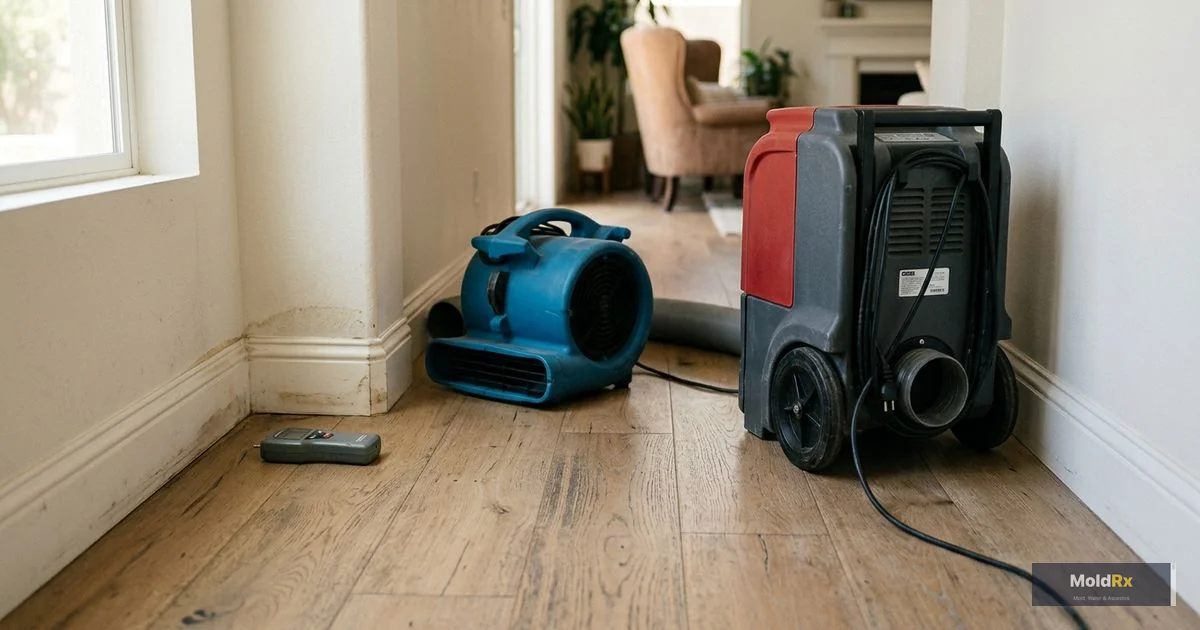
- Comprehensive moisture mapping — professional moisture meters, hygrometers, and thermal imaging to identify every area of intrusion, including hidden moisture behind walls, under flooring, and in ceiling cavities
- Full documentation — photographs, moisture readings, and written assessment for your insurance claim from the moment the team arrives
Step 2: Emergency Water Extraction
Standing water is removed immediately using truck-mounted and portable extraction units. This is the most time-critical phase — every gallon remaining actively migrates deeper into your structure and accelerates category degradation.
In Upland homes with slab-on-grade foundations, water that penetrates beneath flooring creates Class 4 specialty drying situations. In Craftsman-era homes with pier-and-beam foundations, water can pool in crawl spaces and saturate structural members from below. Rapid extraction prevents escalation in both scenarios.
Extraction covers:
- All accessible surfaces and cavities
- Carpet, pad, and subfloor assemblies
- Wall cavities via extraction ports when necessary
- Cabinets, closets, and confined spaces
- HVAC ductwork and evaporative cooler systems if water has entered
Step 3: Structural Drying and Dehumidification
Upland's inland climate presents a different drying challenge than coastal cities. While ambient humidity is generally lower than on the coast, the extreme heat creates rapid evaporation that must be controlled — not just encouraged — to prevent moisture from migrating to unaffected areas and to ensure materials dry evenly rather than surface-drying while retaining deep moisture.
Our vetted professionals calibrate drying systems to Upland's specific conditions:
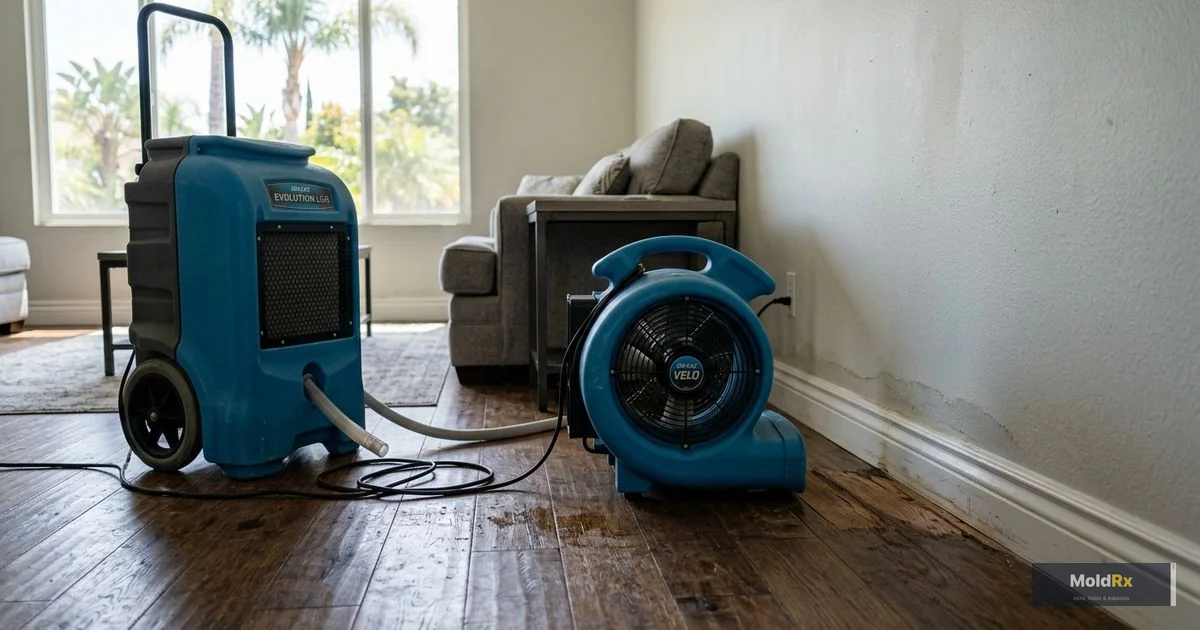
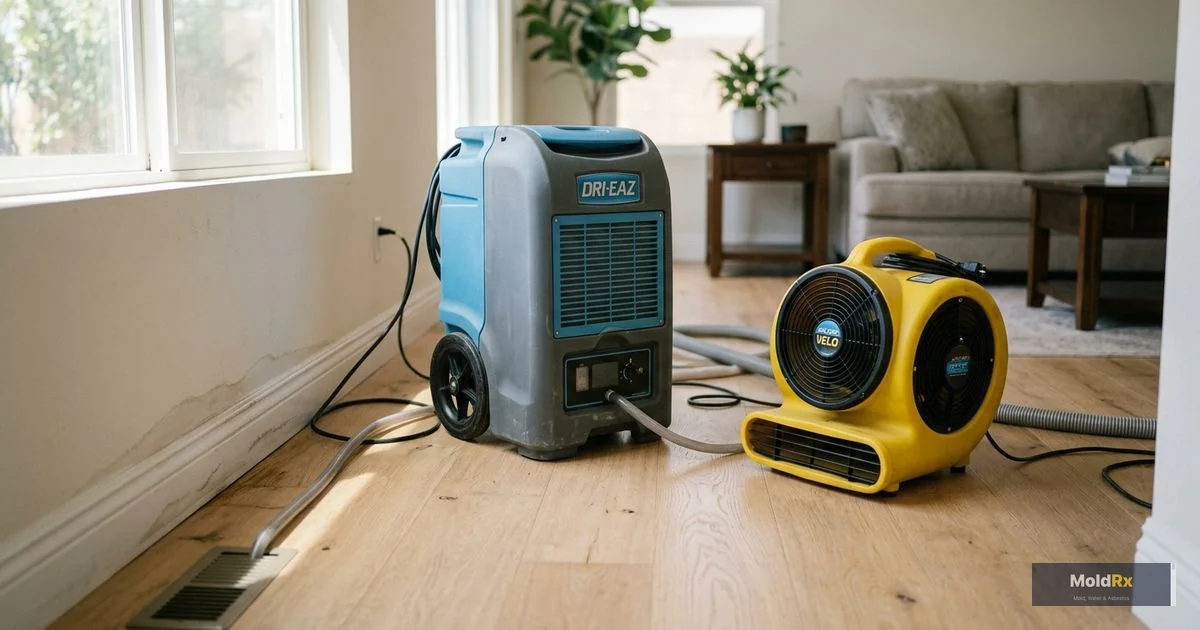
- Industrial dehumidifiers — LGR or desiccant units maintaining controlled atmospheric conditions for proper material moisture release
- High-velocity air movers — positioned for maximum evaporation across wet surfaces
- Continuous monitoring — daily moisture readings tracking drying progress in every affected material, confirming the trajectory matches the calculated drying plan
- HVAC isolation — preventing distribution of moisture and contaminants to unaffected areas
Structural drying in Upland typically takes 3 to 5 days for standard events — but Craftsman homes with plaster walls, original hardwood, and dense materials can require 7 to 10 days of specialty drying. Per IICRC S500, drying is complete only when verified moisture readings confirm materials have reached dry standard.
Step 4: Contamination Control and Antimicrobial Treatment
For Category 2 and Category 3 events — including storm flooding from mountain runoff, sewage backups in homes with aging laterals, and any standing water left more than 24 hours in Upland's heat — contamination control is mandatory:
- EPA-registered antimicrobial agents applied to all affected surfaces
- Removal and disposal of all contaminated porous materials
- HEPA air filtration capturing airborne particulates and microbial fragments
- Containment barriers preventing cross-contamination
- Full Cal/OSHA compliance for worker safety
- Proper waste disposal per local regulations
Step 5: Damage Assessment, Repair, and Restoration
Once drying is verified and contamination control is complete, all affected materials and systems are assessed:
- Drywall and insulation — removed below flood cut for Category 2/3; assessed for mold risk in Category 1
- Flooring — hardwood, laminate, tile, and carpet evaluated; damaged materials replaced
- Structural framing — joists, studs, and sill plates checked for moisture retention and fungal growth
- Cabinetry and built-ins — particle board construction evaluated for swelling and delamination
- Electrical and mechanical systems — all water-exposed components evaluated by licensed professionals per code
For historic Upland properties, our specialists work to preserve original Craftsman details, match period-appropriate materials, and maintain architectural character throughout the restoration.
Request your free emergency estimate now — or call (888) 609-8907 to get a vetted restoration team to your Upland property immediately.
The Most Common Water Damage Emergencies in Upland
Slab Leaks in Post-War Tract Homes
Upland's 1950s-1970s tract homes sit on slab-on-grade foundations with supply and drain lines buried beneath concrete. Decades of soil movement, seismic shifts, and Upland's extreme temperature swings stress these pipes until they fail. Water migrates upward through the slab, saturating flooring and subfloor materials — often undetected until warped floors, musty odors, or inexplicable water bill increases signal the damage. By then, the problem is extensive. Slab leaks demand Class 4 specialty drying and professionals who understand concrete moisture dynamics.
Mountain Runoff and Flash Flooding
When winter storms hit the San Gabriel range, runoff funnels directly through Upland — particularly through San Antonio Heights, North Upland, and foothill neighborhoods. Storm water carries sediment, debris, and contaminants that make it automatically Category 3 black water. Aging storm drain infrastructure in these areas compounds the problem, creating street-level flooding that enters homes through every available pathway. Flash flood events can deposit inches of contaminated water inside a home in minutes.
Heat-Related Water Heater and Appliance Failures
Upland garages routinely exceed 110 degrees in summer. Water heaters operating in that environment fail prematurely — tanks corrode faster, pressure relief valves malfunction, and supply connections weakened by years of thermal cycling finally give way. A 40- or 50-gallon tank failure in a superheated garage sends water flooding across the slab and into the living space. Similarly, washing machine supply hoses brittle from heat exposure rupture without warning, and irrigation systems stressed by temperature extremes crack and send water against foundations.
Sewage Backups
Original cast iron sewer laterals in Upland's older neighborhoods — particularly in the historic downtown district and areas with mature tree canopy — are prone to root intrusion, joint separation, and complete blockage. A sewer lateral failure introduces Category 3 black water into the home through every low-point drain. This is a health emergency requiring immediate professional response with full Cal/OSHA protocols, total removal of affected porous materials, and thorough EPA-registered antimicrobial treatment.
Evaporative Cooler Overflows
Swamp coolers are common in Inland Empire homes, including many in Upland. Float valve failures, clogged overflow pans, and cracked water lines in rooftop or window-mounted units send water directly into ceiling cavities, wall assemblies, and insulation — creating Class 3 overhead water damage that saturates everything below. Because the water enters from above, the damage footprint can be enormous before any visible signs appear at floor level.
Why MoldRx Only Sends Vetted Restoration Professionals
What "vetted" means at MoldRx:
- IICRC S500 certification — every specialist holds current certification in professional water damage restoration
- IICRC S520 compliance — mold remediation assessment standards followed, because water damage and mold are inseparable
- Proper licensing — all contractors hold valid CSLB licenses as required by California law
- Cal/OSHA compliance — full adherence to worker safety requirements in contaminated environments
- EPA-registered products — all antimicrobial agents registered with the U.S. Environmental Protection Agency
- Documented processes — every step photographed, measured, and recorded for insurance documentation
MoldRx does not perform restoration work directly. We connect Upland homeowners in crisis with vetted, certified professionals who will handle the job correctly — not whoever is available, but whoever is qualified for your specific situation.
Upland Neighborhoods and Areas We Serve
Our vetted water damage restoration specialists respond to emergencies across every Upland neighborhood:
- San Antonio Heights — prestigious foothill enclave with direct mountain runoff exposure; homes ranging from mid-$500K to $3M+
- Foothill Knolls — hillside properties with concentrated storm water drainage challenges
- North Upland — foothill-adjacent residential area with aging infrastructure and flood vulnerability
- Historic Downtown — 1920s-1940s Craftsman homes with the oldest plumbing systems in the city
- Cable Airport area — residential neighborhoods near the world's largest family-owned public airport
- Upland Hills — established residential community with mid-century construction
- Colonies Crossroads — mixed residential and commercial area
We serve all Upland ZIP codes: 91784, 91785, and 91786.
We also provide emergency water damage response to neighboring communities including Rancho Cucamonga, Ontario, Claremont, Montclair, San Antonio Heights, and Mount Baldy.
Related Emergency Services in Upland
Water damage triggers secondary issues that require specialized response:
- Mold Removal in Upland — mold colonization begins within 24-48 hours; Upland's summer heat dramatically accelerates this timeline in saturated materials
- **** — professional air and surface sampling to confirm or rule out microbial amplification
- **** — pre-1980 homes may contain asbestos in drywall compound, floor tiles, insulation, and textured ceilings; material demolition during restoration must include asbestos assessment per Cal/OSHA and EPA regulations
- Asbestos Removal in Upland — licensed abatement if asbestos-containing materials are identified
Upland's historic Craftsman homes and mid-century tract houses were built during the peak decades of asbestos-containing material use. Any restoration involving material demolition in a pre-1980 home requires asbestos assessment — no exceptions.
-> Learn more about all remediation services in Upland
Frequently Asked Questions — Water Damage Restoration in Upland
How quickly do I need to act on water damage in my Upland home?
Immediately. Per IICRC S500, microbial growth begins within 24 to 48 hours — and in Upland's extreme summer heat, that timeline compresses significantly. Warm, saturated materials in a 100-degree environment become mold incubators within hours. The difference between a same-day response and a next-day response can determine whether your home needs drying or demolition. Call (888) 609-8907 or request your free estimate now.
Does Upland's inland climate make water damage worse?
In some ways, yes. While lower ambient humidity aids surface drying, Upland's extreme heat creates rapid, uncontrolled evaporation that can drive moisture deeper into dense materials rather than removing it. Heat also accelerates microbial growth in saturated materials and puts enormous stress on plumbing systems, water heaters, and appliances — causing the failures that create water emergencies in the first place. Professional restoration with controlled drying conditions is essential.
Will my homeowner's insurance cover water damage restoration?
Most policies cover sudden and accidental water damage — burst pipes, water heater failures, appliance malfunctions. Storm flooding and gradual damage from neglected maintenance typically require separate coverage. Our vetted professionals document every detail — moisture readings, photographs, category and class determinations — to provide your adjuster with complete, professional-grade documentation supporting your claim.
How long does water damage restoration take in Upland?
A contained Category 1, Class 1 event may take 3 to 5 days. A major Category 2 or 3, Class 3 or 4 event — especially in Craftsman homes with plaster and hardwood requiring specialty drying — can take 7 to 14 days or more. Our vetted professionals provide honest timelines after assessment, not optimistic projections designed to win the job.
What should I do right now while waiting for the restoration team?
If safe: shut off the water source (main valve, appliance valve, or fixture valve). Turn off breakers to areas with standing water near outlets. Do not walk through standing water of unknown contamination. Do not use fans or HVAC — this spreads moisture and contaminants. Move valuables to dry areas if safe. Call (888) 609-8907 or request your free estimate — our team will guide you through next steps while dispatch begins.
Are Upland's older Craftsman homes at greater risk?
Yes. Craftsman-era homes from the 1920s-1940s carry plumbing systems that are 80 to 100+ years old. Original galvanized supply lines, cast iron drains, and lead or clay sewer laterals are far past their engineering lifespan. Plaster walls and original hardwood floors create Class 4 specialty drying situations. And pre-1950 construction may contain lead paint and asbestos, adding regulatory complexity to any restoration requiring material disturbance.
Your Upland Home Is Taking Damage Right Now — Call Immediately
Every minute water sits in your Upland home, it is migrating deeper into materials, escalating in contamination, and — especially in this heat — creating explosive conditions for mold growth. Your aging plumbing is not going to repair itself. The mountain runoff is not going to stop. And the water saturating your subfloor is not going to dry on its own, no matter how hot it gets outside.
MoldRx exists for exactly this moment. We only send vetted, IICRC S500 and IICRC S520 certified restoration professionals who hold valid CSLB licenses, follow Cal/OSHA safety requirements, and use EPA-registered products. We do not guess. We do not cut corners. We do not send unqualified crews to your home.
Request your free emergency estimate now or call (888) 609-8907 — 24 hours a day, 7 days a week. A vetted Upland restoration specialist will be on the way.