Water Damage Restoration in Yucaipa, CA — MoldRx
24/7 Emergency Water Damage Restoration Professionals Serving Yucaipa and the San Bernardino Mountain Foothills
Water does not wait. Not for morning. Not for the weekend to end. Not for a second estimate. Every hour it sits inside your walls, pooled beneath your flooring, or wicking upward through your slab foundation, the damage compounds — subfloor materials warping beyond salvage, drywall disintegrating from the inside out, insulation collapsing under saturated weight, and mold colonies germinating within 24 to 48 hours. In Yucaipa, where 1960s and 1970s plumbing fails without warning in hillside homes, where mobile home parks along Wildwood Canyon sit on aging infrastructure, where burn-scar debris flows from the San Bernardino Mountain foothills funnel contaminated runoff directly into residential neighborhoods, where the December 2025 storms triggered flash flooding and evacuation orders across northeast Yucaipa and Oak Glen — the difference between a manageable restoration and a catastrophic structural rebuild comes down to one thing: how fast professional extraction begins.
This is not a situation that improves with time. It gets worse with every passing hour.
MoldRx only sends vetted water damage restoration professionals who follow IICRC S500 standards — the national benchmark for water damage inspection, extraction, drying, and restoration. Our teams arrive with commercial-grade equipment, document everything for your insurance claim from the first minute on-site, and do not leave until moisture readings confirm your property is dry and safe.
Call now for emergency service — (888) 609-8907. Fast response. Professional extraction and drying.
Why Water Damage Is an Emergency in Yucaipa
Yucaipa sits at approximately 2,600 feet elevation in a transitional zone where the Inland Empire meets the San Bernardino Mountain foothills. With a population of roughly 55,000 residents spread across a terrain that rises from 1,800 feet on the valley floor to 3,600 feet along the ridgelines, this city occupies one of the most geographically complex water damage environments in San Bernardino County. Framed by the Crafton Hills to the west, Wildwood Canyon to the south, and the steep mountain slopes of Oak Glen and Forest Falls to the northeast, Yucaipa's topography means water follows gravity in aggressive and unpredictable ways.
The Housing Stock Problem: Five Decades of Aging Plumbing
Yucaipa's residential development spans multiple eras, and each one carries its own water damage risks.
The city's oldest neighborhoods — established in the 1960s and 1970s when Yucaipa was a small agricultural community — contain homes that are now 50 to 60+ years old. These properties sit on original galvanized steel and copper plumbing that has endured decades of thermal cycling between summer highs in the upper 90s and winter lows in the low 30s. Galvanized pipes corrode from the inside, reducing flow and eventually rupturing. Copper supply lines develop pinhole leaks from decades of expansion and contraction. Slab leaks are endemic in homes built on the clay-heavy soils found throughout the Yucaipa Valley — soils that shift and settle over time, stressing supply lines running beneath concrete foundations.
The 1990s and 2000s brought significant growth. Subdivisions expanded up the hillsides and into areas like Chapman Heights — a nearly 1,000-acre development completed around 2006 — and newer communities along the upper elevations. These homes used CPVC and PEX plumbing that is more reliable but not immune to failure. Builder-grade water heaters, dishwasher supply lines, and refrigerator ice maker connections all have finite lifespans. In homes now 20 to 30 years old, these components are entering their failure window.
Then there are Yucaipa's mobile home and manufactured housing communities. Crafton Hills Mobile Estates, built in 1970 with 159 home sites, and mobile home parks along Wildwood Canyon represent a significant portion of Yucaipa's housing stock. Manufactured homes use lighter-gauge plumbing — polybutylene, CPVC, or PEX depending on the era — running through floor systems and interior walls far thinner than conventional construction. When supply lines fail in these structures, water saturates particleboard subflooring that loses structural integrity within hours, not days.
The December 2025 Storms: Yucaipa's Wake-Up Call
On December 24, 2025, an atmospheric river slammed San Bernardino County. Flash flooding struck Yucaipa directly. San Bernardino County declared a local emergency. Governor Newsom proclaimed a state of emergency covering San Bernardino County on December 23. Over 8,000 residents in Yucaipa, Oak Glen, and Mountain Home Village were placed under evacuation orders or warnings. A Care and Reception Center opened at Serrano High School on December 24.
The flooding was not an isolated event. Just three months earlier, in September 2025, a powerful storm triggered debris flows from the El Dorado Fire burn scar areas into Oak Glen and Forest Falls communities. Debris flows moved across the Yucaipa Ridge area. San Bernardino County Public Works deployed heavy equipment — clearing over 1,770 cubic yards from Oak Glen Channel and 3,100 cubic yards from Birch Creek Channel. Eight pieces of heavy equipment worked Forest Falls simultaneously.
This is Yucaipa's reality. The city sits at the base of mountain slopes scarred by recent wildfires. When rain hits those burn scars, there is no vegetation to slow the runoff. Water, mud, and debris channel downhill through Wildwood Canyon, along Oak Glen Road, and directly into residential areas. Homes in the path of these flows face Category 3 (black water) contamination — the most hazardous classification under IICRC S500 — requiring full removal of all contacted porous materials, PPE protocols, and thorough sanitization.
Yucaipa's Sloping Terrain Amplifies Every Water Event
Yucaipa's terrain is not flat. Homes built on hillside lots throughout the upper elevations, along the Crafton Hills ridge, and in the canyon communities face a fundamental physics problem: water runs downhill. Storm runoff concentrates against downhill foundations. Retaining walls direct water flow in ways the original grading may not have anticipated. French drains installed during construction clog over decades. And when a supply line fails inside a hillside home, gravity pulls that water through every layer of the structure before it ever becomes visible at floor level.
Properties on the valley floor face the opposite problem. They collect runoff from every direction. Storm drain infrastructure built for a smaller community struggles to handle the volume generated by decades of hillside development above.
The 24-48 Hour Mold Window
Mold colonization begins within 24 to 48 hours of moisture exposure. The EPA and IICRC S520 both confirm this timeline. In Yucaipa, where summer interior wall cavities routinely exceed 90 degrees, germination can begin in as little as 12 to 18 hours. Stachybotrys chartarum (black mold) can colonize within 48 to 72 hours on saturated drywall and cellulose insulation. Burn-scar debris flow water introduces organic material that accelerates microbial growth beyond what clean water damage would produce.
Once mold takes hold, your restoration scope expands from water damage into a combined water damage and mold remediation project — dramatically increasing cost, timeline, and disruption. Professional drying within the first 24 hours is the single most effective mold prevention measure. Box fans and open windows are not substitutes for commercial dehumidification equipment. In a hillside home where water has migrated through multiple floor levels, they are worthless.
Insurance Documentation Starts Immediately
Insurance policies require prompt notification and mitigation. Delayed response can result in denied claims — insurers may argue that secondary damage resulted from failure to mitigate rather than the original event. Professional documentation beginning the moment technicians arrive establishes the timeline insurers need. Most homeowner's policies cover sudden and accidental water damage — burst pipes, failed water heaters, appliance line ruptures. Flood damage from external sources like burn-scar debris flows or storm runoff typically requires separate flood insurance. Our documentation includes initial loss assessment with timestamped photographs, water category and damage class classification, daily moisture readings, equipment placement records, drying progress reports, and final verification readings. This package gives your adjuster the objective evidence needed to validate the claim.
Water Damage Categories and Classes
The IICRC S500 standard classifies water damage by contamination level and physical scope. Understanding the classification determines safety protocols, equipment requirements, and which materials can be salvaged.
Category 1 (Clean Water) — from a sanitary source like a broken supply line or water heater inlet. Not an immediate health threat, but degrades to Category 2 or 3 within 48 to 72 hours if not extracted. In Yucaipa's summer heat, this degradation accelerates.
Category 2 (Gray Water) — significant contamination from washing machine overflow, dishwasher discharge, or toilet overflow with urine. Requires antimicrobial treatment. Contacted porous materials — carpet pad, particleboard, unsealed drywall — typically require removal.
Category 3 (Black Water) — the most hazardous. Sewage backups, floodwater from burn-scar debris flows, storm runoff, and any standing water present long enough to support pathogens. The December 2025 and September 2025 storm flooding in Yucaipa qualifies as Category 3 — carrying mud, debris, sewage overflow, and bacterial contamination. There is no drying Category 3 carpet or pad — it gets removed. All contacted porous materials must be discarded.
The IICRC S500 also classifies scope into four classes: Class 1 (minimal absorption, small area), Class 2 (significant absorption with wall wicking — common in Yucaipa supply line failures), Class 3 (water from overhead saturating walls, ceilings, insulation, and floors — frequent in hillside homes where water enters at upper levels), and Class 4 (specialty drying of low-permeability materials like concrete slabs and hardwood — standard in Yucaipa slab leak scenarios).
Our Water Damage Restoration Process
Every water damage event is different, but the IICRC S500 protocol provides the systematic framework our vetted professionals follow on every Yucaipa job.
1. Emergency Response and Assessment — Technicians identify the water source, classify the water category (Category 1 through 3) and damage class (Class 1 through Class 4), and map the full extent of moisture intrusion using thermal imaging and penetrating moisture meters — including water you cannot see behind walls, beneath flooring, and in lower levels of hillside homes where gravity has carried it.
2. Water Extraction — Standing water is removed immediately using truck-mounted and portable extraction units. Submersible pumps handle deep standing water from flood events. For debris flow contamination, extraction must address both water and sediment. For mobile homes, specialized extraction targets floor cavities and the crawlspace beneath the structure. Every gallon removed directly reduces drying time and limits secondary damage.
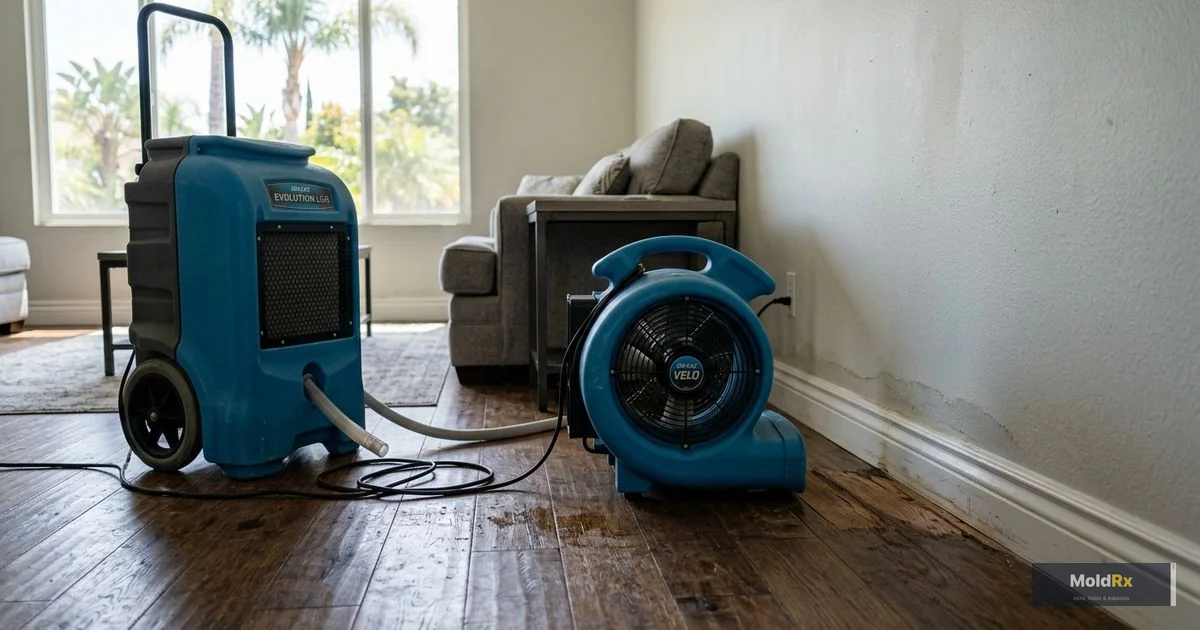
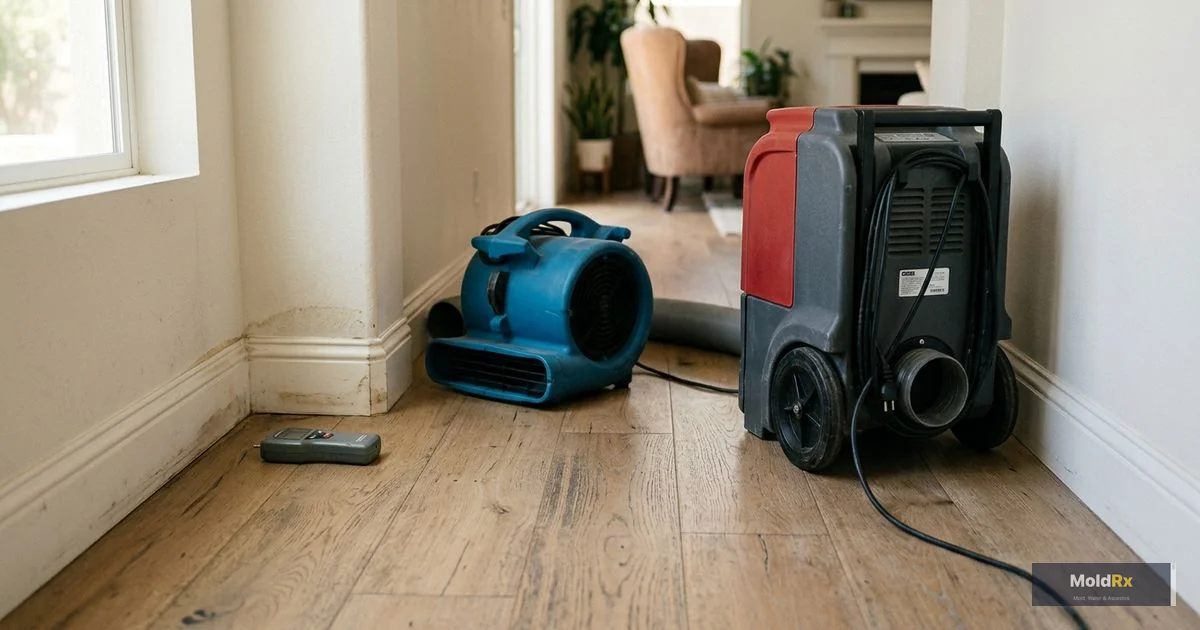
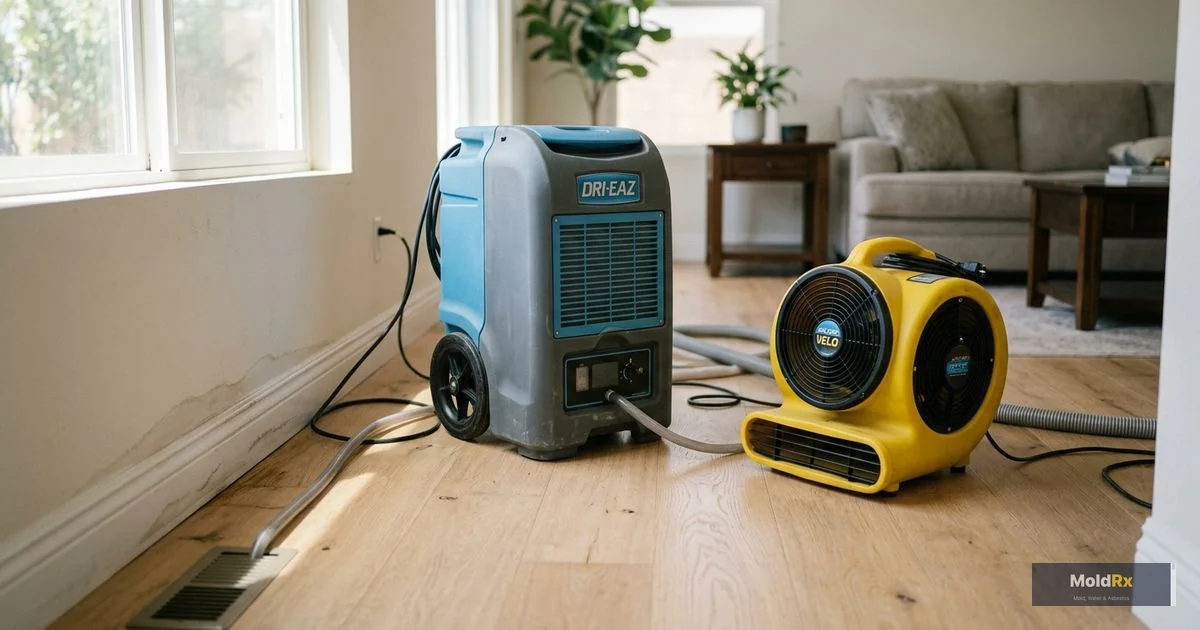
3. Structural Drying and Dehumidification — Commercial-grade dehumidifiers and high-velocity air movers are positioned according to psychrometric calculations calibrated for Yucaipa's elevation and humidity conditions. Wall cavities receive directed airflow through injection drying systems. Yucaipa's lower ambient humidity can aid drying, but only when professional equipment creates the controlled environment needed to extract moisture from building materials — not just from the air. The goal is to reach dry standard throughout all affected materials.
4. Moisture Monitoring and Documentation — Daily moisture readings using pin-type and pinless meters, thermo-hygrometers, and thermal imaging. Every reading is logged and provides your insurance adjuster with timestamped evidence that professional drying was performed per IICRC S500 standards.
5. Cleaning, Sanitizing, and Antimicrobial Treatment — Category 2 and Category 3 losses require antimicrobial application to all contacted structural materials. HEPA air scrubbers filter airborne contaminants. Burn-scar debris flow contamination requires enhanced sanitization protocols. All work complies with Cal/OSHA safety requirements and IICRC S500/S520 standards.
6. Restoration and Rebuild — From reinstalling baseboards to replacing drywall, insulation, flooring, and cabinetry. Mobile home floor assembly replacement when subflooring has been compromised. All rebuild work is performed by CSLB-licensed professionals.
Get emergency help now — (888) 609-8907.
What to Do Before We Arrive
- Shut off the water source if you can reach the shutoff safely. For slab leaks, turn off the main supply at the meter. For mobile homes, the shutoff is typically beneath the unit near the water hookup.
- Turn off electricity to affected areas at the breaker panel. Never step into standing water near active outlets or electrical connections.
- Move valuables to dry ground. Remove documents, photos, and electronics from affected rooms.
- Document everything with photos and video before moving anything. This evidence is critical for insurance.
- Do not use a household vacuum on standing water — shock hazard.
- Do not run fans or your HVAC system. You risk spreading contaminated moisture through ductwork and into unaffected areas.
- Do not open windows in summer — Yucaipa's heat accelerates mold germination in saturated materials.
- If debris flow water has entered your home, do not attempt cleanup without PPE. This water is Category 3 — contaminated and potentially hazardous.
What Sets MoldRx Apart
- Fast emergency response. Water damage is the most time-sensitive restoration service. The faster extraction begins, the more of your property we save.
- IICRC S500-certified professionals only. Every technician holds current IICRC certification and CSLB licensing. These are trained water damage restoration specialists who understand mountain foothill conditions, burn-scar contamination, and manufactured housing construction.
- Complete documentation for insurance. From the first photo to the final moisture reading, every step is documented to support your claim.
- Psychrometric drying science calibrated for Yucaipa's elevation and semi-arid climate — not guesswork. Faster drying times, fewer complications.
- We only send vetted professionals. When we put a team in your home, our reputation goes with them. If something is not right, you call us directly.
Yucaipa Neighborhoods We Serve
MoldRx provides emergency water damage restoration throughout Yucaipa and surrounding communities:
- Yucaipa Boulevard Corridor — Mixed-era development from 1960s through 2000s. Aging plumbing in older homes, slab leak risks on clay soils throughout.
- Chapman Heights — Nearly 1,000-acre subdivision completed circa 2006. Newer plumbing but aging appliance connections and water heaters entering their replacement window.
- Wildwood Canyon — Mobile home communities and hillside residences with unique plumbing vulnerabilities, drainage challenges, and burn-scar debris flow exposure.
- Crafton Hills Area — Including Crafton Hills Mobile Estates (built 1970, 159 sites) and surrounding residential neighborhoods. Manufactured housing with particleboard subflooring and crawlspace moisture risks.
- Oak Glen Road Corridor — Properties exposed to mountain runoff and debris flow from burn-scar areas. Elevated Category 3 contamination risk during winter storms.
- Upper Yucaipa / Hillside Communities — Homes on sloping lots where gravity drives water intrusion through multiple levels before visible signs appear.
- Dunlap / Central Yucaipa — Established neighborhoods with 1970s-1990s housing. Galvanized and copper plumbing reaching end-of-life.
Coverage extends to ZIP code 92399 and neighboring communities including Redlands to the west, Calimesa to the south, Beaumont to the east, and Oak Glen and Forest Falls to the northeast.
Related Services
- Mold Removal in Yucaipa — If the 24-to-48-hour mold window has passed, IICRC S520 remediation is the next step.
- Asbestos Removal in Yucaipa — Licensed abatement required under Cal/OSHA and EPA regulations when asbestos-containing materials are disturbed.
-> Learn more about remediation services in Yucaipa
Frequently Asked Questions
How quickly do you respond to water damage emergencies in Yucaipa?
We treat every call as an emergency because it is one. Yucaipa and the mountain foothill communities are within our primary service area. Extraction that starts within the first few hours saves exponentially more material than extraction that starts the next day. The 24-to-48-hour mold window is real and it does not pause.
What should I do first when I discover water damage?
Stop the water source if you safely can. Turn off electricity to affected areas at the breaker panel. Do not walk through standing water near active electrical connections. If the water is from storm flooding or debris flow, do not attempt cleanup without proper protective equipment. Then call (888) 609-8907 immediately.
Is water damage from burn-scar debris flows more dangerous than a pipe burst?
Yes. Debris flow water is classified as Category 3 (black water) under IICRC S500 — the highest contamination level. It carries mud, sewage overflow, road debris, and bacterial contamination. All contacted porous materials must be removed and discarded. The cleanup and sanitization protocols are significantly more extensive than for a clean water supply line failure.
My mobile home has water damage. Is restoration different from a regular house?
Yes. Mobile and manufactured homes use different construction materials — thinner walls, particleboard subflooring, lighter-gauge plumbing, and crawlspace foundations that introduce unique moisture dynamics. Our vetted professionals have specific experience with manufactured housing restoration and understand which materials can be dried in place and which must be replaced.
Does homeowner's insurance cover water damage restoration?
Most policies cover sudden and accidental water damage — burst pipes, failed appliances, water heater ruptures. Flood damage from external sources like debris flows or storm runoff typically requires separate flood insurance. We document every aspect of the restoration to support your claim.
How long does water damage restoration take?
A contained Category 1 event in one room may reach dry standard in three to five days. A major event involving multiple rooms, Category 3 contamination, or debris flow damage can require one to three weeks or more. We do not rush drying — incomplete drying leads to mold.
What is the difference between water damage categories?
Category 1 is clean water from a sanitary source. Category 2 is gray water with contaminants that can cause illness. Category 3 is black water — sewage, floodwater, debris flow water, or grossly contaminated water. All categories are defined by the IICRC S500 standard.
Will you work with my insurance adjuster?
Yes. We provide complete technical documentation — photos, moisture readings, drying logs, equipment records, verification data — directly to your adjuster. Our documentation follows IICRC S500 standards, the framework most insurers use to evaluate water damage claims.
Do I need mold testing after water damage?
If professional drying began within 24 hours and readings confirm dry standard, testing may not be necessary. But if response was delayed, musty odors persist, or Category 2/3 water was involved — especially burn-scar debris flow contamination — we recommend post-restoration mold testing to confirm no colonization occurred. Prevention is always less disruptive than remediation.
Get Water Damage Restoration in Yucaipa Now
Water damage is an active emergency that gets worse every hour. The materials in your home are absorbing water right now. Mold spores are finding the moisture they need. Structural elements are weakening. Whether it is a burst supply line in your Chapman Heights home, a slab leak silently saturating your foundation off Yucaipa Boulevard, a plumbing failure flooding your mobile home in Wildwood Canyon, or burn-scar debris flow contamination pushing through your garage from the mountain foothills — waiting makes everything worse.
MoldRx only sends vetted water damage restoration professionals who follow IICRC S500 standards, carry current CSLB licensing, and understand Yucaipa's mountain foothill terrain, burn-scar contamination risks, and mix of conventional and manufactured housing. Every technician complies with Cal/OSHA safety standards and EPA guidelines for contaminated water handling.
Every hour matters. Do not wait.
Call MoldRx now — (888) 609-8907. Every hour matters.